E2Expo presents a B2B platform designed to bridge the gap between sustainability solution providers and business users. The deck highlights a massive $5.5 trillion current market size, projected to reach $15 trillion by 2030. E2Expo's strategy relies on a 'hybrid' model of industry intelligence and business promotion to build community and drive commerce. While the deck boasts a team with 30+ years of collective experience and an existing website with over 1,000 pieces of content, it lacks specific financial projections, detailed unit economics, and a clear competitive landscape analysis. The…
Key takeaways
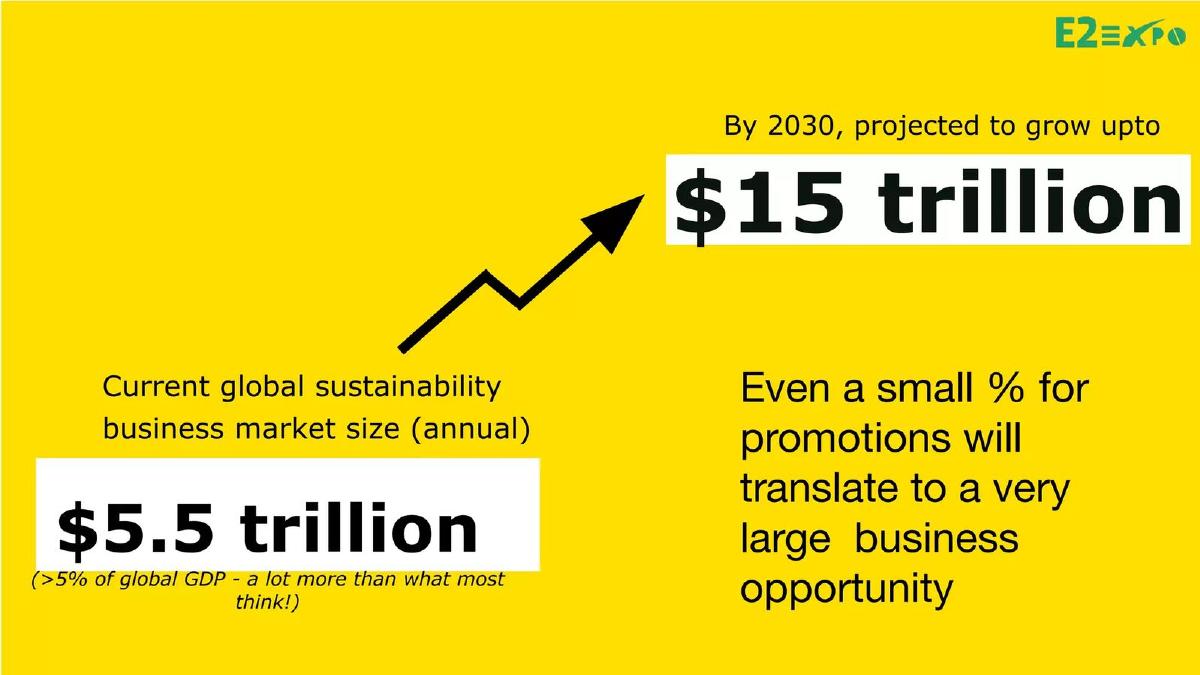
- The current global sustainability business market is valued at $5.5 trillion, representing over 5% of global GDP (Slide 4).
- The market is projected to grow to $15 trillion by 2030 (Slide 4).
- E2Expo employs a hybrid model combining industry intelligence for customers and business promotion for providers (Slide 8).
- The platform already hosts over 1,000 pieces of content and covers three industries and three solution types (Slide 12).
- The parent company, EAI, has been a player in Indian cleantech consulting since 2008 (Slide 15).
- The team has consulted for over 250 clients, including GE, ExxonMobil, and the World Bank (Slide 15).
- The revenue model includes 13 distinct avenues such as company showcases, webinars, and research listings (Slide 16).
- The funding request is $1.25 million for the first year's efforts in team building and marketing (Slide 17).
Executive Summary and Market Context
Slides 1-4: The Sustainability Opportunity
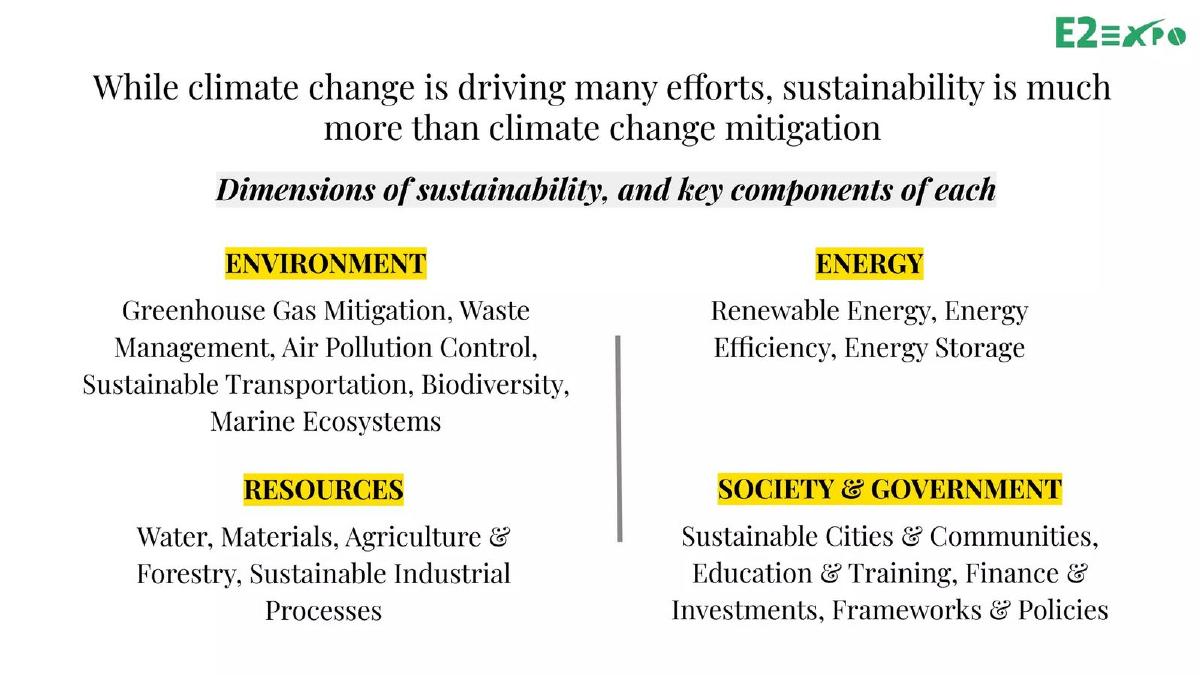
The E2Expo deck opens with a clear mission statement on Slide 1: an "Online Promotion Platform for the Global Sustainability Industry." It immediately moves into a macro-economic justification for the business. Slide 2 asserts that sustainability has transitioned from a philosophy to "big business," while Slide 3 defines the scope of the industry across four dimensions: Environment, Energy, Resources, and Society & Government. This broad definition allows the company to claim a massive Total Addressable Market (TAM).
Slide 4 provides the core market data, citing a current annual global sustainability business market size of $5.5 trillion (representing >5% of global GDP). The slide projects this market to grow to $15 trillion by 2030 . The underlying thesis is that even a small percentage of this market spent on promotions represents a significant business opportunity for a specialized platform.
Problem and Solution
Slides 5-7: Solving the Focus Gap
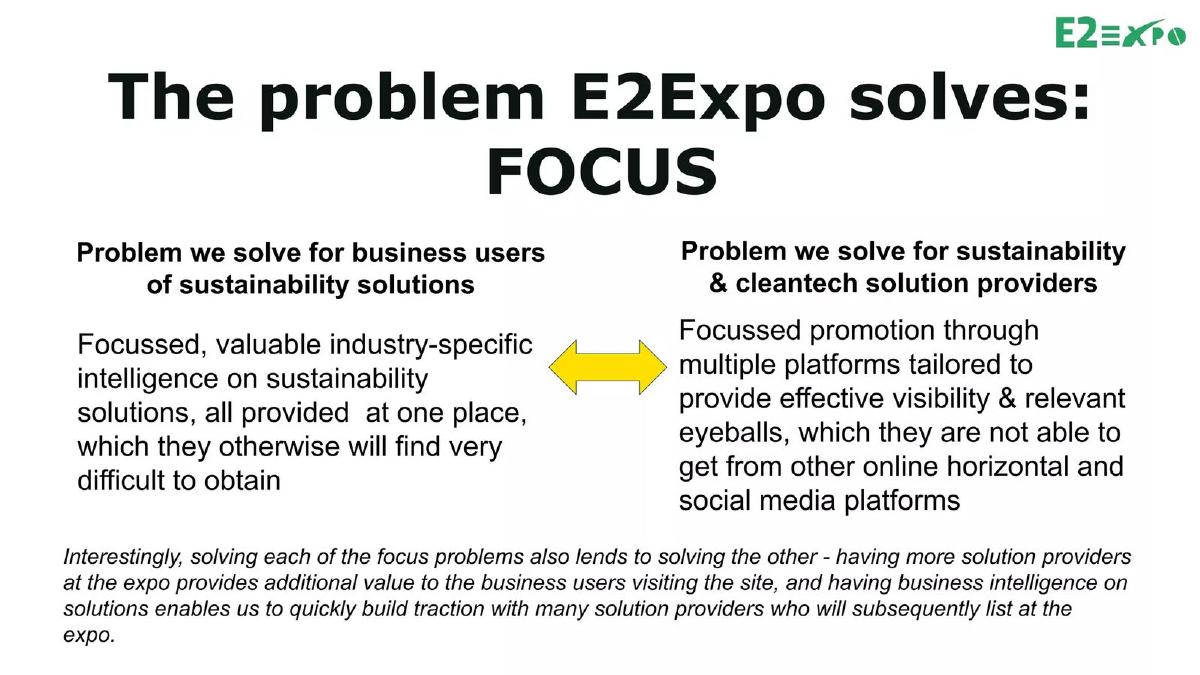
Slide 5 introduces the problem statement, which is elaborated upon in Slide 6. The company identifies "FOCUS" as the primary pain point. For business users, the problem is the difficulty in obtaining industry-specific intelligence. For solution providers, the problem is the lack of effective visibility on horizontal social media platforms. E2Expo proposes to be the bridge between these two groups.
Slide 7 defines the opportunity as becoming the "world's largest online platform for promotion of sustainability products, solutions & services." It claims the market is currently untapped with little competition, positioning E2Expo as an early mover with the requisite expertise.
Slides 8-10: The Hybrid Model
Slide 8 introduces the "hybrid" approach: combining Business Promotion for providers with Industry Intelligence for customers. Slide 9 justifies this by stating that intelligence is a critical need with few current providers, and that content serves as the foundation for building communities and entry barriers. Slide 10 visualizes this flywheel: unique content drives community engagement, which in turn enables commerce (monetization) through relevant, scalable eyeballs.
Target Audience and Current Traction
Slides 11-12: Audience and Operating Status
Slide 11 lists the target stakeholders, ranging from CXOs and sustainability professionals to investors and policy makers. The company plans to target 15 industries and 20 solution segments within three years. Slide 12 provides the most critical data regarding current progress. It confirms that E2Expo is an operating website with over 1,000 pieces of content . At the time of the deck, it covered three industries (Fashion, Food & Beverage, Packaging) and three solutions (Solar, Bio-energy, EVs).
Roadmap and Team
Slides 13-15: The 10-Year Vision and Execution Team
Slide 13 and 14 outline a long-term horizon. The goal is to evolve from a B2B content platform in 2021-22 to the world's largest online marketplace for sustainability by 2030. The milestones are categorized as "Set the Base" (2021-22), "Expand" (2022-23), "Scale" (2023-25), and "Aim for the Stars" (2025-30).
Slide 15 focuses on the team's credentials. It highlights 30+ person years of experience in sustainability and cleantech research. Crucially, it mentions that the parent company, EAI, has been a leader in Indian cleantech consulting since 2008 and has consulted for over 250 clients, including major names like GE, GSK, ExxonMobil, Reliance, Pepsi, and the World Bank . The founders are also described as prior "dot commers" with experience in venture-funded firms.
Business Model and Investment Ask
Slides 16-19: Revenue and The Ask
Slide 16 lists 13 revenue avenues, including webinars, product launches, and research listings. This suggests a diversified income stream but lacks specific pricing or projected contribution margins for each. Slide 17 contains the formal ask: $1.25 million for the first year's efforts. The funds are intended for team building and marketing. Slide 18 and 19 conclude the deck with a vision of profitability and contact information for Co-founder Narasimhan Santhanam.
What Works
Strong Market Tailwinds: The deck successfully taps into the global shift toward sustainability, backed by significant (though broad) market figures on Slide 4. · Domain Expertise: The connection to EAI (Slide 15) provides immediate credibility. Having a list of 250+ past consulting clients suggests a deep understanding of the target audience's needs. · Existing Traction: Mentioning that the site is live with 1,000+ pieces of content (Slide 12) proves that the team can execute on the content side of the hybrid model. · Clear Flywheel: The Content-Community-Commerce diagram on Slide 10 is a standard but effective way to explain how a B2B marketplace builds value and defensibility.
What is Missing
Financial Projections: The deck asks for $1.25 million but provides zero information on projected revenue, burn rate, or how long this capital will last beyond the "first year." · Competitive Landscape: Slide 7 claims there is "little competition," which is a risky assertion in the crowded B2B marketplace and sustainability tech sectors. A slide comparing E2Expo to existing trade directories or LinkedIn groups would have been beneficial. · Unit Economics: There is no mention of Customer Acquisition Cost (CAC) or Lifetime Value (LTV). For a platform relying on "marketing efforts to bring traffic" (Slide 14), these metrics are vital. · Detailed Team Bios: While Slide 15 mentions collective experience, it does not name the specific leadership team members (other than the co-founder on the final slide) or their individual track records.
Founder Takeaways
Leverage Parent Credibility: If your startup is a spin-off or backed by an established consulting firm, use their client list to build trust, just as E2Expo did on Slide 15. · Define Your Hybrid Value: E2Expo's distinction between "Intelligence" and "Promotion" (Slide 8) is a smart way to show how they attract two different sides of a marketplace simultaneously. · Be Specific About the Ask: While E2Expo stated the amount ($1.25M), they could have improved the deck by providing a pie chart or breakdown of how that money is allocated across hiring, tech, and marketing. · Avoid "No Competition" Claims: Investors rarely believe a multi-trillion dollar market has no competition. It is better to acknowledge competitors and explain why your "focus" (Slide 6) is a superior differentiator.
Frequently asked questions
- What is E2Expo's primary value proposition?
- E2Expo positions itself as a specialized B2B platform that solves the 'focus' problem in the sustainability sector. For business users, it provides industry-specific intelligence in one place. For solution providers, it offers targeted promotion and visibility to relevant audiences that horizontal social media platforms cannot match, as stated on Slide 6.
- How does E2Expo plan to generate revenue?
- According to Slide 16, the company has identified 13 revenue streams. these include company showcases, case studies, partnership listings, university research listings, product launches, webinars, education/training listings, solution demos, white paper listings, and conferences. The model relies on the synergy between these avenues to create a 'cascading effect' for solution providers.
- What is the current stage of the product?
- Slide 12 indicates that E2Expo is an operating website (www.e2expo.com). At the time of the deck, the platform featured content for three industries (Fashion, Food & Beverage, Packaging) and three solutions (Solar, Bio-energy, EVs), with a total of over 1,000 pieces of unique content.
- Who is the target audience for the platform?
- Slide 11 identifies the key target audience as corporate sustainability professionals, solution providers, senior management/CXOs, entrepreneurs, investors, marketing professionals, and policy makers. They aim to target the top 15 relevant industries and 20 solution segments within the first three years.
- What is the specific funding ask and its intended use?
- Slide 17 states a requirement of $1.25 million for the first year of operations. These funds are earmarked for two primary purposes: building a strong internal team and executing marketing efforts to drive traffic to the platform and establish it as a high-quality business content hub.