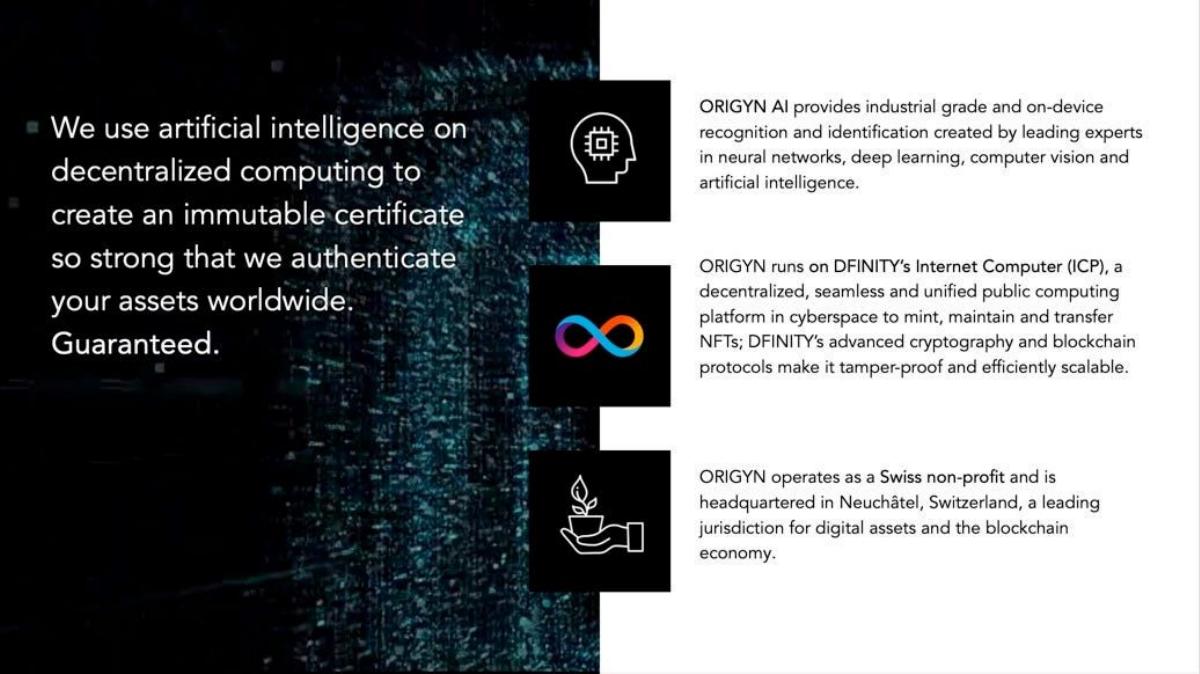
ORIGYN Foundation’s 13-slide deck is a study in institutional positioning. By structuring as a Swiss non-profit and drawing direct parallels to DFINITY and Ethereum, the company successfully raised $20M in a 2021 Pre-Series A round. The deck prioritizes 'Trust and Authenticity' as its core value proposition, addressing the specific pain points of deep fakes and physical-to-digital asset verification. While the deck lacks traditional SaaS metrics like CAC or LTV, it compensates with a heavy emphasis on governance, regulatory compliance, and a leadership team with deep roots in the Swiss 'Crypt…
Key takeaways
- The deck positions the company as a Swiss non-profit foundation to mirror the successful structures of Ethereum and DFINITY (Slide 3).
- Authentication and traceability are identified as the primary 'modern challenges' for digital assets (Slide 2).
- The competitive landscape slide explicitly claims that Ethereum-based solutions cannot scale to the power of the Internet Computer Protocol (ICP) (Slide 5).
- ORIGYN Art is presented as a specific vertical led by influential global participants to bridge physical art and NFTs (Slide 4).
- The leadership team includes Gian Bochsler, a DFINITY council member, and Daniel Haudenschild, former partner at EY (Slide 6).
- The OGY token is introduced as the mechanism for governance and participation in 'surplus economic value' (Slide 7).
- The deck relies on high-level strategic positioning rather than granular financial projections or unit economics.
- Switzerland's regulatory environment is leveraged as a key competitive advantage for hosting global standards bodies (Slide 3).
Institutional Trust as a Product
The ORIGYN Foundation deck, used to secure a $20M Pre-Series A in 2021, represents a departure from the typical 'disruptor' narrative. Instead, it adopts the tone of a 'standard-setter.' In the volatile world of 2021 NFTs and digital assets, ORIGYN pitched stability, Swiss neutrality, and institutional-grade authentication. The deck is concise at 13 slides, focusing heavily on the 'Who' and the 'Where' to justify the 'What.'
Slide 1: Title and Branding
The opening slide is minimalist, featuring the ORIGYN Foundation logo—a colorful, stylized square—against a black background. The disclaimer at the bottom, stating the document is 'provided for information only,' signals a formal, perhaps even legalistic approach common in Swiss foundation fundraising. There is no tagline here, allowing the brand name to stand alone.
Slide 2: The Modern Challenge
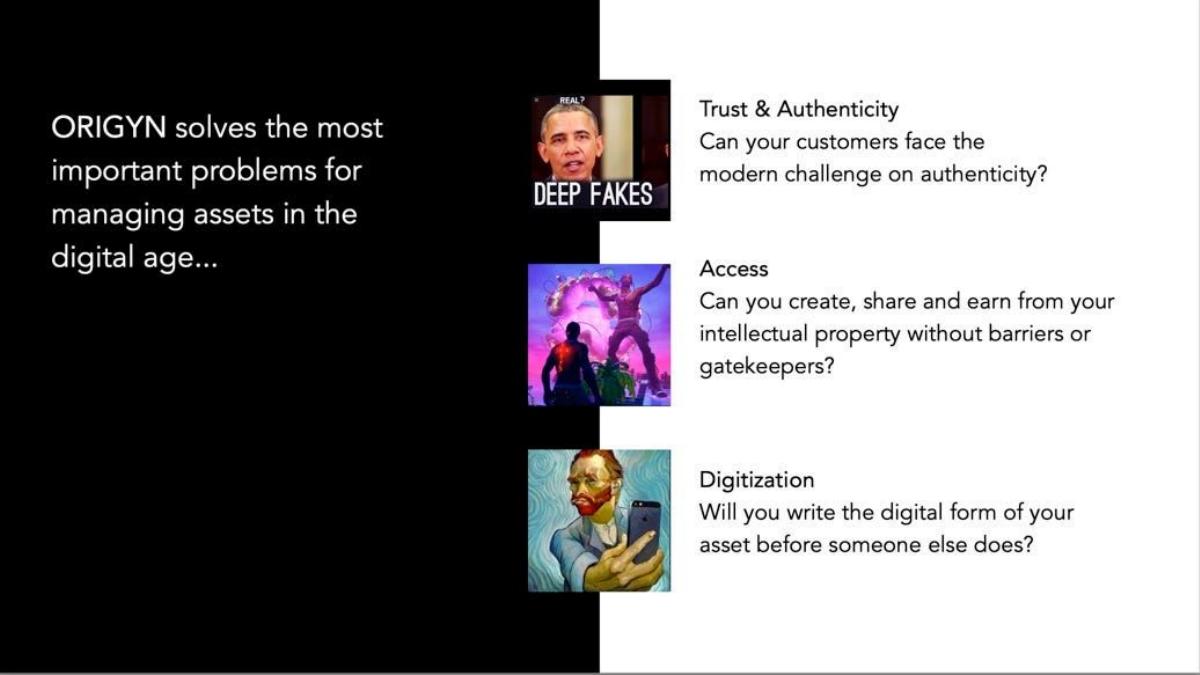
Slide 2 identifies three core problems: Trust & Authenticity, Access, and Digitization. It uses provocative imagery, including a 'Deep Fakes' label over a picture of Barack Obama and a Van Gogh-style self-portrait holding a smartphone. The text asks, 'Will you write the digital form of your asset before someone else does?' This creates a sense of urgency for brands and creators, framing ORIGYN not just as a tool, but as a defensive necessity in the digital age.
Slide 3: The Swiss Foundation Advantage
This is arguably the most important slide for their specific funding round. It explicitly states, 'ORIGYN is a Swiss non-profit foundation.' By name-checking DFINITY and Ethereum, they anchor their valuation and structural expectations to multi-billion dollar ecosystems. The inclusion of logos for the United Nations, IATA, and ISO serves to associate ORIGYN with global standards bodies. The slide argues that the Swiss regulatory environment is the only logical home for a platform 'trusted with financial transactions and security.'
Slide 4: Vertical Focus - ORIGYN Art
Slide 4 introduces 'ORIGYN Art,' a specific division of the foundation. It claims to be 'led and governed by the most influential global participants in the art market.' The focus is on the 'connection between a physical art asset and NFT / digital certificate.' This addresses a major pain point in the 2021 NFT craze: the lack of a verifiable link between a real-world object and its digital twin. By creating a dedicated vertical, they demonstrate how the foundation's broad goals apply to high-value niche markets.
Slide 5: Competitive Landscape and The ICP Edge
The competition slide uses a standard four-quadrant matrix, plotting 'Authentication & Secure Transactions' against 'Traceability & Tracking.' ORIGYN places itself in the top-right corner. Crucially, it critiques competitors like OpenSea and Masterworks for providing 'limited asset lifetime guarantee' and being 'prone to fraud.' It also takes a direct shot at Ethereum-based solutions like Arianee and AURA, stating they 'can not scale to the power of the ICP' (Internet Computer Protocol). This technical distinction is a key part of their pitch to sophisticated crypto investors.
Slide 6: Leadership Team
The leadership slide features Gian Bochsler and Daniel Haudenschild. The bios are heavy on institutional credibility. Bochsler is highlighted as a 'driving force in the fintech community' and a DFINITY council member. Haudenschild is noted as the CEO of ORIGYN Entreprise SA, a former partner at EY, and the Board Chair of the Crypto Valley Association. This combination of 'crypto-native' and 'big-four accounting' experience is designed to reassure investors that the $20M will be managed with professional oversight.
Slide 7: The OGY Token
The final slide in this sequence explains the utility of the OGY token. It is described as the 'basis to guarantee our Certificates.' The slide outlines three functions: guarantee, governance, and participation in 'surplus economic value.' This is a standard 'tokenomics' pitch, but it is framed within the context of the foundation's mission rather than speculative trading. The background image is a high-tech, abstract digital weave, reinforcing the AI and blockchain nature of the product.
What Works in the ORIGYN Deck
Institutional Anchoring: By positioning themselves alongside Ethereum and DFINITY, ORIGYN bypasses the 'scrappy startup' phase and moves straight to 'infrastructure play.' This is highly effective for raising large sums ($20M) at a Pre-Series A stage.
Clear Vertical Application: The ORIGYN Art slide (Slide 4) provides a concrete example of how their abstract authentication technology works in the real world. It moves the conversation from 'what is the tech?' to 'how does this change the art market?'
Regulatory Confidence: In a sector often plagued by regulatory uncertainty, ORIGYN leans into its Swiss headquarters and non-profit status. This is a powerful signal to conservative investors or family offices who might be wary of the 'Wild West' aspects of crypto.
What is Missing from the ORIGYN Deck
Unit Economics: There is no mention of how the foundation sustains itself long-term. While it is a non-profit, investors still need to see a path to 'surplus economic value' (mentioned on Slide 7) and how that value is captured and distributed.
Product Roadmap: The deck is very high-level. It lacks a timeline for when specific features or verticals (beyond Art) will launch. There are no screenshots of the actual AI authentication interface or the user experience for a brand.
Traction Metrics: For a $20M round, one would expect to see some form of pilot program results, letters of intent (LOIs) from luxury brands, or partnership announcements. The deck relies entirely on the reputation of its founders and its structural positioning rather than hard data.
Founder Takeaway: The Power of the 'Foundation' Narrative
Founders building in the infrastructure or protocol space should study how ORIGYN uses its corporate structure as a marketing tool. If you are building something intended to be a 'global standard,' pitching as a standard-setting body (like a foundation) can be more effective than pitching as a traditional for-profit company. It changes the investor's perspective from 'how much profit will this company make?' to 'how essential will this protocol become?' Additionally, the use of a competitive matrix (Slide 5) to highlight a specific technical limitation of an entire ecosystem (in this case, Ethereum's scalability compared to ICP) is a bold but effective way to differentiate a project in a crowded market.
Frequently asked questions
- Why did ORIGYN choose a non-profit foundation structure?
- As stated on Slide 3, ORIGYN adopted the Swiss non-profit foundation model to align with successful blockchain predecessors like Ethereum and DFINITY. This structure is intended to foster trust, mission-driven governance, and decentralized operations, which are critical for establishing a global authentication standard in luxury goods and art.
- What is the specific technology mentioned for authentication?
- Slide 5 mentions that ORIGYN delivers 'authentication technology & AI algorithms' that other platforms lack. Specifically, it highlights the use of the Internet Computer Protocol (ICP) as a scaling advantage over traditional Ethereum-based competitors, aiming for a more robust end-to-end customer lifetime journey.
- How does the OGY token function within the ecosystem?
- According to Slide 7, the OGY token serves three primary purposes: it provides the basis to guarantee the foundation's digital certificates, enables users to participate in the governance of foundation activities, and allows holders to participate in surplus economic value generated by the ecosystem.
- Who are the key competitors identified in the deck?
- Slide 5 identifies several competitors across different quadrants. These include existing marketplaces like OpenSea and Masterworks, analog solutions involving paper certificates, and other blockchain-based solutions such as Arianee, Luxochain, and the AURA Blockchain Consortium.
- What market verticals does ORIGYN target?
- While the deck mentions assets in the digital age broadly, Slide 4 specifically highlights 'ORIGYN Art' as a vertical focused on connecting physical art assets to NFT digital certificates. Publisher reports also indicate a focus on collectibles, digital media, and luxury goods.