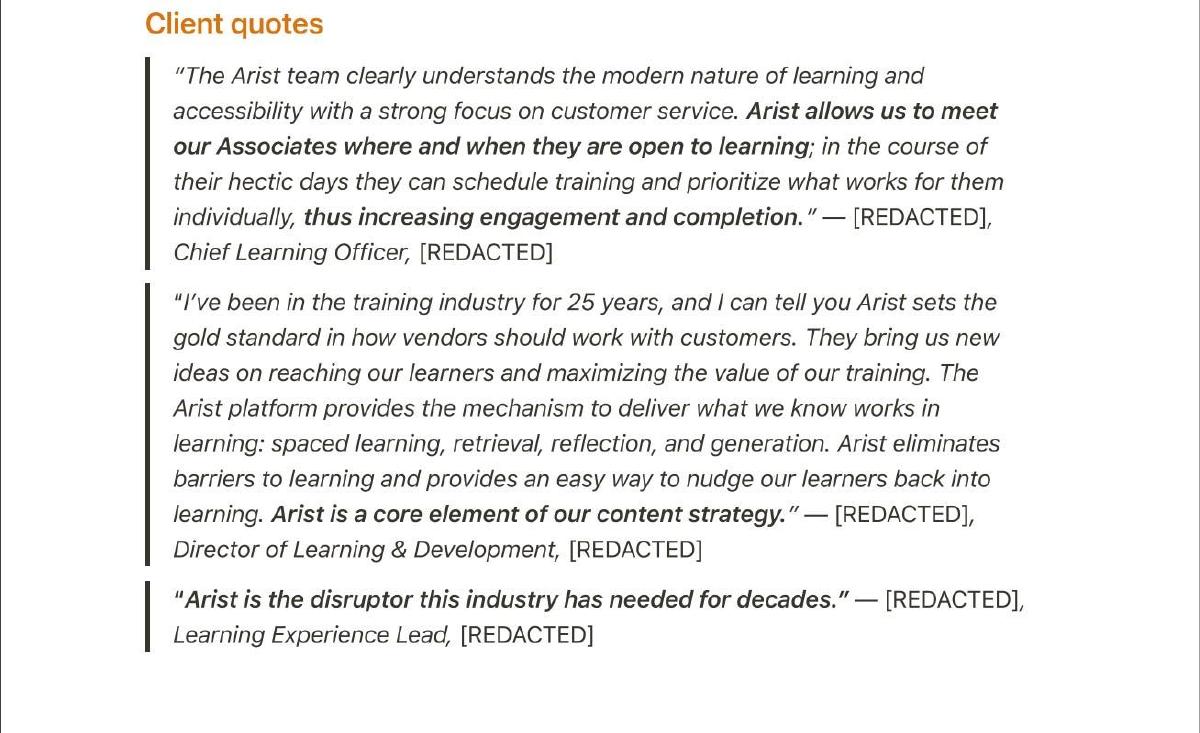
Arist’s Series A presentation deviates from the traditional visual-heavy pitch deck, opting instead for a structured 'pitch memo' format. This approach allows the company to provide deep context on its unique delivery mechanism—SMS, Slack, and MS Teams—addressing the core friction of traditional Learning Management Systems (LMS). By highlighting a Net Promoter Score (NPS) of over 90 and adoption rates 5x higher than traditional tools (Slide 1), Arist positions itself as a high-engagement alternative to cumbersome corporate training. The deck leans heavily on academic and enterprise validation…
Key takeaways
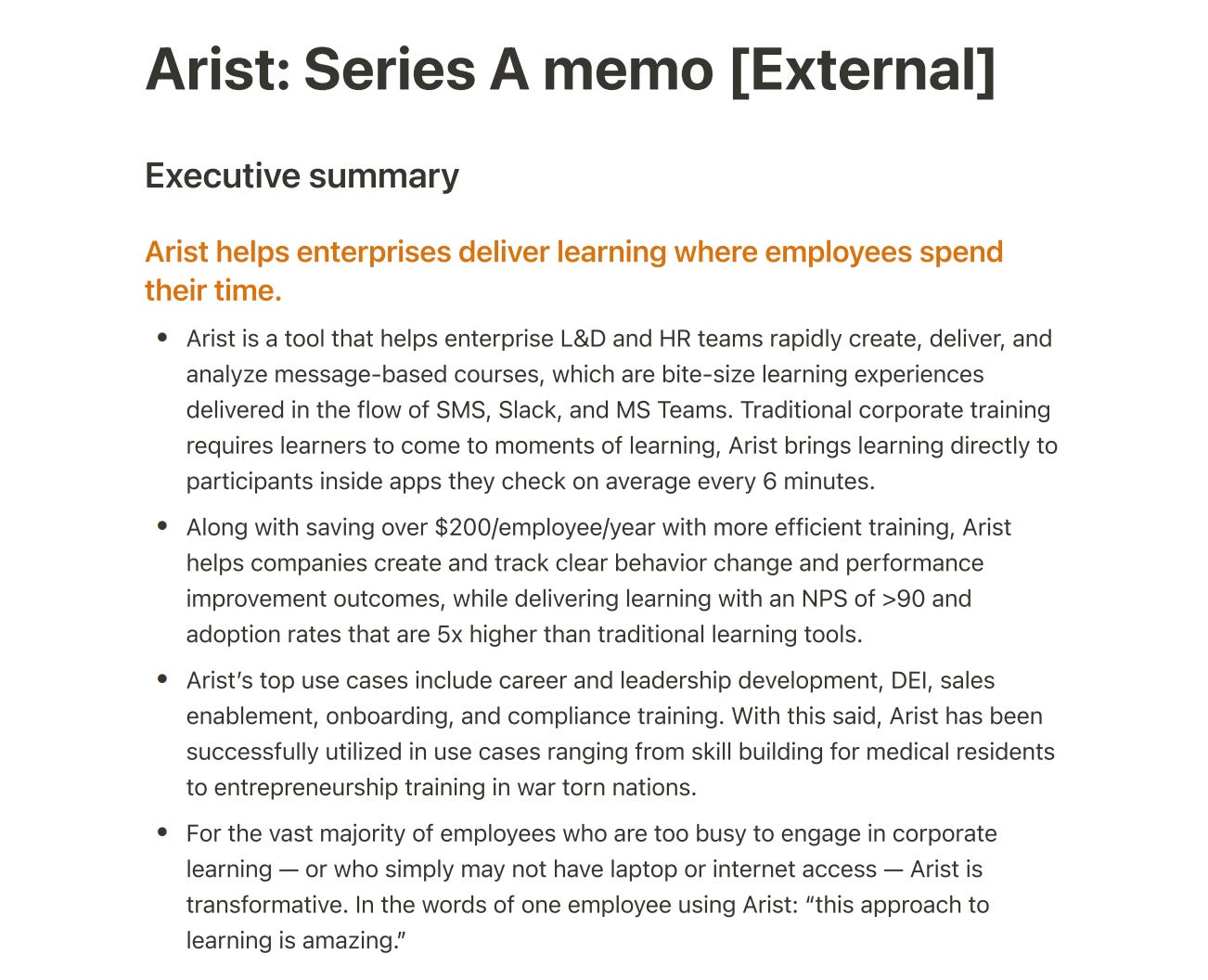
- Arist utilizes a memo-style deck, prioritizing narrative depth over visual flair to explain its micro-learning model (Slide 1).
- The platform claims an NPS of >90, significantly higher than industry standards for corporate training (Slide 1).
- A key value proposition is the $200/employee/year savings generated through more efficient training delivery (Slide 1).
- The deck highlights a specific study by the University of Washington showing a >12% performance increase among 1,400 participants (Slide 4).
- Arist targets the 'deskless' or busy worker, noting that 95% of employees open a text within 3 minutes (Slide 4).
- The product includes a library of 40+ pre-built courses covering DEI, sales enablement, and compliance (Slide 5).
- The team slide emphasizes deep industry expertise, including advisors who are former Chief Learning Officers at Google and Microsoft (Slide 7).
- Arist had raised $4.235M across Pre-seed, Seed, and Seed+ rounds prior to this Series A (Slide 8).
The Memo Format: A Strategic Choice for Series A
Arist’s Series A presentation is not a traditional pitch deck. It is a structured 'external memo.' This format has gained traction in recent years among high-growth startups because it forces a level of narrative rigor that slides often lack. For a company like Arist, which operates in the crowded EdTech/L&D space, the memo allows them to clearly differentiate their 'message-based' approach from the 'platform-based' approach of traditional Learning Management Systems (LMS). By using text-heavy slides, they can explain the psychological and behavioral reasons why SMS and Slack training works better than video-based modules.
Slide 1: Executive Summary
The opening slide sets the stage by defining Arist as a tool for 'learning in the flow of work.' It immediately addresses a massive pain point in corporate America: the fact that employees check their messaging apps every 6 minutes on average. The summary claims three major wins: saving over $200 per employee per year, achieving an NPS of >90, and seeing adoption rates 5x higher than traditional tools. This is a classic 'hook' slide that uses hard numbers to justify the rest of the read.
Slide 2: Key Metrics (Redacted)
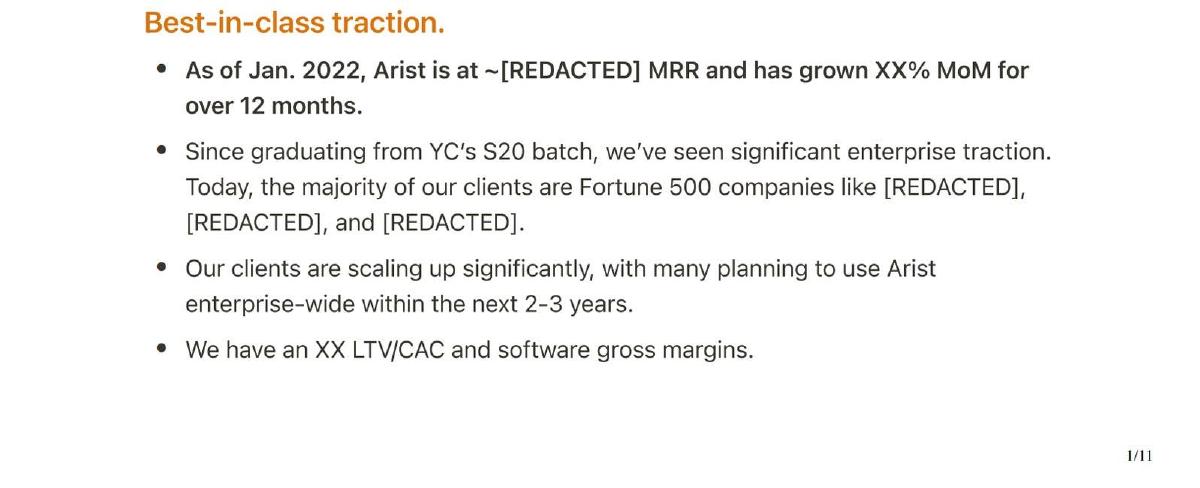
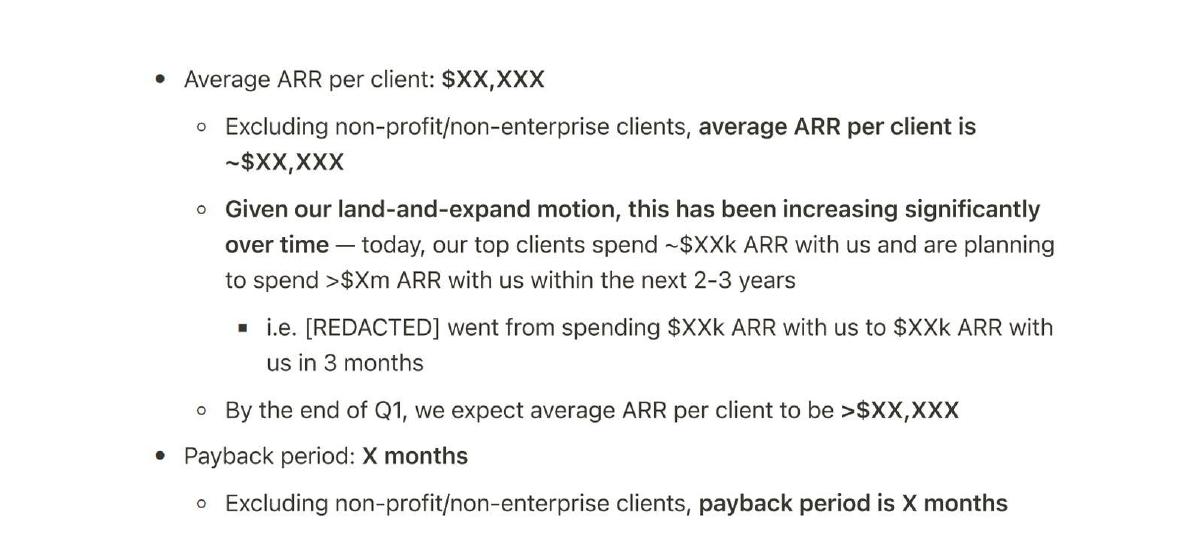
Slide 2 is dedicated to the 'Key Metrics as of Jan. 2022.' While the specific figures for MRR, CMGR, LTV, and CAC are redacted in this public version, the list of metrics itself is telling. Arist is tracking the 'Standard SaaS' suite, including LTV:CAC ratios and monthly churn. The inclusion of 'Average sales cycle' is particularly important for enterprise L&D tools, which often suffer from long, bureaucratic procurement processes. By highlighting this, Arist suggests they have a repeatable and efficient sales motion.
Slide 3: Why Arist Exists
This slide focuses on the mission: making learning as 'accessible, enjoyable, and seamless as a message a day.' It positions Arist as the 'cheaper, faster, and more effective' alternative to LMS platforms. The narrative here is about friction reduction. Traditional training requires a 'moment of learning' where an employee stops working; Arist integrates the learning into the work itself. This is a subtle but powerful shift from 'destination learning' to 'embedded learning.'
Slide 4: Core Benefits and Academic Validation
One of the strongest slides in the deck, Slide 4, provides external validation. It cites a study by the University of Washington that tied Arist to a >12% performance increase in a sample size of 1,400. This moves the conversation from 'employees like it' (NPS) to 'it actually works' (performance). It also includes a startling engagement stat: 95% of employees open a text within 3 minutes. This is the 'unfair advantage' of the SMS medium compared to email or LMS notifications.
Slide 5: Product and Compliance
Slide 5 provides a glimpse of the Arist dashboard. It emphasizes that L&D teams can 'rapidly create, launch, and assess' courses. The mention of a 'template library of 40+ courses' is a key scalability indicator—it shows that Arist isn't just a delivery pipe, but a content enabler. Crucially, this slide also displays SOC 2, CCPA, and GDPR badges. For enterprise software, these security certifications are not optional; they are a prerequisite for any Series A investment.
Slide 6: Case Studies and Global Impact
This slide moves from theory to practice. It lists three distinct case studies: DEI training at GLISI, OBGYN training at the University of Washington, and entrepreneurship training with EY. The EY example is particularly interesting, as it highlights the platform's ability to reach learners in 'hard-to-reach regions like Nigeria and Venezuela.' This demonstrates that Arist’s low-bandwidth, message-based approach has a global reach that video-heavy platforms cannot match.
Slide 7: The Team and The 'CLO' Advantage
The team slide (Slide 7) lists Bianca Nieves (Growth), Sam Johnson (Engineering), and Joel Theodros (Sales). The backgrounds include impressive names like Dropbox, Udacity, and the US Department of Defense. However, the most significant part of this slide is the final bullet point: 'Our advisors include the former Chief Learning Officers of Google, Microsoft, and McDonald’s.' In the L&D world, having the endorsement of the people who ran training for the world's largest workforces is the ultimate form of social proof.
Slide 8: Funding History
The final slide in this selection tracks the company's capitalization history. Arist raised a $235,000 Pre-seed in 2019, followed by two $2 million rounds (Seed and Seed+) in 2020 and 2021. The presence of top-tier firms like Craft Ventures and Y Combinator, along with industry-specific investors like Acadian Ventures, shows a consistent upward trajectory and strong institutional backing heading into the $12M Series A.
What Arist Does Exceptionally Well
Arist excels at quantifying the qualitative . Corporate training is often seen as a 'check-the-box' activity with hard-to-measure results. By leading with a 90+ NPS and a 12% performance increase, Arist turns a 'soft' HR cost into a 'hard' ROI calculation. They also do a great job of addressing the 'So What?' of their technology. They don't just say they use SMS; they explain that SMS is superior because it has a 95% open rate within three minutes. They bridge the gap between the feature (messaging) and the benefit (engagement).
What is Missing from the Deck
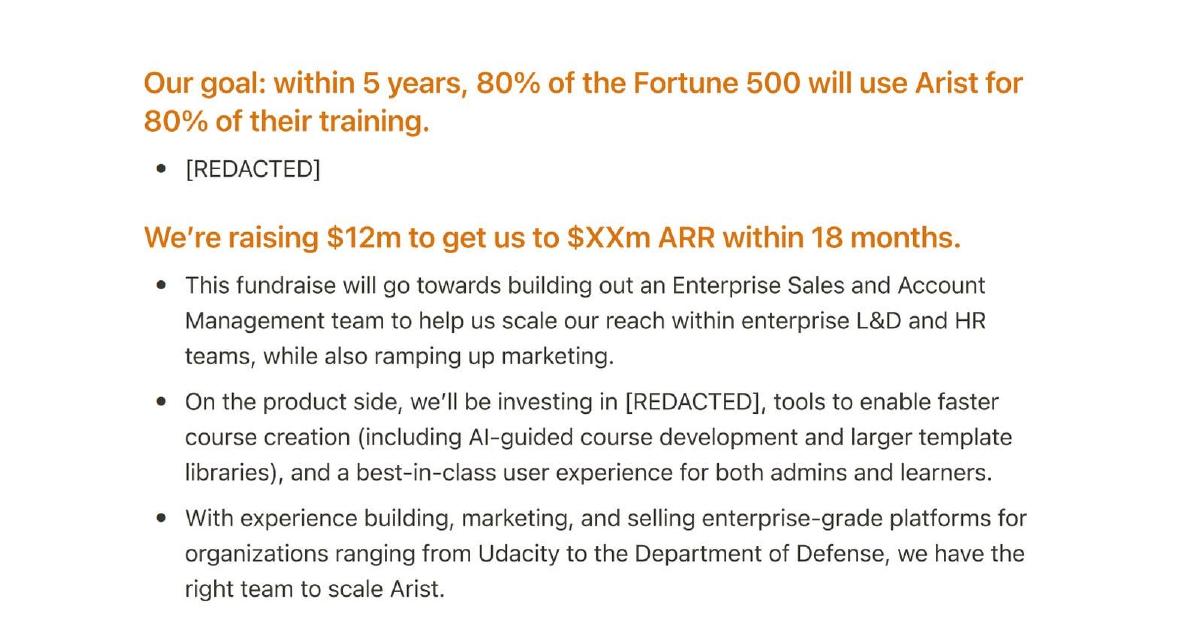
While this is a memo and not a full deck, there are a few notable omissions. First, there is no explicit 'Ask' slide in this version. While we know from publisher reports that they raised $12M, the memo doesn't detail how that capital will be deployed (e.g., hiring, R&D, international expansion). Second, there is a lack of competitive landscape analysis . While they mention 'traditional LMS' platforms, they don't name specific competitors or explain how they defend against other micro-learning startups. Finally, the unit economics (CAC payback period, expansion revenue) are hinted at in the metrics slide but not expanded upon in the narrative, which is usually a key focus for Series A investors.
Founder's Guide: What to Copy from Arist
Use the Memo Format for Complex Sales: If your product requires a change in user behavior (like moving from video to text), a memo allows you to build a logical case that a 10-word slide cannot. · Lead with Validation: Arist doesn't just say their product works; they cite the University of Washington. If you have academic or third-party data, put it on the first few slides. · Highlight 'Deskless' Accessibility: If your software works for employees who don't have a laptop (a huge segment of the global workforce), make that a central pillar of your pitch. · Leverage Industry Advisors: The 'CLO' advisory board is a masterclass in building credibility. Find the 'Godfathers' of your specific industry and get them on your advisory slide. · Focus on Friction: Arist’s best argument is that they meet users where they already are. Identify the 'destination' your users are currently forced to go to, and explain how you bring the value to their existing workflow.
Frequently asked questions
- Why did Arist use a memo format instead of a traditional slide deck?
- The memo format, popularized by firms like Sequoia and Rippling, allows for a more nuanced explanation of complex value propositions. For Arist, it helps articulate why message-based learning is superior to traditional LMS platforms by providing space for data-heavy case studies and behavioral psychology insights that might be lost in a visual-only slide.
- What are the primary delivery channels for Arist's training?
- As stated on Slide 1, Arist delivers bite-sized learning experiences directly through SMS, Slack, and Microsoft Teams. This strategy aims to meet employees where they already spend their time, rather than forcing them to log into a separate, often ignored, corporate portal.
- How does Arist prove the ROI of its micro-learning platform?
- Arist uses three main pillars for ROI: cost savings ($200/employee/year), engagement (90+ NPS and 5x higher adoption), and performance (a 12% increase in performance as validated by a University of Washington study). These metrics are highlighted on Slides 1 and 4 to appeal to budget-conscious HR and L&D leaders.
- What specific use cases does the deck highlight?
- The deck lists several high-impact use cases including DEI training for 5,000 educators, OBGYN training for medical residents, and entrepreneurship training in regions like Nigeria and Venezuela. These examples on Slide 6 demonstrate the platform's versatility across different industries and technical constraints.
- Who are the key investors and advisors supporting Arist?
- According to Slide 8, previous rounds were led by Craft Ventures, Acadian Ventures, Y Combinator, and GFC. Furthermore, Slide 7 notes that their advisory board includes former Chief Learning Officers from Google, Microsoft, and McDonald’s, providing significant institutional credibility in the L&D space.