The Arrcus Series B deck is a concise, 10-slide presentation that leans heavily on the company's strategic positioning within the networking infrastructure market. Rather than focusing on month-over-month growth or specific revenue figures, the deck builds a narrative around the '5G Revolution' and the need for a decoupled, software-driven network operating system. By highlighting a board and advisor list featuring heavyweights from Cisco, Juniper, and Google, Arrcus establishes immediate credibility in a high-barrier-to-entry sector. The deck successfully argues that the networking industry…
Key takeaways
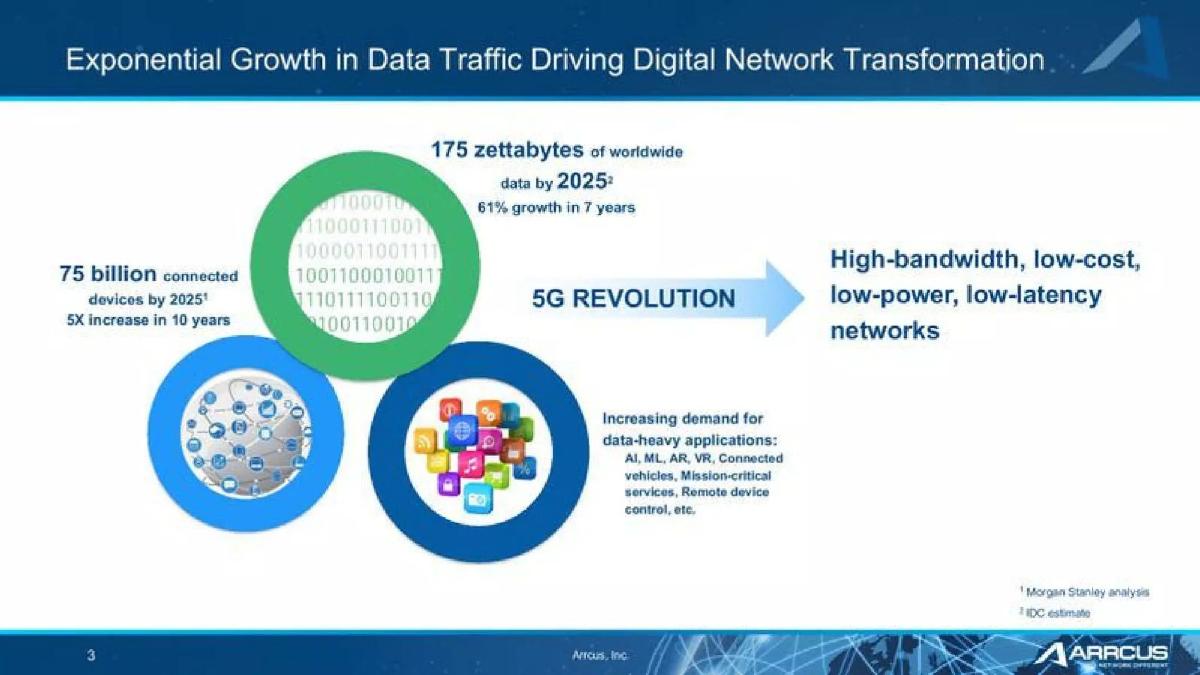
- The deck identifies a massive market shift toward 175 zettabytes of worldwide data by 2025 on slide 3.
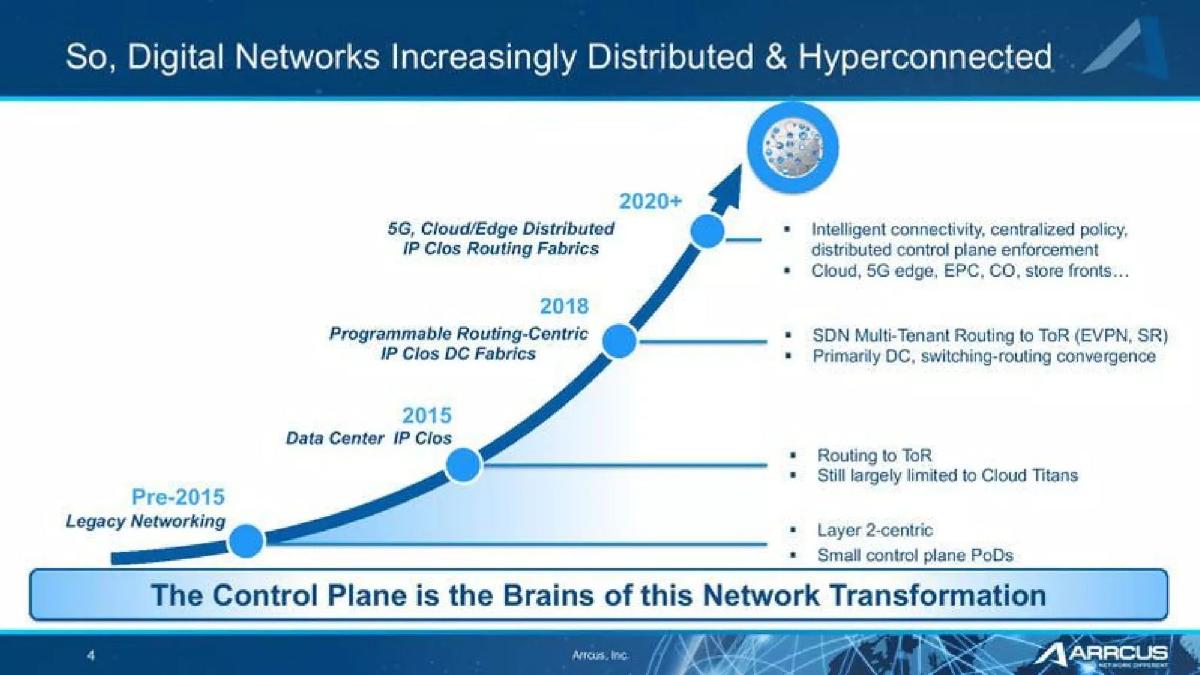
- Arrcus positions their software, ArcOS, as the 'Control Plane' or 'Brains' of the network transformation on slide 4.
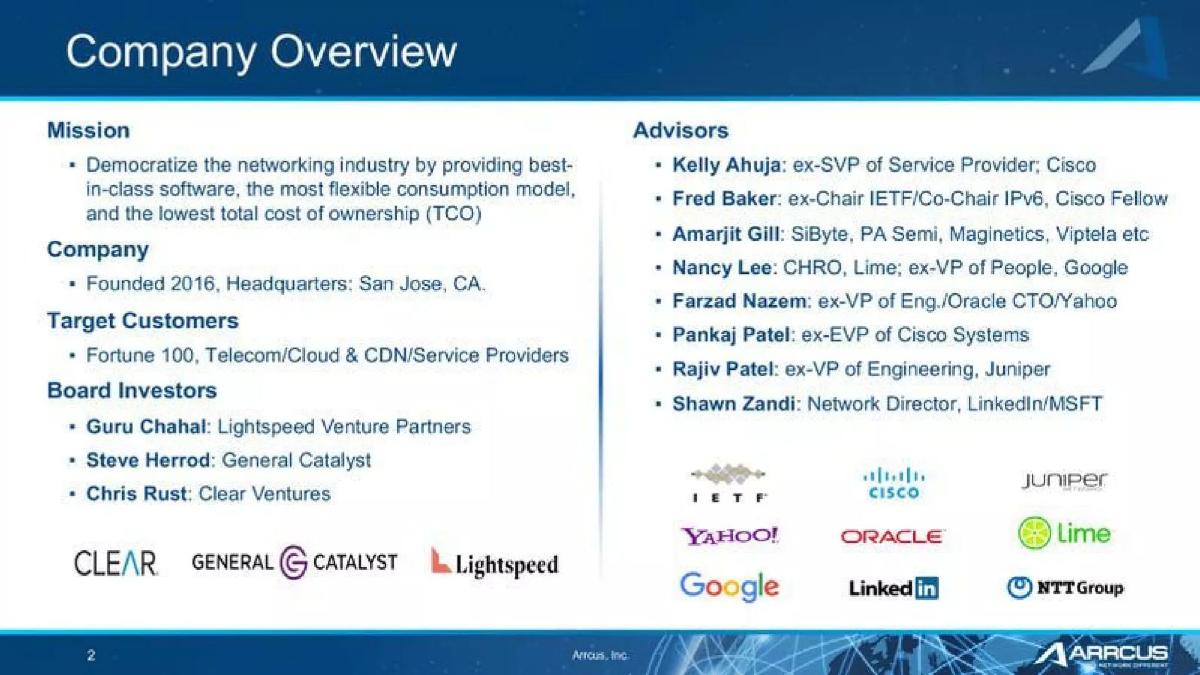
- The company uses a high-profile advisor list, including former SVPs from Cisco and Juniper, to establish technical authority on slide 2.
- They explicitly define their target customers as Fortune 100, Telecom/Cloud & CDN, and Service Providers on slide 2.
- The deck highlights a transition from 'Proprietary Vertical Integration' to 'Open Integration' on slide 8.
- Arrcus describes itself as 'The New OEM' on slide 7, emphasizing a flexible consumption model and lower total cost of ownership.
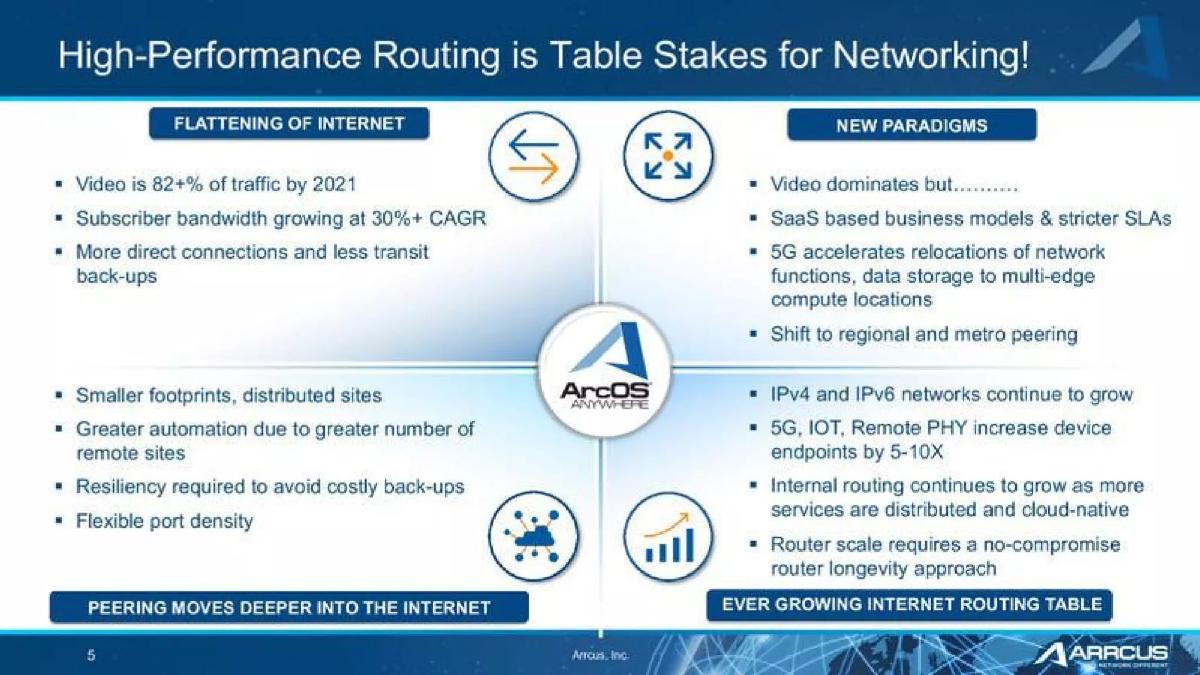
- The presentation notes that video will account for 82+% of internet traffic by 2021 on slide 5.
- The deck omits all financial data, including revenue, burn rate, and the specific $30M ask mentioned in catalogue facts.
Introduction: The Strategic Series B
The Arrcus Series B pitch deck, used to secure $30M in 2019, is a study in high-level strategic alignment. Unlike many Series B decks that dive deep into cohort analysis and sales velocity, Arrcus focuses on the macroeconomic and technical shifts that make their existence necessary. The company, founded in 2016 and headquartered in San Jose, CA (Slide 2), positions itself as a disruptive force in the networking industry by decoupling software from hardware.
Slides 1-2: The Foundation and Pedigree
Slide 1 is a standard title slide, but Slide 2, 'Company Overview,' does a significant amount of heavy lifting. It establishes the mission: to 'Democratize the networking industry.' It also lists their target customers, which are not small businesses but Fortune 100, Telecom/Cloud & CDN, and Service Providers . This immediately signals the scale of the opportunity.
The most notable part of Slide 2 is the 'Advisors' list. In infrastructure tech, credibility is everything. By listing former SVPs and VPs from Cisco, Juniper, Google, and Oracle , Arrcus tells investors that the people who built the current internet believe Arrcus is building the next one. The inclusion of board investors from Lightspeed, General Catalyst, and Clear Ventures further validates this pedigree.
Slides 3-5: The 'Why Now' and Market Dynamics
Slide 3, 'Exponential Growth in Data Traffic,' uses data from Morgan Stanley and IDC to forecast 175 zettabytes of worldwide data by 2025 and 75 billion connected devices. This slide sets the stage for the '5G Revolution,' which acts as the primary catalyst for their growth. The arrow points toward a need for 'High-bandwidth, low-cost, low-power, low-latency networks.'
Slide 4 provides a historical timeline of network transformation. It moves from 'Legacy Networking' (Pre-2015) to '5G, Cloud/Edge Distributed IP Clos Routing Fabrics' (2020+). The key takeaway here is the footer: 'The Control Plane is the Brains of this Network Transformation.' Arrcus is claiming the 'brain' space, which is the most defensible and profitable part of the network.
Slide 5, 'High-Performance Routing is Table Stakes,' explains the 'Flattening of the Internet.' It notes that video will be 82+% of traffic by 2021 and that subscriber bandwidth is growing at a 30%+ CAGR. This slide justifies the need for their product by highlighting the limitations of current paradigms, such as the need for greater automation and resiliency to avoid costly back-ups.
Slides 6-8: The Product and Competitive Advantage
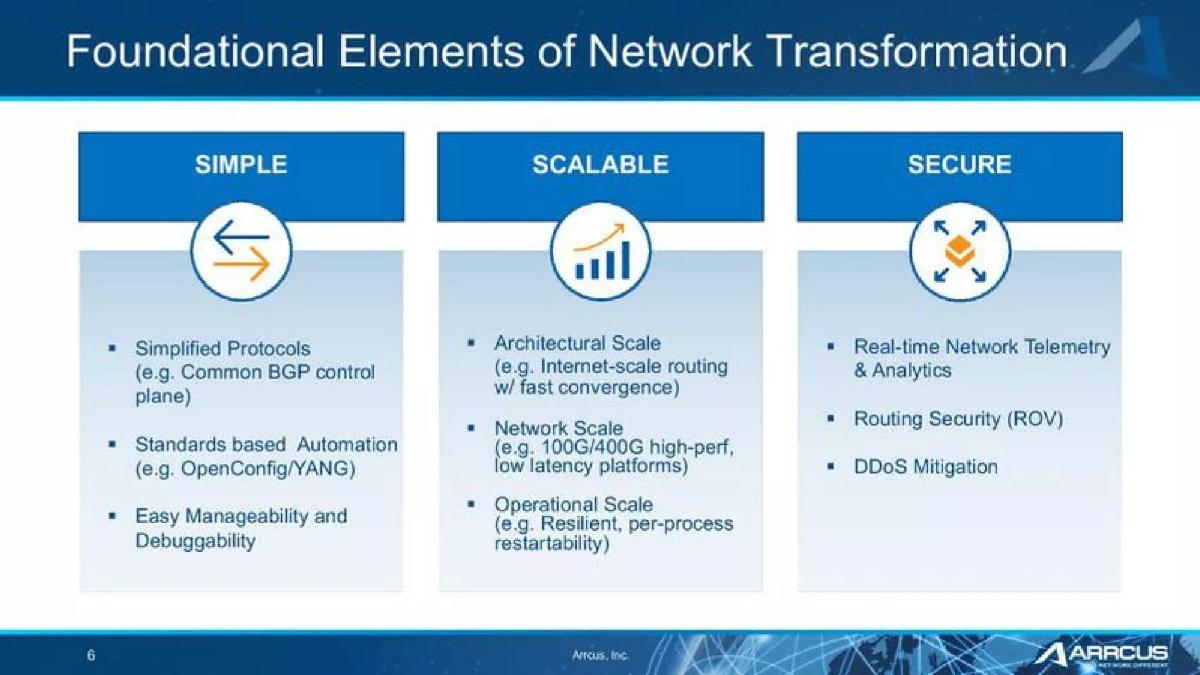
Slide 6 breaks down the 'Foundational Elements' into three pillars: Simple, Scalable, and Secure . It gets technical, mentioning BGP control planes, OpenConfig/YANG, and 100G/400G platforms. This slide is likely intended for the technical due diligence portion of a partner meeting, proving the software is built for modern standards.
Slide 7 introduces the concept of 'Arrcus: The New OEM.' This is a bold positioning statement. They aren't just a software vendor; they are a new type of Original Equipment Manufacturer that allows customers to 'Select the Right Software with the Right Hardware at the Right Costs.' The visual shows ArcOS sitting atop 'Any Hardware' and 'Any Silicon.'
Slide 8, 'Arrcus Enables Choice,' is the 'killer' slide of the deck. It contrasts 'Proprietary Vertical Integration' (listing incumbents Arista, Cisco, and Juniper) with 'Open Integration.' It shows ArcOS working with silicon from Intel, Broadcom, AMD, Arm, and Cavium , and hardware from HP, Dell, and Delta. This visualizes their market-expanding potential: they aren't just competing with Cisco; they are enabling every other hardware maker to compete with Cisco.
Slides 9-10: Benefits and Scaling
Slide 9 summarizes the 'Key Customer Benefits' into three circles: Superior Performance, Flexible Deployment, and Lower TCO (Total Cost of Ownership). While visually simple, these are the three levers that move the needle for Fortune 100 procurement departments.
Slide 10, 'Arrcus Ready to Scale,' introduces ArcIQ , an AI-driven network operations center. This suggests a product roadmap beyond just the operating system, moving into analytics and SaaS-based offerings. The slide concludes by reiterating their 'Proven Experienced Team' and 'Expansive Use Cases.'
What Works in This Deck
1. The 'New OEM' Framing: By positioning themselves as a 'New OEM' rather than just a software startup, Arrcus claims a larger share of the mental model investors have for the networking industry. It suggests they are a foundational platform, not a niche tool.
2. Extreme Credibility: The advisor and board slide is one of the strongest seen in a Series B deck. In a sector where 'nobody ever got fired for buying Cisco,' Arrcus uses these names to mitigate the perceived risk of a startup-led infrastructure shift.
3. Clear Market Catalysts: The deck does an excellent job of tying its success to the 5G rollout and the explosion of video traffic. It makes the company's growth feel inevitable because it is tied to global infrastructure trends.
What Is Missing
1. Financial Metrics: There is a total absence of revenue, ARR, growth rates, or unit economics. For a Series B, this is highly unusual. While the catalogue facts state they raised $30M, the deck itself provides no evidence of commercial traction, such as the number of active deployments or pilot programs.
2. The 'Ask': The deck does not state how much money is being raised or how the funds will be allocated. This information was likely handled in the verbal pitch or a separate document, but its omission makes the deck feel more like a general company overview than a fundraising tool.
3. Case Studies: While they mention target customers like 'Fortune 100,' there are no specific logos of current customers or case studies showing the 'Lower TCO' in action. Investors usually want to see that the 'Open Integration' model has been successfully validated in a production environment by Slide 10.
What a Founder Should Copy
1. The 'Proprietary vs. Open' Comparison: Slide 8 is a perfect example of how to visualize a complex competitive landscape. It doesn't use a standard 2x2 grid; instead, it shows a structural shift in the industry that favors the startup's architecture.
2. Tying Product to Macro Trends: Founders should look at Slide 3 and 5 to see how to use third-party data (IDC, Morgan Stanley) to validate their market timing. It moves the conversation from 'Is this a good product?' to 'Is the world moving in a direction that requires this product?'
3. The Pedigree Slide: If you have high-profile advisors, don't just list their names in small text at the end. Arrcus puts them on Slide 2 with large logos of the companies they came from. This 'borrowed authority' is crucial for startups entering enterprise or infrastructure markets.
Conclusion
The Arrcus deck is a high-conviction play on technical superiority and market timing. It assumes the investor already understands the networking space and focuses entirely on why the old way of doing things is dead. While the lack of metrics is a glaring omission for a typical teardown, in the context of a $30M Series B for a deep-tech company, it suggests that the strategic narrative and the team's pedigree were the primary drivers of the round.
Frequently asked questions
- Why does this Series B deck lack financial metrics?
- In deep-tech infrastructure, the 'moat' is often the technical architecture and the team's ability to execute against incumbents like Cisco. Arrcus likely shared detailed financials in a data room, using this deck primarily to align investors on the strategic 'why now' regarding 5G and data growth. For a Series B, this is unusual but suggests a high degree of investor confidence in the underlying technology.
- How does Arrcus differentiate itself from legacy networking giants?
- Arrcus uses slide 8 to show a direct comparison. Legacy players like Arista and Cisco use proprietary vertical integration (locked hardware and software). Arrcus offers 'Open Integration,' allowing their ArcOS to run on 'Any Switch or Router' and 'Any Silicon,' including chips from Broadcom, Intel, and AMD. This hardware-agnostic approach is their primary value proposition.
- What is the significance of the 'Control Plane' mention on slide 4?
- The control plane is the part of a network that carries signaling traffic and is responsible for routing. By claiming to be the 'brains' of the network, Arrcus is positioning itself as the most critical, high-value component of the stack, rather than just another utility. This justifies a software-style valuation in a traditionally hardware-heavy industry.
- Who are the key people mentioned in the deck?
- The deck leans heavily on its 'Advisors' list on slide 2, which includes Kelly Ahuja (ex-SVP Cisco), Fred Baker (Cisco Fellow), and Rajiv Patel (ex-VP Juniper). By listing these names alongside logos like Google, Oracle, and Yahoo, Arrcus signals to investors that the industry's top minds are backing their specific approach to networking.
- What market trends is Arrcus betting on?
- According to slides 3 and 5, they are betting on the 5G revolution, a 5X increase in connected devices by 2025, and the 'flattening of the internet' where video dominates traffic. They argue that these trends require a shift to regional peering and multi-edge compute locations, which legacy, centralized networking architectures cannot handle efficiently.