Arrival’s 57-slide investor presentation (10 slides analyzed here) positions the company as a disruptive force in the electric vehicle sector by rejecting the capital-intensive legacy OEM model. The core thesis rests on 'Microfactories'—small-footprint production sites that cost $44M to build versus the $950M required for a traditional plant. The deck leans heavily on commercial validation, citing a $1.2 billion order for 10,000 units from UPS and a €100 million investment from Hyundai and Kia. Technically, the company emphasizes proprietary composite materials that reduce tooling costs by 25…
Key takeaways
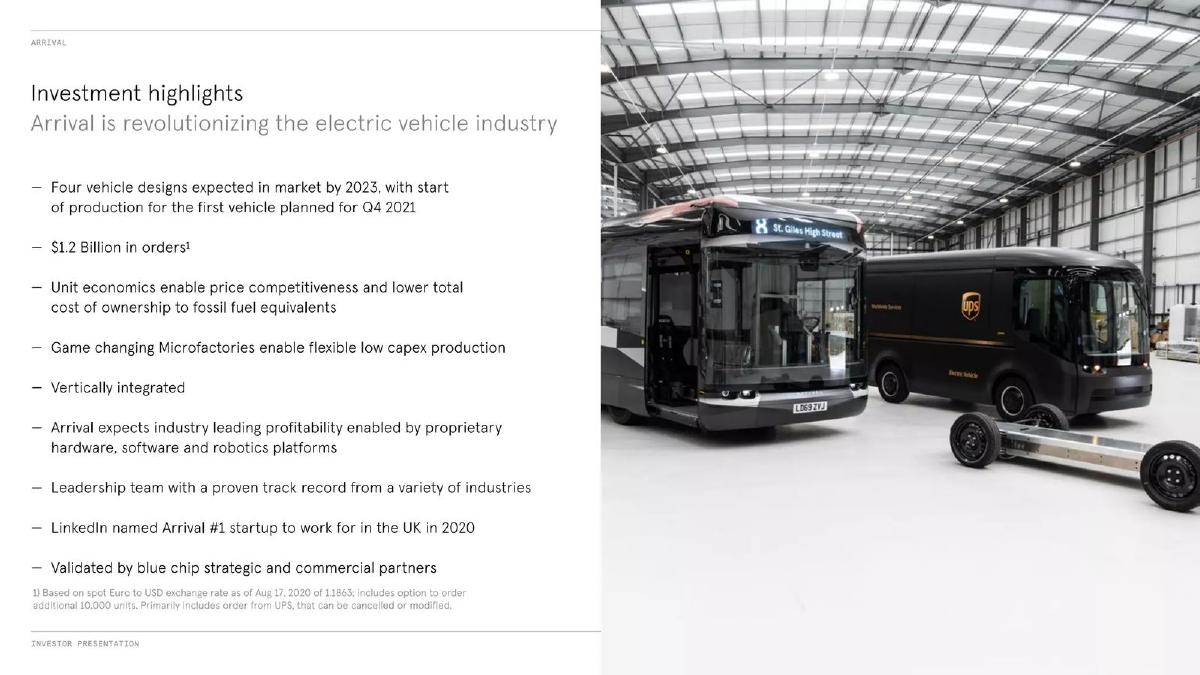
- The company claims a $1.2 billion commercial order from UPS for 10,000 units, with an option for 10,000 more (Slide 7).
- Strategic validation is provided by a €100 million investment from Hyundai and Kia Motors (Slide 7).
- The Microfactory model is projected to cost $44M per site, compared to $950M for a traditional VW factory in Poland (Slide 25).
- Arrival claims its proprietary composite materials reduce tooling costs by 25x and allow for a 18-month vehicle development program (Slide 31).
- The Arrival Van H3L4 N2 is marketed with a 1,975kg payload, significantly higher than the Mercedes Sprinter H2L1 at 1,061kg (Slide 13).
- Financial projections in the benchmarking slide estimate 2024 revenue at $14,135M (Slide 43).
- The management team includes leaders with experience from Yota, LG Electronics, and Google (Slide 49).
- The deck assumes an Enterprise Value of $5.39B for benchmarking purposes against peers like Canoo and Nikola (Slide 43).
Executive Summary: The Microfactory Revolution
Arrival's investor presentation is a comprehensive 57-slide document (of which 10 key slides are analyzed here) that attempts to redefine the economics of automotive manufacturing. Rather than competing on the terms of legacy OEMs—which require billions in CapEx and massive centralized plants—Arrival proposes a modular, decentralized approach. The deck is structured to move from high-level commercial validation (UPS and Hyundai) to technical differentiation (composites and HMI modules) and finally to the financial justification of a multi-billion dollar valuation.
Slide 1: Title and Visual Identity
The cover slide features a top-down render of an Arrival vehicle, emphasizing a minimalist, tech-forward design aesthetic. The branding is clean, utilizing a custom sans-serif typeface. The footer marks the document as 'Confidential - Arrival SARL,' establishing the formal corporate entity behind the presentation.
Slide 7: Commercial and Strategic Validation
This is arguably the most important slide for establishing credibility. It splits validation into two categories: Commercial and Strategic. Under Commercial, it lists UPS with orders worth ~$1.2 Billion for 10,000 units, plus an option for 10,000 more. It notes a trial partnership dating back to 2016. Under Strategic, it highlights a €100 Million investment and collaboration agreement with Hyundai and Kia Motors . The slide explicitly mentions that Hyundai wants to become a top three EV manufacturer by 2025, positioning Arrival as a key enabler of that goal.
Slide 13: Product Benchmarking - The Arrival Van
Arrival uses this slide to demonstrate physical superiority over industry standards like the Mercedes Sprinter and Ford Transit. Key metrics cited include:
Payload: 1,975 kg for Arrival vs. 1,061 kg for the Mercedes Sprinter H2L1. · Unladen weight: 2,275 kg for Arrival vs. 2,439 kg for the Sprinter. · Turning circle: 12.9 meters vs. 14.8 meters for the Sprinter. · Floor to ground: 450 mm vs. 620 mm for the Sprinter.
The data is attributed to company websites as of September 2020, providing a clear competitive frame for the hardware itself.
Slide 19: Section Break
A simple black transition slide titled 'A new method of design and production.' This marks the shift from 'what' they are building to 'how' they are building it.
Slide 25: The Microfactory vs. Traditional OEM
This slide presents the core economic disruption of the Arrival business model. It compares an Arrival Microfactory to a traditional VW Factory in Wrzesnia, Poland. The figures are stark:
CapEx: $44M for one Arrival Microfactory vs. $950M for the VW plant. · Time to open: 6 months for Arrival vs. 36 months for VW. · Factory size: 20,000 sqm for Arrival vs. 2,200,000 sqm for the VW site.
Arrival claims that 10 of its microfactories can match the 100,000 van-per-year output of a legacy plant for less than half the total CapEx ($440M vs $950M).
Slide 31: Proprietary Composite Materials
To achieve the low CapEx mentioned previously, Arrival highlights its use of composites over steel. The slide claims a 25x reduction in tooling costs . It states that composite tooling goes from CAD data to production in two weeks and that the vehicles do not require traditional metal stamping or paint shops—two of the most expensive parts of a traditional car factory. The status section notes these materials are 'Ready for mass production.'
Slide 37: Distributed Production Benefits
This slide elaborates on the 'why' of the microfactory. It argues that decentralized production allows for vehicles 'customized to local needs' and a 'rapid response to shifts in demand.' A key claim here is 'anticipated profitability at low volumes,' which contrasts with the 'millions of units' required for legacy profitability. The visual shows a render of an Arrival Bus destined for a 'City Centre.'
Slide 43: Enterprise Value Benchmarking
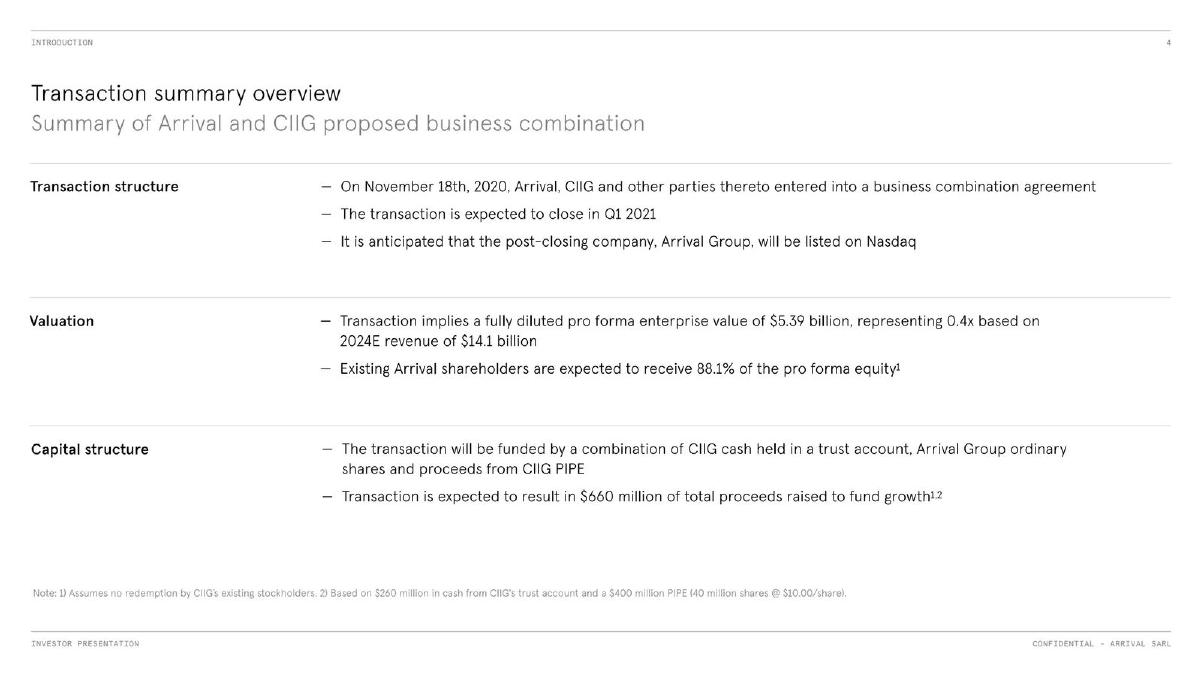
This is the 'Ask' and 'Valuation' justification slide. It uses an Assumed EV of $5.39B . It compares Arrival's projected 2023 and 2024 multiples against peers like Canoo, Fisker, Hyliion, Lordstown, Nikola, Workhorse, and XL Fleet. Arrival projects $14,135M in revenue for 2024E and $3,243M in EBITDA . Based on these projections, the deck argues that Arrival is trading at a 65-71% discount to the median peer multiples, implying a 2.9x to 3.5x upside for investors.
Slide 49: Management Team
The team slide focuses on technical and industrial depth rather than just 'big names.' It includes:
Sergey Malygin (Technology): 15 years experience, formerly at Yota. · Rob Thompson (Materials): Author of 7 books on manufacturing, formerly at LG and Nokia. · Nick Arini (Creation Platform): 50+ patents, formerly at Google and CapitalG. · Jeremy Offer (Design): 30 years in industrial design with clients like Apple and Google.
Slide 57: HMI Module
The final slide in this selection shows a hardware component—the HMI (Human Machine Interface) module. It provides specific dimensions (300mm x 100mm x 100mm) and shows the physical ports. This serves to ground the high-level software and economic talk in actual, tangible hardware engineering.
What Works in This Deck
The deck excels at comparative economics . By placing the $44M Microfactory directly next to a $950M legacy plant, the founders make a compelling case for why their model is more scalable and less risky than traditional automotive plays. The inclusion of the $1.2B UPS order provides the necessary 'de-risking' that investors require for a pre-revenue or early-stage hardware company. Furthermore, the technical slides on composites and HMI modules prevent the deck from feeling like a purely financial play, proving there is real IP behind the projections.
What is Missing
While the deck is thorough, there are notable omissions in this 10-slide sample:
Unit Economics: While factory CapEx is detailed, the specific bill of materials (BOM) or margin per vehicle is not explicitly broken down in these slides. · Regulatory Path: There is no mention of crash testing, homologation, or the specific regulatory hurdles required to get these 'composite' vehicles on public roads in different global markets. · Software Deep Dive: The deck mentions 'software innovation' frequently, but does not show the user interface or the fleet management platform in detail.
Founder Takeaways
Use 'Strategic Validation' to anchor valuation. Arrival doesn't just say they are worth $5B; they show that Hyundai and UPS have already put nine and ten-figure bets on their success. If you have a major partner, make them the centerpiece of your credibility. Quantify the 'New Way.' If you are disrupting an industry, don't just say you are 'cheaper.' Use a slide like Slide 25 to show exactly how much cheaper, faster, and smaller your solution is compared to the status quo. Finally, benchmark against the market. Slide 43 is a masterclass in using peer multiples to make a high valuation seem like a 'discount' to future earnings.
Frequently asked questions
- What is the primary competitive advantage claimed by Arrival?
- Arrival's primary advantage is its 'Microfactory' approach. As shown on Slide 25, these factories require significantly lower capital ($44M vs $950M for traditional OEMs) and can be deployed in just 6 months. This decentralized model allows for production closer to end-markets and profitability at much lower volumes than legacy automotive manufacturing, which typically requires millions of units to break even.
- How does Arrival validate its market demand in the deck?
- Market demand is validated through a massive commercial agreement with UPS. Slide 7 details orders worth approximately $1.2 billion for 10,000 units, plus an option for an additional 10,000. The slide also notes a long-standing trial partnership with UPS since 2016, suggesting the technology has undergone multi-year testing before the large-scale commitment.
- What technical innovations are highlighted regarding vehicle construction?
- Slide 31 focuses on proprietary composite materials. Arrival claims these materials are 'ultra tough' and 'automotive-grade' but do not require traditional metal stamping or expensive paint shops. This innovation reportedly reduces tooling costs by 25x and enables a transition from CAD data to production in just two weeks, drastically shortening the R&D cycle.
- Who are the key members of the management team?
- Slide 49 lists the management team, including Sergey Malygin (Technology), who led software teams at Yota; Rob Thompson (Materials), a global expert with experience at LG and Nokia; and Nick Arini (Creation Platform), who has experience with Google Cloud and holds over 50 patents. The team is positioned as a mix of automotive, materials science, and high-tech software expertise.
- How does Arrival's valuation compare to its peers in this deck?
- On Slide 43, Arrival uses an 'Assumed EV of $5.39B' to benchmark itself. It argues that at this valuation, it trades at a significant discount to the 2024 median enterprise value multiples of peers like Nikola, Fisker, and Workhorse. Specifically, it claims a 71% implied discount to the 2024E median EV/Sales multiple, suggesting a 3.5x 'money multiple upside' for investors.