ARTSTAQ presents a vision for a centralized art exchange, positioning art as a new liquid asset class. The deck identifies significant pain points for over 10 million artists and 100,000 art professionals who struggle for career advancement in a fragmented market. By integrating social and fintech aspects, ARTSTAQ seeks to connect 50 million collectors and 100 million investors. The presentation highlights a 'Smart Advisor' tool for diversified art investment and projects a bold $240 million in revenue by 2020. While the deck successfully communicates a high-level vision and identifies a mass…
Key takeaways
- The company positions itself as the 'World's First Art Exchange' where users can trade art like stocks (Slide 1).
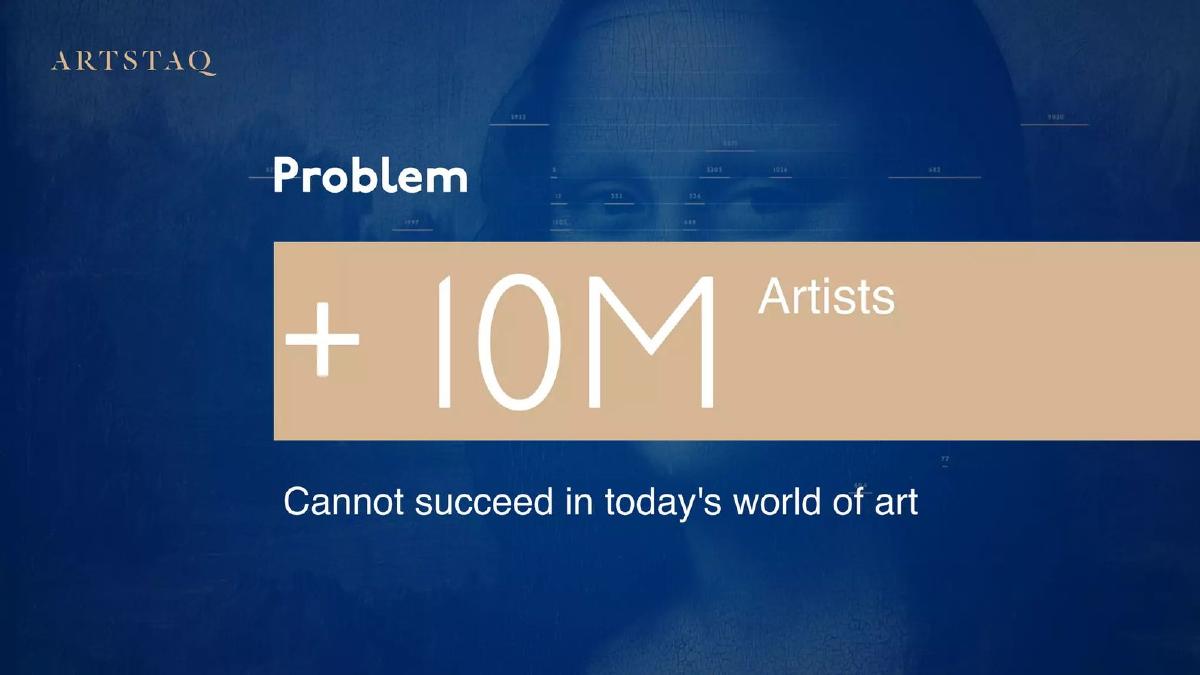
- ARTSTAQ identifies a massive supply-side problem with over 10 million artists unable to succeed in the current market (Slide 2).
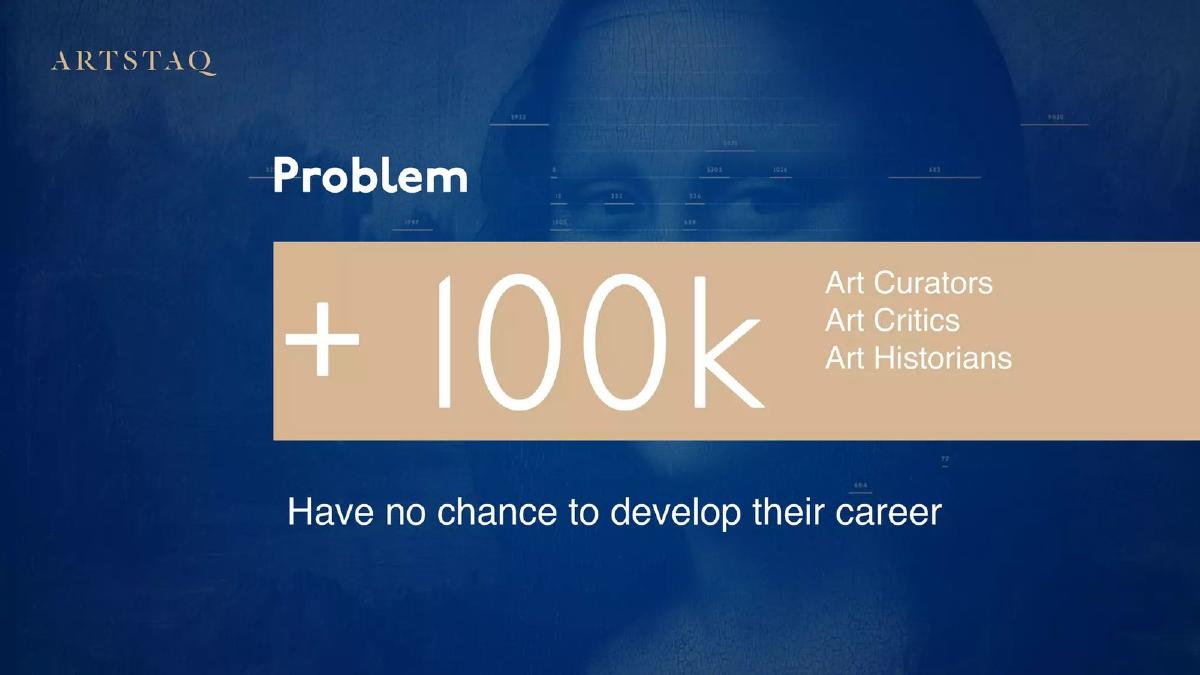
- The deck highlights career stagnation for 100,000+ art curators, critics, and historians as a key market inefficiency (Slide 3).
- The art market is depicted as 'torn into pieces' across numerous fragmented platforms like Sotheby's, Christie's, and Artsy (Slide 4).
- The platform aims to bridge the gap between 50M collectors and 100M investors by treating art as a new asset class (Slide 5).
- Product screenshots show a 'Smart Advisor' that allows users to set investment amounts, duration, and profit margins (Slide 6).
- The total addressable market for art and collectibles is valued at $620 billion (Slide 7).
- The company projected $240 million in revenue by the year 2020 (Slide 8).
Executive Summary: The Financialization of Fine Art
ARTSTAQ enters the pitch with a bold premise: the art market is broken because it lacks the liquidity and transparency of modern financial markets. By positioning themselves as the 'World's First Art Exchange,' they are not just selling a marketplace; they are selling a new infrastructure for an entire asset class. The deck focuses heavily on the scale of the problem and the size of the opportunity, using large-format numbers to emphasize the millions of participants currently underserved by the status quo.
Slide 1: Title and Vision
The cover slide sets a sophisticated tone with a dark blue, textured background featuring a faint image of the Mona Lisa overlaid with data-like grid lines. The tagline is clear and direct: "World's First Art Exchange: Where You Can Trade Art Like Stocks." This immediately communicates the business model to the investor. The slide also features a 'Winner of EXEC 2017' badge and logos from Forbes, TNW, Artnews, and The Art Newspaper, providing immediate social proof and industry validation.
Slide 2 & 3: The Human Problem
Slides 2 and 3 focus on the supply side and the professional ecosystem. Slide 2 states that "+10M Artists Cannot succeed in today's world of art." This is a massive number intended to show the untapped potential of the 'long tail' of the art market. Slide 3 shifts to the gatekeepers, noting that "+100k Art Curators, Art Critics, Art Historians Have no chance to develop their career." By identifying these two groups, ARTSTAQ suggests that the current system is failing both the creators and the experts who validate them.
Slide 4: Market Fragmentation
This slide uses a 'torn paper' visual metaphor to illustrate that the "Art Market is torn into pieces." It lists major incumbents including Bonhams, Phillips, Sotheby's, Christie's, Saatchi Art, Artprice, Artfinder, Artspace, Artnet, Paddle8, and Auctionata. The implication is that the market is siloed, making it difficult for investors to get a holistic view or for assets to move fluidly between platforms. ARTSTAQ positions itself as the unifying force that will mend these fractures.
Slide 5: The Integrated Solution
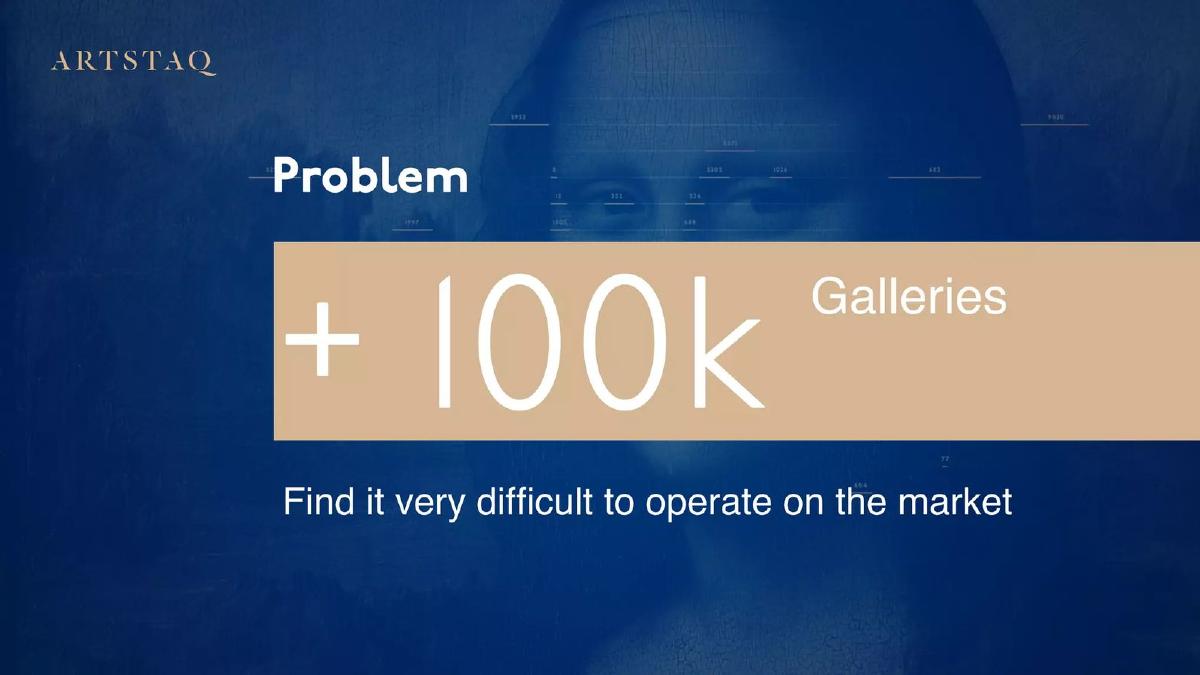
Slide 5 presents a triangular diagram showing how ARTSTAQ (represented by the 'AQ' logo) provides "Full Integration." The diagram connects five key groups: +10M Artists, +50M Collectors, +100M Investors, +100k Galleries, and +100k Art Pros. The slide categorizes the platform's value into a 'Social Aspect' and a 'Fin-tech Aspect,' concluding with the thesis statement: "ART = NEW ASSET CLASS." This is the core of their pitch—moving art from a hobbyist collectible to a serious financial instrument.
Slide 6: Product and Technology
This slide provides the first look at the platform's interface. It highlights a "Trading Smart Advisor" where a user can input an investment amount (e.g., $200,000), a length of investment (e.g., 2 years), and a profit margin (e.g., 10%). The interface then suggests artworks sorted by the 'Smart Advisor.' A second screen shows "Artwork Trading Details," including market value, past year performance (+39%), and an 'IPO Price.' This terminology ('IPO', 'Market Value', 'Select to Trade') reinforces the stock exchange analogy.
Slide 7: Market Size
The deck cites a "$620 B" market size for "Art Market & Collectibles." While this is a massive headline figure, the slide does not provide a source for the data or a breakdown of the Serviceable Addressable Market (SAM) versus the Total Addressable Market (TAM). In a professional teardown, this is noted as a 'vanity metric'—it shows the ocean exists but doesn't explain how much water ARTSTAQ can actually bottle.
Slide 8 & 9: Revenue Projections and Mission
Slide 8 presents a very aggressive financial goal: "$240M by 2020." Given the lack of current traction data in the preceding slides, this figure feels more like a target than a forecast based on historical performance. Slide 9 attempts to ground this ambition by stating, "But more important, We build a new sustainable art trading model." This suggests that their goal isn't just high revenue, but a fundamental shift in how the market operates.
Slide 10: The Team and Advisors
The final slide in this set introduces the "C-Level Team" and "The Advisory Board." The team is led by Roman Komarek (Founder) and Jozef Barta (CEO). The inclusion of an Advisory Board with members from Christie's, Artnet, and Auctionata is crucial for a company trying to disrupt a traditional industry; it signals that they have 'insider' knowledge and connections. The presence of a former E&Y partner adds a layer of financial and corporate governance credibility.
What ARTSTAQ Does Well
The deck excels at conceptual clarity . Within the first three slides, any investor understands exactly what the company is trying to do: build the NASDAQ for art. The visual design is consistent, professional, and uses high-contrast typography to make key figures pop. By focusing on the 'Fin-tech Aspect,' they successfully pivot the conversation away from the subjective 'beauty' of art and toward the objective 'value' of an asset, which is a much more comfortable space for traditional VCs.
What Is Missing from the Deck
The most glaring omission is traction and unit economics . There is no mention of current user numbers, transaction volume, or the take-rate (commission) the platform charges. Without these, the $240M revenue projection is difficult to validate. Additionally, the deck does not explain the underlying technology of the 'AQ Number.' In a market as subjective as art, the algorithm that determines 'value' is the company's entire moat. If they cannot explain why their valuation is more accurate than a traditional appraiser's, the platform's credibility is at risk. Finally, there is no 'Ask' slide —we don't know how much they are raising or what the use of funds will be.
Founder's Takeaway: Copy the Analogy, Fix the Data
Founders should study how ARTSTAQ uses a powerful analogy (the stock exchange) to simplify a complex, fragmented market. This allows them to use familiar financial terminology to describe a non-financial product. However, founders should avoid the 'big number trap' seen on Slide 7 and 8. Instead of just stating a $620B market and a $240M revenue goal, a stronger deck would show the path from A to B using current growth rates, customer acquisition costs (CAC), and lifetime value (LTV) projections. Credibility is built on the logic of the journey, not just the grandeur of the destination.
Frequently asked questions
- What is ARTSTAQ's primary value proposition?
- ARTSTAQ's primary value proposition is the creation of a centralized, liquid exchange for art. By applying fintech principles to the art market, they aim to allow investors to trade artwork with the same ease and transparency as stocks, effectively turning art into a standardized asset class.
- How does ARTSTAQ address market fragmentation?
- The deck argues that the current art market is 'torn into pieces' among traditional auction houses and various online platforms. ARTSTAQ proposes a 'Full Integration' model that brings together artists, galleries, collectors, investors, and art professionals into a single ecosystem to streamline discovery and trading.
- What tools does the platform provide for investors?
- Slide 6 showcases a 'Trading Smart Advisor' and 'Artwork Trading Details.' The Smart Advisor helps users build a diversified art investment plan based on their budget, desired investment length, and target profit margin. It also uses an 'AQ Number' to indicate risk levels for specific artworks.
- Who are the key people behind ARTSTAQ?
- The team is led by Founder Roman Komarek and CEO Jozef Barta. The C-level suite includes a CTO, CPO, VP of Marketing, and Director of Art. Their advisory board features individuals with backgrounds at major industry players like Christie's, Artnet, and Auctionata, as well as professional services firm E&Y.
- What are the major omissions in this pitch deck?
- The deck is missing several critical components for a late-stage or high-growth fundraise. Specifically, it lacks a detailed breakdown of unit economics, a clear explanation of how the 'AQ' valuation algorithm works, a specific 'Ask' (amount of capital being raised), and a roadmap for how they will achieve their $240M revenue target.