The 2015 Asiansbook pitch deck is a 16-slide document focused on securing a private offering at a $2 million valuation. The company describes itself as the 'official Asian social network,' targeting users in South and East Asia with an iOS application and Facebook Connect integration. The deck relies heavily on an 'implied valuation' model, pricing the platform at $20 per user based on a current count of 19,000 users. While the deck outlines a clear investment rationale centered on a 'billion-dollar exit strategy' and increasing user growth, it lacks critical operational details such as speci…
Key takeaways
- The company identifies as the 'official Asian social network' with a specific focus on South and East Asia (Slide 4).
- Asiansbook reports a current user base of 19,000 as of early 2015 (Slide 9).
- The deck uses a 'Value Per User' metric of $20 to justify a baseline platform valuation of $380,000 (Slide 9).
- Management targets a higher valuation range of $1 million to $2 million USD based on comparable transactions (Slide 9).
- The private offering seeks to sell a 25-45% share of the company at the $2 million valuation mark (Slide 11).
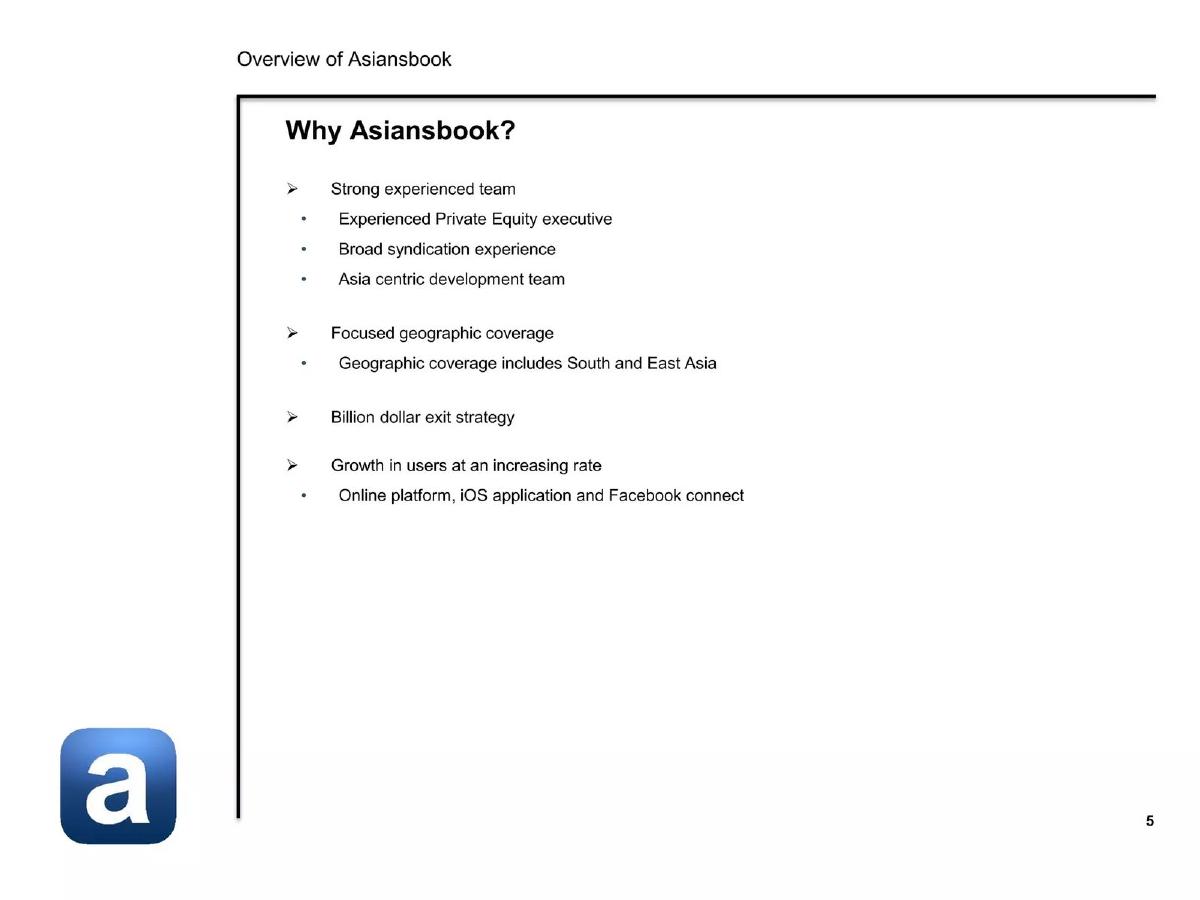
- The platform features an iOS application and utilizes Facebook Connect for user acquisition (Slide 5).
- The team is described as having 'broad syndication experience' and an 'Asia centric development team,' though individual names are not detailed (Slide 5).
- The investment rationale is built on the premise of 'exponential wealth increase' through an early-stage entry and a billion-dollar exit strategy (Slide 13).
Deck Overview
The Asiansbook pitch deck, dated February 21, 2015, is a 16-slide presentation designed to facilitate a private equity offering. The document is structured more like a formal private placement memorandum summary than a modern, design-heavy startup pitch. It focuses heavily on valuation mechanics and the macro-opportunity of the Asian social media market. The company, led by Managing Director Michael Herlache, attempts to bridge the gap between a small current user base and a high-ceiling exit potential.
Slide 1-3: Introduction and Formalities
The cover slide features a skyline image of a financial district, likely London or a similar global hub, rather than a specific Asian city. It introduces Michael Herlache as the Managing Director and displays a simple 'a' logo. Slide 1 is a standard 'General Information and Limitations' disclaimer, emphasizing that the presentation is for internal use and relies on unverified public sources. Slide 2 provides a Table of Contents covering the firm overview, valuation, private offering, rationale, and the purchase process.
Slide 4-6: The Asiansbook Overview
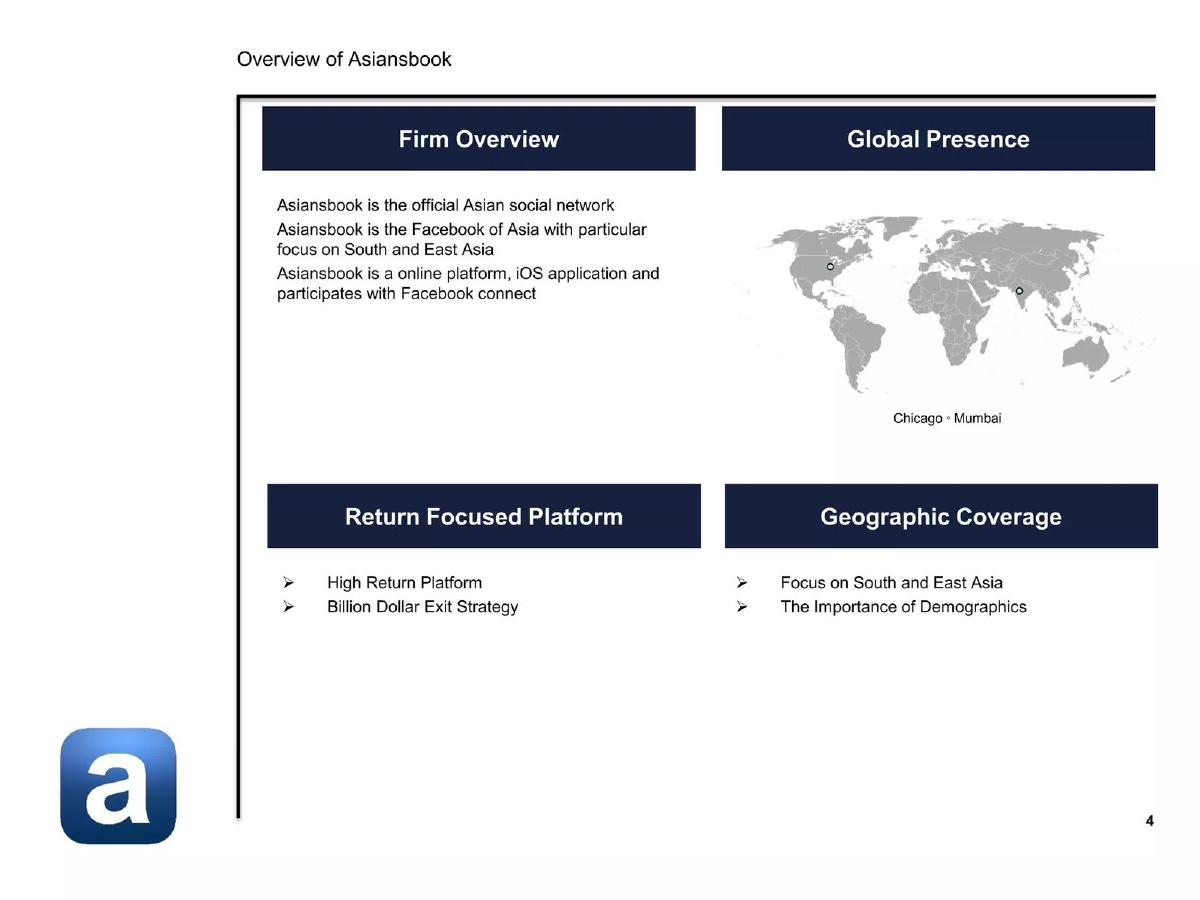
Slide 4 defines the company as the 'official Asian social network' with a focus on South and East Asia. It notes a global presence with dots on a map representing Chicago and Mumbai. The slide explicitly states the goal: a 'Billion Dollar Exit Strategy.' Slide 5, titled 'Why Asiansbook?', lists the core strengths: an experienced team with Private Equity and syndication backgrounds, a focused geographic coverage, and 'growth in users at an increasing rate.' It also mentions the technical stack, which includes an online platform, an iOS application, and the use of Facebook Connect for user onboarding. Slide 6 provides a screenshot of the platform's landing page, which features a background image of Mount Fuji and a standard login/sign-up interface similar to early 2010s social networks.
Slide 7-9: The Valuation Model
This section is the core of the deck's argument. Slide 8 introduces the concept of 'Valuing a Platform,' suggesting that the value is the sum of user valuation plus synergies. Slide 9 provides the specific math: Asiansbook claims 19,000 users. By assigning a 'Value Per User' of $20, they reach an 'Implied Valuation' of $380,000.00. However, the slide concludes that 'Comparable companies & comparable transactions valuations support a higher valuation in the range of $1 mm to $2 mm USD.' This jump from $380k to $2M is the primary leap of faith requested of the investor.
Slide 10-11: The Private Offering
Slide 10 serves as a section header for the offering. Slide 11 contains the specific 'Ask.' The company is targeting a $2 million valuation and intends to sell a 25-45% stake in the business. This implies the company was looking to raise between $500,000 and $900,000 in this specific round, though the total capital sought is not explicitly summed as a single 'Ask' figure.
Slide 12-13: Investment Rationale
Slide 13 outlines the 'Demand' side of the investment. It reiterates that user growth is increasing at an increasing rate. The primary hook for investors is the promise of 'multiple expansion' and 'exponential wealth increase' by getting in early. The 'Billion dollar exit strategy' is mentioned for the third time in the deck, serving as the ultimate justification for the $2 million entry price.
Slide 14-15: The Transaction Process
The deck concludes with the mechanics of the deal. Slide 15 states that Asiansbook runs a 'standard private share sale process' where shares are sold on a percentage basis. There are no details regarding the legal structure (e.g., convertible notes vs. priced equity), though the mention of a 'valuation' and 'share sale' suggests a priced round.
What Works in This Deck
Specific Valuation Math: Unlike many early-stage decks that pull a valuation out of thin air, Asiansbook shows their work on Slide 9. Even if the $20-per-user metric is debatable, providing a baseline calculation gives investors a starting point for negotiation. · Geographic Focus: By narrowing the scope to South and East Asia, the company avoids the trap of trying to be everything to everyone, identifying a specific demographic niche. · Technical Integration: Mentioning Facebook Connect (Slide 5) shows an understanding of reducing friction in user acquisition, a critical component for social networks in 2015.
What Is Missing from This Deck
Revenue Model: The deck is entirely silent on how the company intends to make money. There is no mention of advertising, subscriptions, or data monetization. · Detailed Team Bios: While Michael Herlache is named, the 'Asia centric development team' remains anonymous. In a social media startup, the technical pedigree of the founders is usually a primary selling point. · Competitive Landscape: The deck mentions being the 'Facebook of Asia' but does not address actual regional competitors like WeChat, Line, or KakaoTalk, which were already dominant in 2015. · Use of Proceeds: The deck asks for an investment at a $2M valuation but never explains what the money will be used for (e.g., marketing, hiring, server costs). · Unit Economics: Beyond the total user count, there is no data on Customer Acquisition Cost (CAC) or Lifetime Value (LTV), which are vital for evaluating a social platform's scalability.
Founder Takeaways
Be careful with 'Implied Valuations.' Asiansbook attempts to bridge a massive gap between their calculated value ($380k) and their target value ($2M). When doing this, you must provide a roadmap of how the investment capital will bridge that gap. Simply stating that 'comparables' support a higher price without listing those specific comparables is often insufficient for sophisticated investors.
Don't ignore the competition. In 2015, the Asian social media market was already highly competitive. Claiming to be the 'official' network for the region without acknowledging the existence of multi-billion dollar incumbents makes the pitch feel disconnected from market realities. Always include a competitive matrix that shows your unique angle.
Define the 'Ask' clearly. This deck specifies the valuation and the percentage of equity for sale, but it forces the investor to do the math to figure out the actual check size required. A clear 'We are raising $X for Y months of runway' is more effective than a percentage-based range.
Visual Proof of Growth: The deck claims growth is 'increasing at an increasing rate,' but it only provides a single data point (19,000 users). A growth curve or a month-over-month chart would have been much more persuasive than a bullet point.
Frequently asked questions
- What is the primary value proposition of Asiansbook?
- Asiansbook positions itself as a localized social media alternative tailored specifically for the South and East Asian demographics. By describing itself as the 'Facebook of Asia' on slide 4, the company aims to capture a regional market share that global platforms may not fully serve, leveraging an iOS app and Facebook integration to facilitate growth.
- How does the company justify its $2 million valuation?
- The company uses a two-step valuation approach. First, it calculates an 'implied valuation' of $380,000 by multiplying its 19,000 users by a $20 per-user value (Slide 9). It then argues that comparable company transactions in the social media sector support a premium valuation range between $1 million and $2 million.
- What are the specific terms of the investment being offered?
- According to slide 11, Asiansbook is conducting a private offering. They are targeting a $2 million valuation and are looking to sell between 25% and 45% of the company's total shares. Slide 15 notes that these shares are sold on a 'percentage basis' through a standard private sale process.
- Who is leading the company according to the deck?
- The cover slide identifies Michael Herlache as the Managing Director. Slide 5 further describes the leadership as a 'strong experienced team' featuring a Private Equity executive and a development team focused on Asia, though it does not provide specific names or career histories for the technical staff.
- What is the stated exit strategy for investors?
- The deck repeatedly mentions a 'Billion Dollar Exit Strategy' (Slides 4, 5, and 13). The rationale is that early investment allows for 'multiple expansion' as the user base grows at an increasing rate, eventually leading to a high-value acquisition or public offering typical of successful social networking platforms.