Arya’s 17-slide deck for their 2024 growth round is a masterclass in demonstrating rapid traction and market timing. By framing relationship wellness alongside established categories like sleep tracking and mental health, Arya justifies its $100B market claim. The company reports growing from $3M to $11M ARR within a single year, supported by a $18M non-dilutive financing facility from Bitkraft. The deck leans heavily on the 'why now' of AI, arguing that intimacy is the final frontier for LLMs due to the need for unique, long-term training data. With 80% of its members being millennial moms a…
Key takeaways
- Arya demonstrated significant scale, growing from $3M to $11M ARR in the 12 months prior to the deck (Slide 1).
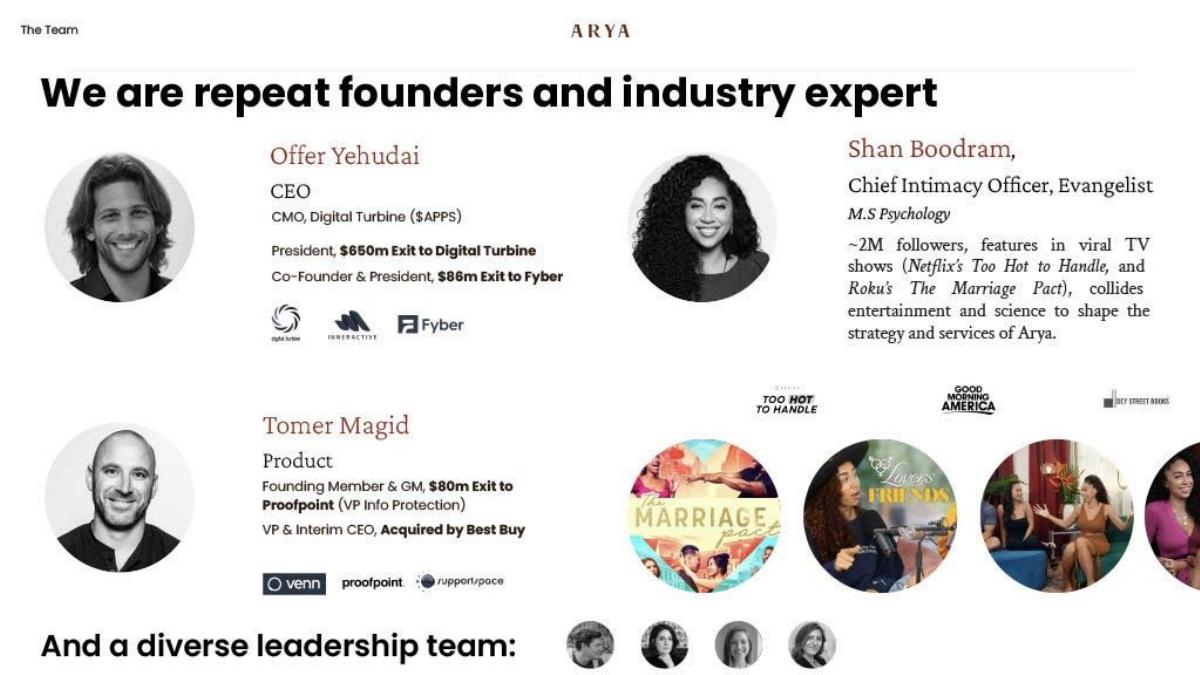
- The founders have a strong track record of exits, including a $650M exit to Digital Turbine and an $86M exit to Fyber (Slide 2).
- The company identifies a $100B market gap between online dating ($10.8B) and the divorce industry ($12.8B) (Slide 7).
- Arya claims a unique 'Data Moat' consisting of over 24 months of training data in the intimacy space (Slide 9).
- User engagement is high for a wellness app, with a reported 50% WAU/MAU ratio (Slide 11).
- The core demographic is highly specific, with 80% of members identified as millennial moms (Slide 11).
- The business model relies on a hybrid approach because users 'pushed back' on receiving intimacy advice solely from AI (Slide 15).
- The deck highlights a specific e-commerce pain point: users avoid buying intimacy products on shared family accounts like Amazon (Slide 16).
Executive Summary: The Relationship Economy
Arya’s pitch deck for their $21M growth round is a focused, data-driven narrative that attempts to legitimize 'relationship wellness' as a massive, untapped vertical. By anchoring the company’s growth—$3M to $11M ARR in 12 months—against the backdrop of the $100B 'Relationship Economy,' the founders make a case for a new category of consumer tech. The deck is notable for its honesty regarding product pivots, specifically the shift to a hybrid human-AI model after user pushback.
Slide 1: The Hook and Traction
The cover slide does not waste time. It defines Arya as 'The Couples Wellness Companion' and immediately presents two heavy-hitting metrics: $16M raised to date and a jump from $3M to $11M ARR in the last 12 months. This establishes the company as a high-growth entity before the problem is even fully articulated. The mention of the '$100B Relationship Economy' sets the scale for the opportunity.
Slide 2: The Pedigree
The team slide highlights significant exit experience. CEO Offer Yehudai is credited with a $650M exit to Digital Turbine, while other co-founders and executives are linked to exits of $86M (Fyber), $80M (Proofpoint), and leadership roles at Digital Turbine. This slide is designed to de-risk the investment by showing the leadership has successfully scaled and exited companies in the ad-tech and enterprise sectors.
Slides 3-5: The Cultural Context
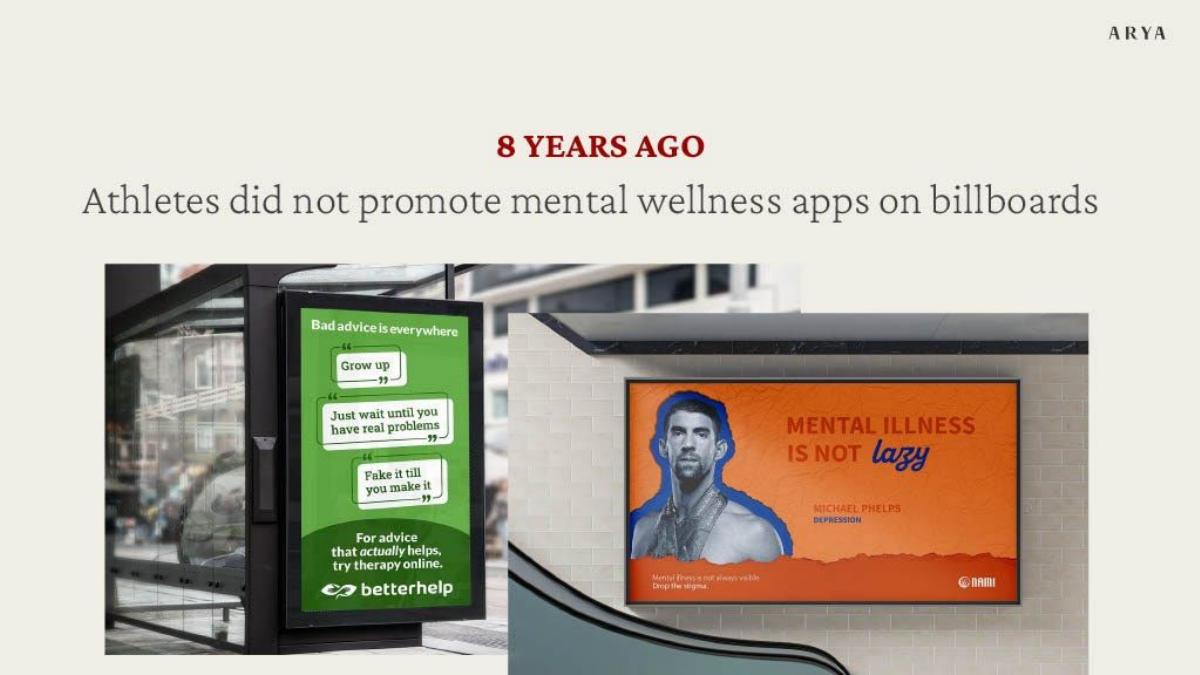
These slides use a 'Then vs. Now' framework to normalize Arya’s market. Slide 3 notes that 20 years ago, online dating was 'weird.' Slide 4 points to the recent normalization of mental health apps. Slide 5 highlights the rise of wearables like the Oura Ring for sleep tracking. The logical progression is that relationship coaching is the next logical step in the 'wellness' evolution.
Slide 6: The Problem Statement
Arya quantifies the 'struggle' with intimacy in America. It cites that 140M Americans struggle with connection, 40% of couples divorce, and 33% are in sexless relationships. By using these figures, Arya frames its product not as a luxury, but as a utility for a widespread social issue.
Slide 7: The $100B Gap
This is the 'Market' slide. It visualizes a gap between Online Dating ($10.8B) and the 'downstream' industries of Therapy ($21B) and Divorce ($12.8B). Arya positions itself in the middle—the 'Relationship Game'—suggesting that by helping couples before they reach the divorce stage, they can capture a massive share of spend currently lost to reactive services.
Slides 8-9: The Solution and Product
Slide 8 introduces the 'Couples' Companion' which combines AI Concierge, Guidance, and Commerce. Slide 9 explains the 'How It Works,' emphasizing that they are 'Not a Chatbot.' They highlight a 'Data Moat' of 24 months of training data, which they claim is the 'last place LLMs are going after' due to its private, intimate nature. The slide also mentions 'pros on staff' for quality control, indicating a human-in-the-loop AI model.
Slides 10-11: Market Reach and Demographics
Slide 10 sets a goal of reaching 500,000 couples and $200M in revenue, comparing relationship wellness to skincare and nutrition. Slide 11 is the 'Traction' slide, revealing that 80% of members are millennial moms. It lists impressive engagement metrics: 80% 6-month retention and 50% WAU/MAU (Weekly Active Users to Monthly Active Users), which is exceptionally high for a non-social media consumer app.
Slide 12: The Commerce Engine
This slide explains the monetization strategy beyond subscriptions. It argues that intimacy and sexuality are no longer taboo and that people trust AI for emotional support and purchases. It specifically mentions that Arya thrives where 'taboo' products are concerned, suggesting a high-margin e-commerce play.
Slides 13-16: Lessons Learned (The 'Surprise' Slides)
This section is unique. Instead of a standard 'Why We Win' list, Arya shares three things that surprised them. Slide 14: Users want a proactive concierge that talks to both partners. Slide 15: Users pushed back on pure AI advice, leading to a hybrid approach. Slide 16: Users won't buy intimacy products on shared Amazon accounts. These slides demonstrate product maturity and a deep understanding of their specific user base.
Slide 17: The Ask
The final slide details the $21M growth round. It notes 'Full participation of all existing VCs' (Ibex, Play Ventures, Patron) and mentions $18M in non-dilutive cohort financing from Bitkraft. The stated goal is to break even by year-end and 4x their ARR to 'tens of millions.'
What Works in This Deck
Traction Front-Loading: Putting the $3M to $11M ARR growth on Slide 1 immediately captures interest and justifies the 'Growth Round' label. · Demographic Specificity: Identifying 'millennial moms' as 80% of the user base gives investors a clear picture of the customer profile and the 'mental load' the product is solving. · The 'Surprise' Slides: Sharing failures or pivots (like the pushback on pure AI) builds credibility. It shows the founders are listening to data rather than just following AI hype. · Hybrid Revenue Model: Combining a high-retention service (coaching) with a high-margin commerce platform (intimacy products) creates a diversified and defensible business model.
What Is Missing
Unit Economics: While 'payback under 8 months' is mentioned, there is no detailed breakdown of Customer Acquisition Cost (CAC) or Lifetime Value (LTV). · Competitive Landscape: The deck mentions dating apps and therapy platforms but does not address direct competitors in the 'AI relationship coach' space, which has seen several new entrants recently. · Regulatory/Privacy Risks: Given the 'intimate' nature of the data being used to train their models, a slide addressing data privacy, encryption, and the risks of handling such sensitive information would have been appropriate for a growth round. · E-commerce Logistics: The deck highlights the commerce opportunity but doesn't explain if they are holding inventory, drop-shipping, or white-labeling products.
Founder Takeaways
Own the 'Why Now': Arya successfully argues that while dating and therapy are solved, the 'middle' of the relationship is a massive, underserved gap. Founders should look for similar 'gaps' between established bookend industries. · Use Non-Dilutive Capital as a Signal: Mentioning the $18M from Bitkraft shows that the company has access to capital that doesn't cost equity, which is a strong signal of business health and predictable cash flows. · Highlight Engagement Over Downloads: The 50% WAU/MAU stat is far more impressive to a growth investor than a total download count. It proves the product is 'sticky.' · Address the 'Taboo': If your product deals with sensitive subjects, lean into the privacy benefits. Arya’s point about the 'Amazon family account' is a relatable, practical reason why their platform is necessary.
Frequently asked questions
- What is Arya's primary revenue driver?
- While the deck mentions a jump to $11M ARR, it suggests a dual-revenue stream. Slide 8 and 12 highlight a 'Commerce' component, while Slide 11 mentions 'payback under 8 months,' implying a subscription or membership model. The deck explicitly states that e-commerce and AI are merging, with Arya thriving in the 'taboo' categories of intimacy and wellness products.
- How does Arya differentiate its AI from standard chatbots?
- According to Slide 9, Arya is 'Not a Chatbot.' The company uses a proactive concierge model that engages both partners simultaneously rather than just answering questions. They also employ 'pros on staff' for quality control and claim a data moat of 24 months of unique training data that general LLMs lack access to.
- Who is the target audience for Arya?
- Slide 11 provides a very specific demographic profile: 80% of Arya's members are millennial moms. The deck uses a map of the United States covered in pins to illustrate that this is a 'nation-wide need,' rather than a niche coastal trend.
- What are the key financial metrics mentioned in the deck?
- The deck reports $11M ARR (up from $3M in 12 months), 80% 6-month retention, and a 50% WAU/MAU engagement rate. It also notes that the company has raised $16M to date prior to this $21M growth round and has secured $18M in non-dilutive financing.
- What did the founders learn during the early stages of the business?
- Slides 13 through 16 detail 'surprising' lessons: users want proactive concierges rather than reactive assistants, they distrust pure AI for intimacy advice (requiring a hybrid human-AI model), and they value the privacy of Arya's platform for purchases they wouldn't make on a shared Amazon account.