The Ascend pitch deck is a textbook example of a 'team-first' narrative for a complex technical product. Published in 2021 but referencing data from 2015, the deck addresses the acute shortage of big data skills by proposing a platform that automates the 'how' of data engineering, allowing users to focus on the 'what.' The leadership team, featuring former executives from Ooyala, Google, and Twitter, provides the necessary credibility to sell into the Fortune 2000. While the deck is light on specific unit economics and a formal financial ask, it excels at defining a clear 'bet' on the future…
Key takeaways
- The leadership slide (Slide 2) establishes massive credibility, noting CEO Sean Knapp orchestrated a $410M acquisition by Telstra.
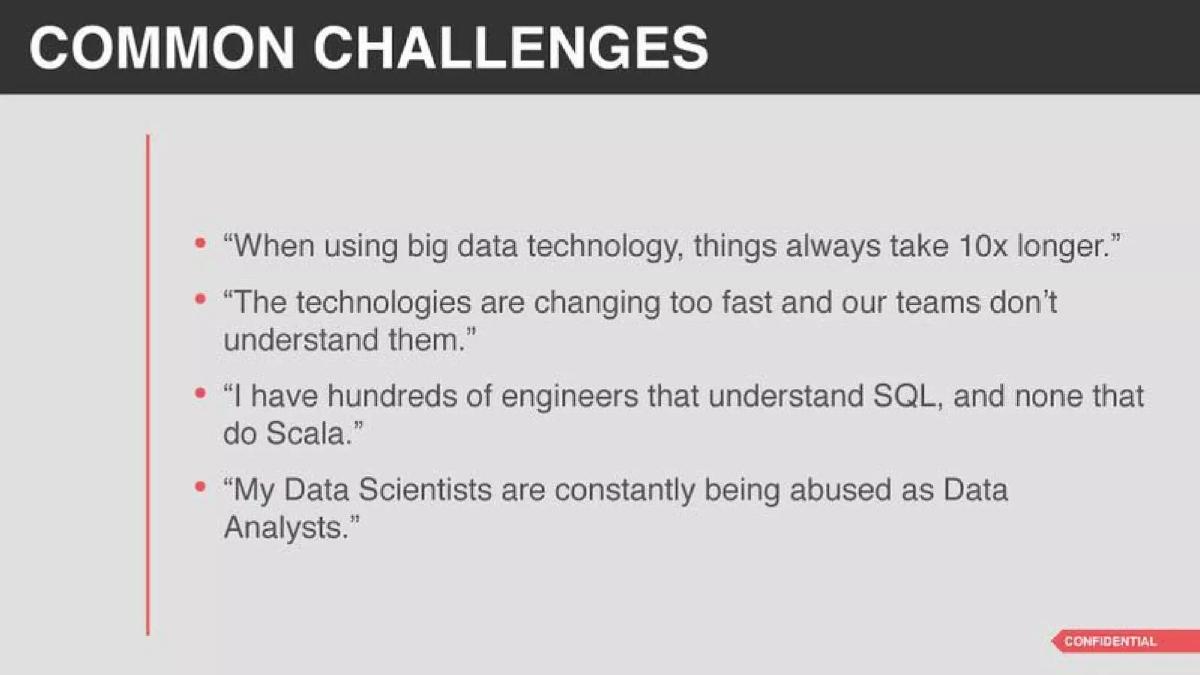
- Ascend identifies a specific market pain point: the shortage of Scala experts versus the abundance of SQL-capable engineers (Slide 5).
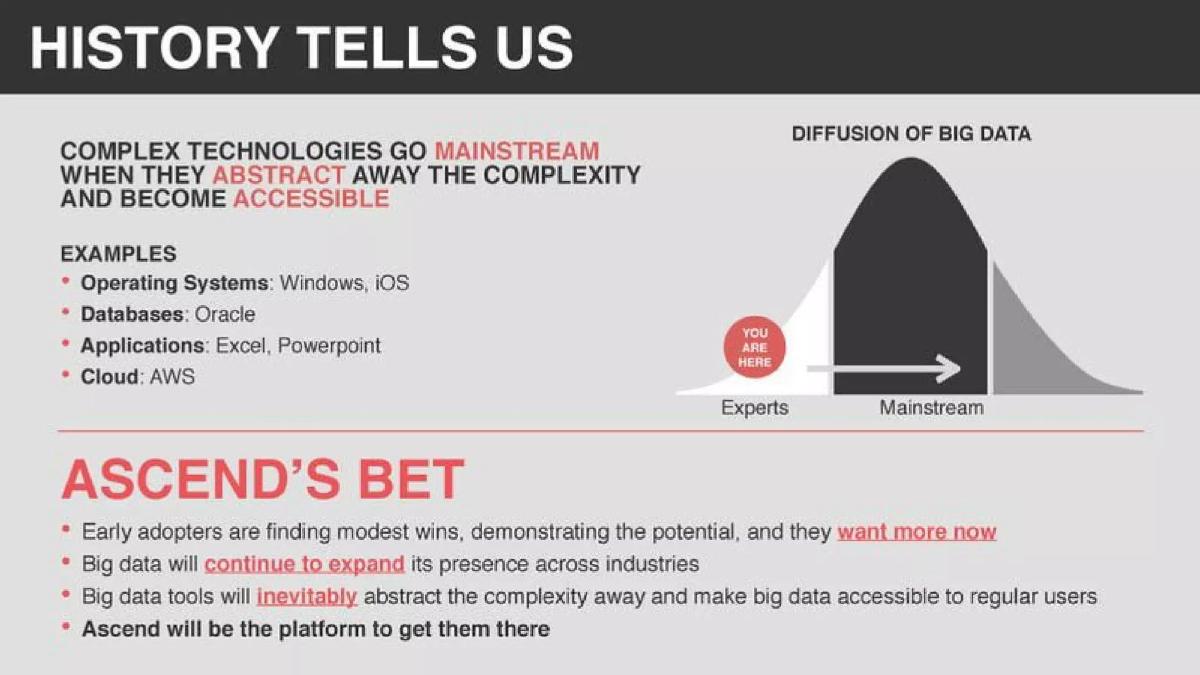
- The deck uses a diffusion of innovation curve to argue that big data is currently stuck in the 'expert' phase and needs abstraction to go mainstream (Slide 6).
- Target customers are clearly defined as Fortune 2000 companies in cloud-friendly industries like Media, Retail, and Finance (Slide 7).
- The product value proposition is framed as a checklist where Ascend handles 11 out of 12 technical tasks, leaving only 'Business Logic' to the user (Slide 8).
- Technical differentiation is based on a 'Declarative Data Graph' that translates business logic into underlying tasks automatically (Slide 9).
- The deck claims the platform can reduce project times by up to 90% (Slide 10).
- The landscape slide (Slide 11) avoids a standard 'X/Y' axis in favor of a partner-centric view, identifying Amazon, Microsoft, and Google as both partners and potential risks.
Slide-by-Slide Analysis
Slide 1: Title Slide
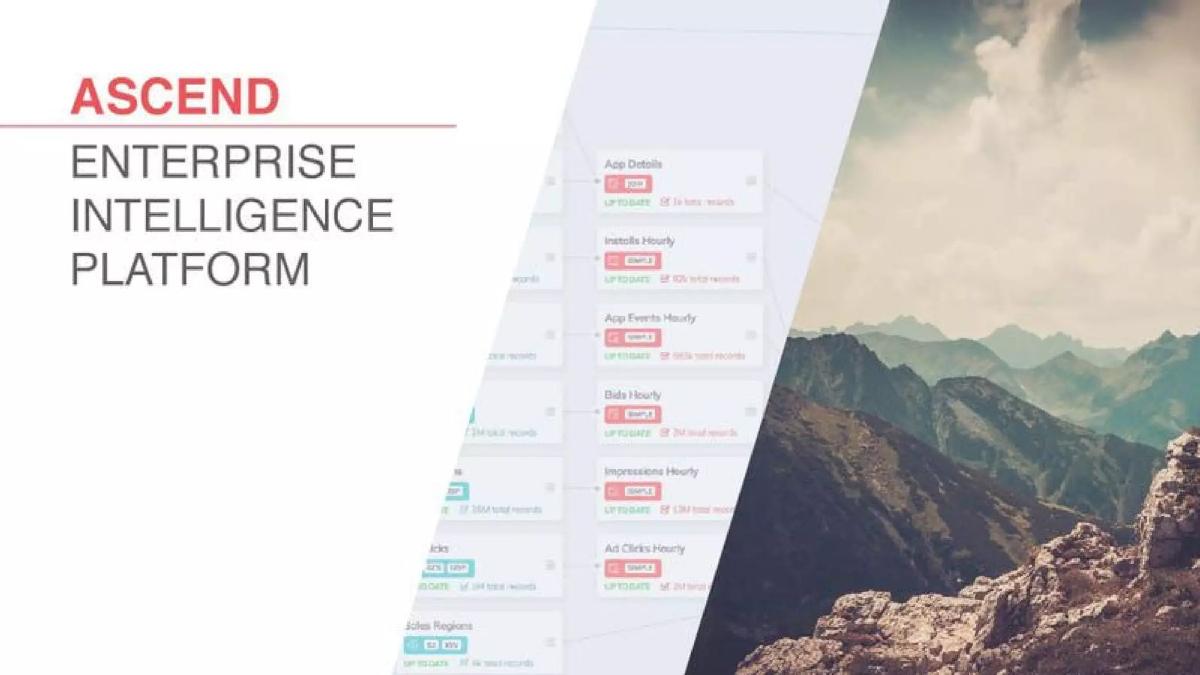
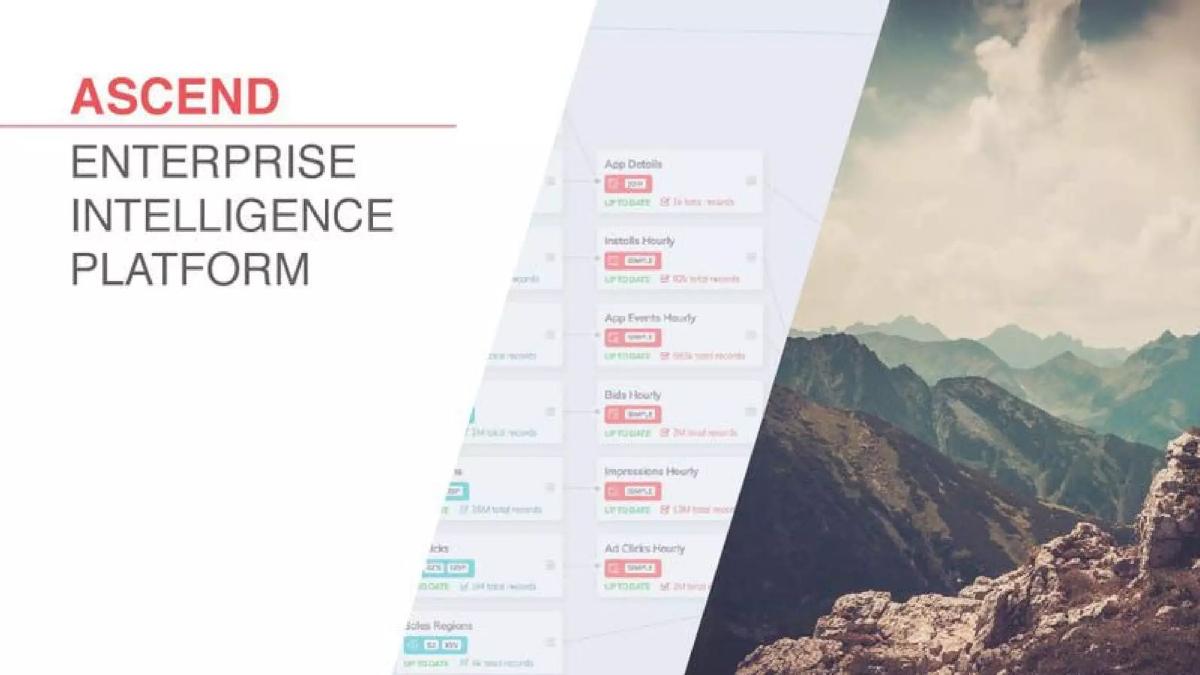
The deck opens with a clean, minimalist title slide. It identifies Ascend as an 'Enterprise Intelligence Platform.' The background image of a mountain range reinforces the brand name, while a faint overlay of a data flow diagram hints at the technical nature of the product. This slide establishes a professional, enterprise-grade tone immediately.
Slide 2: Leadership
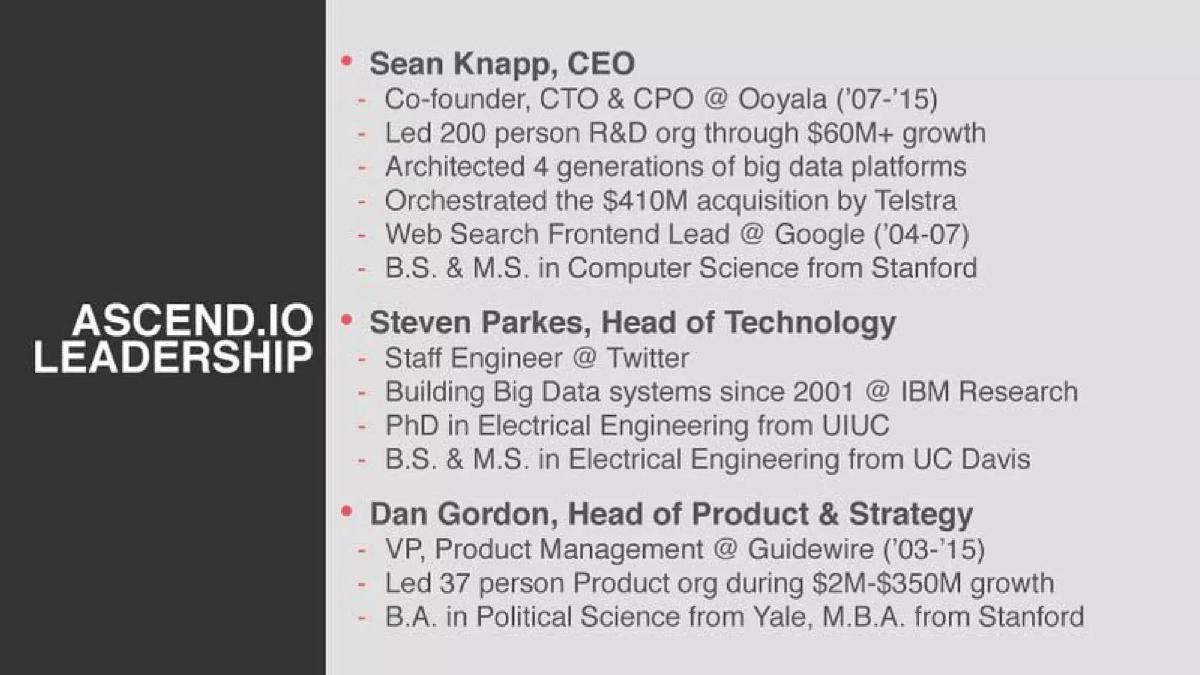
This is arguably the strongest slide in the deck. It lists three key executives with deep pedigree. Sean Knapp (CEO) is noted as a co-founder and CTO of Ooyala, where he led a 200-person R&D team and orchestrated a $410M acquisition . Steven Parkes (Head of Technology) brings experience from Twitter and IBM Research, holding a PhD from UIUC. Dan Gordon (Head of Product & Strategy) is credited with leading a product org through $2M to $350M growth at Guidewire. For a technical startup, this level of 'been-there-done-that' experience significantly lowers the perceived execution risk for investors.
Slide 3: The Big Data Opportunity
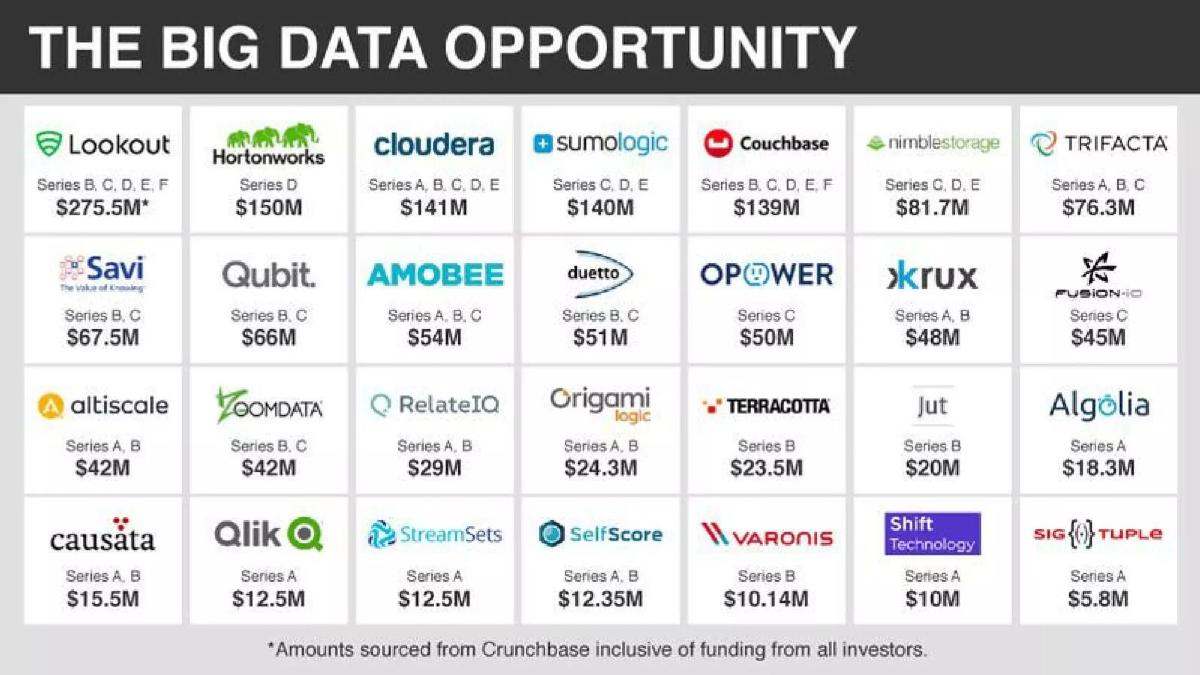
Instead of a standard TAM/SAM/SOM slide, Ascend presents a grid of 28 companies in the big data space, along with their funding rounds and amounts sourced from Crunchbase. Figures range from $5.8M (SigTuple) to $275.5M (Lookout) . This slide serves to validate the sector's appetite for capital and the scale of the 'opportunity,' suggesting that big data is a high-value, well-funded category where Ascend belongs.
Slide 4: Market Context
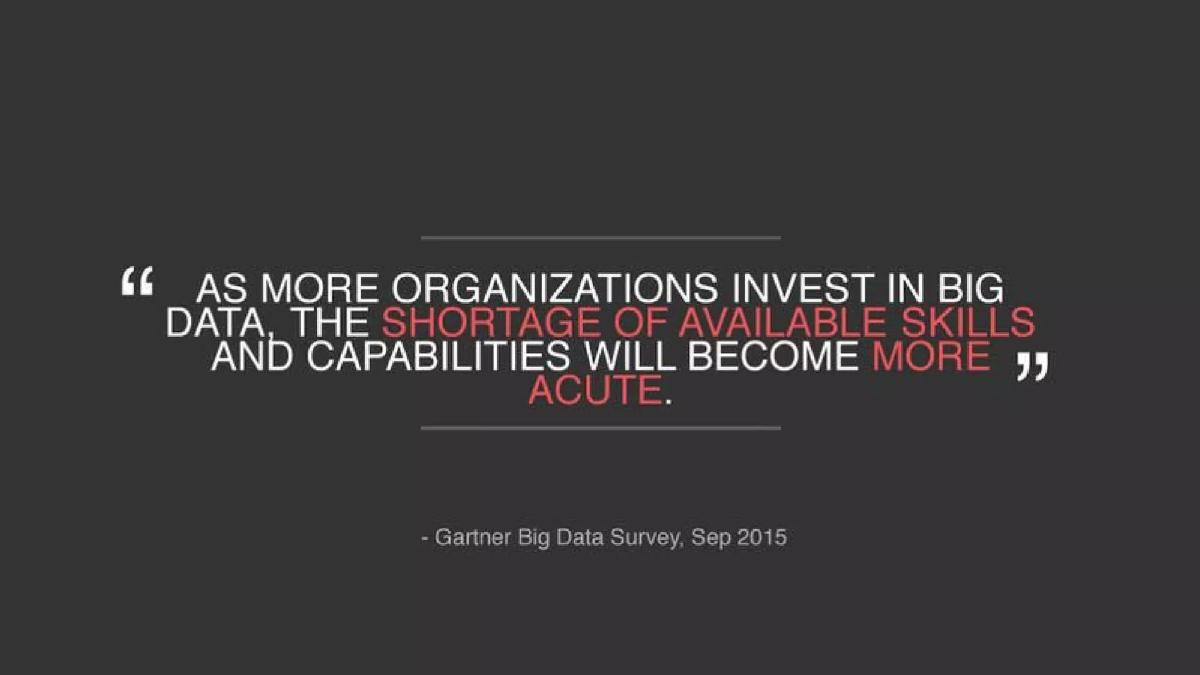
A quote from a September 2015 Gartner Big Data Survey highlights that the 'shortage of available skills and capabilities will become more acute.' This sets the stage for the 'Problem' by identifying a macro trend: the demand for big data exceeds the supply of people who know how to manage it.
Slide 5: Common Challenges
This slide humanizes the problem through four quotes representing customer pain points. The most poignant is: 'I have hundreds of engineers that understand SQL, and none that do Scala.' This identifies the specific technical barrier Ascend intends to break. Other quotes mention projects taking 10x longer and data scientists being 'abused' as data analysts, further defining the inefficiency in current workflows.
Slide 6: History Tells Us
Ascend uses a 'Diffusion of Big Data' curve to explain their market timing. They argue that complex technologies (like OS, Databases, and Cloud) only go mainstream when they 'abstract away the complexity.' The slide places the current market in the 'Experts' phase and positions Ascend as the platform to move it into the 'Mainstream.' This is a classic 'Why Now' argument based on technological evolution.
Slide 7: Ascend Targets
This slide provides a granular breakdown of the Go-To-Market strategy. It targets Fortune 2000 companies in sectors like Media and Finance. It distinguishes between the Buyer (CIO/CTO) and the User (Data Analysts/SQL developers). By identifying that coding is 'optional' for the user, they reinforce the abstraction theme introduced earlier.
Slide 8: The Ascend Platform
This slide uses a checklist to show the division of labor. Out of 12 tasks—ranging from 'Integrate data sources' to 'Error Recovery'—the customer is only responsible for one: Business Logic . Ascend claims to handle the other 11. A screenshot of the UI shows a node-based pipeline, visually demonstrating how the 'automation' looks in practice.
Slide 9: How Ascend Works
This slide explains the technical architecture. It moves from a Data Modeling Interface (the 'Declarative Data Graph') to an Automation Engine , then to Distributed Workers , and finally to Processing Infrastructure . It emphasizes that existing infrastructure (represented by the Hadoop elephant) continues to do the heavy lifting, while Ascend acts as the brain.
Slide 10: Competitive Advantages
The advantages are split into Business and Technical categories. On the business side, the headline claim is a reduction in project times by up to 90% . Technically, the deck highlights the 'design once, run forever' philosophy and the unique combination of 'mutable, persistent, and declarative' data handling.
Slide 11: Landscape
Rather than a competition grid, this slide offers an 'Ascend Viewpoint' on different categories. It positions BI tools (Tableau) as downstream partners and Open Source ecosystems (Databricks) as technologies they rely on. It acknowledges the 'risk of expanding product offerings' from cloud giants like Amazon and Google, which shows a level of intellectual honesty often missing in pitch decks.
Slide 12: Closing Slide
The deck ends with a punchy tagline: 'Big Data is such a cluster. See life from the top of the stack.' It includes the company website (Ascend.io) but lacks a specific call to action or contact information for the founders.
What Works
Team Pedigree: The leadership slide is world-class. Having founders who have already built, scaled, and exited large technical organizations is a massive advantage. · Clear Problem Definition: The 'SQL vs. Scala' argument (Slide 5) is a very concrete way to explain a complex technical gap to a non-technical investor. · Strategic Positioning: By positioning themselves as an 'abstraction layer' rather than a replacement for existing tools, they lower the barrier to enterprise adoption. · Visual Evidence: The inclusion of actual platform screenshots (Slides 8 and 9) helps ground the high-level vision in a tangible product.
What is Missing
The Ask: There is no mention of how much money the company is raising or what the terms are. · Traction Metrics: The deck is entirely vision-based. There are no mentions of current revenue, number of pilots, or specific customer logos (other than the Ooyala demo in the screenshot). · Financial Projections: There is no forward-looking data on how the company plans to scale its own business model. · Roadmap: While the 'Why Now' is clear, the 'What's Next' is not. There is no timeline for product development or market expansion.
Founder Takeaways
Lead with your strengths: If you have a team that has exited for hundreds of millions, that should be your second slide, not your last. · Use 'The Bet': Ascend's 'History Tells Us' slide (Slide 6) is a great way to frame a startup's existence as an inevitability of market evolution. · Define the User vs. the Buyer: Especially in Enterprise SaaS, showing you understand that the person writing the check is different from the person using the tool is crucial. · Be honest about the giants: Acknowledging that Amazon or Google could compete with you (Slide 11) builds more trust than claiming you have no competition.
Frequently asked questions
- What is the primary problem Ascend is trying to solve?
- Ascend targets the 'acute' shortage of big data skills. As cited on Slide 5, many organizations have hundreds of engineers who understand SQL but none who understand Scala. The platform aims to abstract the complexity of big data technology, which currently makes projects take '10x longer' than they should, allowing non-experts to build complex data pipelines.
- How does Ascend differentiate itself from competitors like Databricks or Cloudera?
- According to Slide 11, Ascend views the open-source big data ecosystem (Cloudera, Databricks) as technologies they rely on rather than direct competitors. Ascend positions itself as the automation layer above these systems. Unlike orchestration tools that are 'Imperative' (focusing on how to do a task), Ascend is 'Declarative' (focusing on what the outcome should be).
- Who is the ideal customer for Ascend based on the deck?
- Slide 7 specifies the target as Fortune 2000 companies that are 'cloud friendly' and have existing investments in data. Specific industries mentioned include Media, Consumer, Retail, Finance, and IoT. The buyer is typically a CIO, CTO, or Head of Line of Business, while the users are data analysts or developers with SQL skills but limited big data expertise.
- What are the key technical advantages claimed by the platform?
- Slide 10 highlights a combination of 'mutable, persistent, and declarative' features. Technically, it uses a 'Declarative Data Graph' to monitor changes in data and automatically translate business logic into tasks. This allows for 'design once, run forever' operations that are non-disruptive to existing big data systems.
- What critical fundraising information is missing from this deck?
- The deck lacks a 'The Ask' slide, meaning there is no mention of how much capital is being raised or the valuation. It also omits a roadmap, financial projections, and current traction metrics (such as ARR or specific customer names), focusing instead on the vision, team, and market opportunity.