AssistMe presents a B2B sales automation tool designed to offload administrative tasks like customer research and meeting follow-ups. The deck relies heavily on a persona-driven narrative ('Jenny') and third-party data from the Corporate Executive Board to establish that sales reps spend only 29% of their time actually selling. While the deck excels at quantifying the theoretical ROI—claiming a potential €48,000 increase in annual sales per rep—it suffers from significant gaps in execution detail. The Go-To-Market slide uses placeholders ('XXX') for key metrics and target contacts, suggesting…
Key takeaways
- The deck utilizes a 2011 Corporate Executive Board study to claim that B2B sales reps spend only 29% of their time on sales activities (Slide 3).
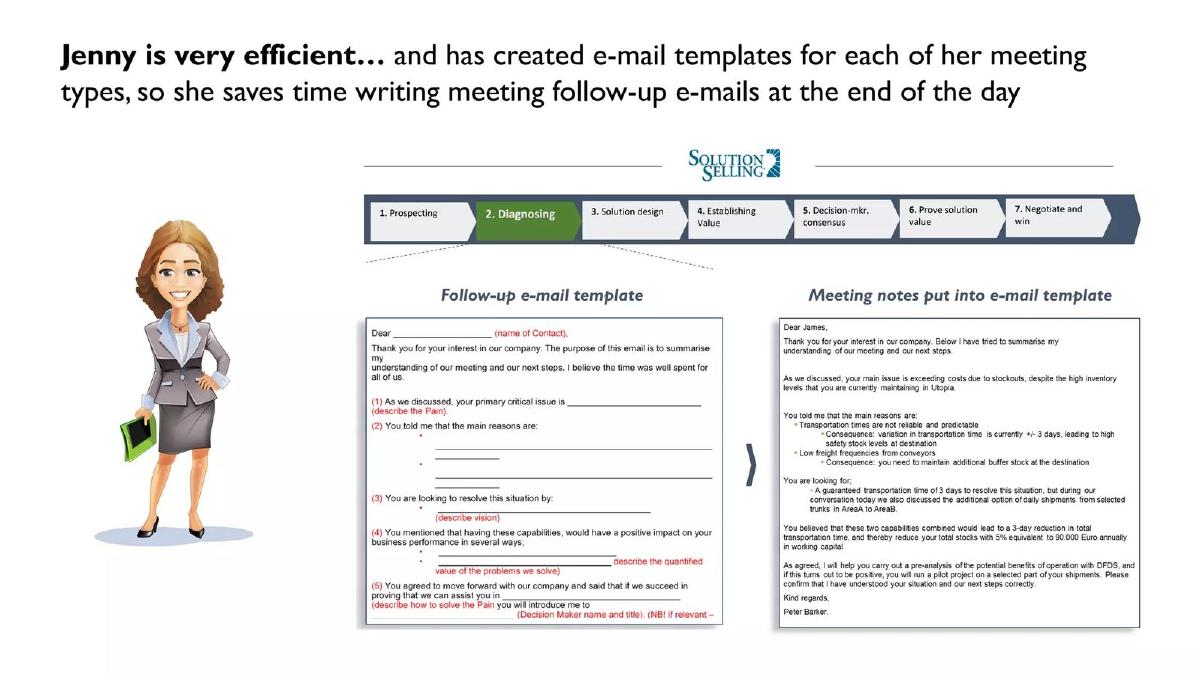
- AssistMe targets three specific administrative pillars: Customer Research, Meeting Agenda drafting, and Meeting Follow-up emails (Slide 4).
- The value proposition is built on a 10% time-saving assumption, which equates to 4 hours out of a 40-hour work week (Slide 5).
- Financial modeling assumes a €60,000 average annual salary for a B2B rep and a required 8x revenue multiplier for value creation (Slide 5).
- The product positions itself between fully automated solutions and manual virtual assistants in India or the Philippines (Slide 6).
- The Go-To-Market strategy is highly localized to the logistics industry, specifically targeting Rhenus Logistics, DB Schenker, and Arvato (Slide 8).
- The deck contains multiple placeholder values, such as '+XXX Sales Representatives,' indicating a lack of finalized data at the time of publication (Slide 8).
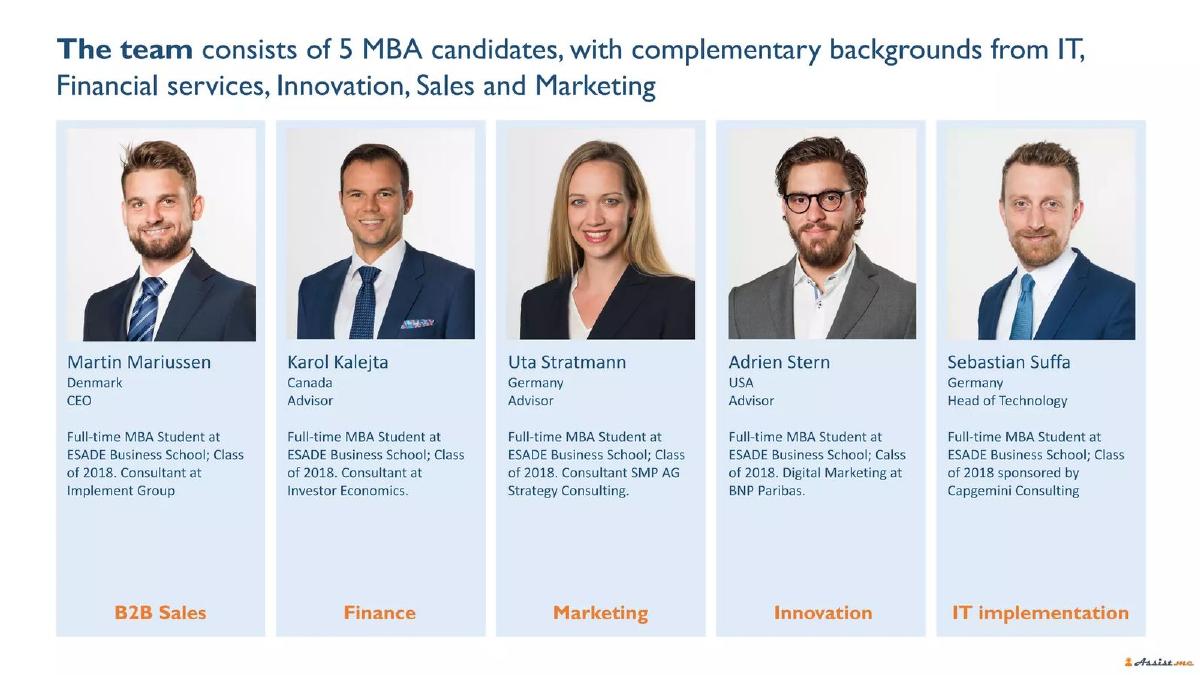
- There is no information regarding the founding team, technical architecture, or current funding status in the provided slides.
The Persona-Led Pitch: Analyzing the AssistMe Deck
The AssistMe pitch deck is a classic example of a problem-first narrative. It spends a significant portion of its real estate establishing a relatable 'pain point' before introducing the solution. While this is a standard storytelling technique in fundraising, the effectiveness of this specific deck is hampered by a lack of concrete data and the heavy use of placeholders. Below is a slide-by-slide breakdown of the 10 provided slides.
Slide 1: Title Slide
The deck opens with a minimalist title slide featuring the AssistMe logo—a stylized orange icon of a person wearing a headset—and the tagline "B2B Sales Assistance." The branding is simple, using a high-contrast orange and dark grey color palette. There is no mention of the company's stage, year, or location on this slide.
Slide 2: The Persona (Jenny)
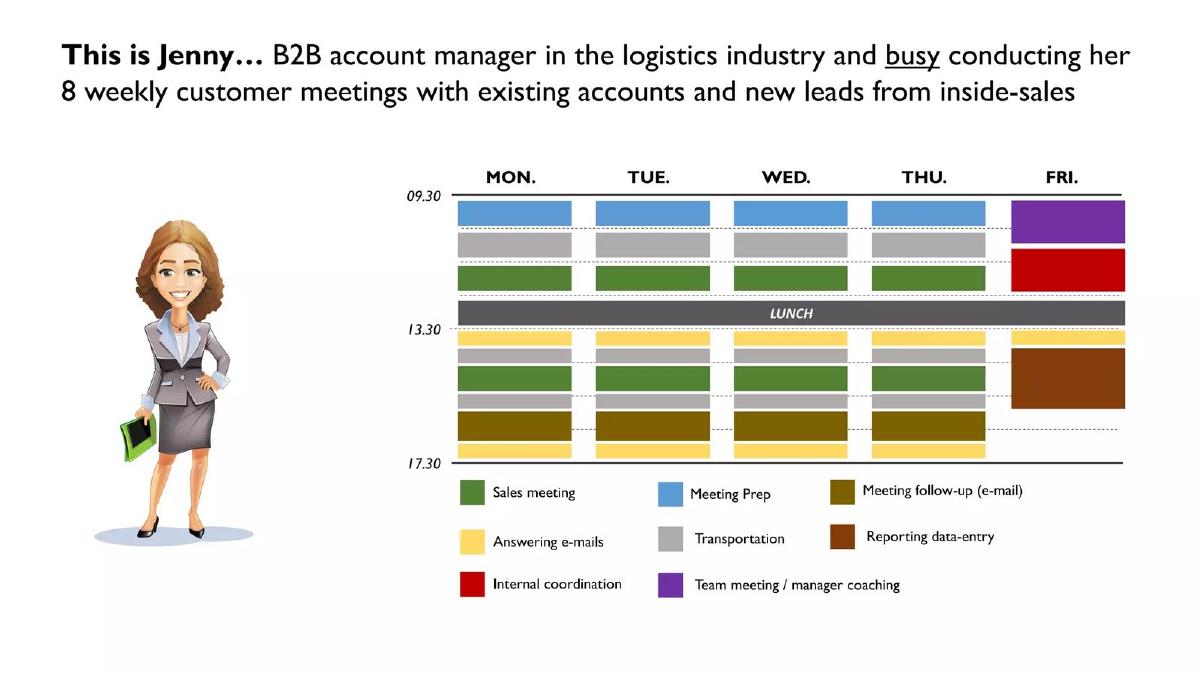
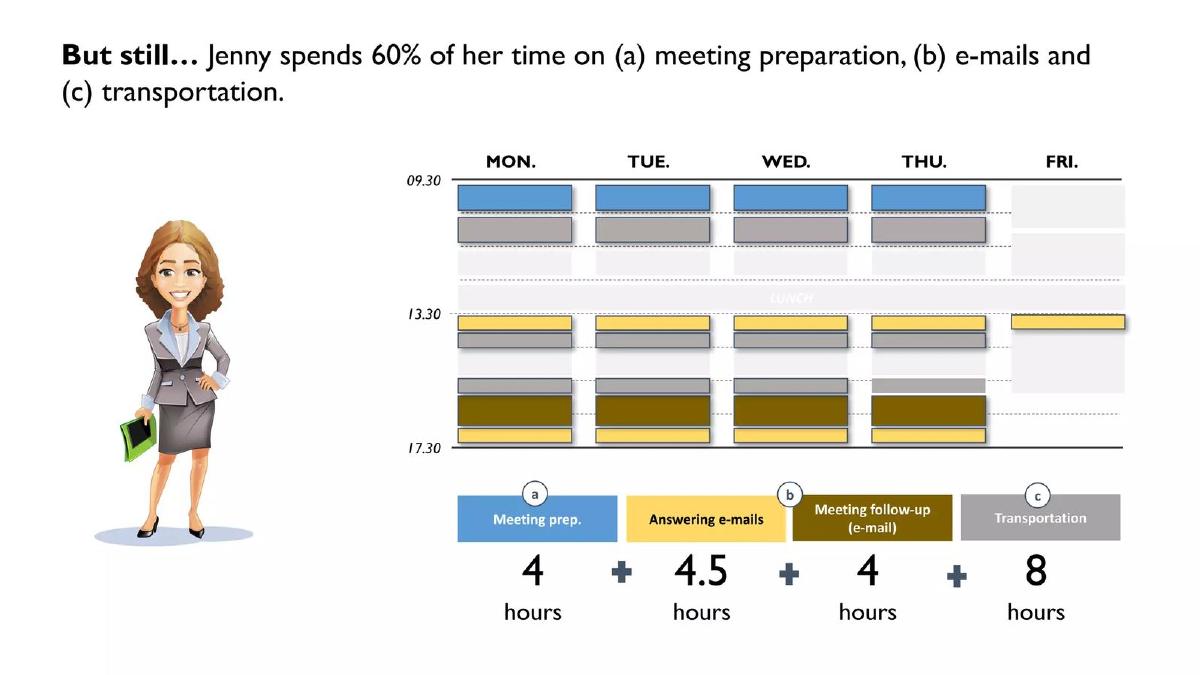
Slide 2 introduces "Jenny," a B2B account manager in the logistics industry. The slide uses a cartoon avatar and a color-coded weekly calendar to visualize her schedule. It notes she is "busy conducting her 8 weekly customer meetings." The calendar shows that her time is fragmented across "Meeting Prep," "Transportation," "Answering e-mails," and "Reporting data-entry." This slide serves to humanize the data that follows, grounding the problem in a specific day-to-day reality for a sales professional.
Slide 3: The Macro Problem
This slide transitions from the individual (Jenny) to the industry at large. It cites a 2011 time study by the Corporate Executive Board, stating that the average B2B sales rep spends only 29% of their time on sales activities with the customer. The remaining time is split between Pre-sales (27%), Post-sales (29%), and Admin/Non-sales (15%). It includes a quote from sales consultant Alice Heiman: "I'd like 60%+ of each day to be directly related to moving a sale forward." This slide is effective at establishing a large, quantifiable gap in productivity, though the use of a study from 2011 may be viewed as dated by modern investors.
Slide 4: The Solution Pillars
Slide 4 introduces the specific ways AssistMe intends to help. It identifies three core features: Customer Research (sending short reports on potential customers within hours), Meeting Agenda (drafting agendas for the rep to approve), and Meeting Follow-up (drafting follow-up emails based on rep input). The right side of the slide lists intended outcomes, including "Increased Sales Effectiveness" and "Reduced 'Time-to-Performance' for new sales reps." Notably, there are no screenshots of the product; the solution is described purely in conceptual terms.
Slide 5: The Value Proposition (ROI)
This is the most data-dense slide in the deck. It attempts to quantify the value of the "Meeting Follow-up" feature alone. Based on "Conservative Assumptions," it claims a 10% time saving (4 hours out of a 40-hour week). It calculates an Annual cost saving/rep of €6,000 and a theoretical Annual lost sales/rep of €48,000 . The math assumes a €60,000 annual salary and an 8x revenue multiplier. While the logic is sound, these figures are entirely theoretical and not based on actual results from a pilot program.
Slide 6: Competitive Positioning
Slide 6 uses a "Sales Automation Market 2.0" map to show where AssistMe fits. It places the company in the "Presentation" and "Live Chat" categories of a larger ecosystem. A quadrant on the right compares AssistMe to hiring virtual assistants in India or the Philippines. AssistMe claims to be different because it "automatically suggests follow-up e-mail" rather than requiring a manual task-handover to a human assistant. This slide attempts to show that AssistMe is a technology-first solution rather than a service-based one.
Slide 7: Go To Market (Transition)
This is a simple divider slide with the text "GO TO MARKET." It signals a shift from the product's value to the company's execution strategy.
Slide 8: Launch Strategy
Slide 8 details "Step 2: Launching Direct Sales." The goal is to establish a presence in the logistics industry by acquiring "3 Industry Challengers." The slide lists three specific companies: Rhenus Logistics , DB Schenker , and Arvato Bertelsmann . However, the slide is unfinished; it uses "XXX" as placeholders for the names of Sales Directors and the total number of sales representatives. This suggests the deck was either a template or was published before the founders had finalized their outreach list.
Slide 9 & 10: Section Dividers
The final two slides provided are simple dividers for "FINANCIALS" and "PRODUCT DEVELOPMENT." No actual data, charts, or roadmaps are included for these sections in the provided images. This is a significant omission, as these sections usually contain the most critical information for a due diligence process.
What Works in This Deck
The primary strength of the AssistMe deck is its logical flow . It follows a classic narrative arc: identify a specific person (Jenny), prove that her problem is widespread (the 29% stat), offer a specific solution (the three pillars), and calculate the financial impact (the €48,000 ROI). By focusing on the logistics industry, the founders also demonstrate a commitment to a "beachhead" market strategy, which is often more appealing to investors than a generic "we help everyone" approach.
The ROI calculation on Slide 5 is particularly well-structured. Even if an investor disagrees with the 8x multiplier, the deck provides the underlying assumptions (salary, hours worked, etc.), allowing the investor to run their own math. This transparency in logic is a hallmark of a professional pitch.
What is Missing
The omissions in this deck are substantial. First and foremost, there is no Team slide . In early-stage startup investing, the team is often more important than the idea. Without knowing who is building the AI, an investor cannot assess the technical feasibility of the product. Second, there is a total lack of product evidence . There are no mockups, no dashboard views, and no explanation of the underlying AI technology. This makes the product feel like "vaporware."
Furthermore, the placeholder data on Slide 8 is a major red flag. Presenting a deck with "XXX" instead of names or numbers suggests a lack of preparation. Finally, the deck lacks any traction or validation . There are no mentions of beta testers, waitlists, or even informal feedback from the logistics companies they are targeting. The entire pitch is built on the assumption that if they build it, the value will be realized, without providing proof that anyone wants to buy it.
Founder Takeaways
Founders should look to the AssistMe deck as a template for quantifying a value proposition . The way they break down a rep's time into euros is a great way to make an abstract benefit (saving time) feel concrete and urgent. However, founders must avoid the mistake of using placeholders in a final version of a deck. If you don't have the data yet, it is better to omit the slide or use ranges rather than "XXX."
Additionally, if you are pitching an AI-driven solution, you must show the product. In a market crowded with "AI wrappers," showing a unique UI or a specific workflow is essential to prove that you have built something more than just a prompt for a large language model. Always include a team slide that highlights why you are uniquely qualified to solve this specific problem in this specific industry.
Frequently asked questions
- What is the core problem AssistMe is solving?
- AssistMe addresses the 'administrative bloat' in B2B sales. Citing a 2011 study, the deck argues that reps spend 71% of their time on non-selling activities like prep, transportation, and data entry. By automating research and follow-ups, they aim to reclaim 10% of a rep's time, theoretically allowing for more customer-facing interactions and higher revenue generation.
- How does AssistMe calculate its ROI for customers?
- The ROI is calculated using a 'lost revenue' perspective. It assumes a rep earning €60,000 must generate 8x their salary (€480,000) to be profitable. If the tool saves 10% of their time, the deck claims this translates to a €6,000 cost saving or a theoretical €48,000 increase in sales capacity per year, per representative.
- What is the specific target market for the launch?
- The deck outlines a very narrow Go-To-Market strategy focused on the logistics industry. Slide 8 identifies three 'Industry Challengers' as primary targets: Rhenus Logistics, DB Schenker, and Arvato Bertelsmann. The strategy relies on leveraging existing LinkedIn connections to reach Sales Directors at these specific firms.
- What are the biggest omissions in the AssistMe deck?
- The deck is missing several critical components: a Team slide (essential for AI/SaaS), a Product slide (no screenshots or UI), and a Traction slide (no current users or revenue). Additionally, the Go-To-Market and Financial sections are largely placeholders, leaving the actual scale and cost of the business unknown to the reader.
- How does AssistMe differentiate itself from other sales tools?
- Slide 6 uses a quadrant map to position AssistMe. It claims to require a lower 'degree of sales rep input' than manual virtual assistants (like those in India or the Philippines) while offering a higher 'degree of automation' than traditional CRM or lead gen tools. It specifically focuses on the 'in-between' tasks of suggesting and finalizing follow-up emails.