Athennian raised $5.5M in 2021 using a remarkably concise 6-slide deck. The presentation avoids the typical fluff of long-winded problem statements, instead opting for a direct 'Old Way vs. New Way' comparison. The core of their argument rests on a timeline slide that highlights how legacy competitors were founded in the 1980s and 1990s, positioning Athennian as the only modern alternative. While the deck is light on team and specific financial figures (which are redacted in this version), it excels at defining a clear, multi-billion dollar TAM and demonstrating a sharp uptick in 'Active Enti…
Key takeaways
- The deck uses a 6-slide structure to focus exclusively on market gap, product solution, and growth trajectory.
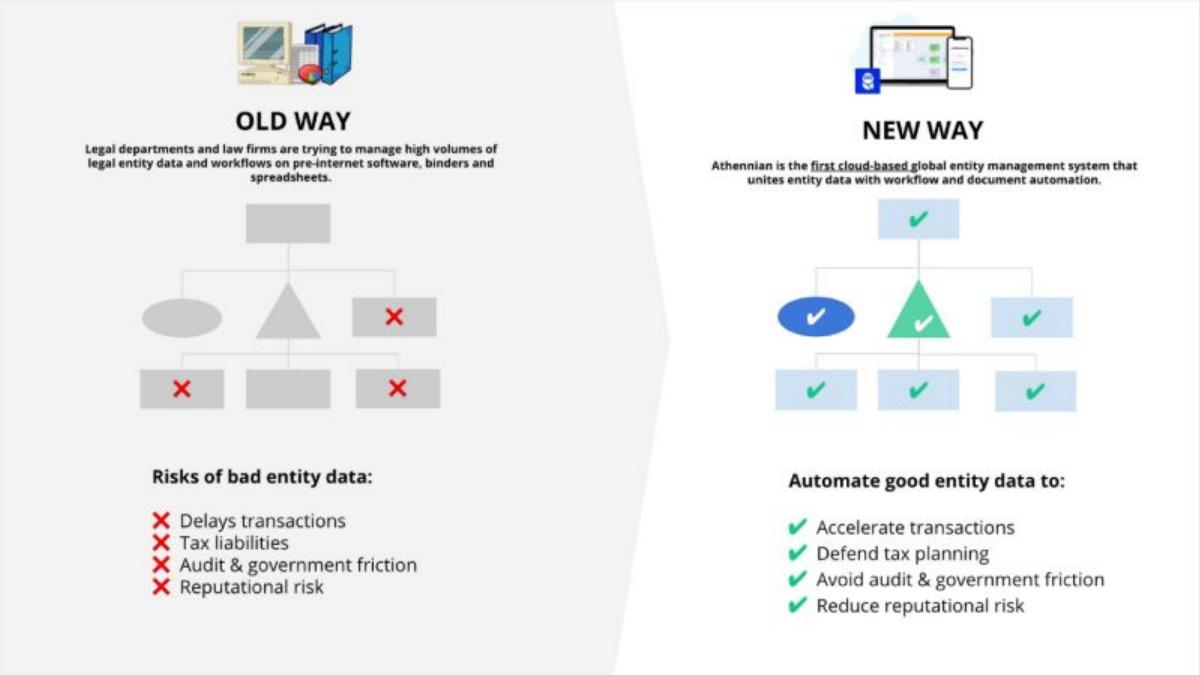
- Slide 2 employs a 'Old Way vs. New Way' visual to contrast manual, high-risk processes with automated, cloud-based workflows.
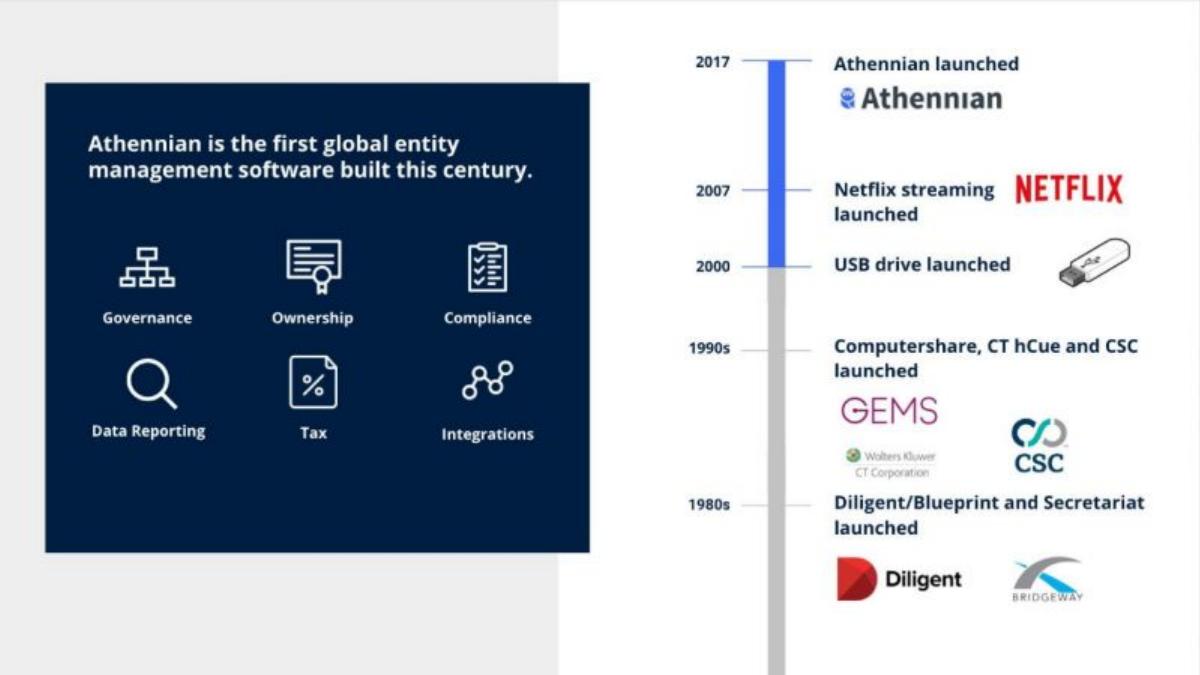
- Slide 3 features a powerful timeline showing that major competitors like Diligent and GEMS were launched in the 1980s and 1990s, whereas Athennian launched in 2017.
- The company claims to be the 'first global entity management software built this century' on Slide 3.
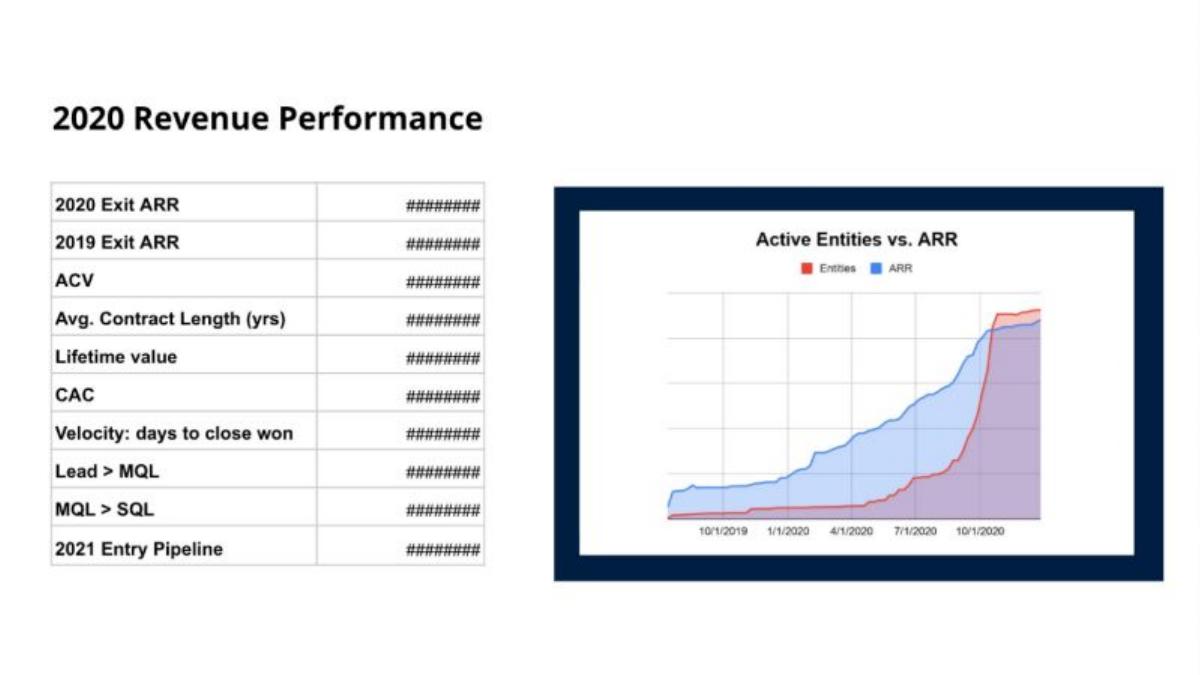
- Revenue performance metrics on Slide 4 are redacted with placeholders (#######), but the accompanying chart shows a significant surge in 'Active Entities' starting in Q3 2020.
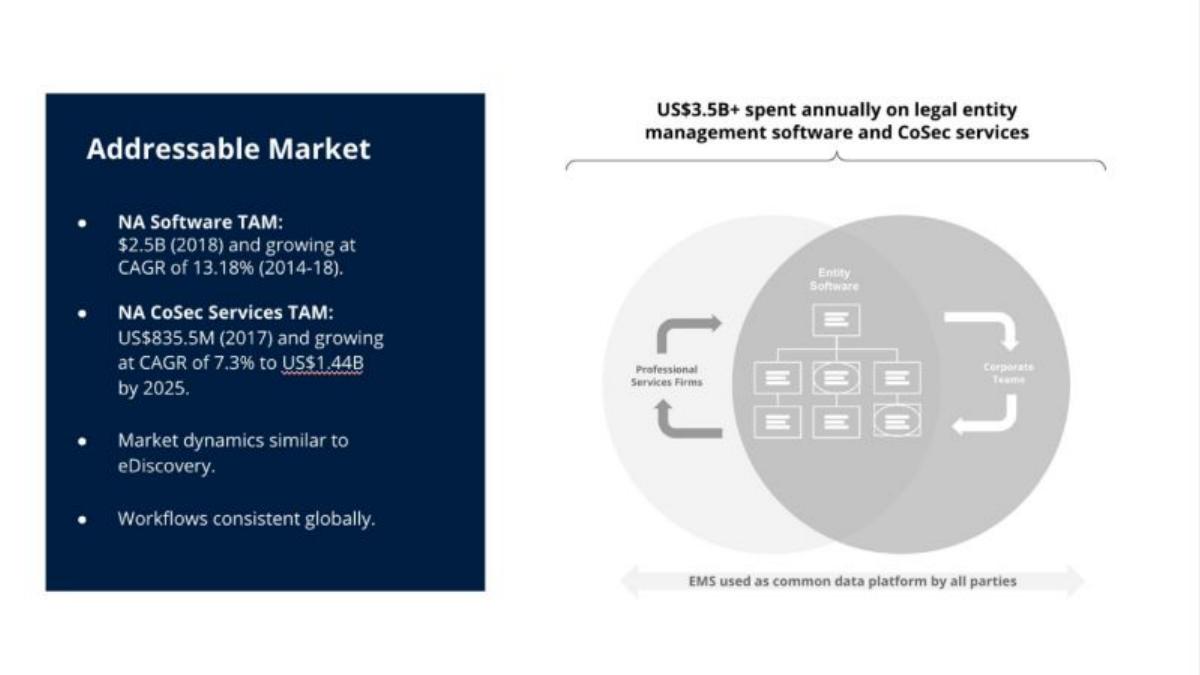
- Slide 5 identifies a US$3.5B+ annual spend on legal entity management software and CoSec services.
- The Addressable Market slide (Slide 5) notes that NA Software TAM was $2.5B in 2018 with a 13.18% CAGR.
- The deck omits a team slide, a specific funding 'ask,' and detailed unit economics like LTV/CAC ratios, which are listed as placeholders on Slide 4.
The Power of the Replacement Play
Athennian’s Series A pitch deck is a clinical example of how to pitch a 'replacement' product in a stagnant market. They aren't trying to invent a new category; they are trying to modernize an old one. The legal entity management space is historically dominated by legacy players with on-premise roots. Athennian uses this 6-slide deck to highlight the technological debt of the incumbents and position themselves as the only modern choice for global legal departments.
Slide 1: The Visual Hook
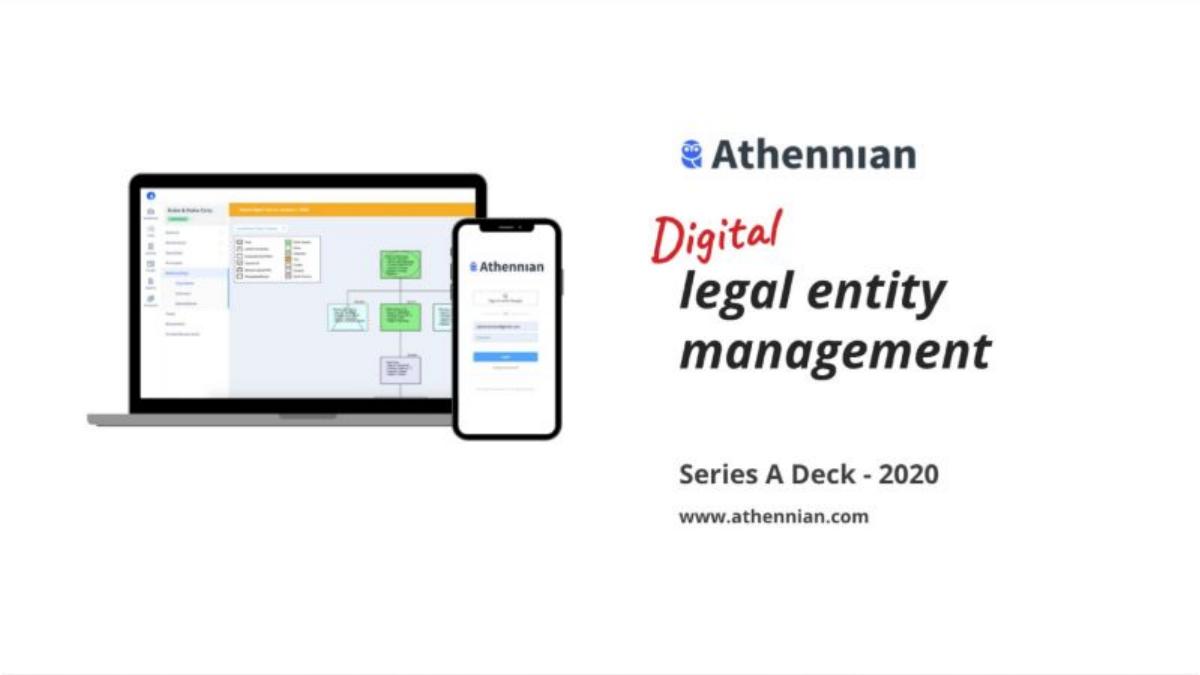
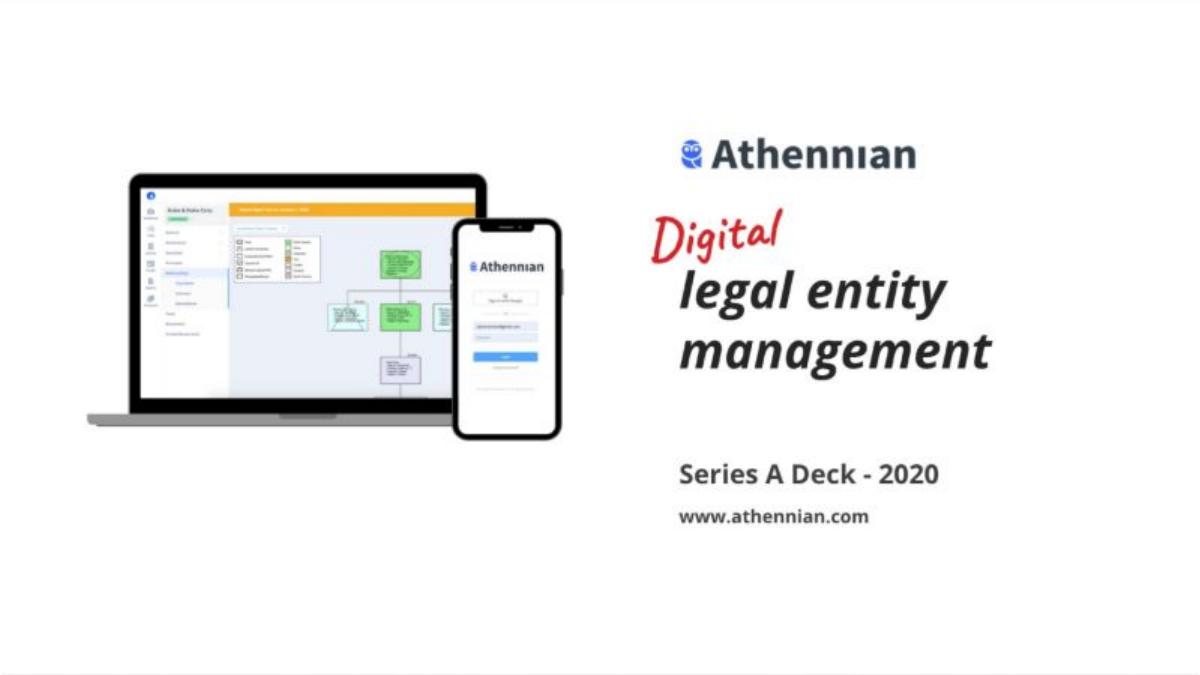
The title slide is functional and clean. It features the Athennian logo, the tagline 'Digital legal entity management,' and a mockup of the software on both a laptop and a mobile device. This immediately signals that the product is cross-platform and cloud-native—a subtle jab at legacy competitors that often struggle with mobile accessibility. The slide clearly states 'Series A Deck - 2020,' setting the stage for the growth story to follow.
Slide 2: Old Way vs. New Way
Slide 2 is a classic comparison slide. On the left, 'OLD WAY' is associated with an icon of a 1990s desktop computer and physical binders. It lists risks such as 'Delays transactions,' 'Tax liabilities,' and 'Reputational risk.' On the right, 'NEW WAY' shows the Athennian interface with green checkmarks. The text identifies Athennian as the 'first cloud-based global entity management system that unites entity data with workflow and document automation.' This slide does the heavy lifting of defining the value proposition: moving from fragmented, manual data to automated, centralized workflows.
Slide 3: The Generational Gap Timeline
This is arguably the most important slide in the deck. It features a vertical timeline. At the bottom, in the 1980s and 1990s, it lists competitors like Diligent, Blueprint, Secretariat, GEMS, and CSC. In the middle, it places cultural milestones like the launch of the USB drive (2000) and Netflix streaming (2007). At the top, it places Athennian’s launch in 2017. The headline 'Athennian is the first global entity management software built this century' is a powerful framing device. It makes the competition look obsolete without needing to criticize their specific features; their age becomes the criticism.
Slide 4: Revenue Performance and Traction
Slide 4 provides a table of key SaaS metrics, though the actual numbers are redacted in this version. The categories listed—2020 Exit ARR, ACV, Avg. Contract Length, LTV, CAC, and Velocity—show that the company is tracking the right KPIs for a Series A stage. To the right of the table is a chart showing 'Active Entities vs. ARR.' While the Y-axis has no numbers, the slope of the 'Active Entities' line (red) shows a massive vertical spike starting around October 2020. This suggests a successful product launch or a major enterprise contract win that significantly increased the volume of data on the platform.
Slide 5: Addressable Market
The market slide breaks down the opportunity into Software and Services. It cites a 'NA Software TAM' of $2.5B (2018) and a 'NA CoSec Services TAM' that is projected to grow to $1.44B by 2025. By including services in their TAM, Athennian is signaling that their software isn't just for in-house legal teams, but also for the law firms and professional service providers that manage entities for their clients. The slide also notes that 'Market dynamics [are] similar to eDiscovery,' which is a helpful analogy for investors who have seen the massive returns in the eDiscovery software boom of the previous decade.
Slide 6: External Resource
The final slide in this set is a promotional slide for the platform where the deck was hosted (bestpitchdeck.com). It does not contain company-specific information but serves as a placeholder for the end of the presentation.
What Works in This Deck
The Narrative of Obsolescence: By focusing on the founding dates of their competitors, Athennian creates a 'Why Now?' that is rooted in technology cycles. They don't have to prove the competitors are bad; they just have to prove they are old.
The Service/Software Hybrid TAM: Many SaaS companies ignore the service side of their market. By explicitly mentioning 'CoSec Services,' Athennian shows they understand the ecosystem of law firms that act as gatekeepers and potential channel partners.
Visual Simplicity: The deck is not cluttered. It uses icons and simple charts to convey complex enterprise software concepts. This is ideal for a Series A pitch where the goal is to get the investor to the next meeting.
What Is Missing
The Team: For a $5.5M Series A, the 'Who' is just as important as the 'What.' This deck lacks a team slide, which would normally highlight the founders' experience in legal tech or enterprise SaaS. This is a significant omission for a full pitch.
The Ask: There is no slide detailing how much capital is being raised (though we know from catalogue facts it was $5.5M) or how that capital will be deployed (e.g., hiring, sales expansion, R&D).
Unit Economics: While the placeholders for CAC and LTV are there, the lack of even a 'ratio' (like 3:1) makes it hard to judge the efficiency of their go-to-market strategy.
What Founders Should Copy
The Timeline Strategy: If you are entering a 'boring' enterprise category dominated by old players, use a timeline to show how much the world has changed since your competitors were built. Mentioning Netflix or the iPhone as milestones that happened after your competitors launched is a great way to highlight their legacy architecture.
The 'Old Way vs. New Way' Visual: Don't just list features. Show the workflow shift. Using a diagram of a corporate structure (the 'entity tree') and showing how it moves from 'Red X' (manual/broken) to 'Green Check' (automated) is much more effective than a bulleted list of features.
Focus on a Proxy Metric: Athennian tracks 'Active Entities.' For your business, find the one metric that represents 'usage' or 'value' better than just revenue. In legal tech, the number of entities managed is a direct indicator of how 'sticky' the software has become within a corporation.
Frequently asked questions
- Why is the Athennian deck so short?
- At 6 slides, this is likely a 'teaser' or a high-level presentation used to anchor a live conversation rather than a full due-diligence deck. It focuses on the 'Why Now?' and the market size, which are the two most critical questions for a Series A investor in a niche enterprise category. By keeping it short, they force the investor to focus on the massive technological debt of the incumbents.
- What is the most effective slide in the deck?
- Slide 3, the timeline slide, is the strongest. It visually anchors the competition in the pre-internet or early-internet era (1980s and 1990s). By placing Athennian's 2017 launch after the launch of Netflix streaming and the USB drive, they make the competitors look like relics. This 'generational gap' argument is a classic and effective way to pitch a SaaS replacement play.
- How does Athennian define its market?
- They define it through two lenses on Slide 5: the Software TAM ($2.5B) and the Corporate Secretarial (CoSec) Services TAM ($835.5M). This is a smart move because it suggests their software can either replace service-heavy workflows or be used by those service firms, effectively doubling their potential reach across both corporate teams and professional service firms.
- What metrics are missing from the performance slide?
- Slide 4 is a 'Revenue Performance' template where every single figure—including Exit ARR, ACV, CAC, and Pipeline—is redacted with '#' symbols. While the trend lines for 'Active Entities' and 'ARR' are visible, the lack of hard numbers makes it impossible to judge the company's capital efficiency or actual scale from this specific version of the deck.
- Is the lack of a team slide a red flag?
- In a Series A deck, a team slide is usually mandatory. Its absence here suggests this version of the deck was edited for public distribution or was part of a larger presentation where the team was introduced separately. For a $5.5M round, investors would certainly require deep bios on the founders' legal and engineering backgrounds.