At Home Nursing Services (AHNS) proposes a Seed round to execute a rollup of Medicare-certified home health agencies, specifically targeting the inefficiencies of hospital Emergency Departments (EDs). By placing Home Health Aides (HHAs) directly in the ED to meet patients at the point of discharge, AHNS aims to reduce hospital readmissions and unnecessary ED boarding. The deck emphasizes a regulatory tailwind from a 2019 CMS rule change allowing non-skilled in-home supports as a supplemental benefit for Medicare Advantage plans. While the deck provides strong market validation and a clear ope…
Key takeaways
- The company targets the $80 billion annual cost of Emergency Department visits, of which $8 billion are deemed unnecessary (Slide 2).
- The core product innovation is the 'ED/AHNS linkage,' placing caregivers in the ED for 24-hour discharge readiness to prevent hospital boarding (Slide 3).
- AHNS utilizes a strategic rollup model, acquiring existing Medicare-certified agencies to gain immediate access to infrastructure and user bases (Slide 3).
- The business model leverages a 2019 CMS law change allowing non-skilled in-home supports to be reimbursed under Medicare Advantage plans (Slide 3).
- Initial service areas target high-density markets in Phoenix, California, and Texas, covering 50% of the market through major urban centers (Slide 6).
- The executive team includes Martin Fruchtman, who has 20 years of experience in home care and previously led a firm that raised $1.4 billion for real estate acquisitions (Slide 9).
- Financial projections suggest $21 million in revenue and over $2 million in EBITDA by Year 2 of operations based on a $1 million investment (Slide 10).
- The deck claims a potential for 30x initial investment returns over a five-year period (Slide 10).
At Home Nursing Services Pitch Deck Teardown
At Home Nursing Services (AHNS) presents a pitch deck that is less about a software product and more about a systemic operational overhaul of the geriatric discharge pipeline. The deck, dated April 2023, outlines a Seed round intended to fund a rollup of home health agencies powered by a specific hospital-integration strategy. The following is a slide-by-slide breakdown of the narrative and data provided.
Slide 1: Title Slide
The deck opens with a minimalist title slide. It identifies the company as At Home Nursing Services, Inc and uses the tagline "The Next Generation of Home Care." It explicitly states the purpose: "Pitch Deck for Seed Round - April 2023." There are no logos or graphics on this slide, setting a functional, text-heavy tone for the rest of the presentation.
Slide 2: Problem: Senior Use of Emergency Departments
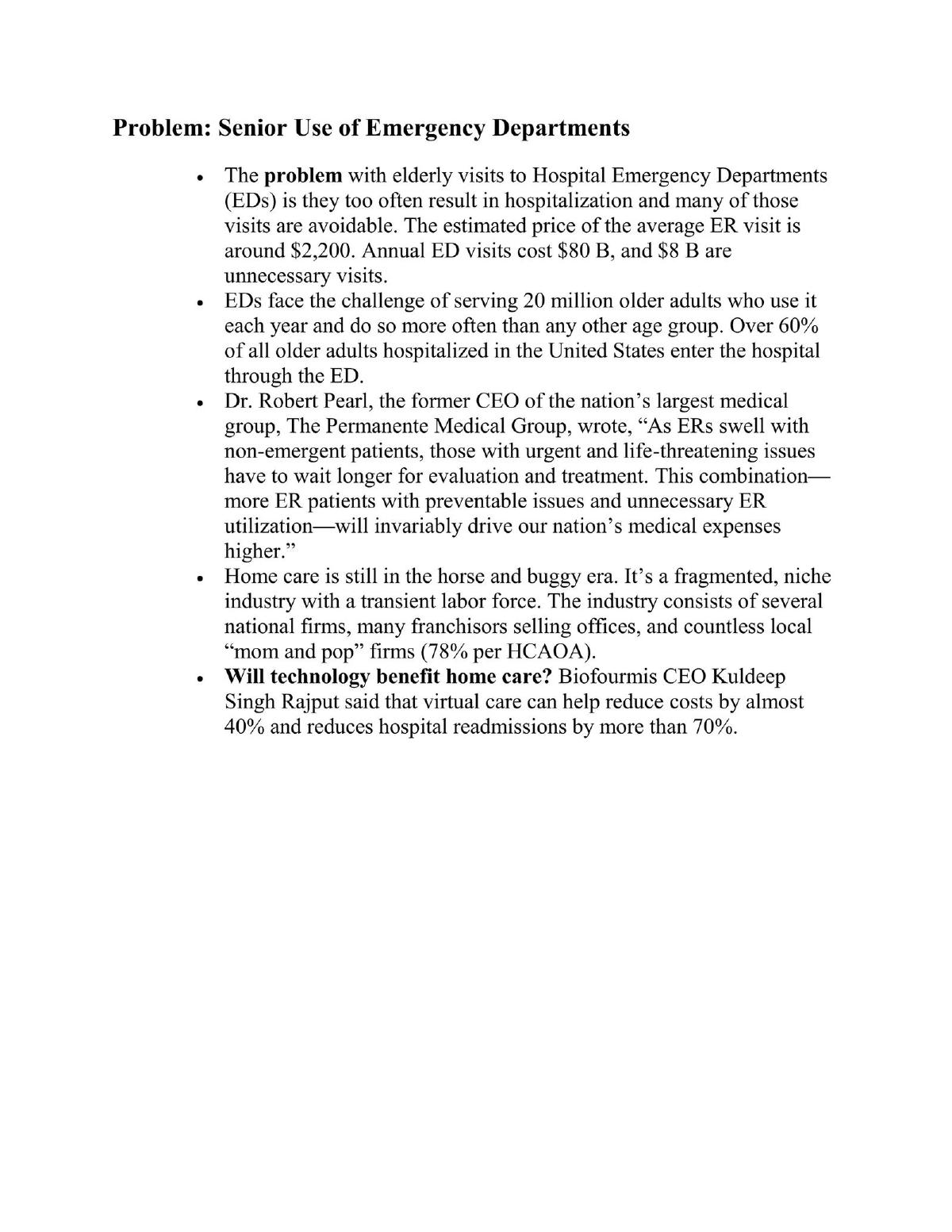
This slide establishes the economic burden of the current healthcare system. It notes that elderly visits to Emergency Departments (EDs) often result in avoidable hospitalizations. Key figures cited include an average ER visit cost of $2,200 , total annual ED visit costs of $80 billion , and $8 billion in unnecessary visits. The slide quotes Dr. Robert Pearl regarding the 'swell' of ERs with non-emergent patients. It also characterizes the current home care industry as being in the "horse and buggy era," fragmented and dominated by "mom and pop" firms (78% per HCAOA). Finally, it quotes Biofourmis CEO Kuldeep Singh Rajput to validate that virtual care can reduce costs by 40% and readmissions by 70%.
Slide 3: Solutions
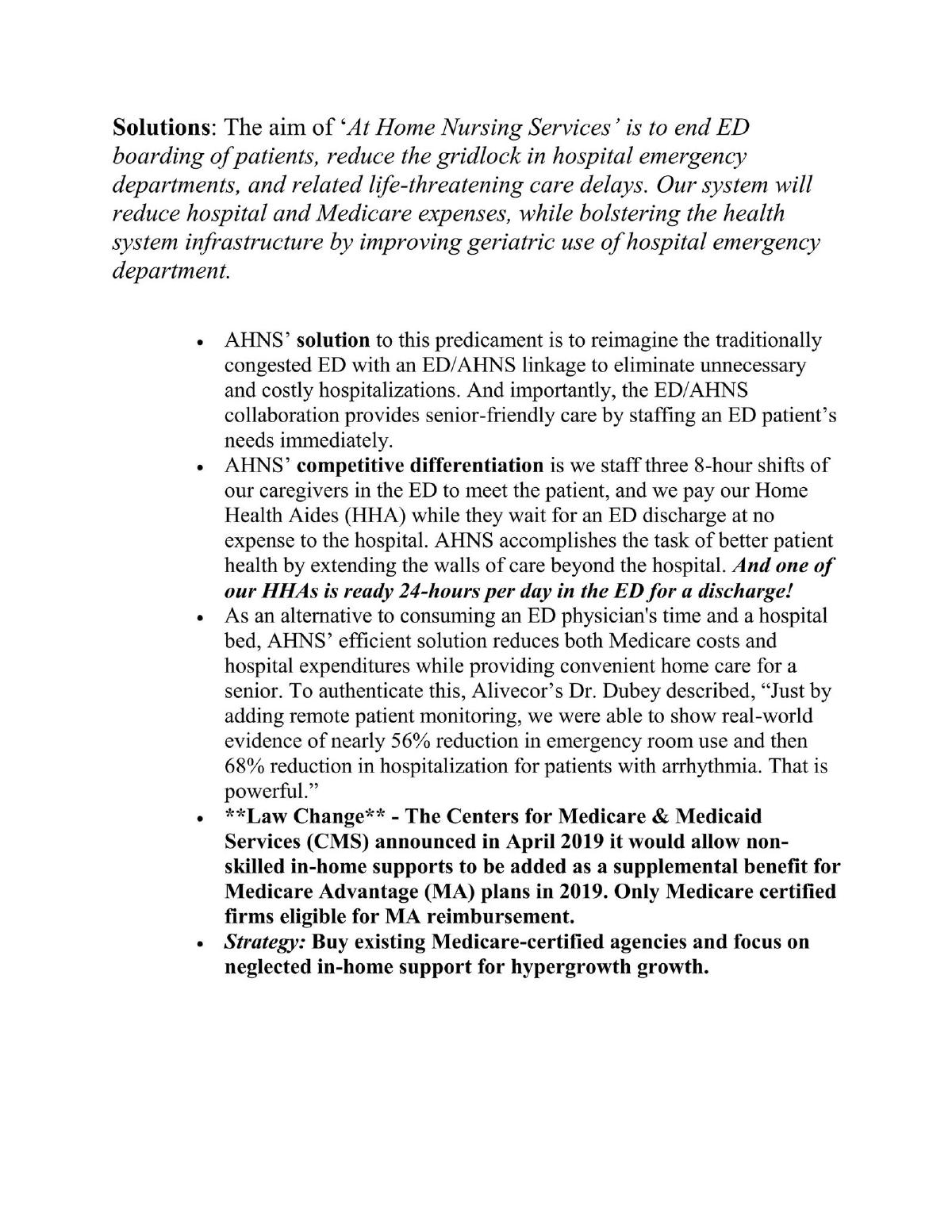
The solution slide introduces the company's primary goal: to end ED boarding and reduce hospital gridlock. The core differentiator is the "ED/AHNS linkage," where the company staffs three 8-hour shifts of caregivers directly in the ED to meet patients at the point of discharge. A critical point of the strategy is the "Law Change" : a 2019 CMS announcement allowing non-skilled in-home supports for Medicare Advantage plans. The stated strategy is to "Buy existing Medicare-certified agencies and focus on neglected in-home support for hypergrowth growth."
Slide 4: Market Validation
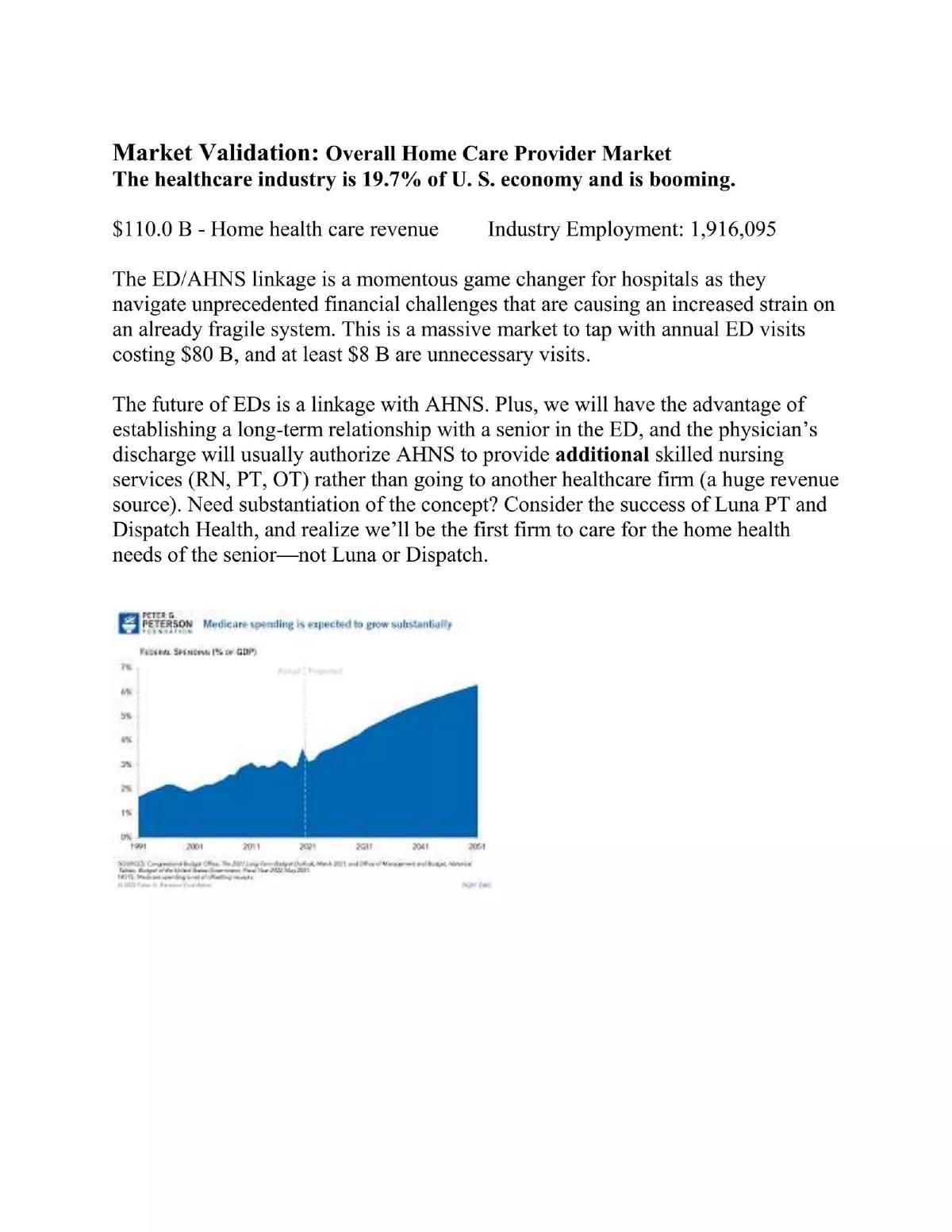
The deck quantifies the market opportunity, noting that the healthcare industry represents 19.7% of the U.S. economy . It cites $110.0 billion in home health care revenue and industry employment of 1,916,095 . The slide positions AHNS against competitors like Luna PT and Dispatch Health, claiming AHNS will be the first to care for the home health needs of the senior specifically through the ED linkage. A chart from the Peter G. Peterson Foundation shows federal Medicare spending expected to grow substantially through 2054.
Slide 5: Product: Home healthcare and custodial care
This slide focuses on the mechanics of the service. It highlights that hospital readmissions for people over 65 are unsustainable for Medicare, with the cost of readmitting one patient averaging over $15,000 . The AHNS model is described as "From Responsive to Anticipatory," ensuring a caregiver is present in the ED for rapid discharge and remains at the patient's home until a permanent replacement is found. It notes that AHNS pays the HHA while they wait in the ED, while Medicare pays for the subsequent home services.
Slide 6: Initial Service Areas and Future Growth
AHNS outlines a geographic strategy focusing on major urban centers to cover 50% of the market. Target areas include:
Phoenix/Maricopa County: 4.4 million · California: Los Angeles (10m), Orange County (3.2m), San Francisco (3.3m), San Diego (3.3m), Inland Empire (4.6m) · Texas: Dallas (2.6m), Harris County/Houston (4.6m), San Antonio (1.4m)
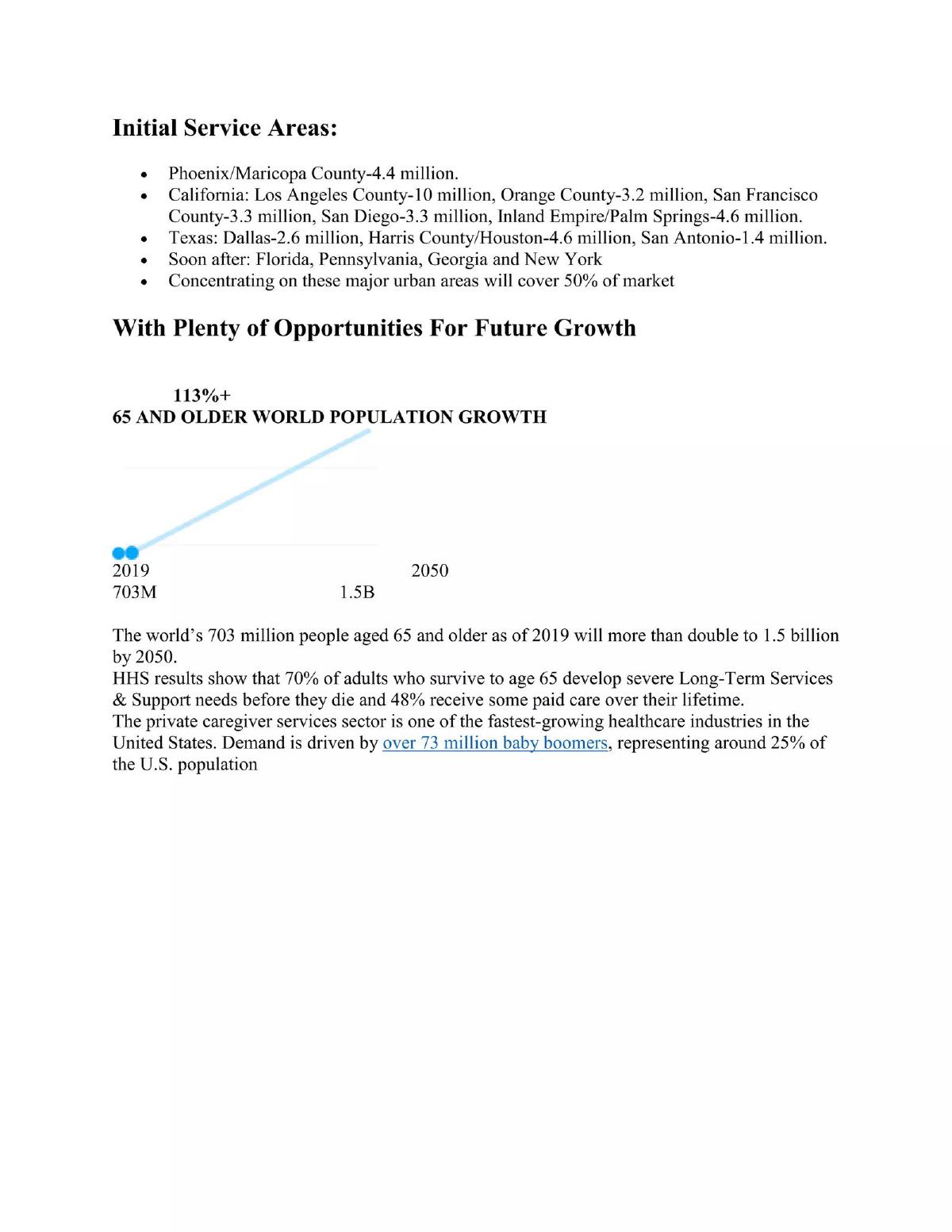
The slide also includes a chart showing the 65+ world population growing from 703 million in 2019 to 1.5 billion by 2050 (a 113%+ increase).
Slide 7: Industry Context and Regulatory Windfalls
This slide reinforces the "why now" by citing AARP data that 90% of seniors plan to remain in their homes. It mentions that 10,000 baby boomers turn 65 every day. It also highlights the Washington State Long-Term Care Trust Act , which provides up to $36,500 in home care benefits, suggesting other states (CA, IL, HA, MN) are examining similar programs, which AHNS calls a "windfall for home care!"
Slide 8: Proof of Concept: Hybrid Proposal
The company describes its model as "Innovation plus 'Strategic Rollup'." It argues that because only Medicare Advantage (MA) certified agencies can provide these new benefits, it is the perfect time for a rollup. To validate the investment potential, it points to Seth Sternberg (Honor) , noting Honor raised $325 million and acquired Home Instead, which has $2.1 billion in revenue.
Slide 9: Our Team
Martin Fruchtman (CEO): 20 years in home care, former CEO of American Companion & Homecare Services. Notably, he was a Sr. V.P. at Coast Savings & Loan/NAPICO, where he helped raise $1.4 billion for the acquisition of 67,000 housing units. · Shen Yun, MBA (President): 10 years of experience in Emergency Management and Emergency Medicine Management (COO and Chief Compliance Officer roles).
Slide 10: Executive Summary
The final slide serves as a summary and a soft 'Ask.' It reiterates the intent to acquire Medicare-certified agencies and form ED linkages. It mentions a "hub and spoke model" for internal growth. The financial projection states the company is "Projected to generate $21 million of revenues and over $2 million of EBITDA in Year 2 of operations on $1 million investment." It concludes by stating that net investor returns are expected to be "over 30x initial investment during five years period."
What At Home Nursing Services Does Well
The deck excels at identifying a specific, high-friction point in the healthcare value chain: the transition from the Emergency Department to the home. By focusing on "ED boarding" and "avoidable hospitalizations," the founders align their interests with both hospitals (who need beds cleared) and payers (who want to avoid $15,000 readmission costs). The use of the 2019 CMS regulatory change provides a strong "Why Now" catalyst that moves the business from a standard service play to a time-sensitive market opportunity.
Furthermore, the team slide is well-constructed for a rollup strategy. Highlighting the CEO's past experience in raising $1.4 billion for large-scale acquisitions (even if in real estate) suggests the competence required to manage a multi-unit acquisition strategy. The inclusion of a President with specific Emergency Medicine Management experience directly supports the core "ED linkage" thesis.
What Is Missing from the Deck
The most significant omission is a detailed Use of Funds breakdown. While Slide 10 mentions a "$1 million investment," it does not specify if this is the total Seed round target or how that million is allocated between agency acquisition, technology development, and operational overhead. In a rollup model, capital allocation is the most critical metric for an investor to evaluate.
Additionally, the deck lacks Unit Economics . While it mentions $21 million in Year 2 revenue, it does not explain the margin profile of an individual agency or the specific cost of staffing the 24-hour ED shifts. There is also no mention of Technology specifics. The deck claims to be "Tech enabled" with a "comprehensive care platform," but provides no screenshots, feature lists, or evidence of how this technology improves the efficiency of the acquired agencies.
What a Founder Should Copy
Founders should emulate the way AHNS ties their business model to Regulatory Tailwinds . By citing specific CMS rule changes and state-level legislation (like the Washington Long-Term Care Trust Act), the company makes its success seem inevitable rather than speculative. This is a powerful way to de-risk a pitch in the eyes of an investor.
The Geographic Targeting on Slide 6 is also a best practice. Instead of saying "we will launch nationally," the deck identifies specific counties and their populations, showing a clear, data-driven roadmap for the first phase of expansion. This level of specificity helps investors visualize the path to the $21 million revenue target mentioned in the summary.
Frequently asked questions
- What is the primary problem At Home Nursing Services is solving?
- AHNS addresses the 'gridlock' in hospital emergency departments (EDs) and the high cost of elderly hospitalizations. According to slide 2, 20 million older adults use EDs annually, and 60% of all older adult hospitalizations enter through the ED. The company aims to reduce the $8 billion spent on unnecessary ED visits and the $15,000 average cost of a single patient readmission by facilitating faster, safer discharges to home care.
- How does the 'ED/AHNS linkage' work operationally?
- As described on slide 3 and slide 5, AHNS staffs three 8-hour shifts of caregivers directly within the hospital ED. These Home Health Aides (HHAs) wait for an ED discharge at no expense to the hospital. Once a patient is cleared, the HHA is ready immediately to transition the patient home, providing a 'responsive to anticipatory' model that ensures the patient is never left without care during the critical discharge window.
- What is the significance of the 2019 CMS law change mentioned in the deck?
- Slide 3 and slide 8 highlight a 2019 ruling by the Centers for Medicare & Medicaid Services (CMS) that allows non-skilled in-home supports to be added as a supplemental benefit for Medicare Advantage (MA) plans. This is a critical piece of the AHNS strategy because only Medicare-certified firms are eligible for this reimbursement, providing a regulatory moat and a new revenue stream for their acquired agencies.
- What is the company's growth and acquisition strategy?
- AHNS employs a 'hub and spoke' model (Slide 10). They plan to acquire existing Medicare-certified agencies in densely populated urban areas (starting with Phoenix, LA, and Dallas) and then expand into adjacent counties without needing additional acquisitions. This 'strategic rollup' allows them to transform existing infrastructure with their technology layer and ED-linkage modality to achieve 'hypergrowth' (Slide 3).
- Who are the key members of the leadership team?
- The team is led by CEO Martin Fruchtman, who brings 20 years of home care experience and a background in large-scale real estate syndication (Slide 9). He is joined by President Shen Yun, MBA, who has 10 years of experience in both emergency management and emergency medicine management. The deck emphasizes their combined financial, legal, and operational backgrounds in healthcare.