The 2020 Atomwise deck is a masterclass in establishing platform credibility through massive scale and partnership depth. Rather than focusing on the 'black box' of AI, Atomwise leads with results: 700+ projects, 16 billion molecules screened, and a staggering $5.5 billion in signed deals. The deck reveals a strategic shift from being a service provider to an ecosystem architect. Through its AIMS Awards and CADDS Ecosystem, Atomwise has built a pipeline that sources biology from academia, validates it via AI, and scales it through partnerships with CROs like Charles River and accelerators lik…
Key takeaways
- Atomwise positions itself as the first to use Convolutional Neural Nets (CNNs) for structure-based drug discovery.
- The platform has screened over 16 billion small molecules, significantly larger than traditional physical libraries.
- The company claims over $5.5B in signed deals and work with the world's Top 10 pharma companies.
- Success rates for hit discovery are cited at 74% overall, even for 'undruggable' targets with no prior training data.
- The business model has evolved into an 'Ecosystem' (CADDS) that supports the full lifecycle of drug development for startups.
- Atomwise has a significant academic 'top-of-funnel' via its AIMS awards, which has handled 775+ projects across diverse fields like oncology and infectious disease.
What this deck actually is
The Atomwise 2020 deck is a high-level strategic partnership and capabilities presentation designed to bridge the gap between deep-tech AI and traditional pharmaceutical research. It is not a standard "Seed-round" pitch deck intended to introduce the basic concept of the company; rather, it functions as a mid-to-late-stage credibility engine. With a stated "$50M+ funding raised" and "700+ drug discovery projects," the deck is focused on establishing Atomwise as the de facto infrastructure for AI-driven medicinal chemistry. It is structured more as a business development tool than a venture capital fundraiser, though the data within it would be central to any Series B or C diligence process.
The single most important finding in this deck is its transition from a pure "Software-as-a-Service" (SaaS) narrative to an "Ecosystem-as-a-Service" model. By highlighting the "AIMS Awards" and the "CADDS Ecosystem," Atomwise positions itself as the central hub connecting academic discovery, venture-backed startups (via Y Combinator), and contract research organizations (like Charles River). The deck argues that Atomwise doesn't just provide an algorithm; it provides a validated pathway from a digital protein structure to a patentable clinical candidate. The document is less about the "code" and more about the "results," emphasizing that the AI is no longer a theory—it is a proven engine with "Over $5.5B in signed deals."
Slide-by-slide walkthrough
Slide 1: Title Slide
The deck opens with a direct, partner-focused value proposition: "Bringing the Power of AI Drug Discovery to our Strategic Partners." The visual language—a digital wireframe hand interacting with a molecular sphere on a dark background—immediately signals the intersection of human expertise and machine computation. The 2020 copyright date places this deck at a critical juncture in the biotech world, just as AI began to be seen as a necessity for modern pharmaceutical development rather than a speculative experiment. The large teal banner and prominent logo placement suggest a brand that is already established rather than a scrappy newcomer.
For an investor or a potential pharmaceutical partner, this slide establishes two things: professional polish and an explicit focus on "Strategic Partners." This is not a pitch for a standalone drug or a specific therapeutic asset; it is a pitch for a platform. The deck is clearly positioned for a B2B audience. An investor reading this sees a company that knows its role in the value chain—not as a competitor to Big Pharma, but as the high-tech engine that powers their pipelines. The inclusion of the URL and copyright information is standard, but the overall design language sets a tone of modern, clinical precision.
The strongest version of this slide might include a sub-headline that quantifies the scale immediately. While "Strategic Partners" is a good start, adding a phrase like "The World's Largest Library of Predicted Molecular Interactions" or "700+ Projects Completed" would give the reader a sense of the sheer computing power and experience they are about to encounter before they even flip the page. As it stands, it is a clean but somewhat generic opening for a company with such massive data claims.
Slide 2: Better Medicines, Faster
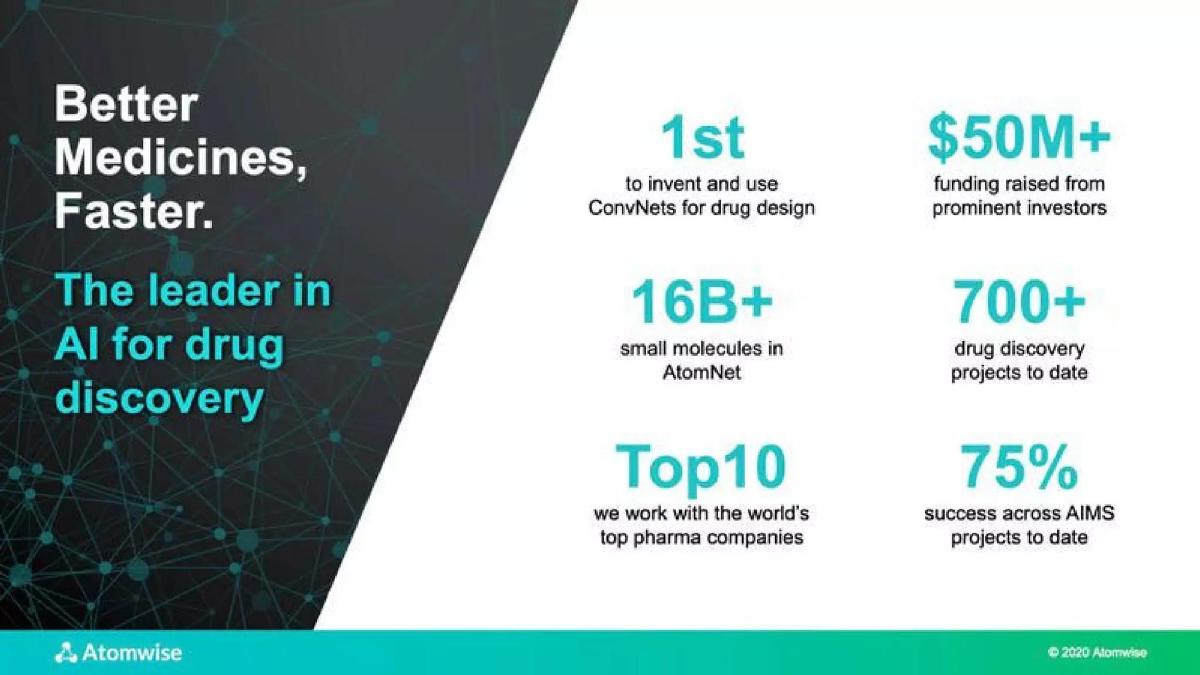
This slide serves as the "Executive Summary" or "Traction" slide, utilizing a diagonal split layout to balance technical imagery with six heavy-hitting metrics. It lists: the claim of being the "1st to invent and use ConvNets for drug design," "$50M+ funding raised from prominent investors," "16B+ small molecules in AtomNet," "700+ drug discovery projects to date," working with the "world's top pharma companies" (Top 10), and a "75% success across AIMS projects to date." The headline "The leader in AI for drug discovery" makes an aggressive claim of market dominance based on these figures.
An investor reads this as a risk-mitigation slide. By stating they have already raised $50M and worked with 700+ projects, Atomwise is signaling they have already passed the "early-stage failure" hurdle and have significant institutional backing. The "16B+ small molecules" figure is particularly impressive for 2020, as it suggests a library size that dwarfs traditional physical labs by several orders of magnitude. The mention of "Top 10" pharma companies provides social proof, even if the specific names aren't listed on this specific slide, suggesting that the industry's most rigorous due diligence teams have already vetted the technology.
To make this slide even stronger, the definition of "Success" in the "75% success across AIMS projects" bullet needs a footnote or quantitative boundary. In the high-attrition world of drug discovery, where "success" can mean anything from "found a binder" to "passed Phase I," this term is a loaded one. Does success mean a binding affinity met a certain micromolar threshold, or that a compound moved to animal trials? To a scientific audience, a 75% success rate in drug discovery sounds almost too good to be true, so defining the specific milestone reached would bolster the credibility of that figure.
Slide 3: Partnerships that Accelerate Drug Discovery
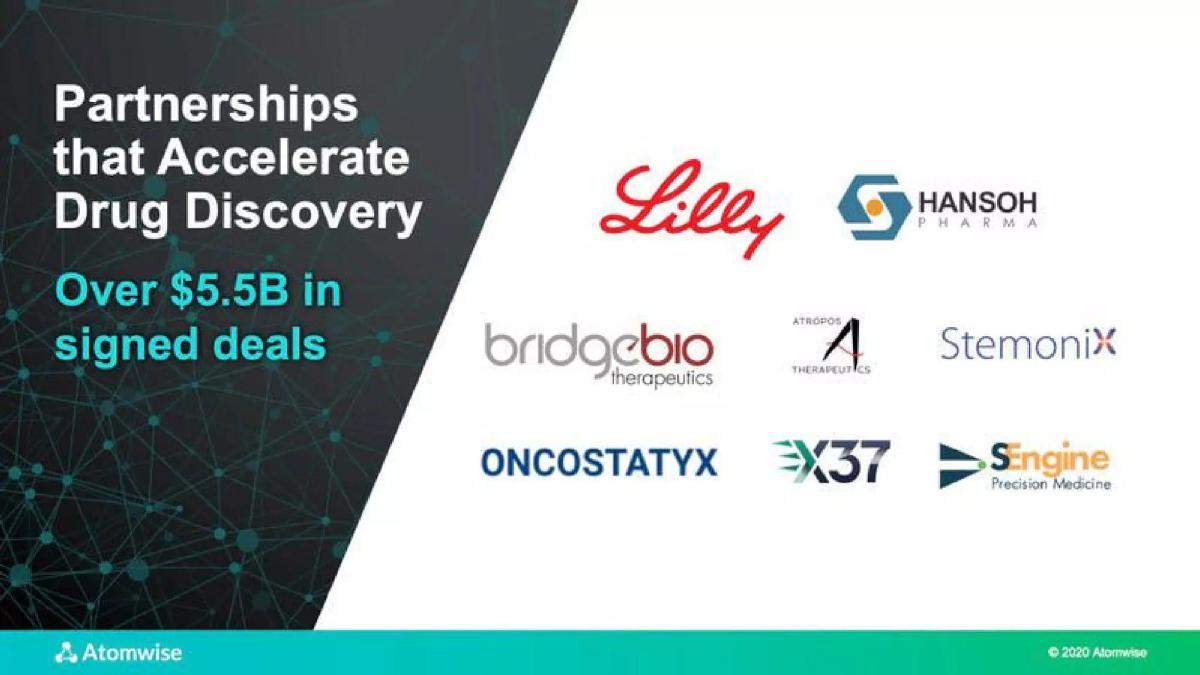
This is a classic "Logo Cloud" slide, but it is anchored by a massive financial figure: "Over $5.5B in signed deals." The logos displayed range from global pharmaceutical giants like "Lilly" and "HANSOH PHARMA" to specialized players and startups like "bridgebio therapeutics," "ATROPOS THERAPEUTICS," "StemoniX," "ONCOSTATYX," "X37," and "SEngine Precision Medicine." This demonstrates that their technology is applicable across the entire spectrum of the biotech industry, from massive multi-national corporations to agile, venture-backed startups.
The "$5.5B in signed deals" figure is the "wow" factor intended to stop a reader in their tracks. It suggests that the market has already valued Atomwise’s contributions at a multi-billion dollar scale. It moves the conversation from "Does this work?" to "How much more of this market can we capture?" The diversity of the partners—covering therapeutics, precision medicine, and oncology—reinforces the platform's versatility. It also highlights that Atomwise is not just a service provider; they are a deal-maker, likely involving future milestones and royalties that could significantly exceed their current venture funding.
The strongest version of this slide would categorize these logos by deal type. For example, distinguishing between "Research Collaborations," "Joint Ventures," and "Equity Partnerships" would help an investor understand the revenue mix. Are these deals primarily fee-for-service, or do they represent long-term upside in the form of clinical milestones? Because the slide combines massive firms with small startups, the $5.5B figure is likely heavily weighted toward the back-end of the larger pharma deals, and clarifying that structure would provide better financial transparency.
Slide 4: Leading AI Technology for Drug Design
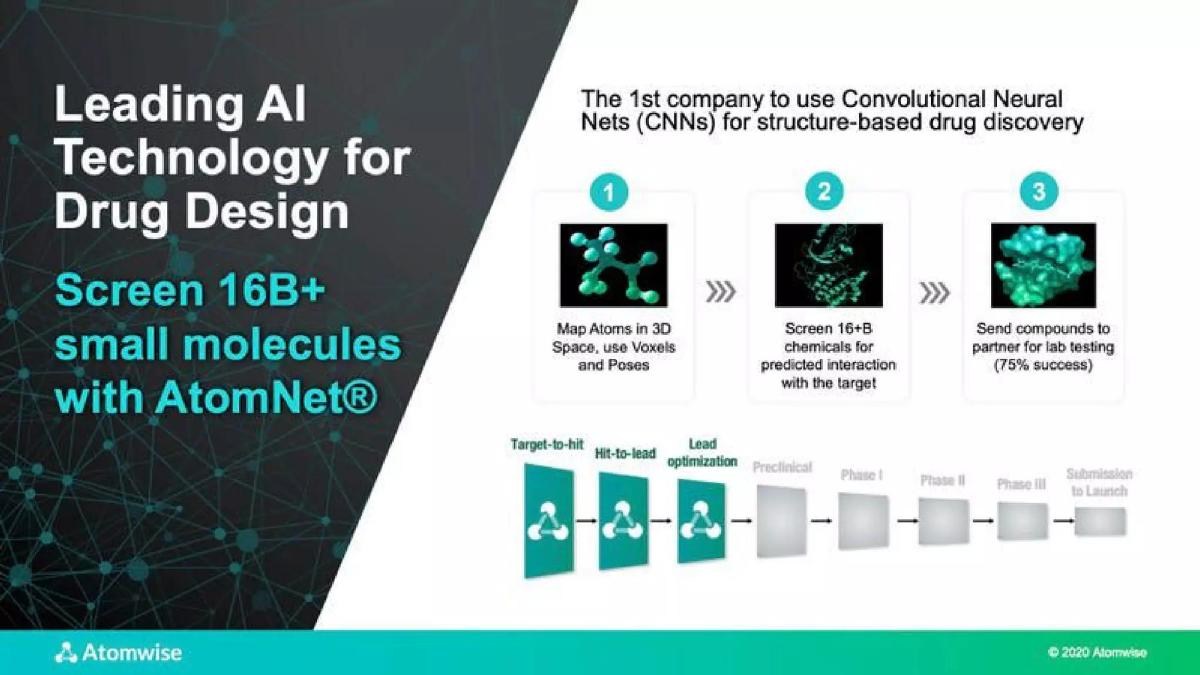
This slide explains the technical "How" behind the results. It highlights the use of Convolutional Neural Nets (CNNs) and the specific technical approach: "Map Atoms in 3D Space, use Voxels and Poses." It outlines a three-step process: 1) Map atoms and use voxels, 2) Screen "16+B chemicals" for predicted interactions, and 3) Send compounds to partners for lab testing, claiming a "75% success" rate in that transition. The bottom of the slide features a horizontal pipeline chart moving from "Target-to-hit" through "Submission to Launch," with Atomwise's primary focus highlighted in the early stages.
The investor takeaway is that Atomwise is a "front-loaded" technology. They accelerate the most expensive and time-consuming earliest stages of discovery—the "Target-to-hit" and "Hit-to-lead" phases. The mention of "16B+ chemicals" screened against a target is the primary differentiator. Traditional high-throughput screening (HTS) might only look at 1-2 million physical compounds in a library; Atomwise is claiming a digital library 8,000 times larger. The focus on "3D Space" and "Voxels" tells an investor that the AI is "seeing" molecules more like a human chemist does, but with the speed of a supercomputer.
This slide is visually dense and the three-step process uses somewhat generic iconography. The strongest version of this slide would include a visualization of the "AtomNet" interface—perhaps showing how a "Voxel" looks compared to a traditional molecular representation. Making the abstract concept of a 3D convolutional neural network more tangible would help non-technical investors grasp why this approach is superior to older methods of computational docking.
Slide 5: A Seamless Partnership from Start to Finish
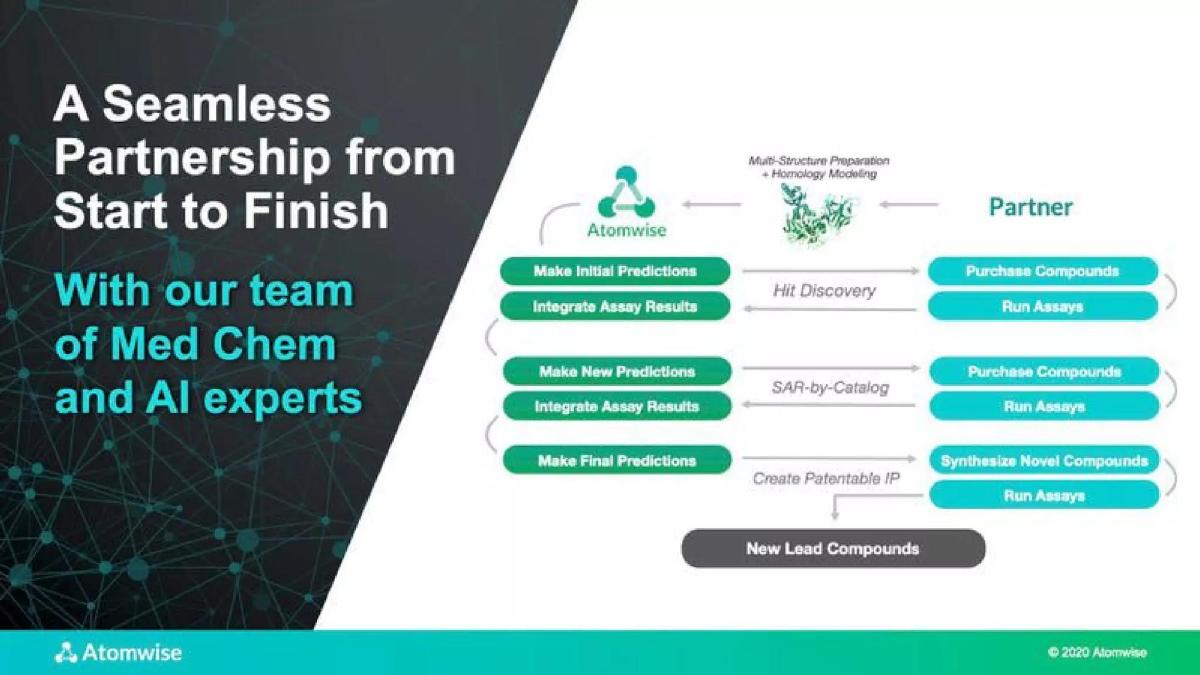
This slide is a detailed workflow diagram that splits responsibilities between "Atomwise" (left column) and the "Partner" (right column). It shows a cyclical process where Atomwise handles "Multi-Structure Preparation," "Initial Predictions," and "Final Predictions," while the partner handles "Purchase Compounds," "Run Assays," and "Synthesize Novel Compounds." The workflow is designed to lead specifically to "New Lead Compounds" and the creation of "Patentable IP." It emphasizes the involvement of a "team of Med Chem and AI experts."
This slide addresses a major pain point in biotech partnerships: operational friction. By showing exactly who does what, Atomwise is pitching itself as a "plug-and-play" chemistry department for a pharma company. The inclusion of "SAR-by-Catalog" (Structure-Activity Relationship) is a sophisticated technical detail that will resonate with medicinal chemists. It shows that Atomwise understands the practicalities of medicinal chemistry—specifically that it is often faster to buy and test existing analogs from a catalog than to synthesize everything from scratch.
The diagram is repetitive, as "Run Assays" and "Make Predictions" appear multiple times. While this accurately reflects the iterative nature of the scientific method, it makes for a cluttered and busy slide. The strongest version of this slide would use a cleaner, circular "loop" graphic to emphasize the speed of these iterations. If Atomwise can complete three "Prediction-Assay" loops in the time it takes a traditional lab to do one, that "Time-to-Lead" metric would be the most powerful addition they could make here.
Slide 6: Proven Success with Challenging Targets
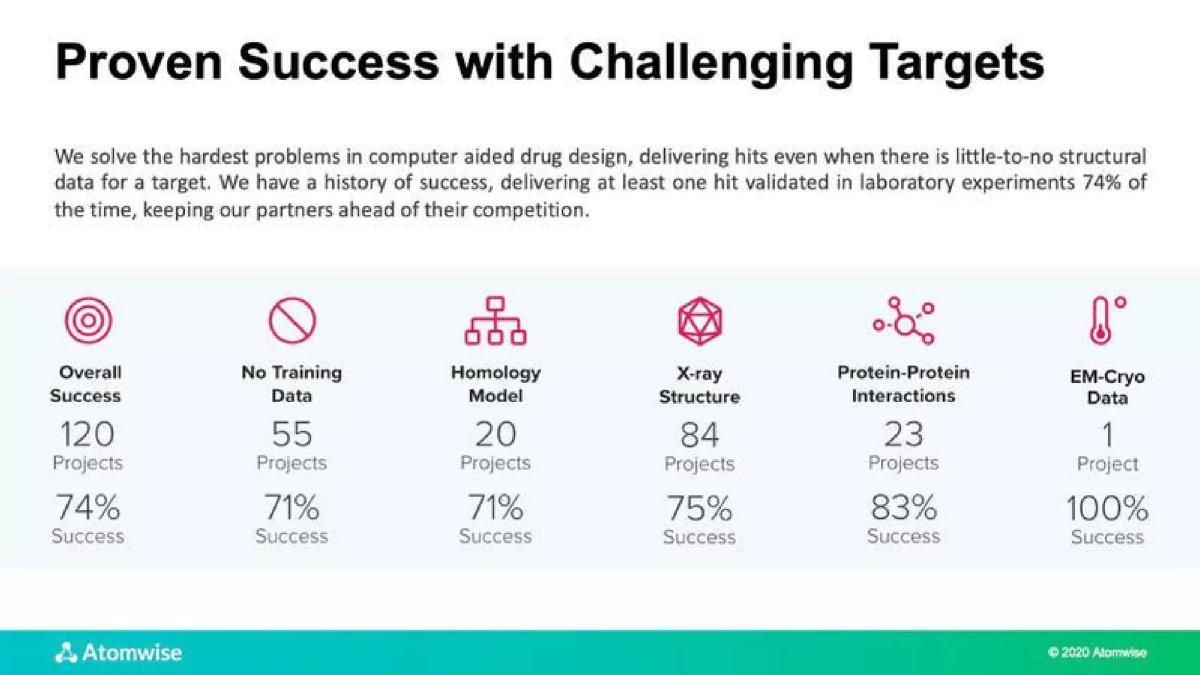
This is arguably the most data-dense and impressive slide in the deck. It breaks down success rates across different types of targets to prove the AI's versatility. It lists "Overall Success" as 74% across 120 projects. It then breaks this down into "No Training Data" (71% success, 55 projects), "Homology Model" (71%, 20 projects), "X-ray Structure" (75%, 84 projects), "Protein-Protein Interactions" (83%, 23 projects), and "EM-Cryo Data" (100%, 1 project). The headline claims they deliver "hits even when there is little-to-no structural data."
To a scientist or a specialized biotech VC, this slide proves that the AI isn't just picking the "low-hanging fruit." Protein-protein interactions (PPIs) are notoriously difficult for traditional drug design; showing an 83% success rate there is a major technical win. The disclosure of "No Training Data" projects (71% success) is particularly strong, as it suggests the AI is not just "memorizing" known drugs but can generalize to entirely new biological problems where no previous template exists. This directly counters the common criticism that AI is only as good as its historical data.
The "EM-Cryo Data" metric, while 100%, is based on a sample size of N=1. In a scientific presentation, this can look like "cherry-picking" to achieve a perfect score. The strongest version of this slide would group smaller sample sizes into a "Specialized Data Sources" category or simply omit the N=1 data point to avoid the statistical insignificance. The slide would also benefit from a definition of "Hit" (e.g., did the compound reach a specific IC50?) to ground these percentages in real-world efficacy.
Slide 7: Academic Partnerships
The deck pivots here to the "top-of-funnel" strategy: how Atomwise gets its technology into the hands of the world's best researchers to build a future pipeline. It outlines three distinct collaboration models: "AIMS Awards Program" (fast, streamlined hit discovery), "Co-Development Project" (tailored collaboration with a revenue-sharing model), and "Joint Venture" (sharing in risks/benefits and access to the CADDS ecosystem). Each model is clearly tiered by the level of commitment and potential financial upside for Atomwise.
Investors see this as a "land and expand" strategy. By giving academic labs access via the AIMS program, Atomwise builds a massive pipeline of potential drug candidates that they can later opt to co-develop or spin out into Joint Ventures (JVs). It is a way to de-risk their own R&D by letting the world's academics do the fundamental biological research while Atomwise retains a stake in the resulting IP. The mention of "Revenue sharing" and "Joint Venture" models indicates that Atomwise is building a diversified portfolio of assets, not just a list of clients.
This slide would be significantly stronger if it quantified the economics. While it mentions "Revenue sharing," it does not specify if that means royalties, equity, or milestone payments. Even a range of typical equity stakes for the JV model would help an investor value the company's "portfolio" of academic bets. Currently, the slide feels more like a brochure for professors than a financial slide for institutional investors.
Slide 8: AIMS Awards Program
This slide zooms in on the "Artificial Intelligence Molecular Screen (AIMS) Awards," which provide academic labs with access to Atomwise's AI design. The program promises a "Virtual screening for your target protein with 2+ million commercially available small molecules" and provides the researcher with "72+ small molecules, prepped, QC tested, and plated, ready for testing in your lab." The imagery moves away from diagrams to photos of scientists, lab trays, and laptops, humanizing the technology.
The strategic value here is the "ready for testing" promise. Atomwise isn't just sending a spreadsheet of chemical names; they are sending physical, 96-well plates of compounds. This removes the final logistical barrier for an academic lab to test the AI's predictions. For an investor, this represents a significant logistics and supply chain capability—managing the sourcing, quality control, and shipping of thousands of compounds—which acts as a moat against smaller AI startups that only offer software.
The slide is visually a bit weak compared to the technical ones. The stock-style photos of researchers don't add much data-driven value. The strongest version of this slide would show a map of the world with pins representing every AIMS award granted to date. This would visually demonstrate the "Enormous Breadth" the company claims and show how they are crowdsourcing the world's biology research into their proprietary ecosystem.
Slide 9: Our CADDS Ecosystem
This slide introduces the "Chemistry for Academic Drug Discovery Startups" (CADDS) ecosystem. It is a cluster-style diagram showing how Atomwise supports "the full lifecycle of preclinical drug development." It lists partners like "Charles River" (for CRO services), "Mcule" and "Enamine" (for vendors), and "Y Combinator" (for funding). The diagram circles various services including "Reg Strategy," "Lab Space," "IP Protection," and "Business Development Advice."
This is a "Platform Play" slide. Atomwise is positioning itself as the center of a new way of doing biotech—one where a founder doesn't need a building or a lab, just a protein target and a partnership with Atomwise. By partnering with Charles River and Enamine, Atomwise is ensuring that once their AI finds a hit, there is a clear, industrial-grade path to synthesize and test it. This ecosystem approach makes Atomwise "sticky"—it is very hard for a startup to leave the Atomwise orbit once their entire development pipeline is integrated into these specific partners.
The diagram is somewhat of a "word soup," and the actual relationship between the circles is not clearly defined. Are these partners providing discounted services? Is Atomwise taking a referral fee? The strongest version of this slide would show this as a linear "Start-to-Finish" timeline for a startup, showing exactly at which month "Charles River" or "Enamine" steps in, and how much faster this ecosystem is than a startup trying to build these relationships from scratch.
Slide 10: Enormous Breadth of Applications
A donut chart shows that Atomwise has "775 accepted projects to date" across a massive variety of disease and application areas. While "Oncology" (38%) and "Infectious Disease" (26%) are the largest focus areas, the company also covers "Neurology" (8%), "Cardiology" (5%), "Immunology" (4%), and even "Agriculture/Antifungals" and "CRISPR/Biodefense." The slide lists specific sub-fields like "Ophthalmology," "Rheumatology," and "Rare Disease."
The investor takeaway here is "unlimited TAM" (Total Addressable Market). If the technology works on a fungus in a field (agriculture) and a brain tumor in a human (neurology), then the company's growth is limited only by computing power and the number of partnerships they can manage. It proves that AtomNet is a general-purpose discovery engine, not a niche tool. This diversification also protects the company from downturns in specific therapeutic areas; if oncology funding dries up, they have 62% of their projects elsewhere.
The "Other 10%" and "3% Biotechnology" categories are a bit vague. Given the precision of the other numbers (down to 2% for some), the strongest version of this slide would break down what constitutes "Other." Additionally, mentioning if any of these projects are in the same therapeutic family as the "$5.5B in signed deals" would help connect the technical breadth to the commercial depth.
Slide 11: Broad Spectrum COVID Projects
Given the 2020 date of the deck, this slide was likely a late addition to show real-world relevance to the then-current global pandemic. It lists 11 different projects targeting various parts of the COVID virus (Mers, SARS-CoV-1, and SARS-CoV-2) with partners like "Columbia University," "Dana-Farber Cancer Institute," and "University of South Australia." Targets include "Nucleocapsid (N-protein)," "NSP15," "Papain-Like Protease (PLpro)," and "Spike-ACE2."
This slide demonstrates speed and responsiveness. It shows that when a new global threat emerged, Atomwise was able to immediately deploy its platform across multiple institutes and "multiple angles of attack." For an investor, this is a real-time case study of the "Better Medicines, Faster" claim from Slide 2. It proves the platform can be "re-programmed" for a new virus in weeks, a feat that would take traditional pharmaceutical companies months or years to mobilize.
The table is visually dense and hard to read at a glance. The strongest version of this slide would highlight one specific COVID success—perhaps a molecule that moved from digital screen to lab testing in record time—to move beyond just "Listing projects" and into "Showing results." Listing eleven "undisclosed" or "University" targets is good for volume, but one validated "Hit" against the Spike protein would be more powerful.
Slide 12: Case Study: Theia Biosciences
This slide provides a concrete outcome: a startup ("Theia Biosciences") built off an "initial research started in collaboration with Atomwise during my first AIMS Award." It features a testimonial and headshot from "Dr. Jeff Perry, Assistant Professor of Biochemistry at UC Riverside and Scientific Co-founder of Theia Biosciences." The focus is on "HTRA1 - 1st in class treatment for Age-Related Macular Degeneration (AMD)."
This is the proof of the "Ecosystem" and "Joint Venture" models mentioned earlier. It shows the full lifecycle: Academic researcher -> AIMS Award -> Startup formation. For an investor, this is potentially the most lucrative part of the business model—the creation of new biotech companies where Atomwise likely holds a significant equity stake or major IP rights. It transforms Atomwise from a "software vendor" into a "biotech incubator."
The slide is highly effective because it names a specific target (HTRA1) and a specific disease (AMD). However, it could be stronger by mentioning the timeframe. How long did it take to go from the first AIMS award to the formation of Theia Biosciences? Speed is the company's primary value proposition, so they should quantify it here. Did Atomwise reduce the "company formation" time by 50%? That is the figure an investor wants to see.
Slide 13: Parkinson’s Disease Research
This slide highlights a high-impact publication in the journal Cell Metabolism titled "Miro1 Marks Parkinson's Disease Subset and Miro1 Reducer Rescues Neuron Loss in Parkinson's Models." It notes that "Atomwise found a novel small molecule that promotes Miro1 degradation" and that treating PD models with this compound "rescues dopaminergic neurodegeneration." It includes a 3D molecular binding model and a screenshot of the Cell Press article.
This is a "Scientific Validation" slide. Publishing in a high-impact journal like Cell is the gold standard for biotech credibility. It proves that Atomwise’s findings aren't just "predicted hits" or "digital guesses"—they are robust enough to withstand rigorous peer review and, more importantly, they show actual biological effects (rescuing neuron loss) in disease models. This directly addresses the "Does it work in biology?" question that skeptics of AI drug discovery often ask.
The "Highlights" section on the right is the most important part of the slide, but it is a bit text-heavy. The strongest version of this slide would highlight that these were "novel" small molecules. If Atomwise discovered a binding site or a molecule that human chemists had overlooked for decades, that "super-human" discovery capability should be the lead headline. The slide currently lets the Cell logo do the heavy lifting, but the data within the paper is the real story.
Slide 14: Hope for an Undruggable Target
The final content slide focuses on "NAT8L," a target described as having "No Physical screening," "No Medicinal Chemistry," and "No Computational screening" previously available. It notes the target had "No available crystal structures" and "Extremely low sequence identity template (20%)." Despite these massive hurdles, the slide claims "Atomwise screened 7.2M compounds in This is the "technical knockout" slide. It takes the hardest possible scenario—a membrane-associated protein that is difficult to purify and has no structural data—and shows that AtomNet can still deliver results where everyone else failed. The "under 2 hours" metric is the most important data point on the slide, as it contrasts with the months or years a traditional approach would take (if it were even possible). It positions Atomwise as the "solver of the unsolvable."
The slide is a bit text-heavy with negatives ("No Physical," "No Med Chem," "No drug-like inhibitors"). While this successfully sets the stage for a "heroic" solution, the strongest version of this slide would end on a more aggressive "Positive" note. For example, showing the binding affinity (Kd or IC50) of the 5 hits would prove they aren't just weak interactions, but viable, high-quality drug leads. As it stands, it's a great "speed" story, but it needs just a bit more "quality" data to close the deal.
Concrete fixes in priority order
Define "Success" Metrics: Throughout the deck, a "74-75% success rate" is cited. In the context of drug discovery, where the industry average for moving from screening to lead is often below 10%, this is an astronomical number. The deck must include a technical footnote defining exactly what "success" means (e.g., "confirmed binding in a primary assay at <10µM") to maintain scientific credibility with sophisticated VCs and pharma partners. · Clarify Business Model Economics: While the deck mentions "$5.5B in signed deals," it does not explain the structure of these deals. An investor needs to know the mix between upfront payments, milestone payments, and royalties. A dedicated slide detailing the "Economic Engine" of their three partnership models (AIMS, Co-Dev, JV) is essential to value the company correctly. · Quantify the "Speed" Advantage: The deck claims "Better Medicines, Faster," but rarely gives a side-by-side time comparison. For Slide 14, they mention "7.2M compounds in <2 hrs." They should apply this quantitative rigor to the other case studies—for example, "Reduced the traditional 18-month hit-to-lead timeline to 14 weeks for Theia Biosciences." · Visual Cleanliness of Workflow: Slide 5 (Partnership Workflow) and Slide 9 (CADDS Ecosystem) are cluttered with overlapping circles, text, and icons. These should be redesigned into clean, linear infographics that clearly define the "handoff" points between Atomwise's AI work and the partner's physical lab work. · Strengthen the "Portfolio" Evidence: The Theia Biosciences case study is an excellent proof of concept, but adding a slide that summarizes the total number of spin-outs, total equity held in partner companies, or total patent filings resulting from AtomNet would demonstrate the cumulative value of the platform more effectively than a single quote. This would prove that Atomwise is an asset-heavy "Powerhouse" rather than just a "Software Vendor."
Frequently asked questions
- What makes AtomNet different from traditional computational chemistry?
- Atomwise defines its tech by its use of Convolutional Neural Networks (CNNs) that process atoms in 3D space using voxels and poses, allowing them to screen 16B+ molecules digitally.
- What is the success rate of Atomwise's AI predictions?
- The deck claims an overall success rate of 74% across 120 projects, specifically highlighting an 83% success rate in notoriously difficult protein-protein interaction (PPI) targets.
- Who are Atomwise's major pharmaceutical partners?
- The deck highlights over $5.5B in signed deals with partners including Eli Lilly, Hansoh Pharma, Bridgebio, and various academic institutions and startups.
- What is the AIMS Awards program?
- The AIMS (Artificial Intelligence Molecular Screen) program is an academic outreach initiative where Atomwise provides researchers with AI screening and 72+ physical small molecules for lab testing.
- Does Atomwise invest in or launch its own biotech startups?
- Atomwise supports startups through its CADDS ecosystem, providing access to partners like Charles River (CRO), Mcule/Enamine (vendors), and venture support like Y Combinator.