ATLAS attempts to position itself as the 'all-in-one solution for every crypto-investor' by merging social networking with financial services. The deck relies on broad market validation, citing 4.64 billion social media users (Slide 3), to justify a platform that includes an in-app wallet, NFT store, and voice-chat features. While the business model outlines four distinct revenue streams—ads, service charges, premium subscriptions, and a discussion board for feature suggestions (Slide 6)—the presentation lacks any mention of a founding team, current traction, or a specific funding ask. The vi…
Key takeaways
- The platform aims to serve as the 'social media' of cryptocurrency consumers (Slide 2).
- Market validation is based on the estimate that 4.64 billion people use social media daily (Slide 3).
- The adoption strategy relies on an incentivized referral program and influencer sponsorships (Slide 5).
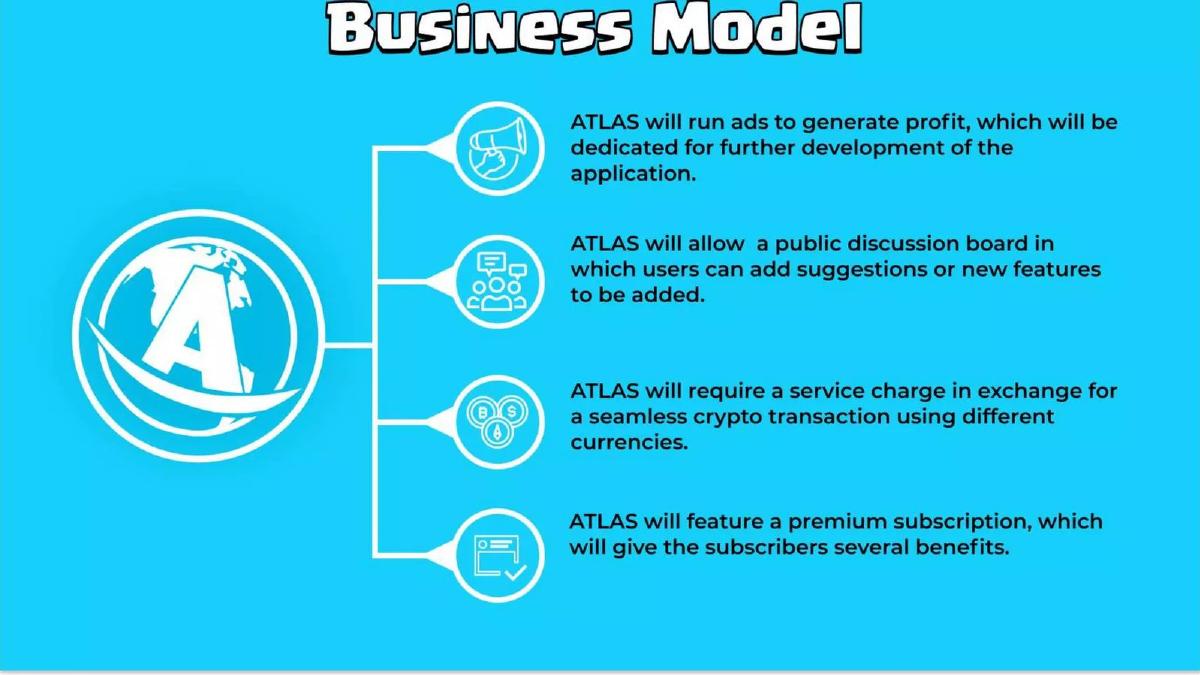
- Revenue is planned through four channels: advertising, service charges on crypto transactions, premium subscriptions, and a public discussion board (Slide 6).
- The product includes an integrated 'ATLAS wallet' for storing and interacting with crypto and NFTs (Slide 9).
- Social features include personal channels, spaces, and voice-based AMA rooms (Slide 10).
- The deck completely omits a team slide, financial projections, and a specific investment ask.
- There is a disconnect between the 'Metaverse MMO' branding on the cover and the fintech-heavy product slides (Slide 1 vs Slide 9).
Slide-by-Slide Teardown
Slide 1: Cover Page
The cover slide introduces the company as 'ATLAS' with the subtitle 'Metaverse MMO.' The primary value proposition stated is 'Make Fast & Easy Investments Anytime, Anywhere!' The visual style uses a 3D globe and castle-like structures, suggesting a gaming or virtual world environment. However, the term 'Super-App' is also used, creating an immediate ambiguity between whether this is a game or a financial tool.
Slide 2: Function
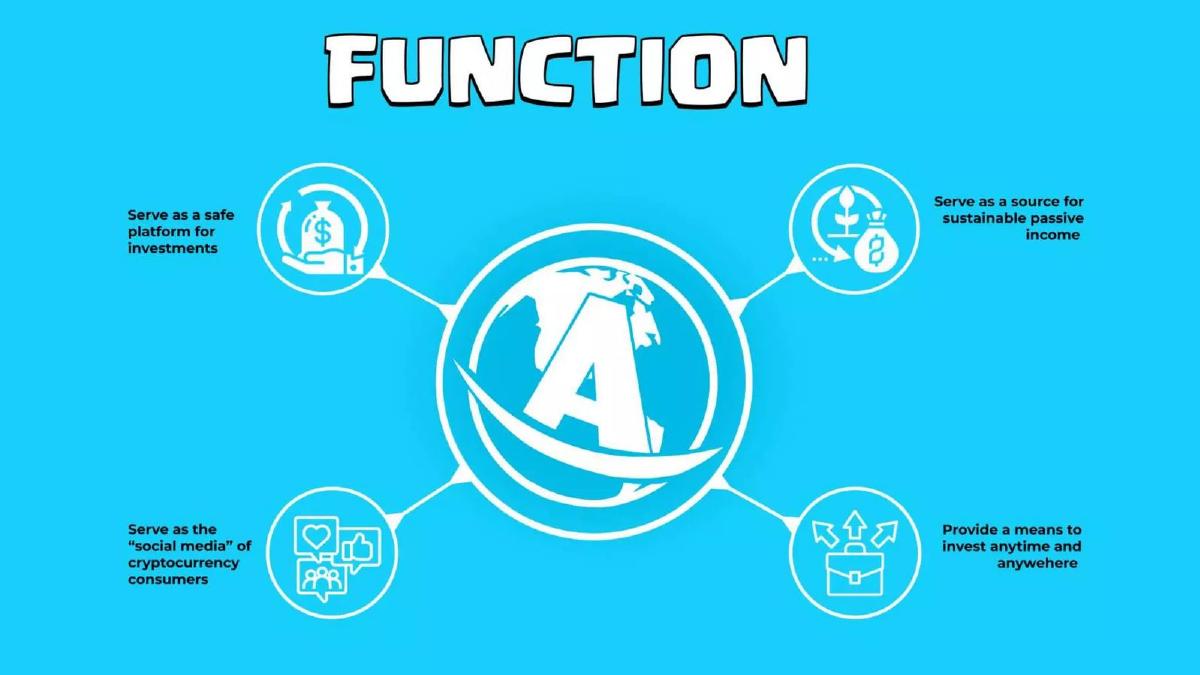
This slide lists four core functions of the platform: serving as a safe platform for investments, acting as a source for sustainable passive income, serving as the 'social media' of cryptocurrency consumers, and providing a means to invest 'anytime and anywhere.' The icons and text are high-level and do not explain the mechanics of how 'sustainable passive income' is generated.
Slide 3: Market Validation (Part 1)
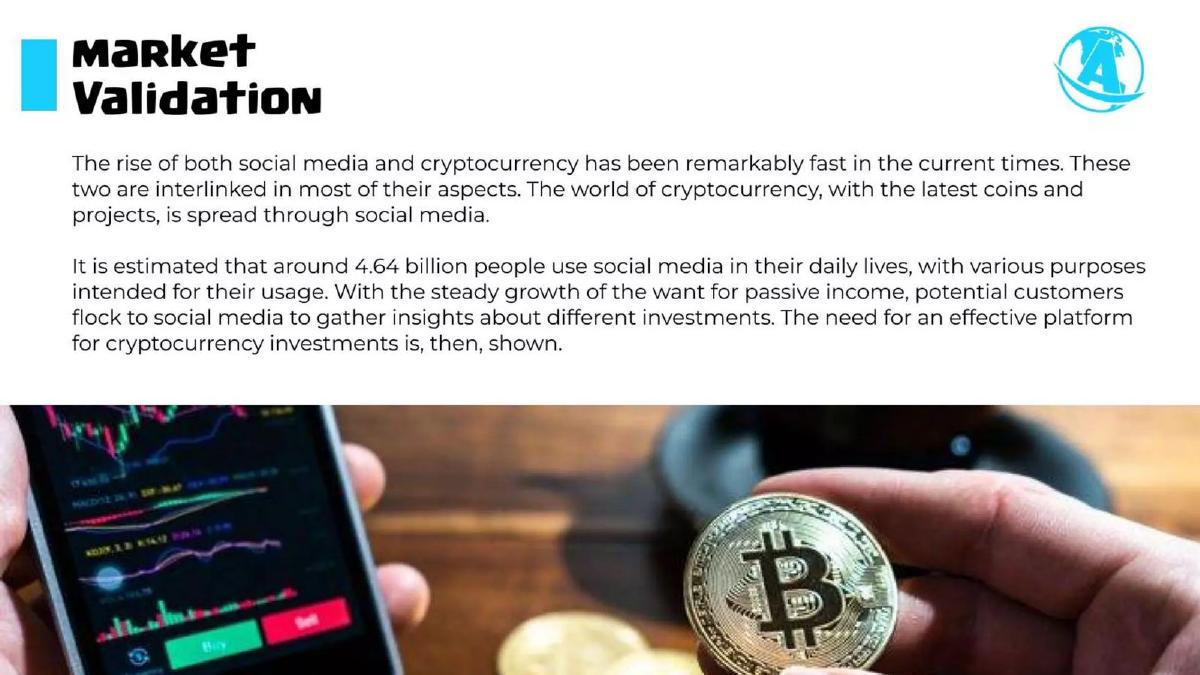
The deck cites a broad market statistic: 'around 4.64 billion people use social media in their daily lives.' It argues that because crypto projects are spread through social media, there is a need for an effective platform for cryptocurrency investments. This is a 'top-down' market validation that lacks specific data on the intersection of social media users and active crypto traders.
Slide 4: Market Validation (Part 2)
This slide introduces the 'Atlas Social System' as a natural marketing platform for 'Atlas Games, Projects, & Ventures.' It suggests a closed ecosystem where the social app drives users to other company-owned products. The slide uses generic stock photography of people in offices and gaming setups.
Slide 5: Market Adoption
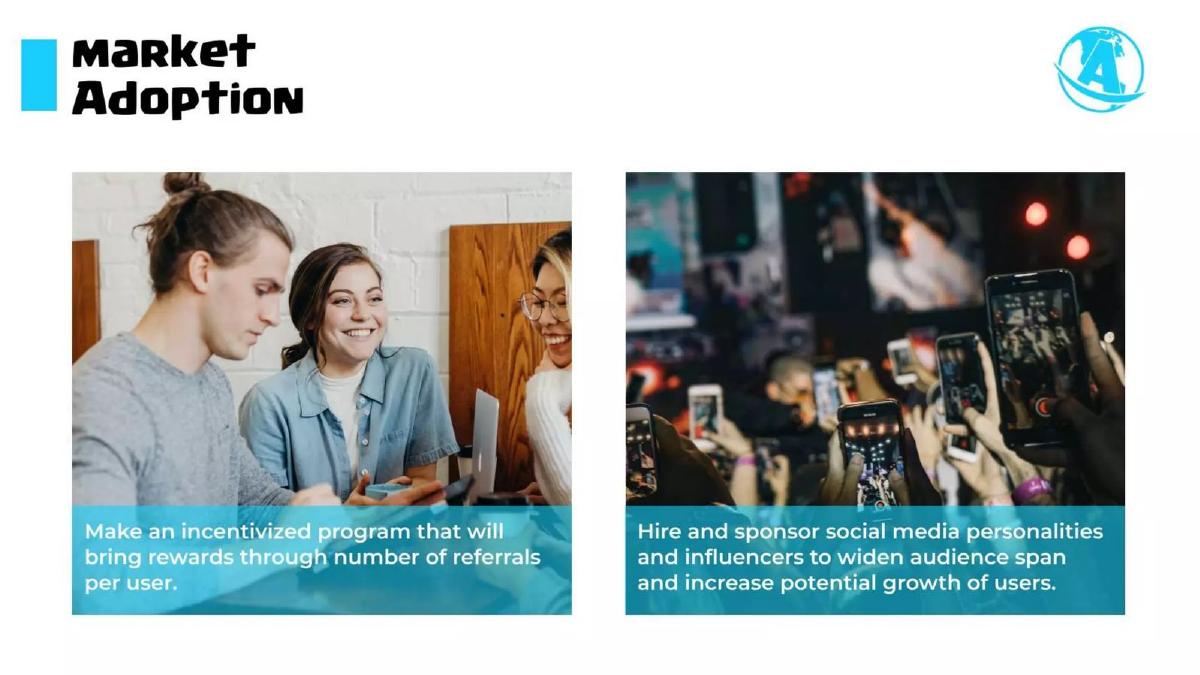
The growth strategy is divided into two tactics: an 'incentivized program' for referrals and the use of 'social media personalities and influencers.' There are no details on the cost of acquisition (CAC) or the specific budget required to execute these influencer sponsorships.
Slide 6: Business Model
ATLAS lists four revenue pillars: 1. Ads: To generate profit for development. 2. Public Discussion Board: Where users suggest features (though it is unclear how this generates revenue). 3. Service Charges: Fees for crypto transactions. 4. Premium Subscription: A paid tier for extra benefits. The slide lacks pricing tiers or projected average revenue per user (ARPU).
Slide 7: Product Overview
This slide shows mockups of the 'ATLAS Super Application.' The UI includes tabs for 'News,' 'Social,' 'NFT Store,' and 'DAPP.' The branding 'Metaverse MMO' appears on the splash screen of the phone mockup, continuing the theme of a gaming-finance hybrid.
Slide 8: Social Features
The mockups here display a voice chat interface (labeled 'VOICE') and a direct messaging list. One screen shows a 'My Wallet' view with a balance of '$328551.30 USD,' though this is clearly a placeholder figure. The social interface appears to mimic existing platforms like Discord or Telegram.
Slide 9: ATLAS DAPP and Wallet
This slide focuses on the 'ATLAS wallet.' It claims to support the 'Smart Chain BEP-20' and shows a list of tokens including Atlas, BNB, and Polygon. It also features an NFT gallery showing popular collections like Bored Ape Yacht Club and Azuki, implying compatibility with major NFT assets.
Slide 10: Social Empire
The final slide emphasizes the ability to 'Create Your Own Social Empire' by running or joining channels and spaces. It highlights voice-based AMA (Ask Me Anything) rooms, featuring a mockup of a 'Mike Flynn' hosting an AMA. The slide concludes the deck without a 'Thank You,' contact information, or a call to action.
What Works
Visual Consistency: The deck maintains a consistent color palette and font choice throughout, which gives it a professional, albeit gaming-centric, look. The use of high-fidelity mobile mockups helps the reader visualize the intended user experience.
Clear Categorization: The deck follows a logical flow from function to market validation, adoption, business model, and finally, product deep-dives. This structure is standard and easy for an analyst to navigate.
Multi-Channel Revenue: By identifying four different ways to monetize (ads, fees, subscriptions, and ecosystem growth), the founders show they are thinking about the long-term sustainability of the platform beyond just a single transaction fee.
What is Missing
The Team Slide: This is the most critical omission. In the cryptocurrency and fintech space, the technical and regulatory background of the founders is paramount. Without knowing who is building the 'safe platform,' investors cannot assess the project's credibility.
The Ask: The deck does not state how much money is being raised, the valuation, or the milestones the funding will help achieve. A pitch deck without an 'Ask' slide is merely a product brochure.
Technical Specifications: For a 'Super-App' that claims to handle crypto transactions and a 'Metaverse MMO,' there is zero information on the underlying technology. It mentions 'Smart Chain BEP-20' on Slide 9, but does not explain the architecture of the social system or the MMO components.
Traction and Roadmap: There are no metrics indicating if a beta version exists, how many users are on a waitlist, or what the development timeline looks like. Investors need to see a path from these mockups to a live product.
Founder Takeaways
Define Your Category: ATLAS suffers from a bit of an identity crisis. The cover says 'Metaverse MMO,' but the product slides show a social media and wallet app. If you are building a 'Super-App,' be very clear about which feature is the 'hook' and which are the 'add-ons.' Mixing gaming and fintech branding can confuse investors regarding your primary target audience.
Avoid Placeholder Metrics: Slide 8 shows a wallet balance of over $300,000. Using large, arbitrary numbers in mockups can sometimes come across as amateurish or misleading. It is better to use realistic or zeroed-out numbers to keep the focus on the UI/UX rather than the hypothetical wealth of a user.
Address Regulation: Any app that includes a 'service charge' for 'crypto transactions' (Slide 6) and a 'personalized wallet' (Slide 9) is entering a heavily regulated financial space. Founders should include at least one bullet point or slide addressing their approach to compliance, KYC (Know Your Customer), and security.
Include Contact Info: Never end a deck without a way for the investor to reach you. Slide 10 ends abruptly, missing a vital opportunity to provide a website link, email address, or social media handle for the project.
Frequently asked questions
- What is the core product of ATLAS?
- ATLAS is described as a 'Super-App' that combines social media functionality with cryptocurrency investment tools. According to Slide 7 and Slide 9, it includes a news feed, a social network, an NFT store, a decentralized application (DAPP) interface, and a personalized 'ATLAS wallet' for managing digital assets.
- How does ATLAS plan to make money?
- Slide 6 outlines four primary revenue streams: running advertisements to fund development, charging service fees for crypto transactions across different currencies, offering a premium subscription with 'several benefits,' and utilizing a public discussion board for user-led feature development.
- Who is the team behind ATLAS?
- The pitch deck does not include a team slide. There is no information regarding the founders, their professional backgrounds, or any advisors involved in the project. This is a significant omission for a startup seeking investment in the complex crypto and social media space.
- What is the company's go-to-market strategy?
- As stated on Slide 5, the market adoption plan focuses on two pillars: an incentivized referral program that rewards users for bringing in new members, and the hiring of social media personalities and influencers to widen the audience span and increase user growth.
- Is there any evidence of current traction or a funding goal?
- No. The 10-slide deck contains no metrics regarding current users, revenue, or partnerships. Furthermore, it does not state how much capital the company is looking to raise or how those funds would be allocated.