The Athersys (ATHX) investor deck from August 2018 serves as a technical validation tool for a publicly traded biotechnology company. Rather than focusing on early-stage problem/solution narratives, the deck leans heavily into clinical trial results, regulatory designations, and manufacturing moats. With MultiStem as the lead candidate, the company showcases a broad pipeline spanning neurological, cardiovascular, and inflammatory diseases. Key data points include a 23.8% delta in 'excellent outcomes' for stroke patients treated within 36 hours (Slide 17) and a clear transition from 2D cell cu…
Key takeaways
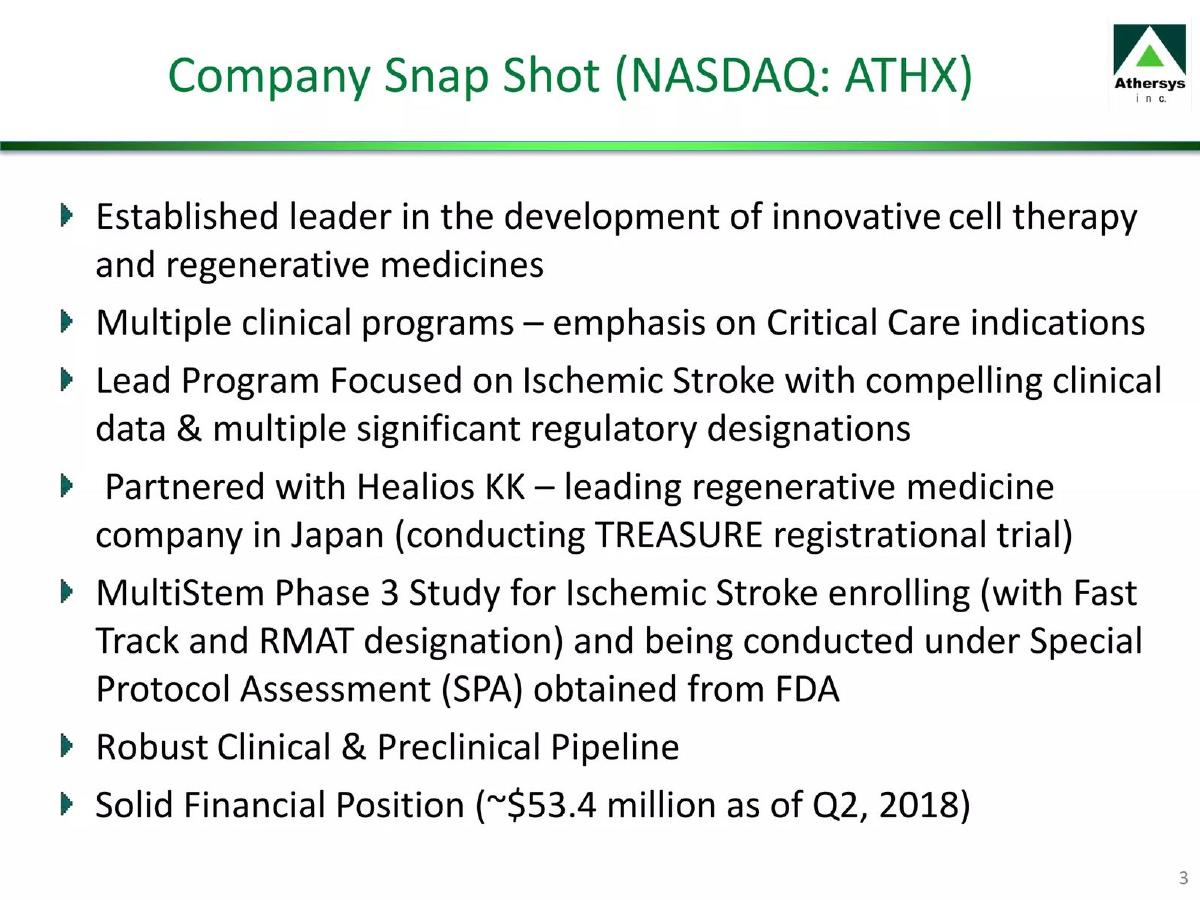
- The company maintains a diverse pipeline with lead programs in Phase 3 for Ischemic Stroke (Slide 2).
- Athersys emphasizes manufacturing as a competitive advantage, transitioning from 2D culture to commercial-scale 3D bioreactors (Slide 9).
- MultiStem's mechanism of action involves modulating the immune response from the spleen to prevent brain tissue loss (Slide 13).
- Clinical data from the Masters-1 trial shows a p < 0.01 significance for early treatment (<36 hours) in stroke patients at one year (Slide 17).
- Biomarker data confirms MultiStem's impact on key inflammatory cytokines like IL-1β (p=0.01) and TNFα (p=0.03) (Slide 21).
- The platform extends beyond stroke to include Acute Respiratory Distress Syndrome (ARDS) and HSC Transplant/GvHD (Slide 2).
- Preclinical data demonstrates reduced inflammation in human lungs with ischemic reperfusion injury (Slide 30).
- The deck highlights regulatory tailwinds including RMAT designation from the FDA and Priority Review from PMDA in Japan (Slide 2).
Athersys Investor Deck: A Technical Deep Dive into Regenerative Medicine
The Athersys (NASDAQ: ATHX) deck from August 2018 is a classic example of a late-stage biotech investor presentation. It moves past the 'visionary' stage and into the 'validation' stage, where the primary currency is clinical data, regulatory milestones, and manufacturing feasibility. The deck is structured to convince institutional investors that the company's lead candidate, MultiStem, is not only biologically effective but also commercially viable through scalable production.
Slide 1: Title and Identity
The cover slide establishes the company's public identity, prominently featuring the NASDAQ ticker (ATHX) and the date (August 2018). The use of a microscopic cell background immediately signals the sector: regenerative medicine and cell therapy. It is a standard, professional entry point for a public company update.
Slide 2: The Regenerative Medicine Pipeline
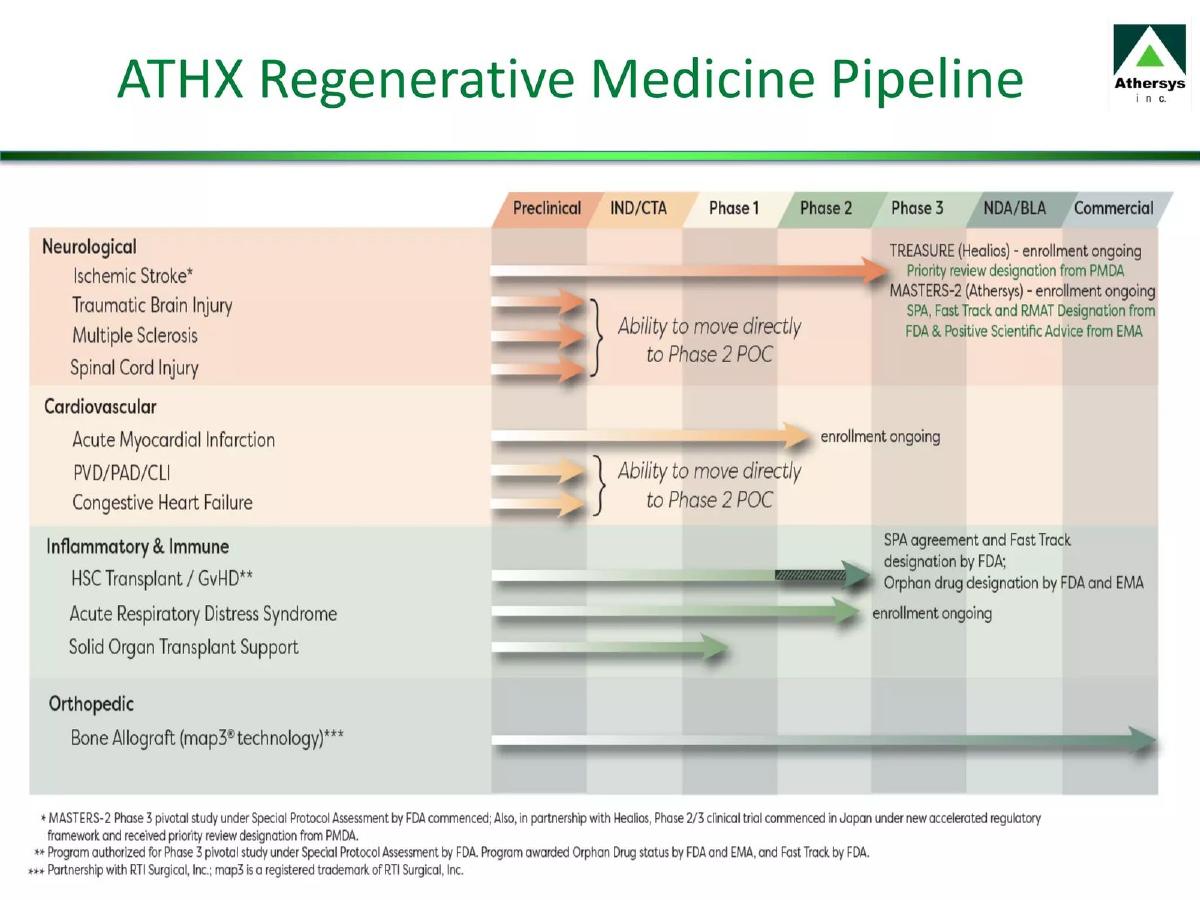
This is one of the most information-dense slides in the deck. It categorizes the Athersys portfolio into four pillars: Neurological, Cardiovascular, Inflammatory & Immune, and Orthopedic. Key highlights from Slide 2 include:
Ischemic Stroke: Listed as the lead program with two Phase 3 trials: TREASURE (Healios) and MASTERS-2 (Athersys). · Regulatory Designations: The slide notes 'Priority review designation from PMDA' and 'RMAT Designation from FDA,' which are critical value drivers in biotech. · Breadth: The pipeline shows MultiStem's versatility, with active programs in ARDS (enrollment ongoing) and HSC Transplant (Orphan drug designation).
The visual layout uses arrows to show the progression from Preclinical to Commercial. Notably, the 'Bone Allograft' program is the only one shown as already reaching the commercial stage, though it is marked as a partnership with RTI Surgical.
Slide 9: Manufacturing as a Competitive Advantage
Cell therapy companies often fail not because their science is bad, but because they cannot manufacture at scale. Slide 9 addresses this head-on. It shows a three-step evolution: Traditional 2D Culture (flasks), 3D Bioreactors (small scale), and Commercial Scale Bioreactors (large stainless steel tanks). The headline 'Highly Scalable: Key Competitive Advantage' tells the investor that Athersys has solved the cost-of-goods and volume challenges that plague autologous (patient-specific) cell therapies.
Slide 13: Mechanism of Action (MOA) for Stroke
Biotech investors need to understand the 'how.' Slide 13 uses a human anatomical diagram to explain that MultiStem is administered intravenously. The core scientific claim is that the cells migrate to the spleen (a key immune organ) to modulate the body's hyperinflammatory response. By downregulating the inflammatory cascade, the therapy prevents the secondary tissue loss and scarring in the brain that typically follows an ischemic stroke. Citing a 2017 publication in Stem Cells adds academic weight to these claims.
Slide 17: Clinical Trial Results (Masters-1)
This slide provides the 'proof' for the stroke program. It presents data from the Masters-1 trial, focusing on 'Excellent Outcomes' (measured by NIHSS, mRS, and Barthel Index). The data points on Slide 17 are specific:
For all trial subjects (ITT), the delta at Day 365 was 14.9% (p=0.02). · For the 'Original Trial Protocol' (early treatment To support the clinical outcomes, Slide 21 provides biochemical evidence. It shows that MultiStem treatment leads to a significant reduction in circulating CD3+ T-cells compared to placebo (p=0.001). Furthermore, a table lists p-values for various inflammatory cytokines at Day 7, including IL-1β (0.01) and TNFα (0.03). This slide is intended to show that the drug is doing exactly what the MOA slide (Slide 13) predicted it would do at a molecular level.
Slide 27: Portfolio Expansion
A simple transition slide titled 'Other Portfolio Programs' indicates that while stroke is the primary focus of this deck, the company has depth in other areas. This is a common tactic to show 'multiple shots on goal,' reducing the perceived risk if the lead program hits a snag.
Slide 30: ARDS and Lung Injury Data
The final slide in this selection focuses on Acute Respiratory Distress Syndrome (ARDS). It shows preclinical data demonstrating that MultiStem (MAPC) reduces inflammation in human lungs. Figure 3 shows a 'significant decrease in overall inflammation' across four different lung samples. Figure 4 provides photomicrographs showing minimal inflammatory cell infiltrates in treated lungs compared to control. This serves to validate the 'Inflammatory & Immune' pillar of the pipeline mentioned on Slide 2.
What Athersys Does Well
The Athersys deck is a masterclass in technical validation . It avoids fluff and focuses on the metrics that matter to biotech analysts: p-values, regulatory designations, and manufacturing scalability. By showing the MOA (Slide 13) alongside the biomarker data (Slide 21) and the clinical outcomes (Slide 17), they build a cohesive 'scientific narrative' that feels logical and evidenced-based. The emphasis on 3D bioreactors (Slide 9) is also a very smart move, as it addresses the primary execution risk in the cell therapy sector.
What is Missing
As this is a 'Company Overview' likely intended for a website or general investor use, several key components are missing from these selected slides:
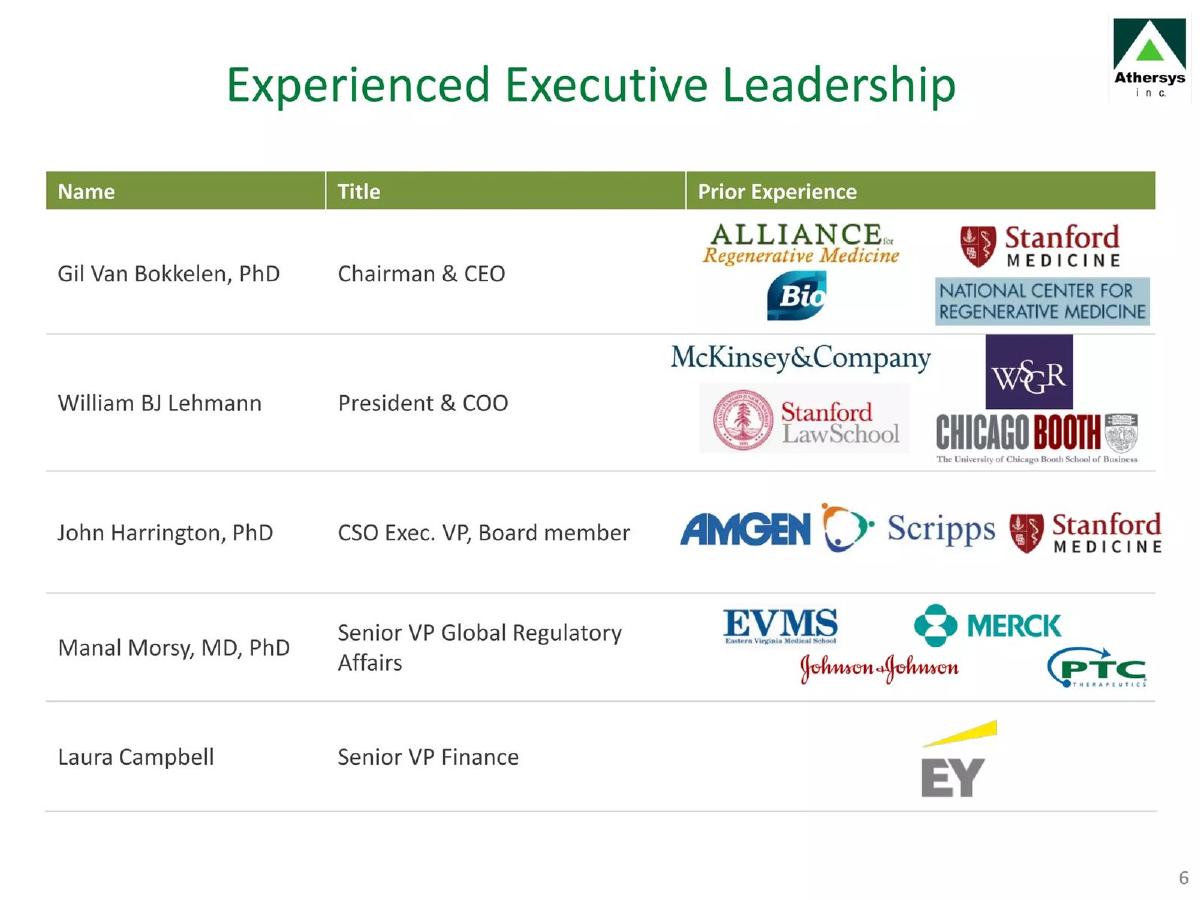
Financials: There is no mention of cash runway, burn rate, or recent capital raises. For a public biotech, these are essential for assessing the risk of dilution. · Team: No slide is provided detailing the management team or scientific advisory board. In biotech, the pedigree of the clinical and regulatory leads is paramount. · Market Size: While the diseases are mentioned, the deck does not quantify the Total Addressable Market (TAM) in dollar terms or patient populations for stroke and ARDS. · Competition: There is no competitive landscape slide. Investors need to know how MultiStem compares to other stem cell therapies or traditional pharmaceuticals in the same space.
Founder Takeaways
Use Data to Tell a Story: Athersys doesn't just say 'it works.' They show the mechanism (Slide 13), the molecular change (Slide 21), and the patient outcome (Slide 17). If you are building a deep-tech or life-sciences company, your deck must connect these dots to be credible.
Address the 'How' of Scaling Early: Many founders focus entirely on the 'what' (the product). Athersys dedicates an entire slide (Slide 9) to 'how' they will make the product at scale. This preempts a major investor concern regarding margins and supply chain.
Highlight Regulatory Wins: In highly regulated industries, designations like 'Fast Track' or 'RMAT' are massive value inflection points. Athersys puts these front and center on their pipeline slide (Slide 2) to signal that the FDA and other agencies see the potential in their work.
Frequently asked questions
- What is the primary therapeutic candidate discussed in the deck?
- The primary candidate is MultiStem, a regenerative medicine product. The deck focuses on its application for Ischemic Stroke, where it is in Phase 3 trials (TREASURE and MASTERS-2), as well as its potential in treating ARDS and other inflammatory conditions.
- How does Athersys address the challenge of cell therapy manufacturing?
- Slide 9 identifies 'Highly Scalable' manufacturing as a key competitive advantage. It illustrates a progression from traditional 2D culture to 3D bioreactors, and finally to large-scale commercial bioreactors, which is a common bottleneck in the cell therapy industry.
- What were the specific clinical outcomes for the stroke trials?
- According to Slide 17, patients receiving early MultiStem treatment (<36 hours) showed a 29.6% 'Excellent Outcome' rate at Day 365 compared to 5.8% for the placebo group. This resulted in a 23.8% delta with a statistically significant p-value of <0.01.
- What regulatory advantages does Athersys claim?
- Slide 2 lists several high-value designations: Fast Track and RMAT (Regenerative Medicine Advanced Therapy) from the FDA, Priority Review from the PMDA in Japan, and Orphan Drug designation from both the FDA and EMA for specific programs.
- What is the biological mechanism behind MultiStem?
- Slide 13 explains that MultiStem works by downregulating neuroinflammation and upregulating repair. Specifically, it targets the hyperinflammatory response emanating from the spleen following a stroke, which otherwise leads to scarring and tissue loss in the brain.