Auctio's 10-slide deck is characterized by extreme brevity and a heavy reliance on visual data over text. Raising $475,000 in 2014, the company positioned itself as a solution for the inefficiencies in B2B lead generation. The deck highlights that referrals convert at 3.74, nearly 4x the average of all other channels. While the deck succeeds in establishing a clear problem-solution fit and demonstrating early traction—growing from 51 to 128 companies in seven months—it lacks critical financial details. There is no mention of unit economics, business model, or a specific funding ask. Despite t…
Key takeaways
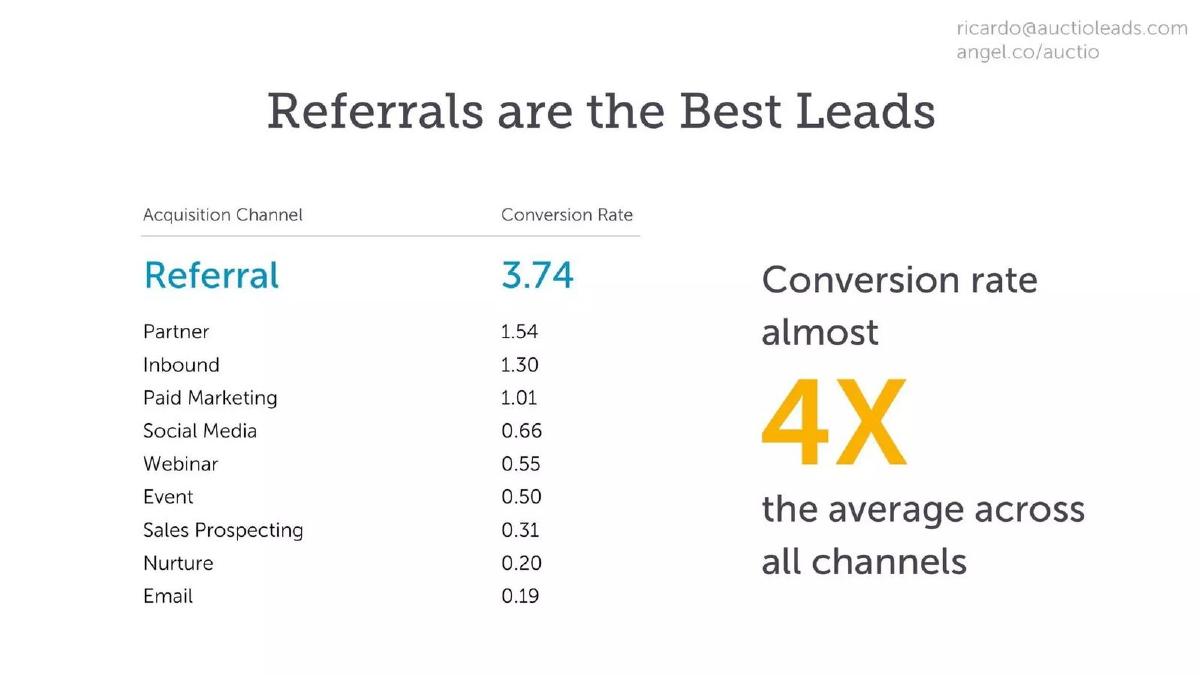
- Referrals are identified as the highest-performing acquisition channel with a 3.74 conversion rate on slide 5.
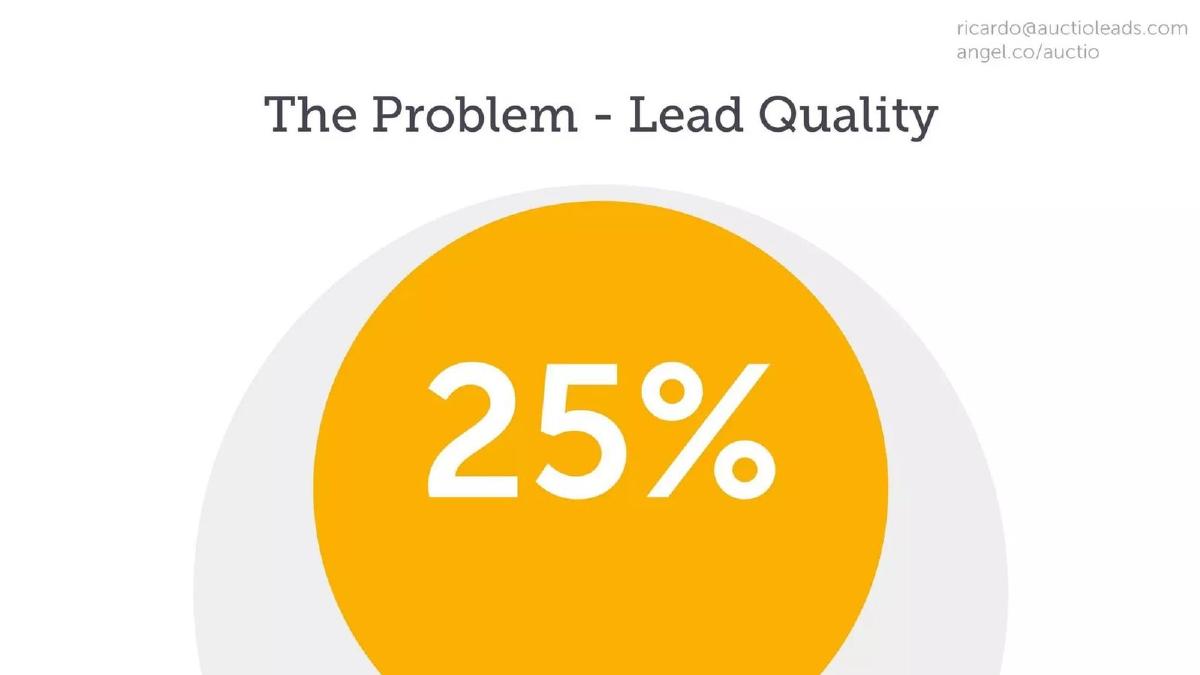
- The deck highlights a significant market gap, noting that lead quality is a major problem with a 25% figure cited on slide 3.
- Traction is demonstrated through a 2x growth in the number of companies using the platform, reaching 128 by October as shown on slide 9.
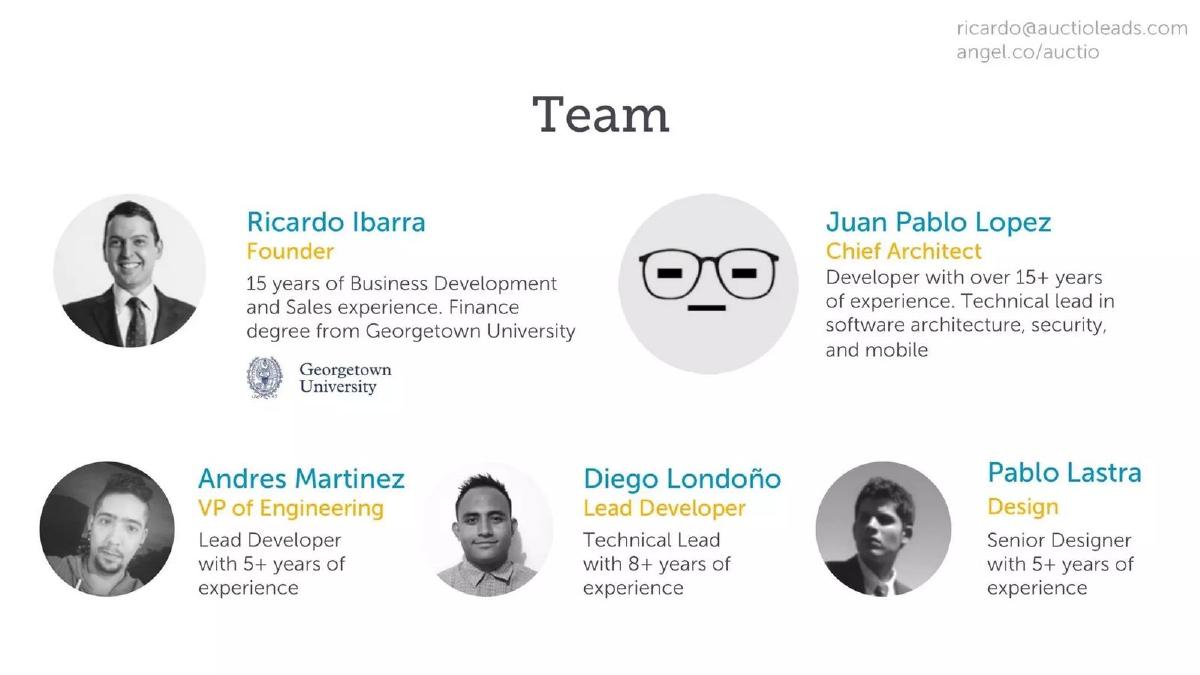
- The team possesses deep domain expertise, including a founder with 15 years of business development experience and a Chief Architect with 15+ years in software on slide 4.
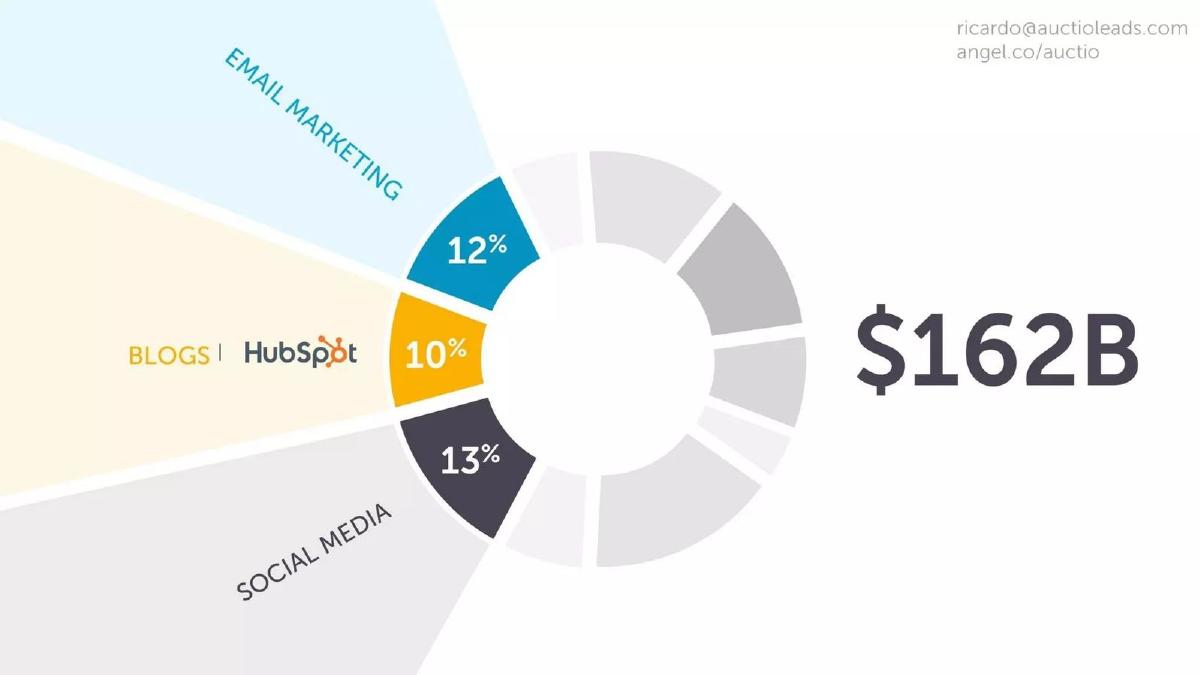
- Market size is visually represented by a $162B figure on slide 6, though the specific breakdown of this TAM is not detailed.
- The deck completely omits a business model slide, leaving the revenue generation strategy to the investor's imagination.
- There is no 'Ask' slide, meaning the specific amount sought and the intended use of funds are not documented in the presentation.
- The solution is presented as a central hub that simplifies a chaotic, multi-channel referral process into a streamlined workflow on slides 7 and 8.
Introduction: The Power of Brevity
Auctio’s 2014 pitch deck is a notable example of the 'less is more' philosophy in startup fundraising. Consisting of only 10 slides, the deck relies heavily on high-impact numbers and clean visuals to tell a story of market inefficiency and a simple, scalable solution. At a time when B2B lead generation was becoming increasingly fragmented across social media, email, and paid ads, Auctio focused on the one channel that consistently outperformed the rest: referrals.
Slide 1: Title and Vision
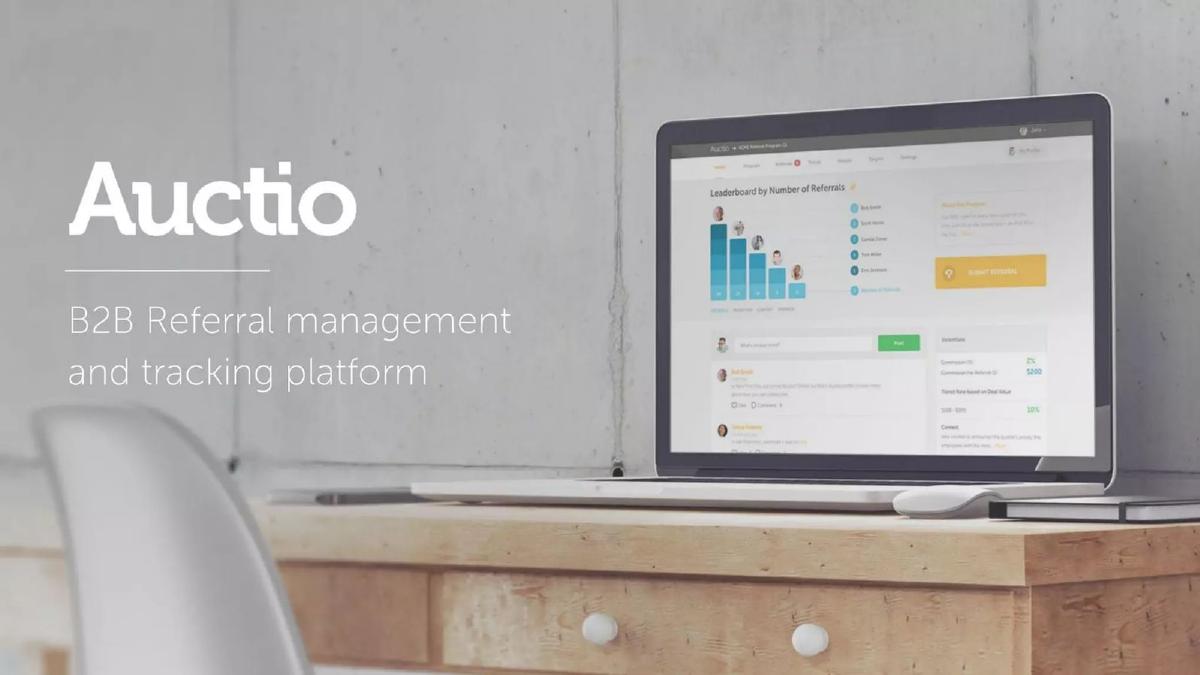
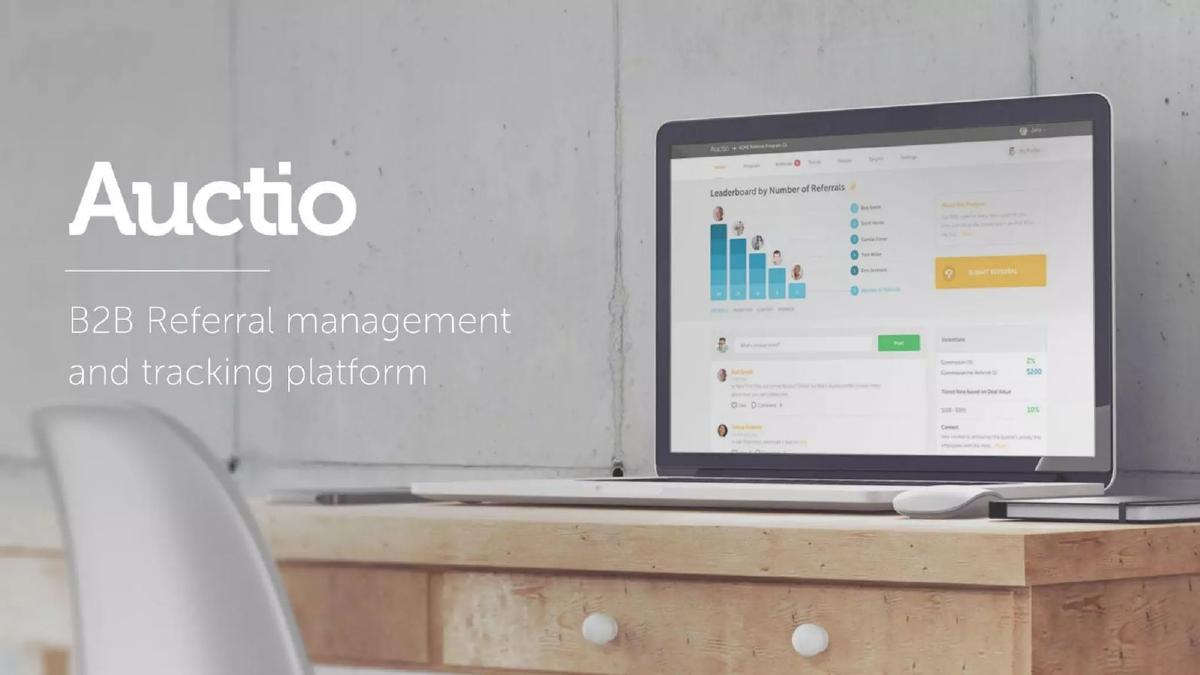
The cover slide is minimalist, featuring a high-quality lifestyle image of a laptop on a wooden desk. The text is simple: Auctio , followed by the sub-headline B2B Referral management and tracking platform . The laptop screen displays a mockup of the dashboard, showing a 'Leaderboard by Number of Referrals' and an 'Incentives' section. This immediately establishes the product as a SaaS tool with a focus on gamification and tracking.
Slides 2 & 3: The Problem Statement
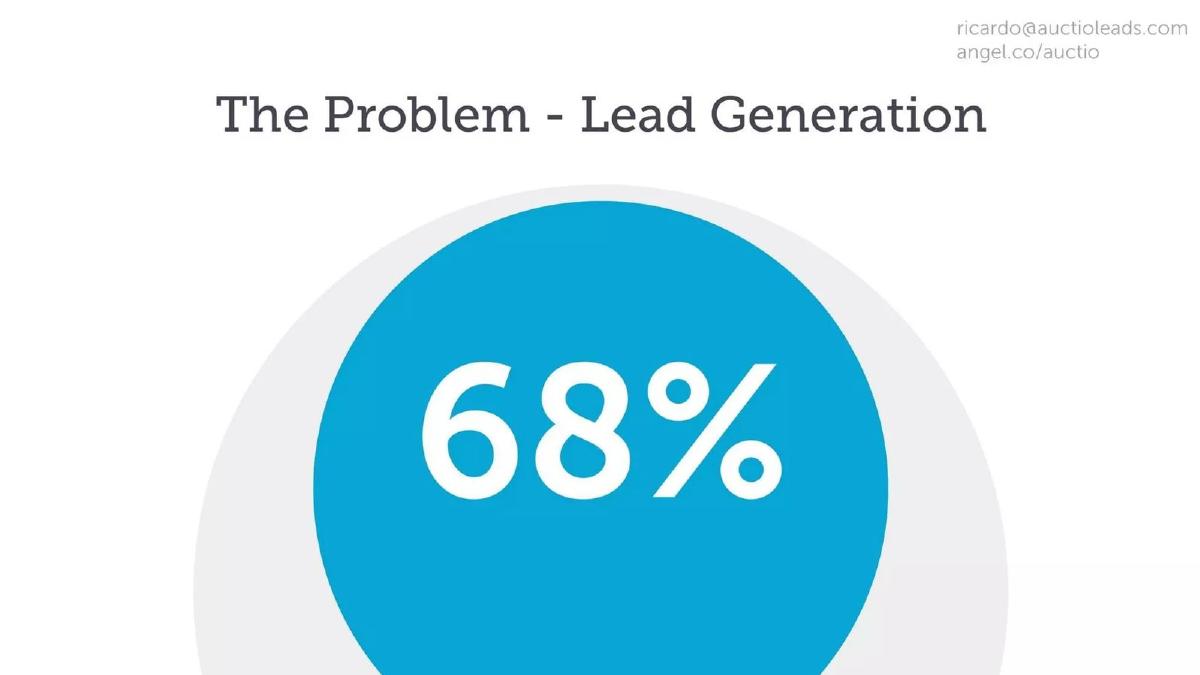
Auctio breaks the problem into two distinct slides. Slide 2, titled The Problem - Lead Generation , displays a massive 68% in a blue circle. Slide 3, The Problem - Lead Quality , shows 25% in a yellow circle. While the deck does not provide the specific source or context for these percentages in the text, the implication in a sales context is clear: a large portion of companies struggle with lead generation, and an even larger portion struggle with the quality of those leads. The lack of explanatory text forces the presenter to provide the narrative, which can be a double-edged sword in a deck sent via email.
Slide 4: The Team
The team slide is one of the most detailed in the deck, highlighting a strong balance between sales and technical expertise. Ricardo Ibarra (Founder) is credited with 15 years of Business Development and Sales experience and a degree from Georgetown University. Juan Pablo Lopez (Chief Architect) brings over 15+ years of experience in software architecture and security. The engineering team is rounded out by Andres Martinez (VP of Engineering) and Diego Londoño (Lead Developer) , with 5+ and 8+ years of experience respectively. Pablo Lastra is listed as the Senior Designer. This slide serves to de-risk the investment by showing a veteran team capable of both building and selling the product.
Slide 5: The Referral Advantage
This is the 'aha' moment of the deck. Titled Referrals are the Best Leads , it compares conversion rates across various acquisition channels. Referral sits at the top with a 3.74 conversion rate. Other channels follow: Partner (1.54), Inbound (1.30), Paid Marketing (1.01), and Social Media (0.66). The slide highlights that the referral conversion rate is almost 4X the average across all channels . This data-driven approach validates the company’s focus on a specific niche within the broader marketing tech stack.
Slide 6: Market Opportunity
Slide 6 uses a doughnut chart to visualize the market. A large $162B figure dominates the right side of the slide. The chart segments include Email Marketing (12%), Blogs/HubSpot (10%), and Social Media (13%). The visual suggests that Auctio is positioning itself to capture a share of a massive total addressable market (TAM) by improving the efficiency of spend that is currently being wasted on lower-converting channels.
Slides 7 & 8: The Solution and Workflow
Slide 7, Current Referral Process , uses a chaotic web of icons and arrows to represent the messy reality of modern referrals. It shows unhappy avatars, question marks, and disconnected communication channels (phone, email, chat). Slide 8, Our Solution , replaces this chaos with a clean, centralized Auctio logo. The unhappy avatars are replaced with smiling ones, and the communication is shown as a streamlined flow through the Auctio platform. This 'Before and After' visualization is a classic pitch deck technique to demonstrate value without getting bogged down in technical specifications.
Slide 9: Traction and Growth
Traction is presented through a simple line graph titled Number of Companies . The data points show a consistent upward trend: 51 in April, 54 in May, 67 in June, 75 in July, 100 in August, 110 in September, and 128 in October . The slide features a large 2X Growth callout. This slide proves that the product has moved beyond the conceptual stage and is gaining actual market adoption.
Slide 10: The Closing Hook
The final slide is unconventional. Instead of a 'Thank You' or contact info, it presents a call to action: Text a B2B Founder: "What % of your revenue comes from referrals?" . This is designed to provoke a realization in the investor that referrals are the lifeblood of B2B companies, yet they are rarely managed with the same rigor as paid ads or email marketing.
What Works in the Auctio Deck
The deck’s greatest strength is its clarity of focus . By centering the entire narrative on the 4x conversion rate of referrals, Auctio makes a compelling mathematical case for its existence. The traction slide (Slide 9) is also highly effective; it shows a clear, non-stagnant growth curve that suggests the team knows how to acquire customers. Finally, the team slide (Slide 4) provides the necessary 'why us' by showcasing decades of combined experience in the exact fields required to make a sales-enablement tool successful.
What is Missing from the Auctio Deck
While the deck is visually clean, it omits several critical pieces of information that most institutional investors require. Unit Economics and Business Model: There is no mention of how much Auctio charges, what the average contract value (ACV) is, or what the customer acquisition cost (CAC) looks like. Competitive Landscape: The deck assumes Auctio is the only player in the space, failing to mention competitors like Influitive or Ambassador, which were active during the same period. The Ask: Perhaps the most glaring omission is the lack of a funding slide. The deck does not state how much money is being raised, the valuation, or the milestones the team intends to hit with the new capital.
What a Founder Should Copy
Founders should emulate Auctio’s visual storytelling . The use of simple icons to represent a complex process (Slides 7 and 8) is far more effective than a wall of text explaining API integrations. The comparative data on Slide 5 is also a brilliant way to justify a startup's existence—if you can prove your niche is 4x better than the status quo, you have a winning argument. Lastly, the closing slide is a great example of how to leave an investor with a 'homework assignment' that reinforces your value proposition long after the meeting ends.
Conclusion
Auctio’s deck is a product of its time—a lean, 2014-era presentation that prioritized speed and high-level metrics over deep financial modeling. While it lacks the rigor of a modern Series A deck, its ability to distill a complex sales problem into a simple '4x better' narrative is a lesson in effective communication. For a seed-stage or early-stage raise of $475,000, this deck did exactly what it needed to do: it proved there was a big problem, a veteran team, and early signs of a working solution.
Frequently asked questions
- What was the primary value proposition of Auctio according to the deck?
- Auctio's primary value proposition was the optimization of B2B lead generation through referral management. The deck argues that while referrals are the most effective lead source, converting at 3.74 (slide 5), the current process is disorganized and inefficient (slide 7). Auctio acts as a centralized platform to track and incentivize these high-quality leads, effectively turning employees and influencers into a scalable marketing channel.
- How did Auctio demonstrate market traction?
- Auctio used a simple line graph on slide 9 to show a steady increase in the number of companies using their platform. The data shows a climb from 51 companies in April to 128 companies in October. The slide explicitly labels this as '2X Growth,' providing investors with a clear visual indicator of product-market fit and adoption speed within a seven-month window.
- Who were the key members of the Auctio founding team?
- The team, detailed on slide 4, was led by Founder Ricardo Ibarra, who brought 15 years of business development and sales experience. Technical leadership included Juan Pablo Lopez (Chief Architect) with 15+ years of experience, Andres Martinez (VP of Engineering) with 5+ years, and Diego Londoño (Lead Developer) with 8+ years. This combination of veteran sales leadership and experienced engineering was a core strength of the pitch.
- What major components are missing from this pitch deck?
- The deck is missing several standard slides required for a comprehensive evaluation. Most notably, there is no business model or pricing slide, no competitive analysis, and no financial projections. Furthermore, the deck lacks a 'The Ask' slide, which typically informs investors how much capital is being raised and how it will be allocated to reach specific milestones.
- How does Auctio frame the problem in the B2B lead generation market?
- Auctio frames the problem through two primary lenses: volume and quality. Slide 2 features a large '68%' figure under 'The Problem - Lead Generation,' and slide 3 features '25%' under 'Lead Quality.' By contrasting these pain points with the high conversion rate of referrals (slide 5), the deck positions Auctio as the necessary tool to fix a broken and expensive acquisition funnel.