AuditBoard’s 2024 acquisition deck is a textbook example of late-stage enterprise SaaS positioning. The company secured a $3B+ valuation by demonstrating a rare combination of high growth (40% YoY) and capital efficiency (FCF+). The deck centers on the 'Risk Exposure Gap,' a narrative device that elevates their software from a simple compliance tool to a mission-critical executive priority. By showcasing that ~50% of the Fortune 500 already use the platform, AuditBoard shifted the conversation from product features to market inevitability. The presentation meticulously maps out a path to $1B…
Key takeaways
- The company reports an ending ARR of $200MM+ with 40% year-over-year growth on slide 2.
- Gross retention is stated at 95%+, indicating extremely high product stickiness within enterprise accounts (slide 2).
- AuditBoard claims a presence in approximately 50% of the Fortune 500 and 6 of the Fortune 10 (slides 2 and 15).
- The total addressable market (TAM) is valued at $20 billion, with current annual spend estimated between $7-13 billion (slide 9).
- A 'Risk Exposure Gap' is quantified by a $14M average cost per noncompliance event and a $1B estimated cost per third-party incident (slide 3).
- The platform architecture is divided into four main customer solutions: Audit, Risk Management, IT Risk & Compliance, and ESG (slide 11).
- The company is Free Cash Flow positive (FCF+), highlighting a focus on capital efficiency alongside growth (slide 2).
- A clear product roadmap shows evolution from SOX compliance in 2015 to a global connected risk platform by 2023 (slide 16).
Executive Summary: The $3B Acquisition Deck
AuditBoard’s acquisition by Hg for over $3 billion in 2024 represents one of the most significant exits in the Governance, Risk, and Compliance (GRC) software sector. The deck used to facilitate this transition is a masterclass in enterprise SaaS positioning. It avoids the common pitfall of focusing solely on features, instead building a narrative around 'Connected Risk'—a strategic necessity for the modern C-suite. With $200MM+ in ARR and a 40% growth rate, the company demonstrates that it has moved past the 'start-up' phase and is now a category-defining incumbent.
Slide-by-Slide Analysis
Slide 1: Title Slide
The deck opens with a clean, professional aesthetic, identifying AuditBoard as "The Modern Connected Risk Platform." The visual elements—concentric circles and user avatars—immediately signal collaboration and a cloud-native environment. The subtitle "Connected Risk" is the central theme that persists throughout the presentation.
Slide 2: AuditBoard at a Glance
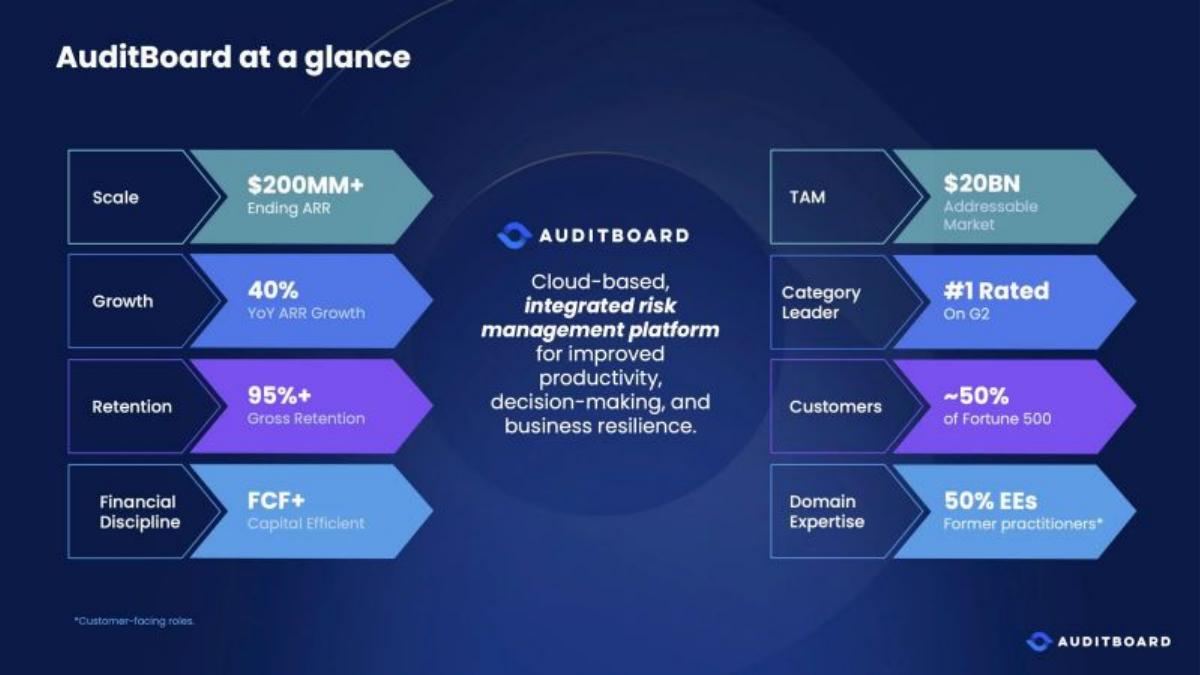
This is the most important slide for any investor or acquirer. It lists eight critical metrics that define the company's success. Scale: $200MM+ Ending ARR. Growth: 40% YoY ARR Growth. Retention: 95%+ Gross Retention. Financial Discipline: FCF+ (Free Cash Flow positive). TAM: $20BN Addressable Market. Category Leader: #1 Rated on G2. Customers: ~50% of Fortune 500. Domain Expertise: 50% of employees in customer-facing roles are former practitioners. This slide establishes immediate credibility; it is difficult to argue with a company that is both high-growth and profitable while serving half the Fortune 500.
Slide 3: The Risk Exposure Gap
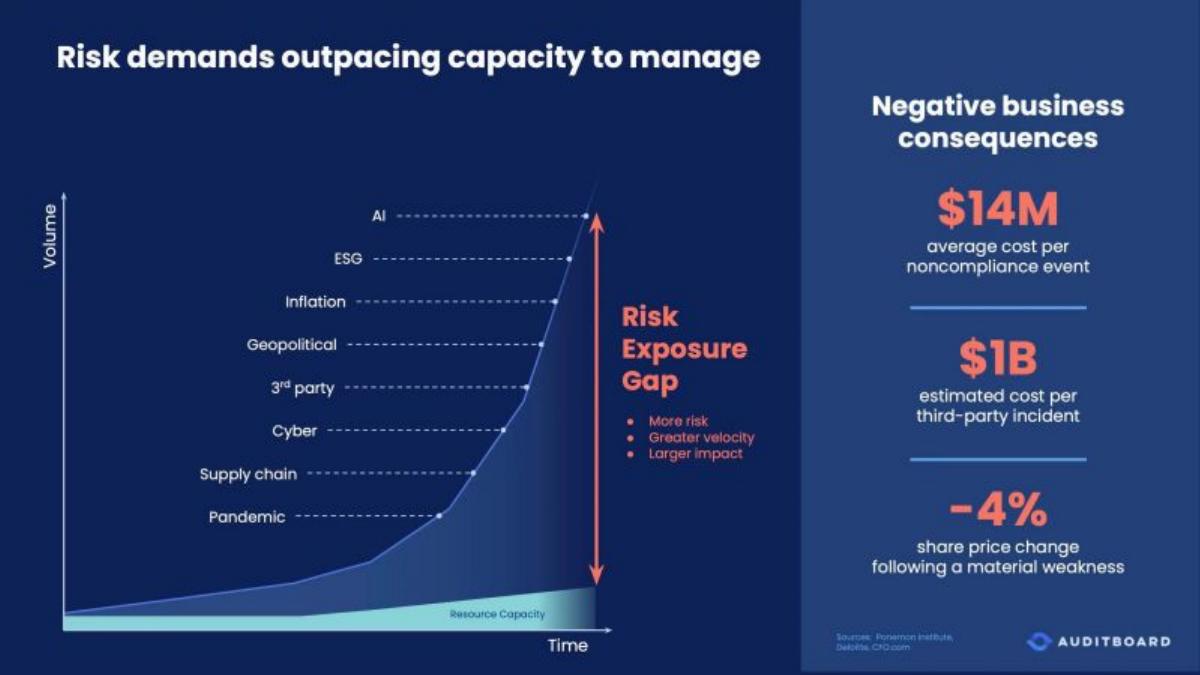
AuditBoard defines the problem not as a lack of software, but as a "Risk Exposure Gap." A graph shows risk volume (driven by AI, ESG, and Pandemics) growing exponentially while resource capacity remains flat. To drive home the stakes, the slide cites three figures: a $14M average cost per noncompliance event , a $1B estimated cost per third-party incident , and a -4% share price change following a material weakness. This shifts the product from a 'nice-to-have' to an insurance policy against catastrophic financial loss.
Slide 4: The Complexity of Regulation
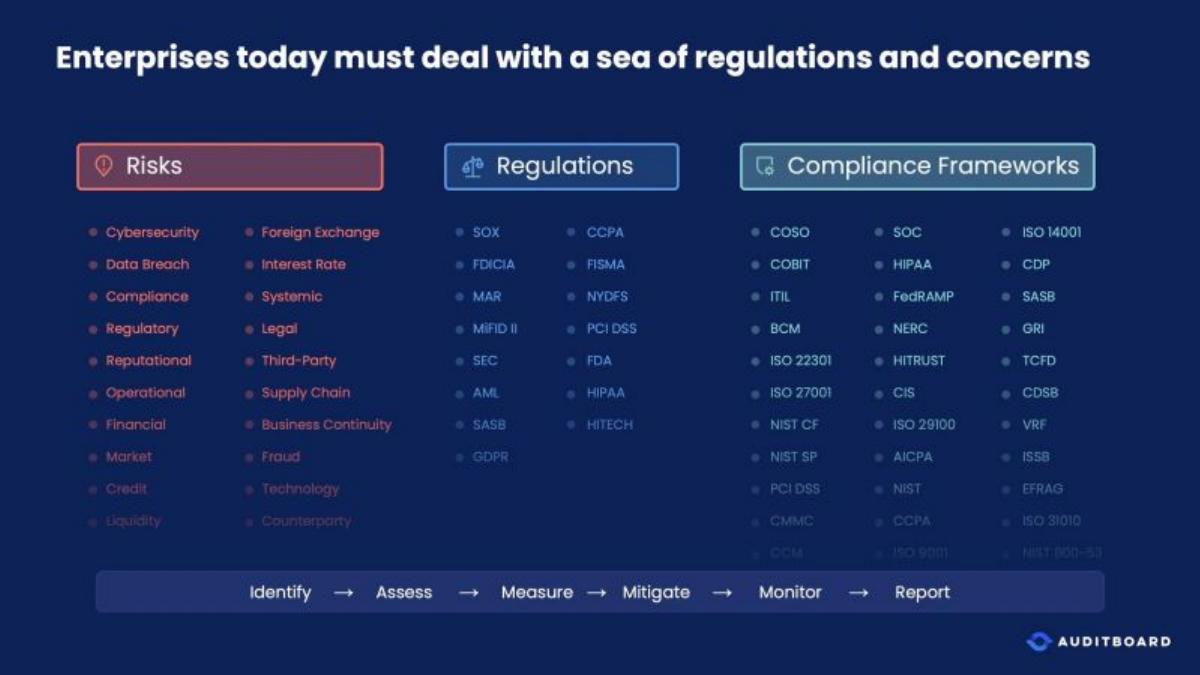
This slide visualizes the "sea of regulations" enterprises face. It lists dozens of acronyms across Risks (Cybersecurity, Fraud), Regulations (SOX, GDPR, HIPAA), and Compliance Frameworks (ISO, NIST, SOC). By listing these, AuditBoard demonstrates the sheer scale of the administrative burden their software automates.
Slide 5: The Three Lines of Defense
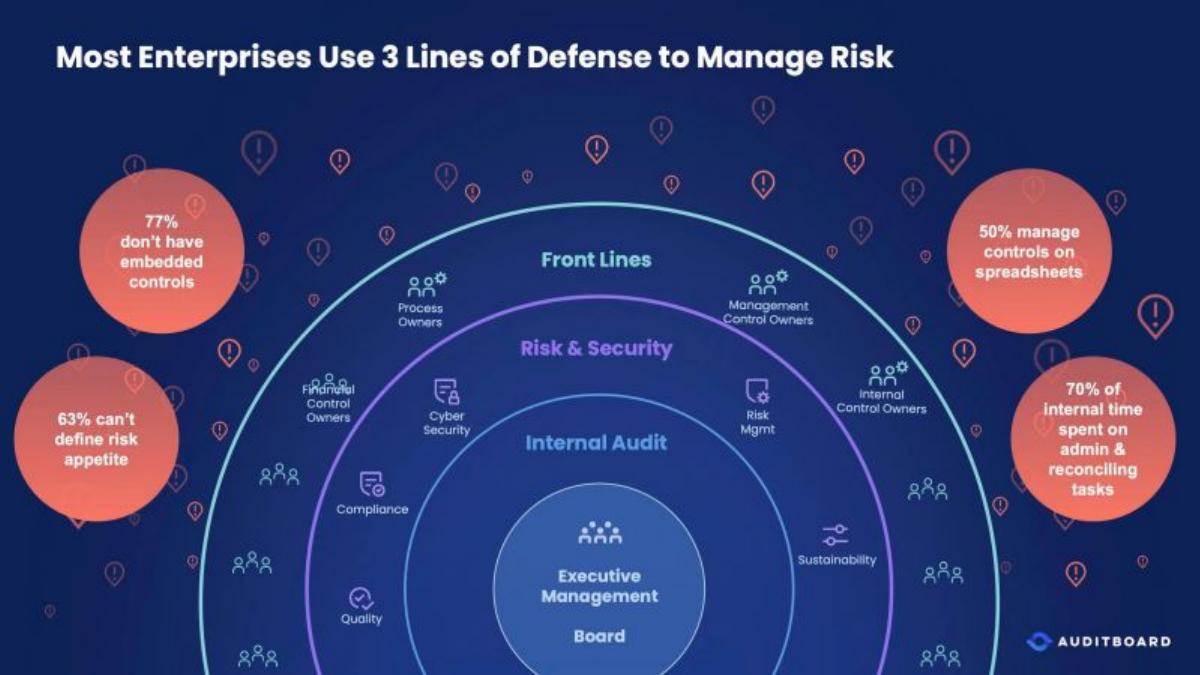
Using a standard industry framework, the deck illustrates how enterprises manage risk across Front Lines, Risk & Security, and Internal Audit. It highlights the inefficiency of current methods: 77% don't have embedded controls , 50% manage controls on spreadsheets , and 70% of internal time is spent on admin tasks . This identifies the specific 'human toll' the platform aims to reduce.
Slide 6 & 7: Complexity and Silos
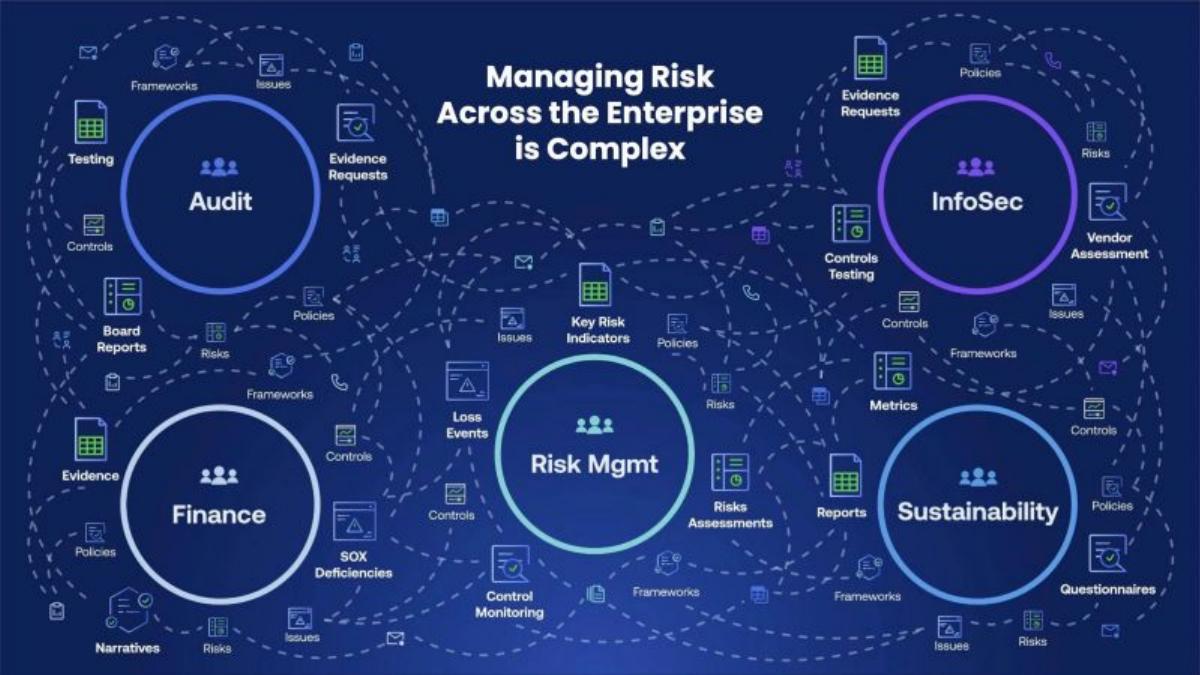
Slide 6 uses a 'spaghetti map' to show how Audit, InfoSec, Finance, Risk Mgmt, and Sustainability are currently tangled in a web of disconnected evidence requests and spreadsheets. Slide 7 summarizes why closing the gap is hard: siloed teams, manual processes, fragmented data, and disparate tools. This sets the stage for the 'Unified' solution.
Slide 8: Existing Solutions Fall Short
The company takes a direct shot at legacy competitors. It buckets them into homegrown tools (spreadsheets) and legacy GRC point solutions. The criticisms are sharp: not built for the cloud, narrow perspective, difficult to use, and requiring extensive customization. This positions AuditBoard as the only 'modern' alternative.
Slide 9: A Large and Growing Market
The TAM slide estimates a $20 Billion Global TAM . It notes that while current annual spend is $7-13 billion, there is a massive 'unvended opportunity' created by accelerating risk context and increasing regulatory demands. The slide cites Gartner and IDC as sources to validate these figures.
Slide 10: The Solution - Modern, Unifying Technology
AuditBoard introduces its platform as the center of a five-petal flower: Audit, Risk, InfoSec, Sustainability, and Finance. The value drivers are connected teams, automated processes, unified data, and a modern platform. This is the 'hero' slide of the product section.
Slide 11: Platform Architecture
This technical slide breaks down the "Connected Risk Platform" into three layers. The top layer consists of Customer Solutions (Audit, Risk Management, IT Risk & Compliance, ESG). The middle layer is Shared Platform Capabilities (AI/ML, Analytics, Workflow). The bottom layer is the Unified Data Core . This architecture explains how the company can expand into new verticals (like ESG) without rebuilding the underlying tech.
Slide 12: AuditBoard AI
Reflecting current market trends, this slide highlights Generative AI capabilities. It mentions "Domain specific GenAI" for drafting issues and controls, and "Intelligent Recommendations" for identifying risk. The inclusion of AI is necessary to prove the platform is future-proof.
Slide 13 & 14: The Difference and Category Leadership
Slide 13 summarizes the competitive advantages: Unified, Connected, Intuitive, and Collaborative. Slide 14 provides social proof, showing AuditBoard as the #1 Rated Vendor in ERM on the G2 Grid, outperforming legacy players in both satisfaction and market presence.
Slide 15: Enterprise Trust
A 'logo slide' that actually carries weight. It lists massive brands like Shopify, Workday, Stripe, Raytheon, and AstraZeneca . The headline repeats the claim that ~50% of the Fortune 500 and 6 of the Fortune 10 use AuditBoard. This is a powerful signal of enterprise-grade reliability.
Slide 16: Product Evolution Timeline
The timeline shows a steady march from a single product (SOX Compliance in 2015) to a multi-product suite (ESG and IT Risk in 2022/2023). This history proves the team's ability to execute on product expansion, which is critical for the next slide's growth projections.
Slide 17: Path to $1B ARR
This slide outlines the future. The staircase to $1B ARR includes: New customer acquisition , Cross-sell , New product solutions , GTM partners , Upsell , and International expansion . It provides a clear roadmap for how an acquirer can realize a return on a $3B+ investment.
Slide 18: Management Team
The team slide features heavy hitters. CEO Scott Arnold (ex-McKinsey), CFO Josh Harding (ex-SailPoint), and others from Salesforce, Bain Capital, and Cisco . The bottom of the slide lists blue-chip investors: Battery Ventures, Dragoneer, and Tiger Global . This confirms that the company has been backed by top-tier institutional capital throughout its journey.
Slide 19 & 20: Conclusion
The deck ends with a simple "Thank you" and a promotional slide for the source of the deck. There is no 'Ask' slide because this is an acquisition deck, not a venture round pitch.
What AuditBoard Does Exceptionally Well
The deck’s greatest strength is its metric-first approach . By putting the $200MM ARR and 95% retention on slide 2, they remove any doubt about product-market fit. Furthermore, the narrative of the "Risk Exposure Gap" is a brilliant way to frame a boring back-office function (audit) as a high-stakes executive priority. The deck is also visually consistent, using a dark blue enterprise-grade palette that feels serious and trustworthy.
What is Missing
As an acquisition deck, it is understandably light on unit economics like CAC (Customer Acquisition Cost) or LTV (Lifetime Value) ratios, which would be present in a Series B or C deck. It also lacks a detailed competitor comparison matrix , opting instead to generalize 'legacy' players. While this works for a category leader, a smaller startup would need to be more specific about how they beat incumbents like ServiceNow or Workiva.
Founder Takeaways: What to Copy
The 'At a Glance' Slide: Every deck should have a single slide that summarizes the 6-8 most impressive facts about the business. Don't make investors hunt for your ARR or retention rates. · Quantify the Pain: AuditBoard didn't just say "compliance is hard." They said it costs $14M per event and drops share prices by 4%. Use hard numbers to define the problem. · The Expansion Staircase: If you are pitching a large round or an exit, you must show a credible path to the next order of magnitude (e.g., the path to $1B ARR). This shows you aren't just thinking about the next quarter, but the next decade. · Platform vs. Product: AuditBoard successfully argued that they aren't just an 'audit tool' but a 'unified data core.' Framing your software as a platform increases your perceived value and potential for cross-selling.
Frequently asked questions
- What is the primary value proposition AuditBoard presents?
- AuditBoard positions itself as a 'Connected Risk Platform.' The core argument is that modern enterprises face a 'Risk Exposure Gap' where the volume of risks (AI, ESG, Cyber) outpaces resource capacity. By unifying siloed teams like Audit, InfoSec, and Finance into a single data core, the platform claims to eliminate the manual toil and fragmented data that lead to costly compliance failures.
- How does AuditBoard justify its $20 billion TAM?
- The deck breaks down the market into current annual spend ($7-13 billion) and 'unvended opportunity' reaching $20 billion. This growth is attributed to three macro factors: accelerating risk context (like AI and supply chain issues), increasing regulatory demands (GDPR, SEC, ESG), and the expanding financial impact of material weaknesses, which can cause a 4% share price drop.
- What specific metrics indicate the company's health?
- Beyond the $200MM+ ARR, the most impressive metrics are the 95%+ gross retention and the fact that 50% of the Fortune 500 are customers. These figures suggest that once the platform is integrated, it becomes a permanent part of the enterprise infrastructure. Being FCF+ also indicates that the company does not rely on constant capital injections to maintain its 40% growth rate.
- How does the deck address the competitive landscape?
- Instead of naming specific competitors, AuditBoard buckets them into 'Homegrown Solutions' (spreadsheets) and 'Legacy GRC/Point Solutions.' It criticizes these for not being cloud-native, requiring extensive customization, and inhibiting cross-team collaboration. AuditBoard then uses G2 and Gartner awards to position itself as the #1 rated modern alternative.
- What is the stated strategy for reaching $1 billion in ARR?
- The 'path to $1B ARR' is presented as a six-step staircase: new customer acquisition, cross-selling to the existing base, launching new product solutions, leveraging GTM partners and alliances, upselling to higher tiers, and finally, aggressive international expansion. This suggests the company sees significant 'room to run' within its current accounts.