Auquan’s 10-slide deck is a masterclass in identifying a high-value, high-friction problem: the 'grunt work' of financial analysts. By quantifying the exact hours spent on specific tasks—like the 20-40 hours monthly spent reviewing management accounts (Slide 3)—the company builds a compelling case for its AI agents. The deck avoids generic AI hype, instead focusing on integration with the 'Vendor Universe' (Slide 9) including Factset and Bloomberg, and providing social proof from anonymous but high-tier institutions like a 'Top 3 Global Asset Manager' (Slide 6). While it lacks a team slide or…
Key takeaways
- The deck quantifies the problem with extreme specificity, citing that analysts spend ~80% of their time on reading, summarizing, and typing (Slide 2).
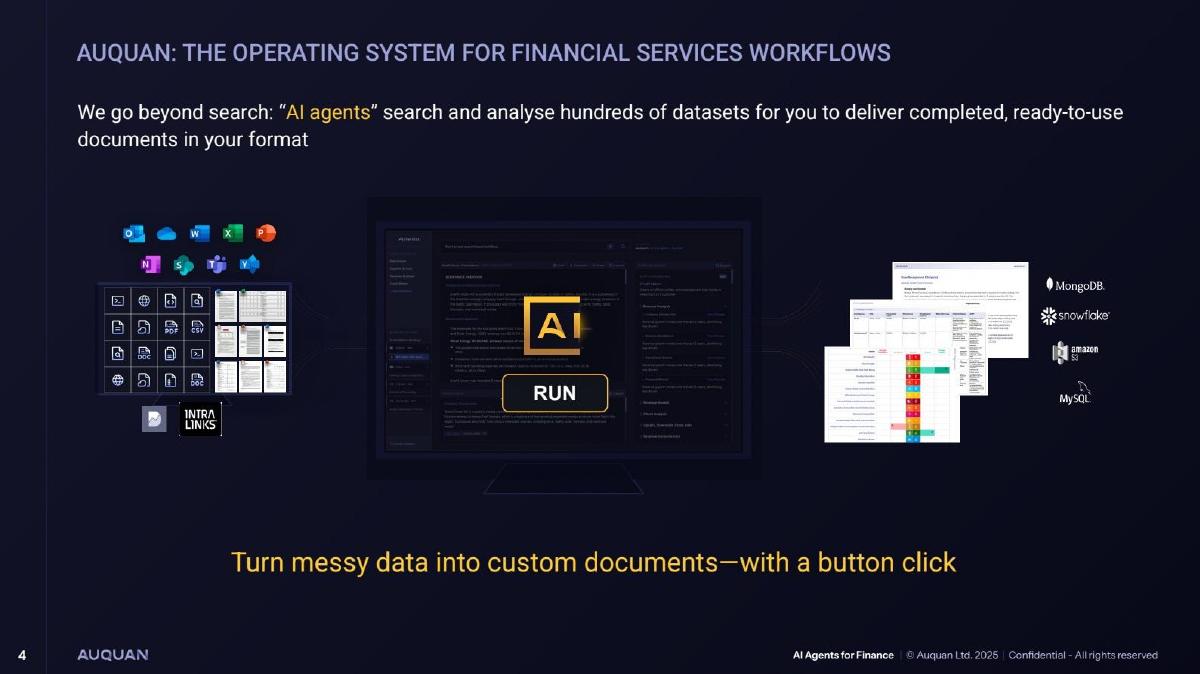
- Auquan positions itself as an 'Operating System' rather than just a tool, showing integrations with MongoDB, Snowflake, and Amazon S3 (Slide 4).
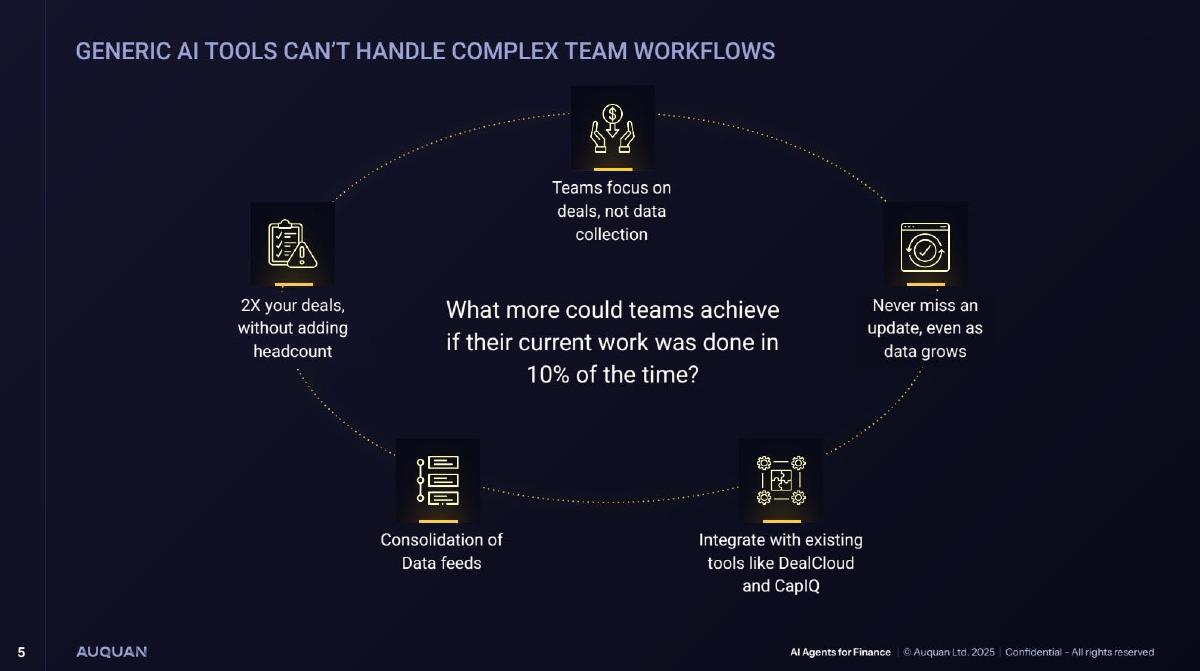
- The value proposition is framed as a capacity multiplier, claiming teams can '2X your deals, without adding headcount' (Slide 5).
- Productivity gains are broken down by specific financial roles, such as saving 2+ days on quarterly credit reviews for private credit firms (Slide 7).
- The platform emphasizes data breadth, claiming access to 2 million+ public and subscription datasets (Slide 9).
- Global scalability is addressed through native support for 65+ languages, covering the top 30 countries by GDP (Slide 10).
- The deck omits a traditional 'Team' slide, 'Competition' slide, and 'The Ask' slide, focusing entirely on product utility and customer results.
- Auquan raised a reported $8M Seed round in 2024, demonstrating that deep workflow specificity can outweigh the need for a standard deck structure.
The Auquan Teardown: A Deep Dive into Workflow Automation
Auquan’s pitch deck is a focused, 10-slide presentation that prioritizes the 'pain' of the customer over the 'prestige' of the founders. In a year where AI startups are often criticized for being 'wrappers' around LLMs, Auquan uses its deck to prove it is a workflow engine deeply integrated into the complex data ecosystems of Tier 1 financial institutions. As reported by Business Insider, this approach helped them secure an $8M Seed round in 2024.
Slide 1: The Hook
The opening slide sets a professional tone with a dark aesthetic and a clear value proposition: "AI Agents for Deep Knowledge Work in Financial Services." The sub-headline, "Liberate your brightest minds from daily grunt work to focus on what matters most," immediately identifies the target audience—executives at firms who are paying high salaries for analysts to perform manual data entry.
Slide 2: Quantifying the Inefficiency
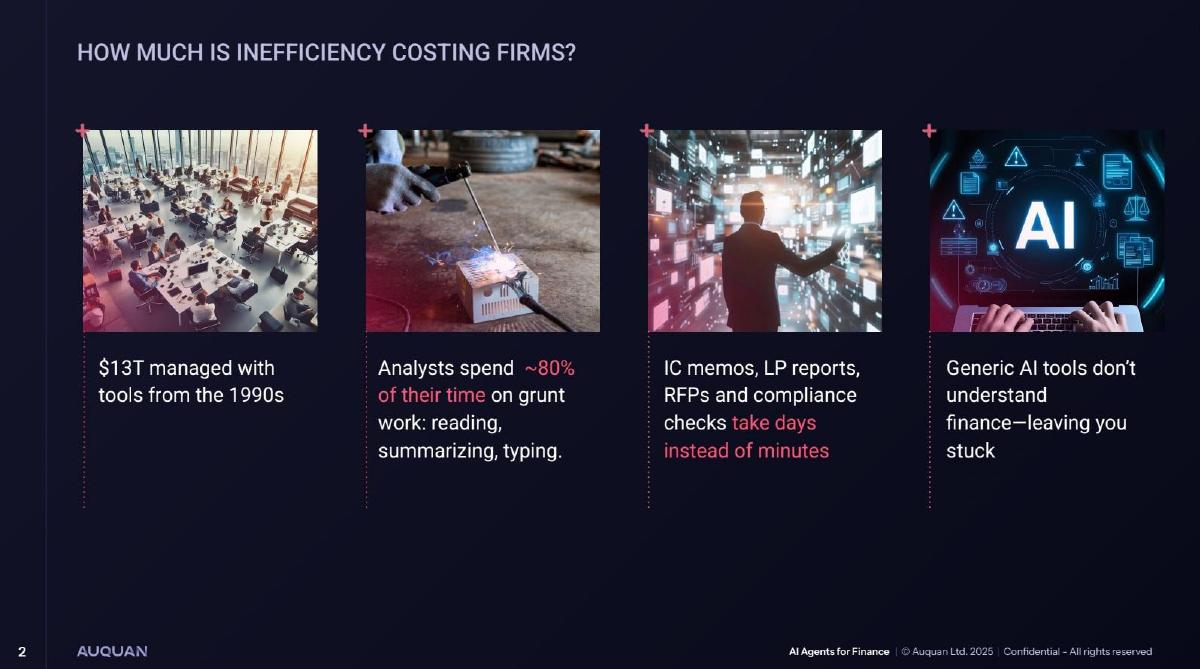
Slide 2 moves quickly to establish the market size and the severity of the problem. It cites that "$13T [is] managed with tools from the 1990s." This is a powerful framing device; it suggests that the industry is overdue for a technological revolution. The slide further claims that analysts spend "~80% of their time on grunt work." By highlighting that generic AI tools lack financial context, Auquan carves out its niche as a specialized solution.
Slide 3: The Reality of Deep Work
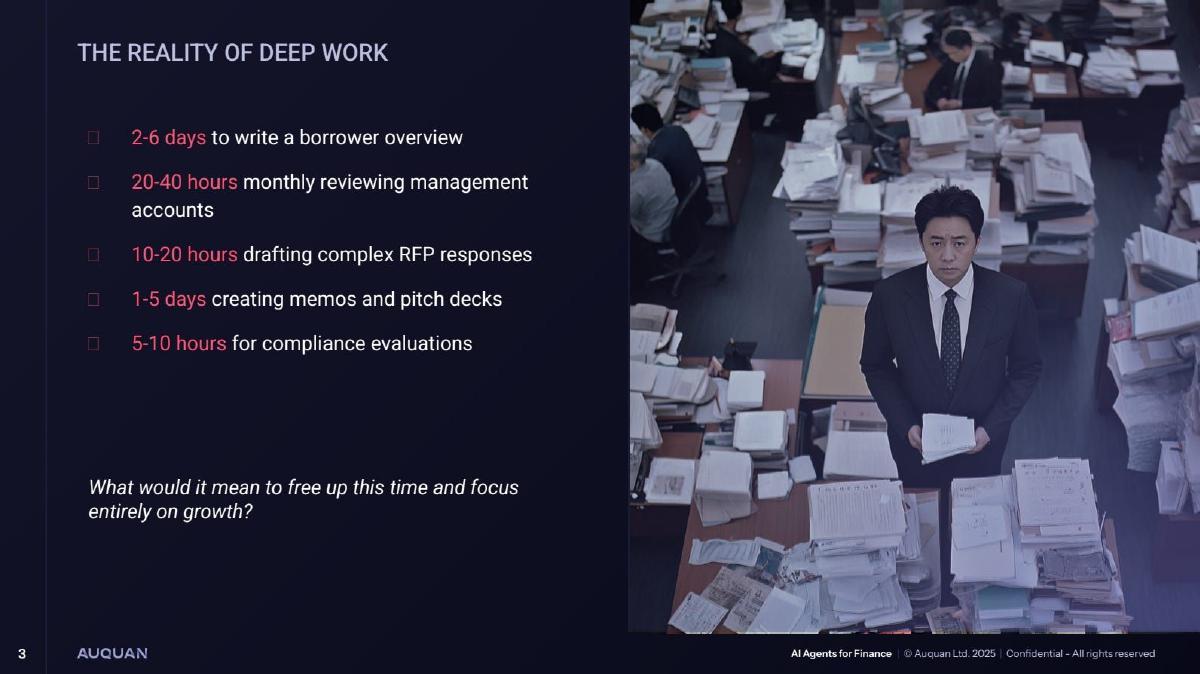
This slide is perhaps the most effective in the deck. It moves from general percentages to specific time-theft examples. It lists five key tasks and their time costs:
2-6 days to write a borrower overview · 20-40 hours monthly reviewing management accounts · 10-20 hours drafting complex RFP responses · 1-5 days creating memos and pitch decks · 5-10 hours for compliance evaluations
This level of granularity shows that the founders deeply understand the daily life of their users. It sets up a 'before and after' narrative that is easy for a VC to validate.
Slide 4: The Operating System
Auquan positions itself as "The Operating System for Financial Services Workflows." The visual on Slide 4 shows a 'Run' button sitting between a messy input of various file types (PDFs, CSVs, DOCs) and a clean output of structured documents. It lists integrations with heavyweights like MongoDB, Snowflake, Amazon S3, and MySQL , signaling that this is an enterprise-grade tool, not a standalone chatbot.
Slide 5: The Value Multiplier
Slide 5 focuses on the 'Why.' It asks, "What more could teams achieve if their current work was done in 10% of the time?" The key takeaway here is the promise to "2X your deals, without adding headcount." In a high-interest-rate environment where financial firms are looking to lean out, the promise of doubling output without increasing the wage bill is a high-impact message.
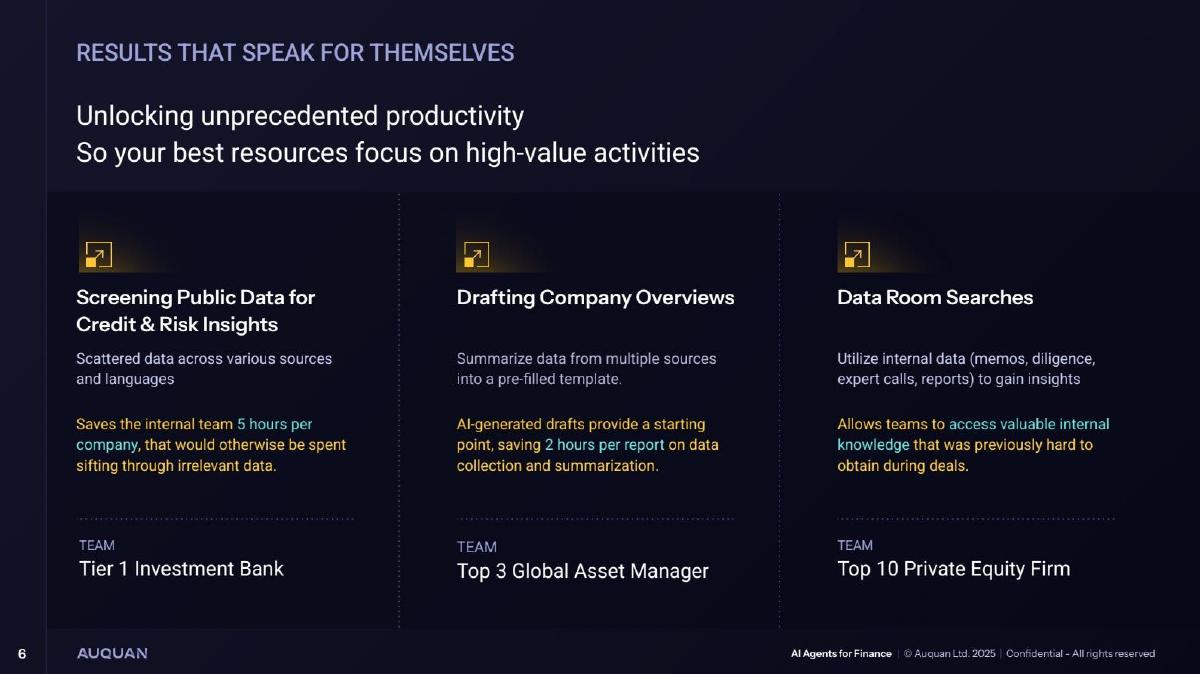
Slide 6 & 7: Social Proof and Case Studies
These two slides provide 'Results That Speak For Themselves.' Auquan uses anonymous but recognizable titles to build credibility:
Tier 1 Investment Bank: Saves 5 hours per company on credit screening. · Top 3 Global Asset Manager: Saves 2 hours per report on company overviews. · Top 10 Private Equity Firm: Unlocks internal knowledge from data rooms. · Top 20 Private Credit Firm: Saves 2+ days on quarterly credit reviews. · Top 5 Asset Manager: Saves 10 hours per week on ESG monitoring.
By covering different sectors (Investment Banking, PE, Private Credit, Asset Management), Auquan demonstrates that its product is a horizontal solution across the vertical of finance.
Slide 8: The Vision
Slide 8 is a transition slide with the text "The possibilities are endless." While visually sparse, it serves to reset the narrative from 'what we do now' to 'where we are going,' though it lacks specific future product roadmap details.
Slide 9: The Data Moat
Slide 9 addresses the 'garbage in, garbage out' concern of AI. It details a "Vendor Universe" including Factset, Bloomberg, and Pitchbook, and claims to connect to "2 Million+ Public & Subscription Datasets." This slide is crucial for convincing investors that the AI has the right fuel to produce accurate financial documents. It also lists integrations with the existing tech stack: SharePoint, Teams, Outlook, and Sales CRM.
Slide 10: Global Scale
The final slide highlights "65+ languages" and native support for the top 30 countries by GDP. This is a subtle but important point for Seed investors; it proves the TAM (Total Addressable Market) is global and that the technology can handle the multi-jurisdictional nature of modern finance.
What Works in the Auquan Deck
Specificity: The deck avoids vague promises of 'better efficiency' and instead uses hard numbers (e.g., '10 hours every week', '2-6 days'). This makes the ROI calculation simple for a prospective buyer or investor.
Integration Focus: By showing logos of data vendors and cloud providers, Auquan proves it isn't trying to replace the existing ecosystem, but rather to sit on top of it. This reduces the perceived friction of adoption.
Customer Segmentation: The case studies are perfectly segmented. They don't just say 'finance companies'; they specify 'Top 20 Private Credit Firm,' which shows they have found product-market fit in specific, high-value sub-sectors.
What is Missing from the Auquan Deck
The Team: There is no team slide in this 10-slide set. For a Seed round, the pedigree of the founders (e.g., former traders, data scientists, or engineers) is usually a primary selling point. Its absence suggests this might be a customer-facing version of the deck or that the product metrics were strong enough to carry the weight.
The Competition: The deck mentions that 'generic AI tools' fail, but it doesn't address other fintech-specific AI competitors. A slide showing how they differ from other financial research platforms would have strengthened the 'moat' argument.
Unit Economics and The Ask: There is no mention of the business model (SaaS, per-seat, per-report) or how much money they are raising and what they plan to do with it. While this information is often shared in a separate document or during the pitch, its omission makes the deck feel more like a sales presentation than a pure fundraising document.
Founder's Playbook: What to Copy
The 'Time-Saved' Framework: If you are building a B2B productivity tool, copy Slide 3. Don't just say you save time; list the specific tasks your users do and exactly how long they take today. It proves you have done your user research.
The Integration Map: Slide 9 is a great way to show how your product fits into a complex enterprise environment. Showing that you 'Connect To' the tools the customer already uses (SharePoint, Outlook) lowers the barrier to entry.
Professional Aesthetic: The use of dark backgrounds with gold/yellow accents (Slide 1, Slide 6) creates a high-end, 'Bloomberg-esque' feel that resonates with financial professionals. It looks expensive, which is appropriate for a tool targeting $13T in assets.
Frequently asked questions
- What is the primary problem Auquan solves?
- Auquan targets the inefficiency of 'deep knowledge work' in finance. According to Slide 2, $13T is managed with tools from the 1990s, leading analysts to spend approximately 80% of their time on manual tasks like reading and summarizing documents rather than high-value deal-making.
- How does Auquan differentiate itself from generic AI tools?
- Slide 2 explicitly states that 'Generic AI tools don’t understand finance—leaving you stuck.' Auquan differentiates by using specialized AI agents that search and analyze hundreds of specific financial datasets to deliver ready-to-use documents in the client's specific format.
- What kind of data does the platform access?
- Slide 9 outlines a 'Vendor Universe' that includes Factset, LexisNexis, DealCloud, Preqin, Pitchbook, CapIQ, and Fitch. It also claims to ingest over 2 million public and subscription datasets, including global media, regulatory updates, and court filings.
- What specific productivity metrics are mentioned?
- The deck provides several benchmarks: saving 5 hours per company for credit screening (Slide 6), saving 2 hours per report on company overviews (Slide 6), and saving 10 hours every week on ESG compliance monitoring (Slide 7).
- Is there information about the founders or the funding ask?
- No. The 10-slide deck provided does not include a team slide, a competition matrix, or a slide detailing the specific amount of capital being raised. It is focused entirely on the problem, solution, and customer success stories.