Juntoz, branded as 'Tu Mall Online,' positions itself as a next-generation online shopping mall for Latin America. The deck, used for a 2018 Pre-Series A raise, emphasizes a hybrid model that combines high technology focus with deep e-commerce know-how, distinguishing itself from both pure SaaS players like Shopify and traditional retailers like Falabella. By offering brands their own subdomains and storefronts within a unified marketplace, Juntoz aims to solve the digital presence gap for regional retailers. The presentation highlights a clear expansion roadmap from Peru into Colombia and Ch…
Key takeaways
- Juntoz identifies as a '100% marketplace platform' offering shop-in-shop and white-label solutions (Slide 3).
- The company claims a unique position in a 2x2 matrix, combining high technology focus with high e-commerce know-how (Slide 3).
- The business model allows brands to operate with their own subdomains, logos, and search bars within the Juntoz ecosystem (Slide 7).
- Juntoz uses Amazon's presence on Tmall.com as a case study to validate the 'shop-in-shop' as a complementary sales channel (Slide 9).
- The company launched in Peru in July 2016 and expanded to Colombia in December 2017 (Slide 11).
- A detailed expansion roadmap targets Mexico, Ecuador, Argentina, and Brazil through 2020 (Slide 11).
- Historical fundraising includes a >$1.25M Pre-Seed in 2015 and a $2.25M Seed round in 2017 (Slide 13).
- The October 2018 'Pre-Series A' ask was $2M to reach a target of 1,050+ stores (Slide 13).
Juntoz Pitch Deck Analysis: The Digital Mall Strategy
The Juntoz pitch deck, presented by Co-founder and CEO Fernando D’Alessio at an Endeavor Demo Day, outlines a comprehensive strategy to dominate the Latin American e-commerce landscape through a 'mall-in-a-mall' marketplace model. Dated October 2018, the deck serves as a vehicle for a $2 million Pre-Series A funding round. It focuses heavily on the structural gap in the market between pure-play technology providers and traditional retailers.
Slide 1: Title and Positioning
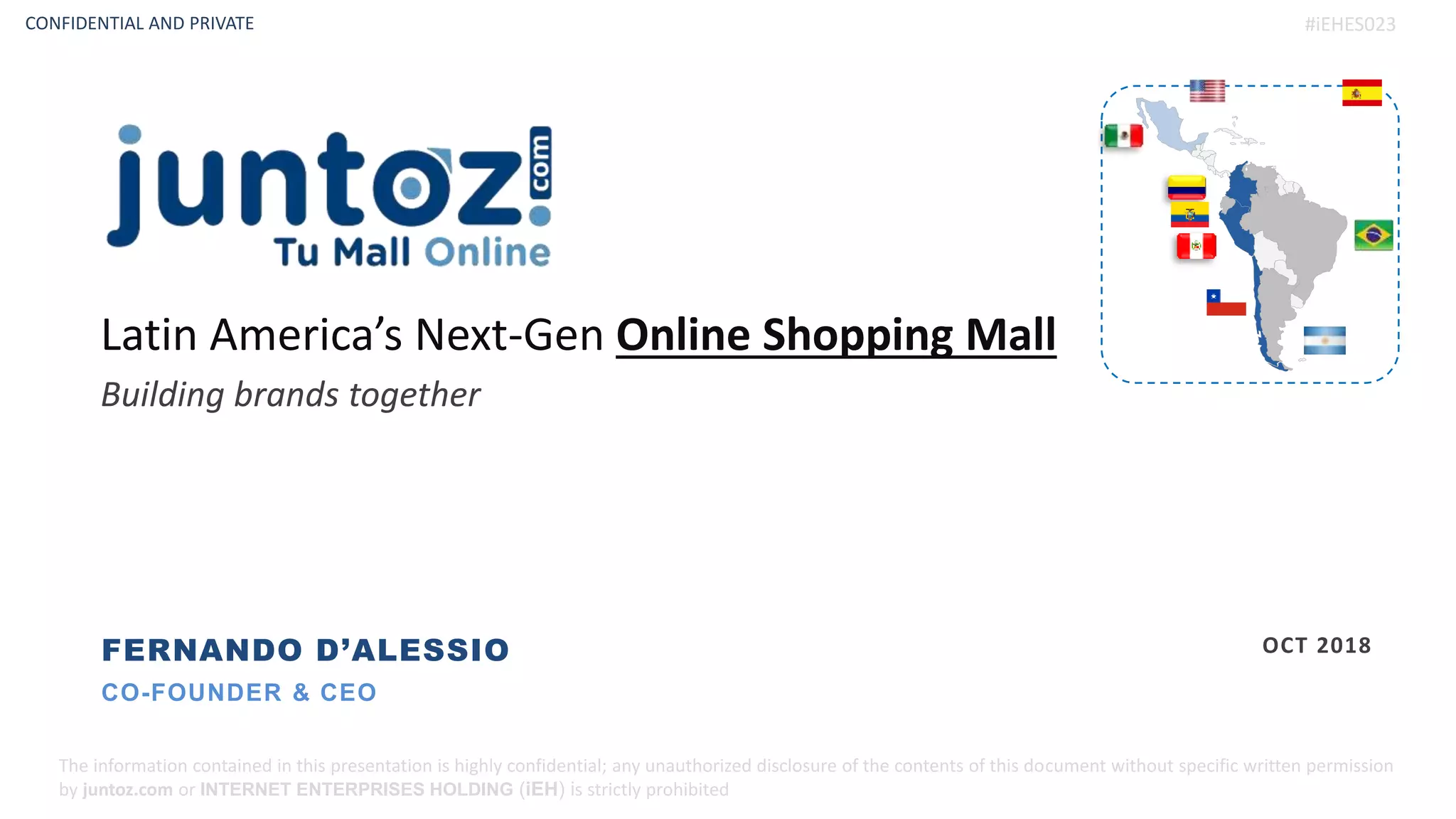
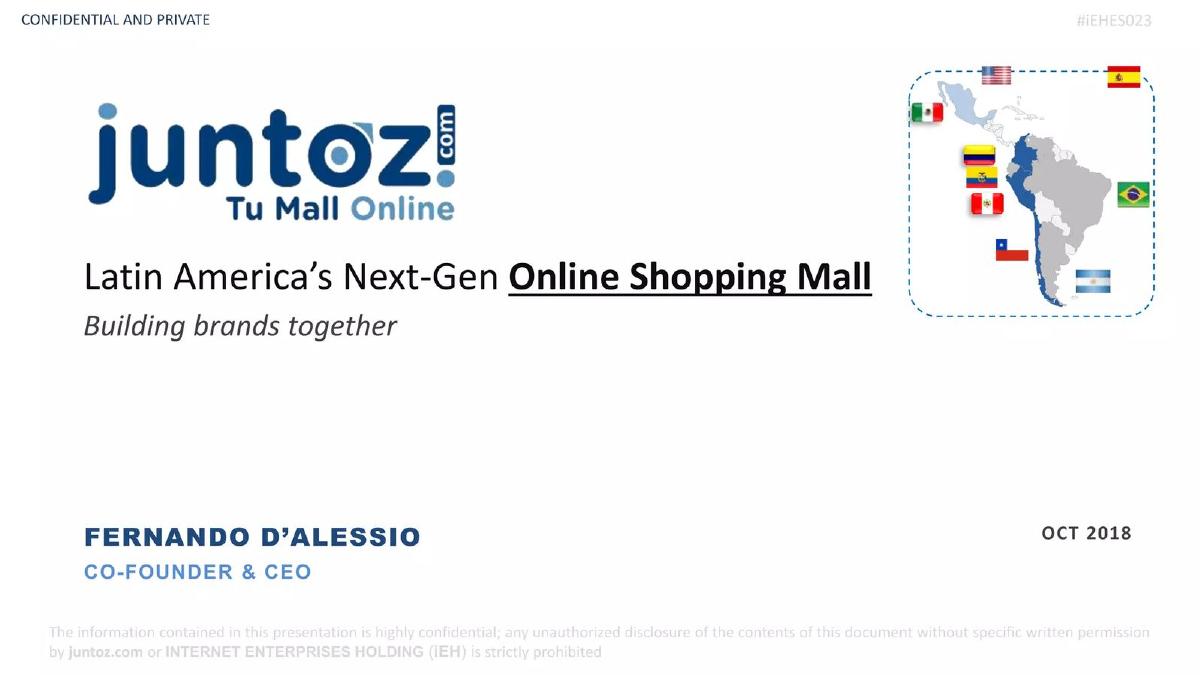
The cover slide introduces the brand 'juntoz.com' with the tagline 'Tu Mall Online' (Your Online Mall). It immediately establishes the geographic focus on Latin America with a map highlighting key markets: Peru, Colombia, Chile, Mexico, Brazil, and Argentina. The sub-header, 'Latin America’s Next-Gen Online Shopping Mall: Building brands together,' sets the collaborative tone of the marketplace model.
Slide 3: The Competitive Landscape
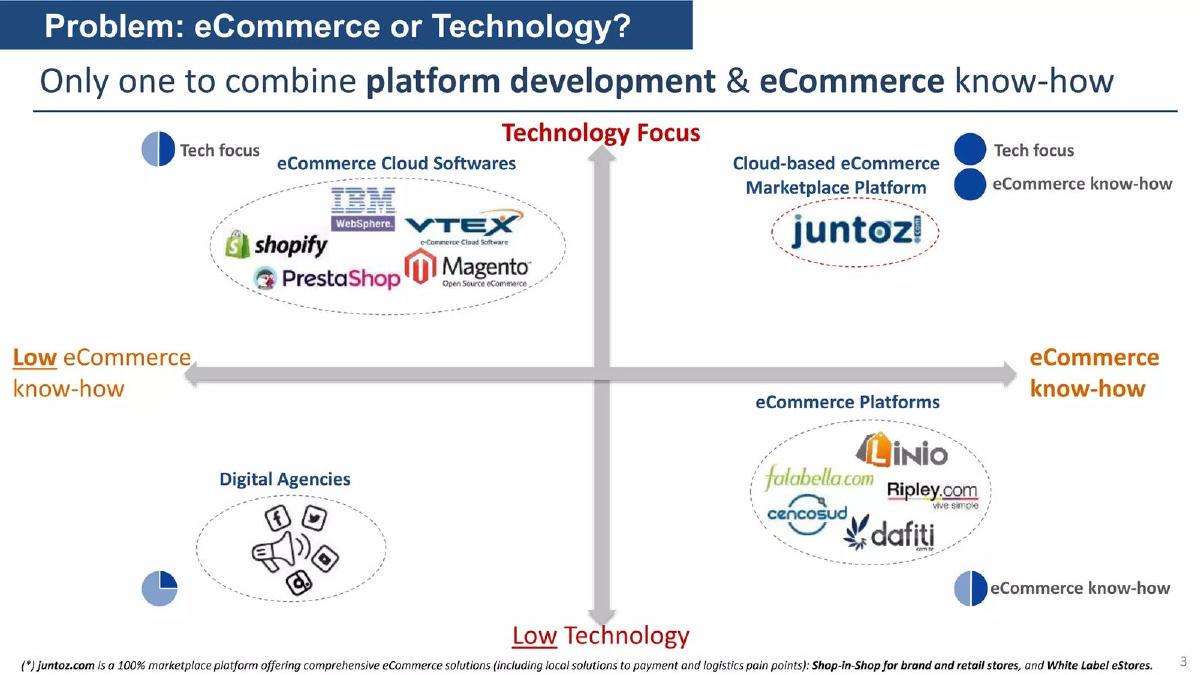
Juntoz uses a standard 2x2 matrix to define the 'Problem: eCommerce or Technology?' The Y-axis measures Technology Focus, while the X-axis measures eCommerce Know-how. Juntoz places itself in the top-right quadrant , claiming to be the 'Only one to combine platform development & eCommerce know-how.' They categorize competitors into three other groups:
Technology Focus / Low Know-how: Cloud softwares like Shopify, Magento, VTEX, and PrestaShop. · Low Technology / Low Know-how: Digital Agencies. · eCommerce Know-how / Low Technology: Traditional e-commerce platforms and retailers like Linio, Falabella, Ripley, and Dafiti.
A footnote specifies that Juntoz is a 100% marketplace platform offering 'Shop-in-Shop' and 'White Label eStores.'
Slide 5: The Opportunity
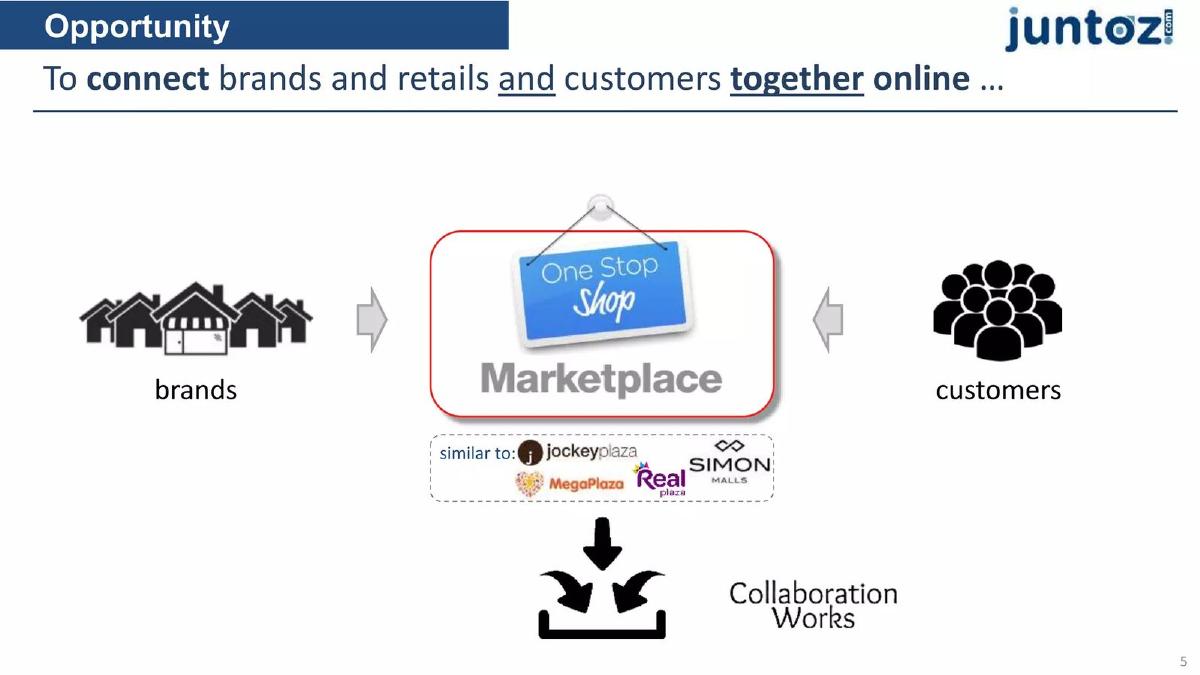
This slide visualizes the marketplace as a 'One Stop Shop' connecting brands and retailers to customers. It draws a direct comparison to physical mall operators, stating they are 'similar to' Jockey Plaza, MegaPlaza, Real Plaza, and Simon Malls. The phrase 'Collaboration Works' emphasizes that the platform is designed to be an ecosystem rather than a siloed retailer.
Slide 7: The Business Model
The 'New Business Model' slide explains the technical execution of their 'online shopping mall' concept. It highlights that each brand operates as its own e-store with five specific features: (1) subdomain, (2) logo, (3) banners, (4) categories/filters, and (5) search bar. This is described as a 'Complementary sales channel' for brands regardless of whether they already have an online presence. The inclusion of an 'O2O' (Online-to-Offline) icon and Google Analytics logo suggests a focus on data-driven retail and omnichannel integration.
Slide 9: Validation via Case Study
To prove the validity of the 'Shop-in-Shop' model, Juntoz uses Amazon as a case study. The slide shows a side-by-side comparison of amazon.cn (a standalone e-store) and amazon.tmall.com (Amazon’s storefront within Alibaba’s Tmall). By showing that even a giant like Amazon uses a larger mall-style marketplace (Tmall) as an additional sales channel in China, Juntoz validates its own value proposition for brands in Latin America.
Slide 11: International Expansion Roadmap
This slide provides a clear timeline of the company’s regional footprint:
Country 1: Peru (Launched July 2016). · Country 2: Colombia (Launched December 2017). · WiP Country 3: Chile (Targeted October 2018). · Future Targets: Mexico (Q3 2019), Ecuador (Q4 2019), Argentina (Q1 2020), and Brazil (Q3 2020).
The slide also checks off 'Multi-Currency' and 'Multi-Country Localization,' while marking 'Multi-Language' and 'Cross-Border E-Commerce' (connecting LatAm to US/EU/China) as works in progress for Q2 2019.
Slide 13: Investor Relations and The Ask
The 'Stages of Funding' slide provides a transparent look at the company’s capitalization history and current needs:
Pre-seed (August 2015): Raised >$1.25M from Angel investors. · Platform Launch (July 2016): Launched in Peru with 100+ stores. · Seed Round (March 2017): Raised $2.25M to expand to Colombia and Chile, reaching 260+ stores. · Pre-Series A (October 2018): The current ask of $2M to reach 1,050+ stores.
A pie chart breaks down the use of proceeds for the $2M: 45% for Talent and Expansion, 35% for Product Development and Technology, and 20% for Marketing.
Slide 15: Conclusion
The final slide reiterates the 'building together' theme with a Venn diagram showing the intersection of Team, Partners, and Customers forming the 'juntoz' community. It provides direct contact information for Fernando D’Alessio, including his email, phone number, and Skype ID.
What Works in the Juntoz Deck
1. Clear Market Positioning: The 2x2 matrix on Slide 3 is a classic but effective way to show why a new entrant is needed. By separating 'Technology' from 'Know-how,' Juntoz creates a niche for itself that isn't just 'another website builder' or 'another retailer.'
2. The 'Mall' Analogy: Comparing the digital platform to well-known physical malls like Jockey Plaza (Slide 5) makes the abstract concept of a 'marketplace platform' immediately understandable to investors who know the Latin American retail landscape.
3. Validation by Proxy: Using the Amazon/Tmall example (Slide 9) is a brilliant way to handle the objection: 'Why wouldn't a brand just build their own site?' By showing that the world's largest e-commerce company still sees value in being inside a 'mall,' they effectively neutralize that concern.
4. Specificity of the Ask: Slide 13 is highly disciplined. It doesn't just ask for money; it shows exactly how much was raised before, what was achieved with that money (store counts), and exactly where the new $2M will go.
What is Missing from the Juntoz Deck
1. Unit Economics: While the deck mentions store counts and expansion, it provides zero data on GMV (Gross Merchandise Volume), CAC (Customer Acquisition Cost), LTV (Lifetime Value), or take rates. Investors in 2018 would have needed to see the underlying profitability of the 'mall' model.
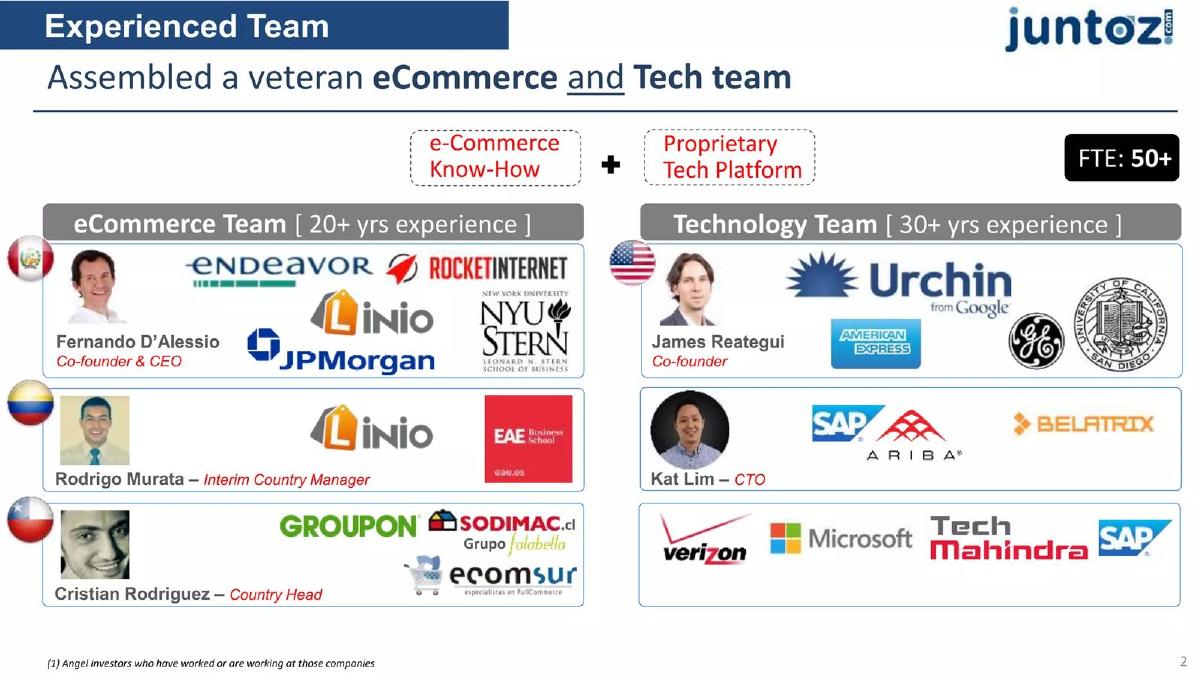
2. Team Slide: The provided slides do not include a team overview. While the CEO is identified, the strength of the engineering and operations teams is vital for a company claiming to lead in 'Technology Focus.'
3. Customer Traction: We see the number of 'stores' (B2B traction), but there is no data on active users, repeat purchase rates, or traffic (B2C traction). A marketplace is only as good as the audience it brings to its tenants.
Lessons for Founders
1. Use Analogies for Complex Models: If you are building a hybrid business model, find a physical-world equivalent. 'The digital version of [X]' is a powerful mental shortcut for investors.
2. Prove the 'Why Now': Juntoz does this by showing the expansion roadmap. By demonstrating that they have already successfully moved from one country (Peru) to another (Colombia), they prove the model is portable, which justifies the 'Series A' level of capital for further expansion.
3. Address the 'Build vs. Buy' Objection: If your product helps companies do something they could theoretically do themselves (like building a website), you must explain the 'network effect' or 'complementary' value of your platform, just as Juntoz did with the Tmall case study.
Frequently asked questions
- What is the core value proposition of Juntoz?
- Juntoz positions itself as an 'Online Shopping Mall' that connects brands, retailers, and customers. Unlike a simple marketplace, it allows brands to maintain their identity through dedicated subdomains, custom banners, and specific search filters, essentially acting as a digital version of a physical mall where each brand has its own storefront.
- How does Juntoz differentiate itself from competitors like Shopify or Linio?
- According to Slide 3, Juntoz occupies a unique quadrant of 'High Tech Focus' and 'High eCommerce Know-how.' It argues that Shopify-style cloud software lacks the marketplace traffic/know-how, while traditional e-commerce platforms like Linio or Falabella lack the advanced marketplace technology infrastructure Juntoz provides.
- What was the company's growth trajectory leading up to the 2018 deck?
- The company launched in Peru in July 2016 with over 100 stores. By March 2017, after raising a $2.25M Seed round, they grew to 260+ stores and expanded into Colombia. By the time of the October 2018 pitch, they were targeting 1,050+ stores across Peru, Colombia, and Chile.
- What is the specific funding 'Ask' in this deck?
- Juntoz was seeking $2 million for a Pre-Series A round in Q4 2018. The slide explicitly breaks down the use of these funds: 45% for talent and regional expansion, 35% for product development and technology, and 20% for marketing efforts.
- Does the deck address internationalization and cross-border capabilities?
- Yes, Slide 11 highlights that the platform is built for multi-currency, multi-country localization, and multi-language support. It also notes a 'Work in Progress' (WiP) initiative for cross-border e-commerce connecting Latin America to the US, Europe, and China, slated for Q2 2019.