Groundcover’s 15-slide deck (8 provided for analysis) is a masterclass in technical positioning within a crowded market. By identifying the specific failures of legacy Application Performance Monitoring (APM) tools—namely high costs and integration friction—Groundcover positions its eBPF-powered solution as the 'Next Linux Superpower.' The deck emphasizes a significant architectural shift: moving processing to the edge to break the traditional visibility-cost tradeoff. With a reported $20M Series A, the company leans heavily on the pedigree of its founders, both veterans of the Israeli Minist…
Key takeaways
- The founders leverage elite technical backgrounds, specifically citing experience as Cyber R&D Group Leaders at the MOD (Slide 2).
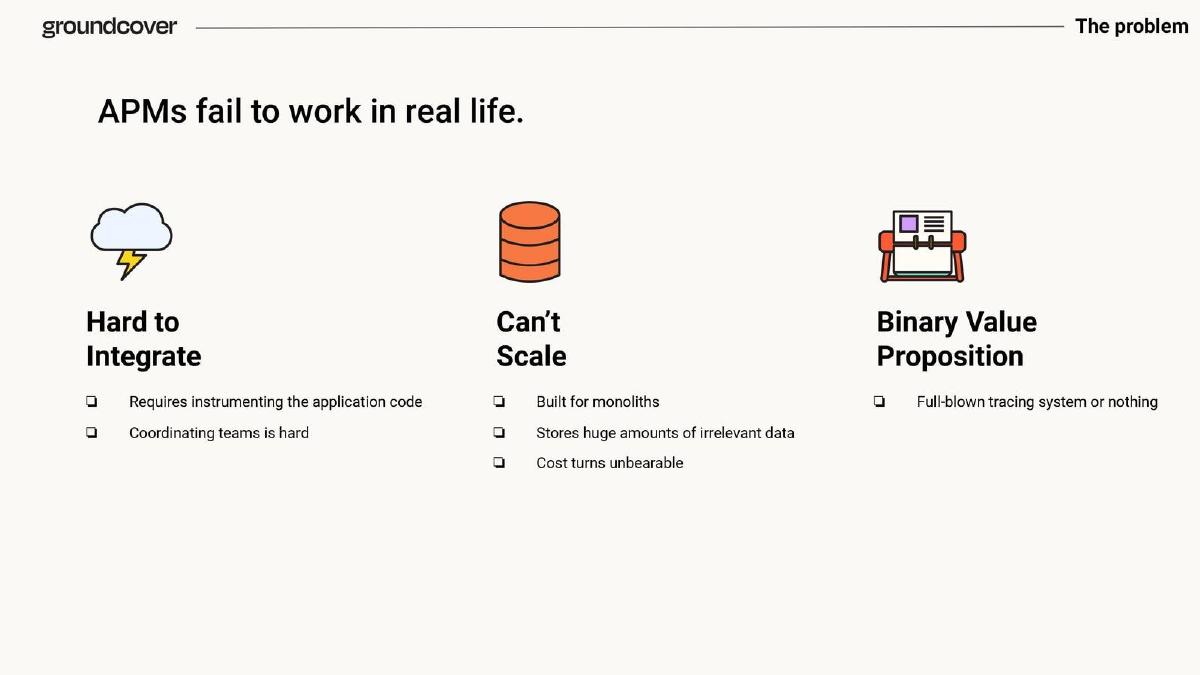
- Groundcover identifies three core failures of current APMs: hard integration, inability to scale, and a binary value proposition (Slide 3).
- The product's 'secret weapon' is eBPF, which they label the 'Next Linux Superpower' for monitoring K8s applications (Slide 4).
- The company claims to break the visibility-cost tradeoff by capturing only the 1% of incident data that matters (Slide 5).
- Product screenshots demonstrate a timeline-based troubleshooting interface that enriches incidents with K8s events and payload captures (Slide 6).
- The business model relies on an in-cluster architecture that yields a 99% operational margin (Slide 7).
- Groundcover targets large-scale companies with an 'on-prem by design' approach to appeal to security-oriented segments (Slide 7).
- The deck emphasizes a '1 minute time-to-value' to contrast with the heavy instrumentation required by competitors (Slide 7).
Groundcover: The eBPF Play for Cloud Observability
Groundcover entered a highly competitive observability market dominated by giants like Datadog and New Relic. Their Series A deck, which reportedly secured $20M in 2024, focuses on a specific technical pivot: using eBPF to eliminate the 'agent fatigue' and astronomical costs associated with traditional monitoring. The deck is visually clean, utilizing a minimalist aesthetic with custom illustrations that soften the highly technical nature of the product.
Slide 1: Title Slide
The deck opens with a minimalist title slide featuring the company name and the date 'April 2022.' This indicates that while the funding was reported in 2024, the core narrative was established early in the company's lifecycle. There is no tagline here, relying entirely on brand recognition or the preceding conversation to set the stage.
Slide 2: Our Story (The Team)
Groundcover places its team slide at the very beginning, which is a common tactic for technical startups founded by individuals with elite backgrounds. Shahar Azulay (Co-Founder & CEO) and Yechezkel Rabinovich (Co-Founder & CTO) are both listed as Psagot Graduates and Cyber R&D Group Leaders @ MOD . The inclusion of the Israeli Ministry of Defense (MOD) and the Psagot program (an elite academic track in the IDF) serves as a high-signal proxy for technical competence. The slide also notes experience at Apple , DayTwo , and CyberMDX , establishing that the founders have both government-level technical training and private-sector scaling experience.
Slide 3: The Problem
The problem slide is titled 'APMs fail to work in real life.' It categorizes the failure of Application Performance Monitoring tools into three buckets:
Hard to Integrate: Requires instrumenting application code and coordinating between multiple teams. · Can’t Scale: Built for outdated monoliths, leading to the storage of 'huge amounts of irrelevant data' and 'unbearable' costs. · Binary Value Proposition: Users are forced to choose between a 'full-blown tracing system or nothing.'
This slide effectively sets up the 'villain' of the story—the high cost and complexity of existing solutions.
Slide 4: Why Groundcover (The Technology)
This slide introduces the solution's core engine. It explicitly states that Groundcover is 'reinventing how folks monitor their applications in K8s' (Kubernetes). The 'not-so-secret weapon' is identified as #eBPF , which they call 'The Next Linux Superpower.' By leading with the technology rather than just features, Groundcover appeals to the technical buyer (DevOps and Site Reliability Engineers) who understands the limitations of user-space monitoring.
Slide 5: Why Groundcover (The Value Prop)
Slide 5 moves from technology to outcomes. The headline 'Observability without limits' is supported by four key pillars:
Distributing power to the edge. · Creating out-of-the-box metrics where the data resides. · Smartly capturing incidents, leaving only the '1% that matters.' · Breaking the visibility-cost tradeoff.
The emphasis on the '1% that matters' is a direct response to the 'irrelevant data' problem mentioned on Slide 3.
Slide 6: Product Interface
Groundcover provides a screenshot of the platform in action, focusing on a 'GetProduct' service error. The slide claims the tool 'enriches every incident with relevant logs, K8s events, payload captures, performance metrics, and related services.' The visual shows a timeline with icons for specific events like 'Out of memory' and 'Crashloop.' This is a 'show, don't tell' slide intended to prove that the eBPF-collected data is translated into a user-friendly, actionable interface for troubleshooting root causes.
Slide 7: Where We Stand Out (Business & Architecture)
This slide summarizes the competitive advantages across three categories:
Frictionless Onboarding: Citing a '1 minute time-to-value' and lower organizational barriers. · In-cluster Architecture: Claiming a '99% operational margin' and a predictable pricing model. This is a massive claim for a SaaS company and suggests that their COGS (Cost of Goods Sold) are extremely low because the customer’s own infrastructure handles the heavy lifting. · Untapped Market Segments: Positioning the product as 'on-prem by design,' making it a fit for large-scale, security-oriented companies.
Slide 8: Closing Slide
The final slide is a simple 'Thank you' featuring the company's bee mascot and floral illustrations. It maintains the brand's friendly, accessible aesthetic, which contrasts with the 'heavy' enterprise software it seeks to replace. No contact information or specific call to action is visible on this slide.
What Groundcover Does Well
The deck is exceptionally focused. It does not try to be everything to everyone; it targets the specific pain points of Kubernetes monitoring. The technical positioning of eBPF as a 'superpower' is a brilliant way to frame a competitive advantage that is difficult for legacy players to replicate without a total architectural rewrite. Furthermore, the claim of a 99% operational margin (Slide 7) is a powerful hook for investors, as it suggests a highly scalable and profitable business model compared to competitors who bear the cost of ingesting and storing massive amounts of customer data.
What is Missing from the Deck
Based on the slides provided, several standard venture deck elements are absent:
Market Size (TAM/SAM/SOM): There is no slide quantifying the dollar value of the observability market. · Traction: While the product is shown, there are no metrics regarding user growth, revenue, or specific customer logos. · Competition: Although they critique 'APMs' generally, there is no direct comparison to specific competitors like Datadog, Grafana, or Honeycomb. · The Ask: There is no slide detailing how much capital is being raised or how it will be deployed.
It is possible these elements were contained in the 7 slides not provided for this teardown, or that the founders relied on a separate data room for these details.
Founder Takeaways
Lead with your 'Unfair Advantage': If your team has elite technical pedigree (like the MOD background on Slide 2), put it upfront. It builds immediate credibility for a complex product. Identify the 'Tradeoff' you are breaking: Groundcover wins by claiming to break the 'visibility vs. cost' tradeoff. Every great startup should be able to identify a similar 'impossible' choice that their technology makes possible. Focus on Time-to-Value: In a world of complex enterprise software, the '1 minute time-to-value' (Slide 7) is a compelling promise that reduces the perceived risk for a potential customer.
Frequently asked questions
- What is the primary technical differentiator for Groundcover?
- Groundcover relies on eBPF (extended Berkeley Packet Filter). As stated on Slide 4, they view this as their 'not-so-secret weapon' and the 'Next Linux Superpower.' This technology allows them to monitor Kubernetes (K8s) applications without requiring developers to instrument their application code, which is a major friction point for traditional APM tools.
- How does Groundcover address the high cost of cloud monitoring?
- Slide 5 and Slide 7 detail their approach to cost. They use an in-cluster architecture to 'distribute the power to the edge,' creating metrics where the data lives. By 'smartly capturing incidents' and leaving only the 1% of data that matters, they claim to break the traditional tradeoff between visibility and high storage costs.
- What is the background of the founding team?
- The team has high-pedigree technical roots. Slide 2 shows that both Shahar Azulay (CEO) and Yechezkel Rabinovich (CTO) are Psagot Graduates and former Cyber R&D Group Leaders at the MOD. Their experience includes roles at Apple, DayTwo, and CyberMDX, signaling deep expertise in machine learning and chief architecture.
- Who is the target customer for this platform?
- While applicable to many, Slide 7 specifically highlights 'large scale companies' and 'security and privacy oriented' segments. Because the solution is 'on-prem by design,' it appeals to organizations that are hesitant to send sensitive telemetry data to third-party cloud providers.
- Does the deck include financial projections or a specific funding ask?
- Based on the 8 slides provided for analysis, there is no mention of a specific funding amount, valuation, or detailed financial projections. The deck focuses almost entirely on the problem, the technical solution, the team, and the architectural advantages of the product.