GroundWORK’s 2012 pitch deck for TED City 2.0 outlines a hybrid social enterprise and data platform designed to revitalize vacant urban buildings. The company’s core value proposition is three-fold: providing property owners with green retrofitting services to lower operating costs, offering vocational schools hands-on training sites for students, and creating jobs within the green economy. The deck is notable for its extremely modest $10,000 funding ask, which is allocated toward research, a technical prototype, and a single-property pilot. While the deck excels at identifying stakeholders—r…
Key takeaways
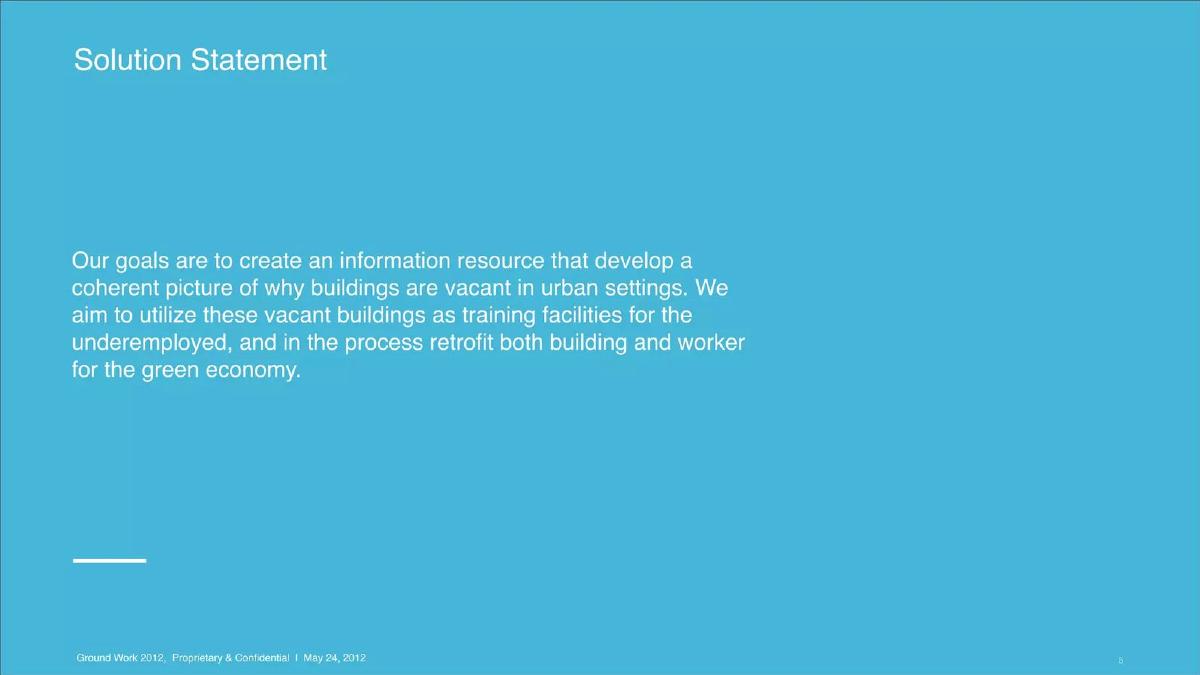
- The project aims to create an information resource to explain why urban buildings remain vacant (Slide 5).
- The team is heavily design-focused, featuring four designers/UX specialists and two MBA candidates in Design Strategy (Slide 3).
- Stakeholder engagement is broad, including the City of San Francisco, vocational schools like Goodwill, and local business owners (Slide 7).
- The strategy follows a five-phase approach, moving from research and technical prototyping to national digital scaling (Slide 11).
- The pilot phase is scheduled to last 15 months, though the timeline for scaling is left as 'X months' (Slide 11).
- The funding ask is exceptionally low at $10,000, with $7,500 specifically earmarked for the pilot program (Slide 13).
- A core design principle is to 'make a financial case to landlords,' acknowledging that social impact requires economic incentives (Slide 15).
- The deck omits standard financial projections, exit strategies, and a detailed breakdown of the 'green economy' market size.
GroundWORK: A Design-Led Approach to Urban Revitalization
The GroundWORK pitch deck, dated May 24, 2012, was prepared for the TED City 2.0 event. It represents a specific era of social entrepreneurship where design thinking was applied to systemic urban problems. The deck is less of a traditional venture capital pitch and more of a project proposal for a social enterprise. It focuses heavily on the 'why' and the 'who,' leaving the 'how much profit' for a later discussion that never actually appears in these slides.
Slide 1: Title and Context
The cover slide establishes the brand name 'Ground Work' (stylized as two words here, though 'GroundWORK' elsewhere) and identifies the venue as the TED City 2.0 Pitch. The background image of hand-drawn nodes and connections on graph paper signals a process-oriented, design-heavy approach. It immediately frames the company as a solution to complex, interconnected urban systems.
Slide 3: The Team
The team slide, titled 'Hello, pleased to meet you!', introduces six members. The composition is noteworthy for its lack of traditional 'business' or 'sales' roles. The team includes:
Tina Santiago: UX Designer, Interactive Producer · Patrick Kennan: Designer, Developer · Dhruvi Shah: Art Director, Designer · Shawn Ardaiz: MBA in Design Strategy Class of 2013 · Adam Elmaghraby: MBA in Design Strategy Class of 2013 · Vika Kovalchuk: Visual Designer, UX Designer
With four designers and two MBAs focused on design strategy, the team is clearly built for product development and systems thinking rather than aggressive market expansion or financial engineering.
Slide 5: Solution Statement
Slide 5 provides a dense paragraph outlining the company's goals. GroundWORK aims to create an 'information resource' to understand urban vacancy. The secondary goal is to use these vacant buildings as 'training facilities for the underemployed.' The ultimate outcome is a dual retrofit: the building is upgraded for the green economy, and the worker is trained for it. This is a classic 'double bottom line' social impact statement.
Slide 7: Stakeholders
This slide lists the various groups GroundWORK has engaged. It is a comprehensive list that demonstrates the complexity of their operating environment:
The City of San Francisco · Local Real Estate Agents & Brokers (LoopNet, Urban Solutions) · Vocational Training Schools (Goodwill, Mission Hiring Hall) · Local Business Owners (SF Made, La Cucina) · Property Owners and Community Residents
The mention that they have 'already begun a dialogue' and are 'forming a steering committee' provides a modicum of traction, showing that the project exists beyond just a conceptual stage.
Slide 9: What is Ground Work?
This slide acts as the value proposition summary. It breaks down the benefits for two primary customers: Property Owners: Receive a green retrofitting service that increases property value and decreases operating costs. Vocational Schools: Receive a physical location to teach students and provide hands-on experience.The slide concludes by stating the broader goal of rejuvenating 'blighted buildings' and 'uplifting communities.'
Slide 11: Our Strategy
The strategy is split into two categories: Pilot and Scale. Pilot (15 months): Includes Phase 1 (Research), Phase 2 (Analysis & Technical Prototype), and Phase 3 (Roll out of one property partnership). Scale (X months): Includes Phase 4 (Physical scale up in San Francisco) and Phase 5 (Digital scale up nationwide).The use of 'X months' for the scaling phase indicates that the team had not yet projected the timeline for growth beyond the initial pilot, a common omission in early-stage social impact decks.
Slide 13: The Ask
Titled 'How $10,000 of Funding Makes This Possible,' this slide is the most surprising for a fundraising analyst. The total ask is only $10,000. It is broken down as follows:
$500: Research Report (printing and analysis) · $2,000: Technical Platform (prototype of online platform and calculator) · $7,500: Pilot Program (developing the partnership for a LEED certification program)
This level of funding is more akin to a small grant or a student competition prize than a seed round. It suggests the project was in a very early 'proof of concept' stage.
Slide 15: Design Principles
The team outlines five 'non-negotiable' principles. The most important from a business perspective is 'Make a financial case to landlords.' This shows an awareness that social good alone will not convince property owners to participate; there must be a clear ROI through reduced operating costs or increased asset value.
Slide 18: Conclusion
The deck ends with a quote from Jane Jacobs' The Death and Life of Great American Cities: 'Cities have the capability of providing something for everybody, only because, and only when, they are created by everybody.' This reinforces the community-centric, urbanist philosophy of the founders.
What Works
Clear Social Mission: The deck does an excellent job of articulating a complex social problem and a multi-layered solution. The 'double retrofit' concept (building and worker) is a strong, memorable hook. Stakeholder Identification: By listing specific local organizations like SF Made and Mission Hiring Hall, the founders show they have done the 'groundwork' (pun intended) to understand the local ecosystem in San Francisco. Modest, Transparent Ask: While the $10,000 figure is low, the breakdown of how every dollar will be spent is clear and logical for a pilot phase.
What is Missing
Revenue Model: There is no mention of how GroundWORK sustains itself. Does the property owner pay a fee? Does the vocational school pay for access? Is it a non-profit reliant on grants? Without a business model, this is a project, not a startup. Market Size: There is no data on the number of vacant buildings in San Francisco or the size of the green retrofitting market. Investors need to see the 'Scale' potential quantified in dollars, not just 'Phase 5.' Competitive Landscape: The deck assumes GroundWORK is the only entity attempting this. In reality, city governments and large NGOs often have similar initiatives. The deck fails to explain why GroundWORK’s 'technical platform' is a better solution than existing city programs. Unit Economics: What is the cost to retrofit one building versus the value created? Slide 13 mentions a $7,500 pilot, but it doesn't explain if that covers the actual construction/retrofitting costs or just the administrative overhead of setting up the partnership.
What a Founder Should Copy
The Stakeholder Slide: Founders building in the 'GovTech' or social impact space should emulate Slide 7. Identifying the specific gatekeepers and partners in your ecosystem demonstrates maturity and reduces perceived execution risk. The Phased Strategy: Slide 11 provides a very clear roadmap. Even if the timelines are estimates, showing a logical progression from 'Research' to 'Technical Prototype' to 'Physical Pilot' helps investors understand the development lifecycle of the product. Design Principles: Including a 'Design Principles' or 'Core Values' slide (Slide 15) is effective for mission-driven companies. It sets the boundaries for how the company will grow and ensures alignment with future partners and investors.
Frequently asked questions
- What is the primary problem GroundWORK is trying to solve?
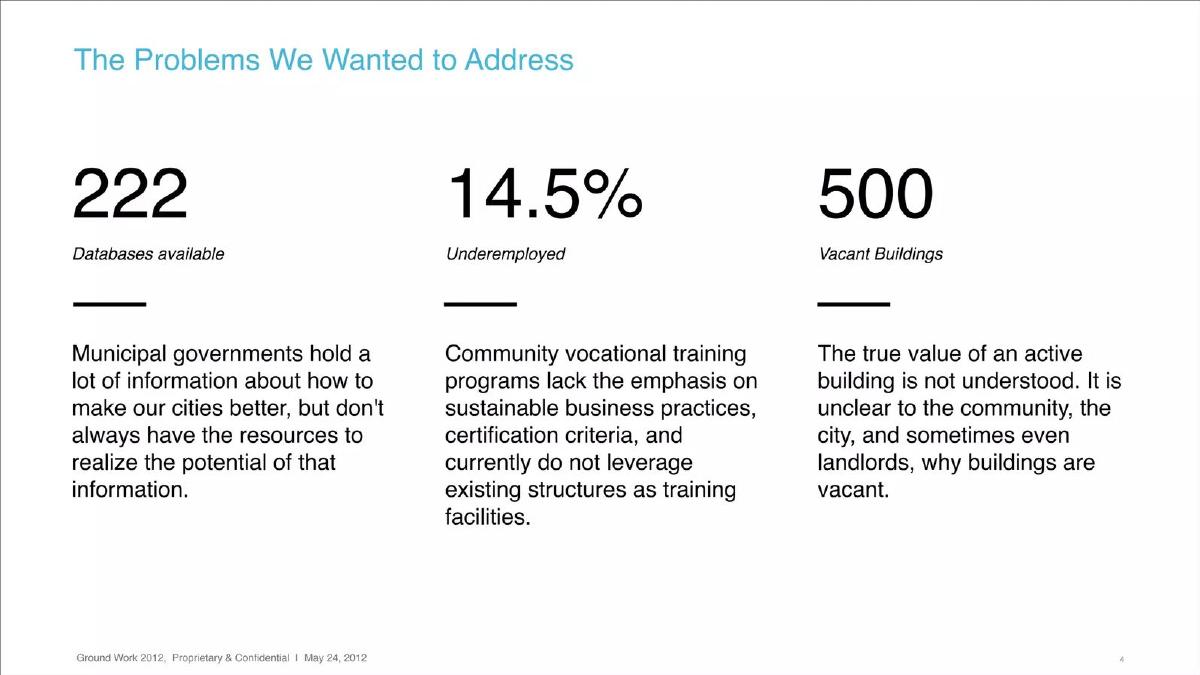
- GroundWORK addresses the dual issues of urban building vacancy and underemployment. According to slide 5, they aim to create a 'coherent picture' of why buildings are vacant and then utilize those spaces as training facilities. This process is intended to retrofit both the physical infrastructure for the green economy and the skill sets of the workers involved.
- How does the company plan to generate value for property owners?
- The deck states on slide 9 that GroundWORK offers a sustainable retrofitting service that increases property value while decreasing operating costs. By positioning the vacant building as a classroom for vocational students, the property owner receives improvements that might otherwise be cost-prohibitive, while the students gain necessary hands-on experience.
- What is the significance of the $10,000 funding request?
- The $10,000 ask on slide 13 is remarkably small for a startup pitch, suggesting this was a grant application or a seed-stage project for a specific competition (TED City 2.0). The funds are divided into $500 for research, $2,000 for a technical platform/prototype, and $7,500 to launch a single-property pilot program in San Francisco.
- Who are the key partners mentioned in the deck?
- GroundWORK identifies a wide array of stakeholders on slide 7. These include government entities (City of San Francisco), real estate platforms (LoopNet), vocational training organizations (Goodwill, Mission Hiring Hall), and local business advocates (SF Made, La Cucina). This suggests a partnership-heavy model rather than a direct-to-consumer or pure B2B approach.
- What are the 'Design Principles' listed in the deck?
- On slide 15, the team lists five non-negotiable principles: green jobs/buildings, making a financial case to landlords, creating local jobs, sharing research output, and enabling others to build on their data. This final point suggests an open-data philosophy, which aligns with the 'information resource' goal mentioned earlier in the deck.