Grover’s pitch deck is a concise, brand-driven presentation that prioritizes the 'why' and 'how' of their rental model over raw financial data. Across 8 slides, the company outlines a mission to democratize tech access while reducing e-waste. The deck leans heavily on lifestyle photography and value propositions like 'no large one-off expenses' and 'tailored and flexible usage times.' While it successfully communicates the user experience and the breadth of its catalog—boasting over 3,000 products across 11 categories—it notably lacks a team slide, financial projections, or a specific funding…
Key takeaways
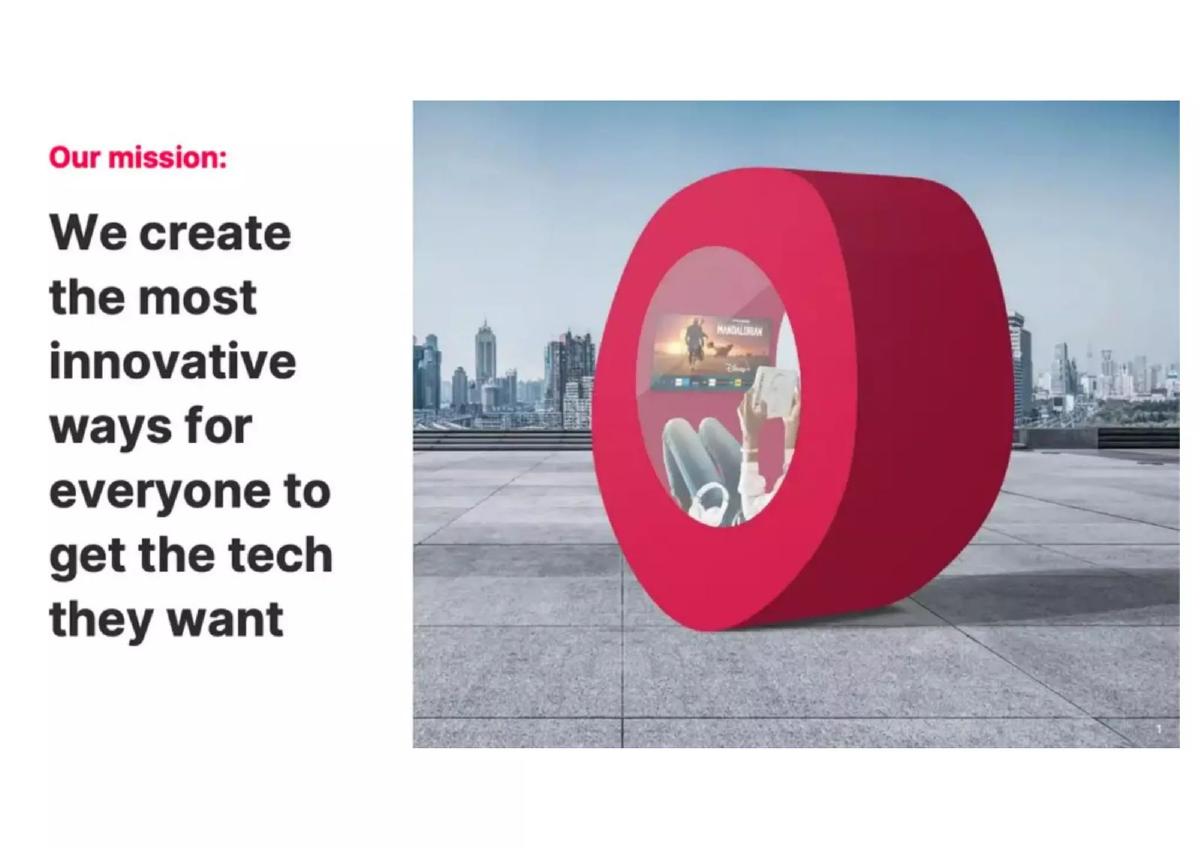
- The company defines its mission as creating innovative ways for everyone to get the tech they want (Slide 1).
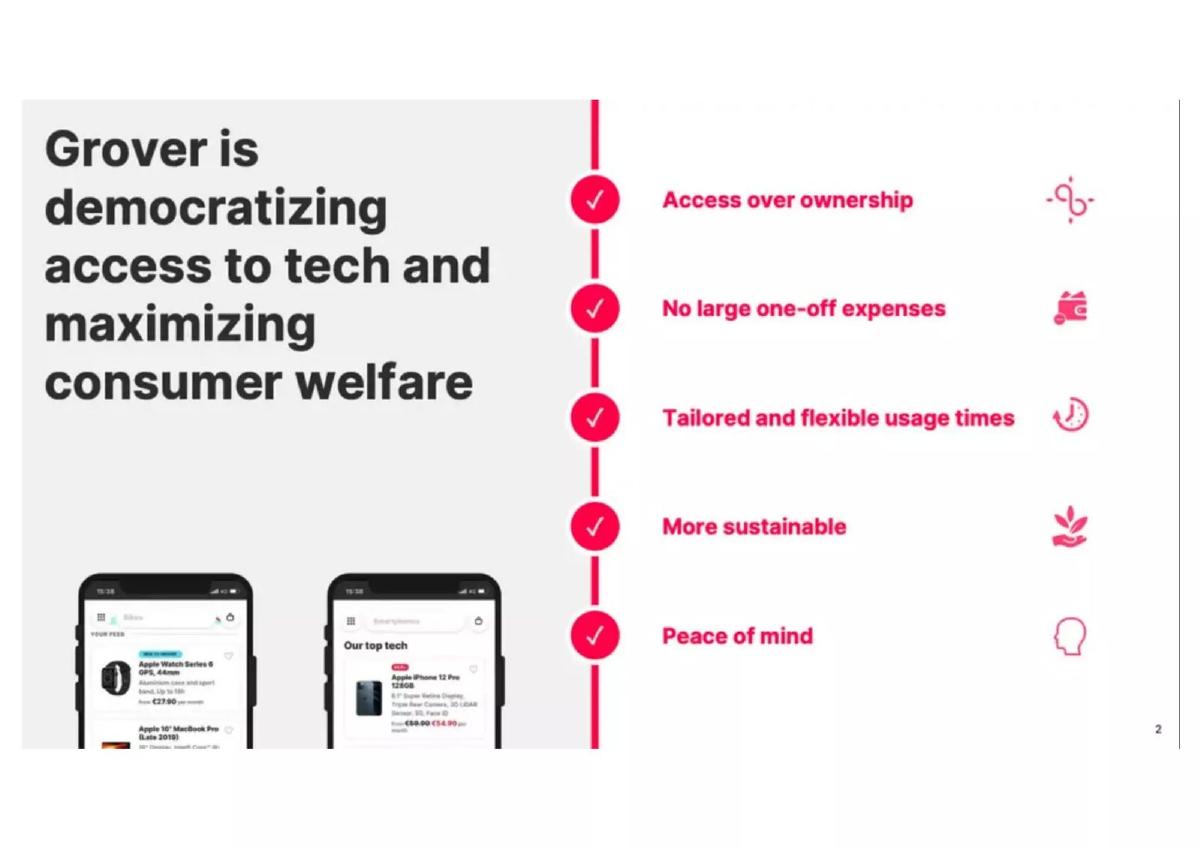
- Grover explicitly positions its value proposition as 'access over ownership' to maximize consumer welfare (Slide 2).
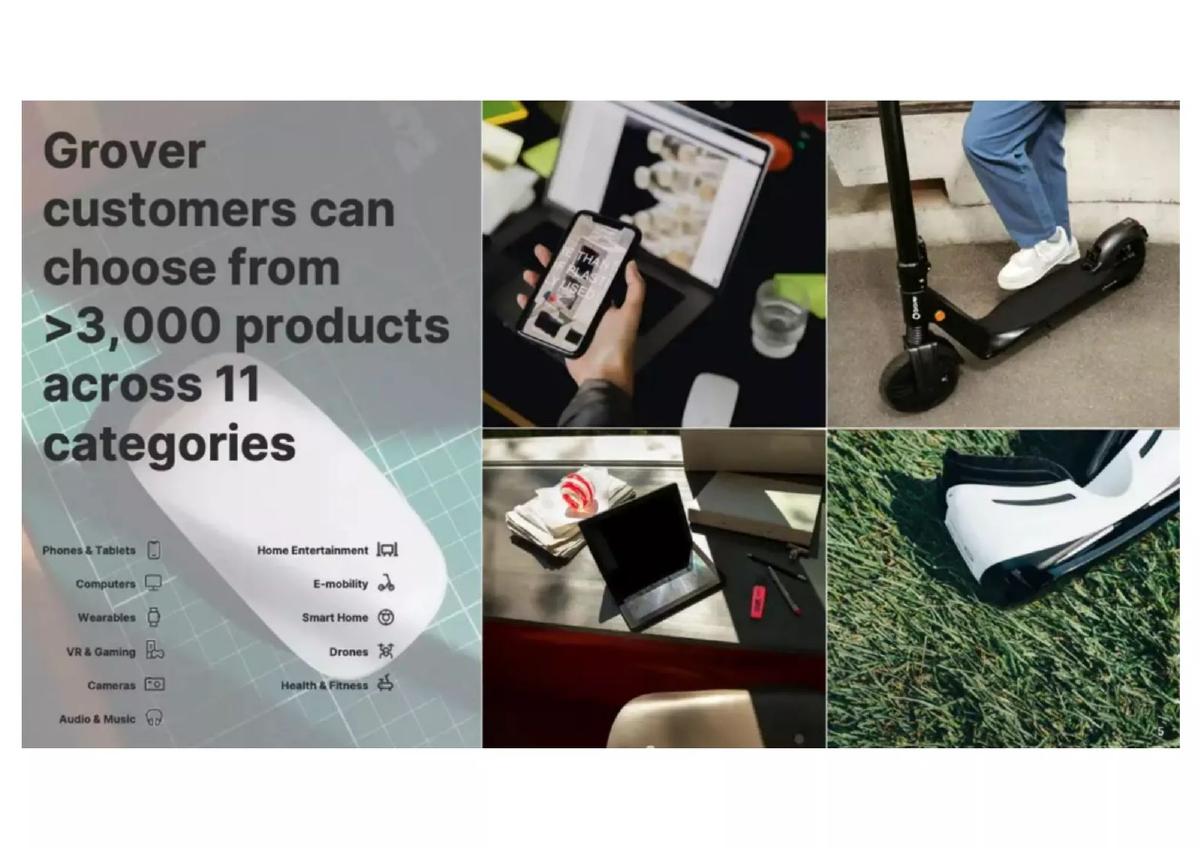
- The platform offers a catalog of over 3,000 products distributed across 11 distinct categories (Slide 3).
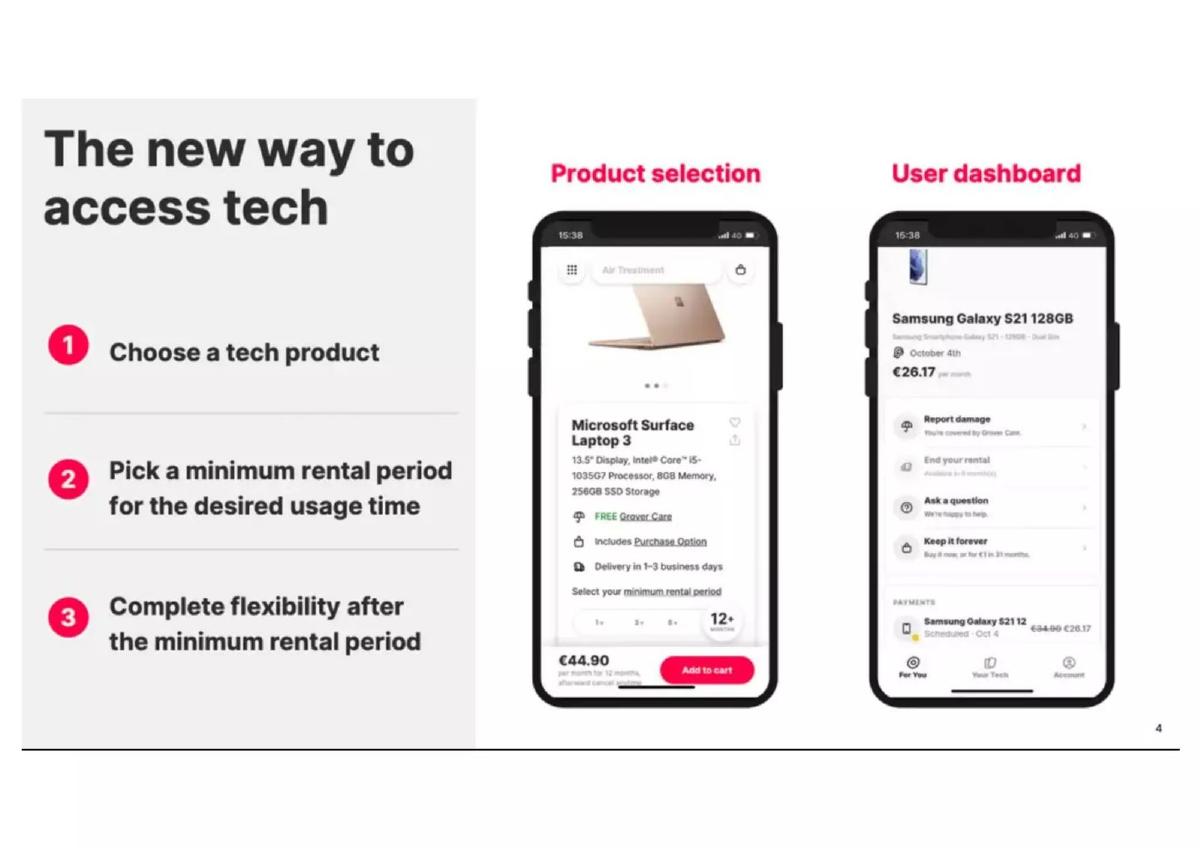
- The user journey is simplified into three steps: choose a product, pick a minimum rental period, and maintain flexibility thereafter (Slide 4).
- Product examples include a Microsoft Surface Laptop 3 for €44.90 per month and a Samsung Galaxy S21 for €26.17 per month (Slide 4).
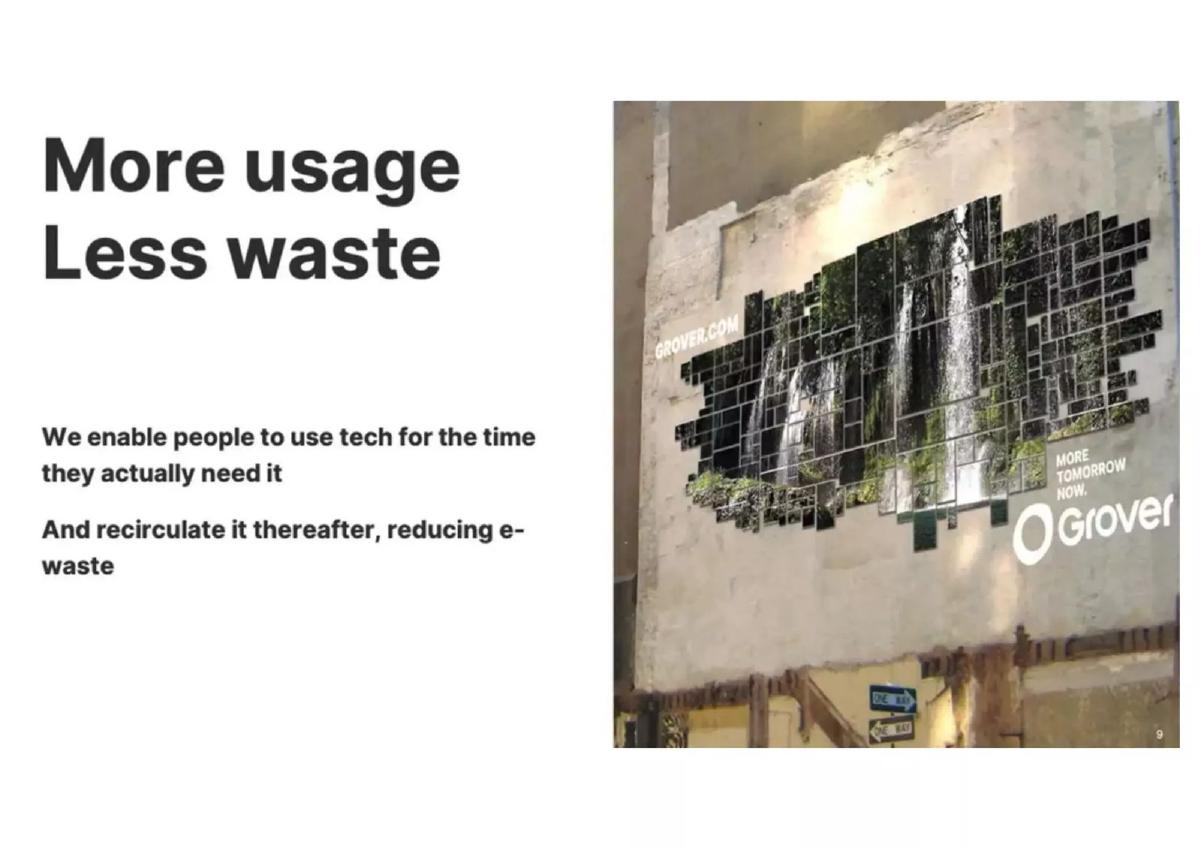
- Sustainability is a core pillar, with the deck emphasizing the recirculation of tech to reduce e-waste (Slide 5).
- The deck uses large-scale outdoor advertising mockups to signal a 'Buying is Over' market shift (Slide 6).
- There is no mention of the founding team, current revenue, or the specific dollar amount being raised in this 8-slide set.
The Brand Manifesto: Grover’s High-Level Approach
Grover’s pitch deck is an exercise in minimalism and brand positioning. Rather than overwhelming the reader with spreadsheets and market growth charts, the company focuses on a fundamental shift in consumer behavior: the transition from ownership to access. This 8-slide deck is designed to sell a vision of a future where 'buying is over,' positioning Grover as the primary infrastructure for this new economy.
Slides 0-1: The Visual Hook and Mission
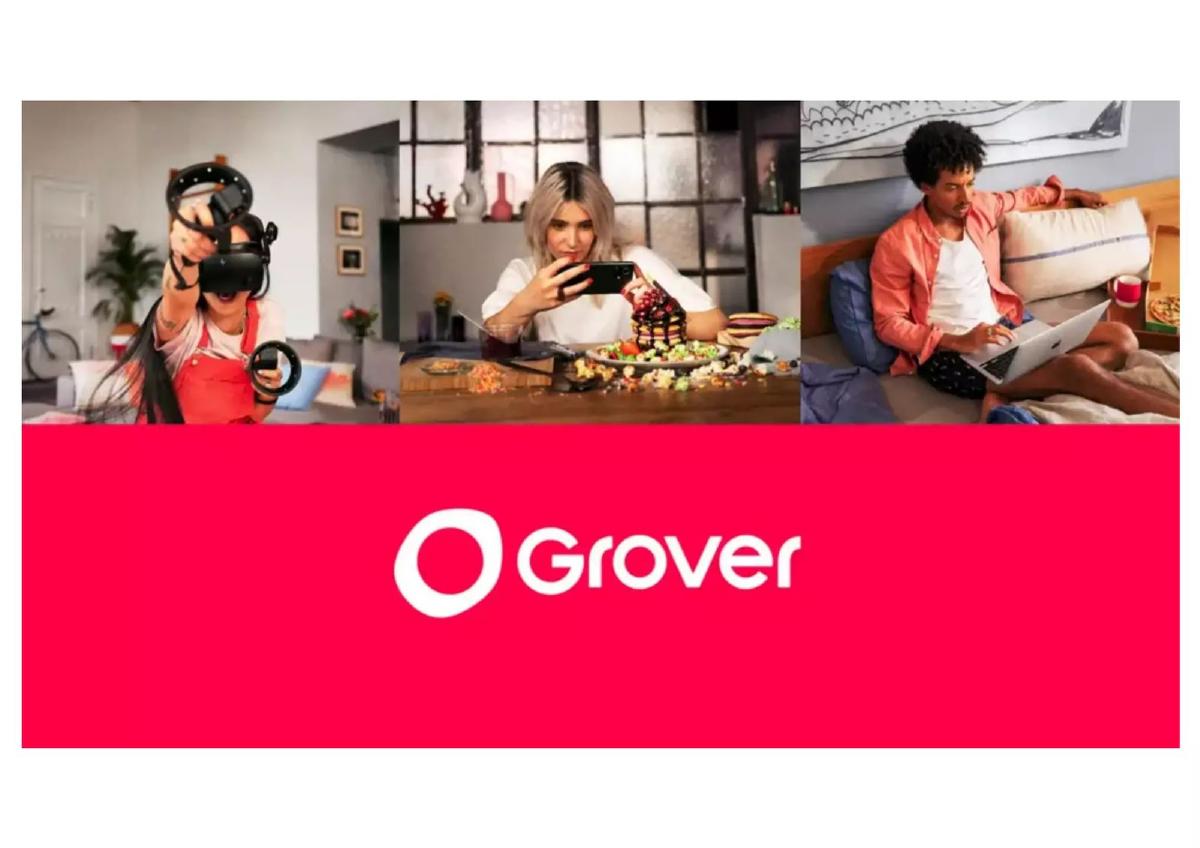
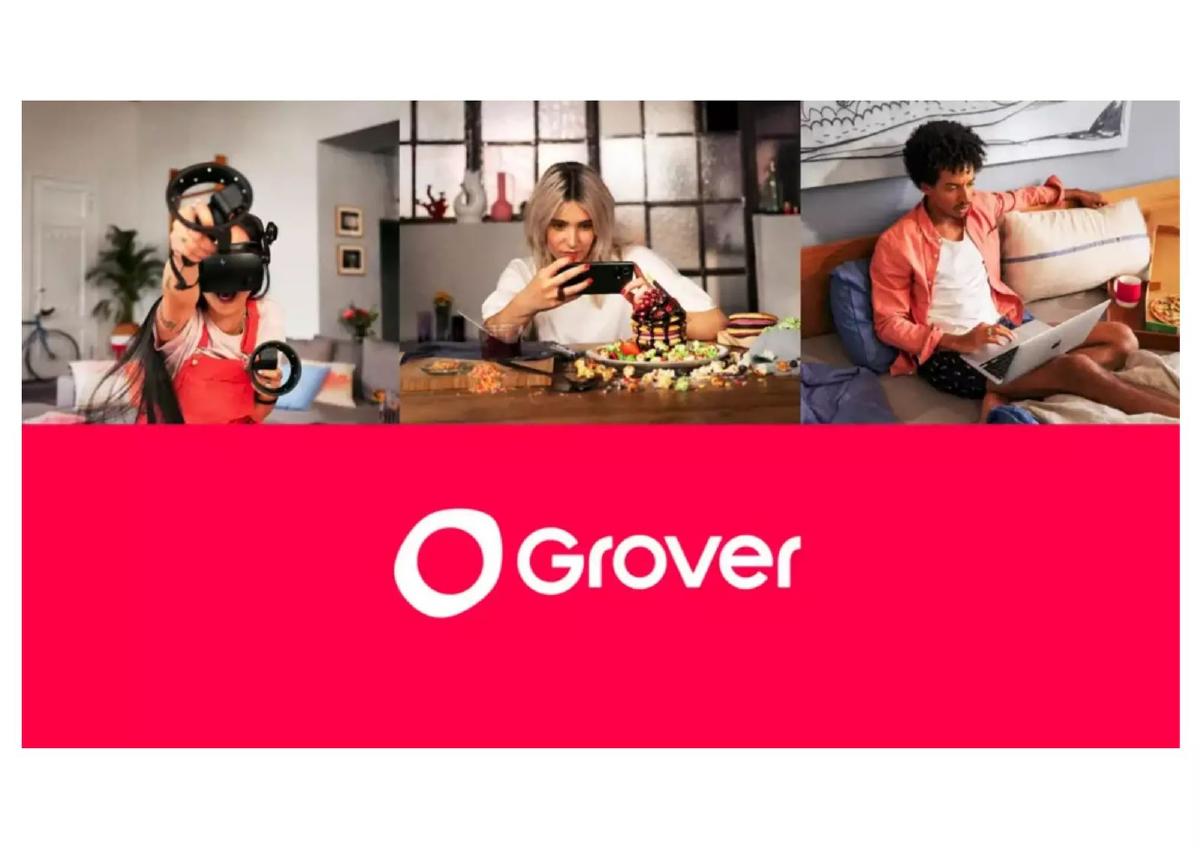
The deck opens with a title slide (Slide 0) featuring three lifestyle images: a woman using VR gear, a woman taking a photo of food with a smartphone, and a man working on a laptop in bed. This immediately grounds the product in everyday consumer life. The Grover logo is prominent against a vibrant red background, establishing the brand's primary color palette.
Slide 1 introduces the mission statement: "We create the most innovative ways for everyone to get the tech they want." The imagery here is more abstract, featuring a large 3D version of the Grover 'O' logo placed in an urban environment, with a screen inside the 'O' showing content from Disney+. This reinforces the idea that Grover is a portal to experiences, not just a hardware provider.
Slides 2-3: Value Proposition and Catalog Breadth
On Slide 2, Grover defines its impact. The headline states, "Grover is democratizing access to tech and maximizing consumer welfare." Five key benefits are listed with checkmarks: Access over ownership, No large one-off expenses, Tailored and flexible usage times, More sustainable, and Peace of mind. This slide effectively addresses the 'why' for the consumer, focusing on financial flexibility and psychological ease.
Slide 3 shifts to the 'what.' It claims that "Grover customers can choose from >3,000 products across 11 categories." The slide lists these categories, which range from standard electronics like Phones & Tablets to niche items like Drones and E-mobility. The use of a collage showing a scooter, a VR headset, and a laptop helps the investor visualize the inventory diversity. This is a crucial slide for proving the scale of the operation without needing a dense table of contents.
Slide 4: The User Experience and Pricing
Slide 4 is perhaps the most functional slide in the deck, titled "The new way to access tech." It breaks the process down into three steps: 1) Choose a tech product, 2) Pick a minimum rental period, and 3) Complete flexibility after the minimum period. The slide features two mobile app mockups. One shows a Microsoft Surface Laptop 3 for €44.90 per month (for a 12+ month rental), and the other shows a Samsung Galaxy S21 for €26.17 per month . These specific price points are vital because they demonstrate the affordability of the service compared to the high retail price of the hardware.
Slides 5-6: Sustainability and Market Sentiment
Slide 5 leans into the ESG (Environmental, Social, and Governance) narrative. With the headline "More usage, Less waste," it explains that Grover recirculates technology to reduce e-waste. The visual is a mural of a waterfall, suggesting a 'natural' and 'clean' approach to consumption. This aligns the company with the growing circular economy movement, which is a significant draw for modern institutional investors.
Slide 6 serves as a bold closing statement. It shows a massive red billboard on a building that reads: "BUYING IS OVER. RENT TECH WITH GOver. GROVER.COM." This is a 'vision' slide. It doesn't provide data, but it communicates the company's ambition to disrupt the entire retail sector. It suggests that Grover isn't just a rental site; it’s a cultural shift.
Slides 7: The Legal Guardrails
The final slide (Slide 7) is a dense legal disclaimer. It notes that the information is for "general informational purposes only" and is not a formal offer to sell shares. It also mentions that the presentation is confidential and contains forward-looking statements. The presence of such a detailed disclaimer usually indicates a company that is operating at a later stage (Series B or beyond) or is preparing for highly regulated investor discussions.
What Works in the Grover Deck
The primary strength of this deck is its clarity of purpose . Within eight slides, any reader understands exactly what Grover does, how much it costs the consumer, and why it matters for the planet. The branding is consistent, using a bold red and clean typography that makes the deck feel professional and modern.
The simplicity of the three-step process on Slide 4 is another highlight. By distilling a complex logistics and financing business into three easy steps, Grover makes the business model feel frictionless. Additionally, the inclusion of specific product prices (€44.90 for a laptop) provides a concrete anchor for the company's value proposition, proving that 'democratizing access' isn't just a buzzword—it's a price point.
What is Missing from the Grover Deck
While the deck is visually compelling, it is strategically incomplete for a standalone fundraise. The most glaring omissions include:
The Team: There is no mention of the founders, their backgrounds, or the executive leadership. For investors, the 'who' is often as important as the 'what.' · Financial Performance: There are no metrics regarding revenue growth, churn rates, or the number of active subscribers. A 'Later' stage company, as categorized in the listing, would typically be expected to show significant traction data. · Unit Economics: The deck doesn't explain the cost of acquiring the hardware versus the lifetime rental income. The profitability of a rental model depends entirely on the number of times a single device can be refurbished and re-rented. · Market Size: There is no TAM/SAM/SOM analysis. While the 'Buying is Over' slide hints at a large market, it doesn't quantify the opportunity. · The Ask: The deck ends without telling the investor how much money is being raised or what the milestones for the next 18-24 months are.
What a Founder Should Copy
Founders should emulate Grover’s lifestyle-first approach to hardware . Many tech startups focus too much on the specs of their platform; Grover focuses on the life the platform enables. The use of high-quality mockups (Slide 4) and 'real-world' advertising examples (Slide 6) helps investors visualize the brand's presence in the wild.
The sustainability narrative (Slide 5) is also a masterclass in modern positioning. By framing a rental business as an environmental solution, Grover taps into a massive pool of ESG-focused capital. Founders in the logistics or e-commerce space should look at how they can frame their efficiency as a benefit to the planet, not just the bottom line.
Finally, the concise value proposition list on Slide 2 is a great template. Instead of long paragraphs, Grover uses five short, punchy phrases to explain why a customer would choose them. This 'skimmability' is essential for decks that are often reviewed in under three minutes.
Final Summary
The Grover deck is less of a financial pitch and more of a brand 'lookbook.' It is highly effective at communicating a vision and a user experience, but it leaves the heavy lifting of financial due diligence for a separate document or data room. For a founder, this deck serves as a reminder that a strong brand identity can make a disruptive business model feel inevitable, even before the first spreadsheet is opened.
Frequently asked questions
- What is Grover's core business model according to the deck?
- Grover operates a subscription-based rental model for consumer electronics. Instead of purchasing devices, users pay a monthly fee for access. Slide 4 illustrates this with specific pricing for laptops and smartphones, highlighting that users can choose a minimum rental period and then enjoy 'complete flexibility' to return, keep, or switch products after that period ends.
- How does Grover address sustainability in its pitch?
- Sustainability is framed through the lens of the circular economy. Slide 5 uses the slogan 'More usage, Less waste,' explaining that Grover enables people to use technology only for the time they need it. The company then recirculates these products to new users, which they claim directly reduces the volume of global e-waste.
- What kind of products can users rent on the platform?
- According to Slide 3, Grover offers more than 3,000 products across 11 categories. These categories include Phones & Tablets, Computers, Wearables, VR & Gaming, Cameras, Audio & Music, Home Entertainment, E-mobility (such as scooters), Smart Home, Drones, and Health & Fitness devices.
- Is there any financial performance data included in the slides?
- No. This specific 8-slide deck is devoid of historical revenue, GMV, customer acquisition costs (CAC), or lifetime value (LTV) metrics. It functions more as a brand positioning document than a data-heavy investor presentation. Founders should note that while this works for brand building, a full fundraise would require significant quantitative backing not present here.
- What is the primary call to action or 'ask' in the deck?
- The deck does not contain a specific 'ask' slide. There is no mention of the round size, valuation, or use of proceeds. The final content slide (Slide 6) is a brand billboard, and the presentation concludes with a legal disclaimer on Slide 7. This suggests the deck is intended for general informational purposes rather than a specific transactional pitch.