Griffin’s 20-slide deck is a masterclass in positioning a high-friction, high-moat business. Rather than shying away from the grueling process of obtaining a UK bank license, the founders lean into it as their primary competitive advantage. The deck effectively contrasts the 'old way' of banking—relying on pooled accounts and manual FTP file transfers—with their modern, API-first architecture. By highlighting a team with deep institutional experience (including a COO who chaired a $65Bn investment committee), Griffin builds the credibility necessary to ask for significant capital in a 'Later'…
Key takeaways
- The deck explicitly states that becoming a bank takes approximately 2 years and requires scarce human expertise, serving as a primary moat (Slide 13).
- Griffin identifies a 50% chance that existing bank 'APIs' are actually just files uploaded to an FTP server, highlighting a technical gap in the market (Slide 9).
- The platform aims to reduce fintech time-to-market from 3-6 months down to days or weeks by offering compliance-as-a-service (Slide 11).
- Revenue is projected to be 70%+ driven by transaction and account fees at current interest rates (Slide 14).
- The team includes a CFO who previously took a UK bank through the authorization process and later took it public (Slide 4).
- Griffin plans to lend to other fintechs at 12% interest, funded by term deposits at 2%, creating a significant spread (Slide 15).
- The Go-To-Market strategy involves providing £25-100K in platform credits to incentivize firms to build on their infrastructure (Slide 16).
- The technical stack is built on a Kafka event-log driven architecture running on Kubernetes (Slide 17).
Griffin: The OS for Embedded Finance
Griffin’s pitch deck is a clinical, highly professional presentation designed for sophisticated institutional investors. Dated June 29, 2020, and addressed to EQT Ventures, the deck tackles one of the most difficult sectors in technology: regulated banking. The company describes itself as a banking-as-a-service (BaaS) provider, but the deck makes it clear that they are not just a software layer; they are building a full-stack bank to eliminate the friction inherent in traditional financial partnerships.
Section 1: Team and Origins
Slide 1: Title The deck opens with a high-altitude shot of London, immediately signaling the geographic focus. A prominent disclaimer at the bottom states that Griffin Financial Technology Ltd is not yet a bank but is seeking regulatory approval from the FCA and PRA. This sets a tone of regulatory transparency that persists throughout the deck.
Slide 2: Introductions A simple transition slide with a waving hand emoji.
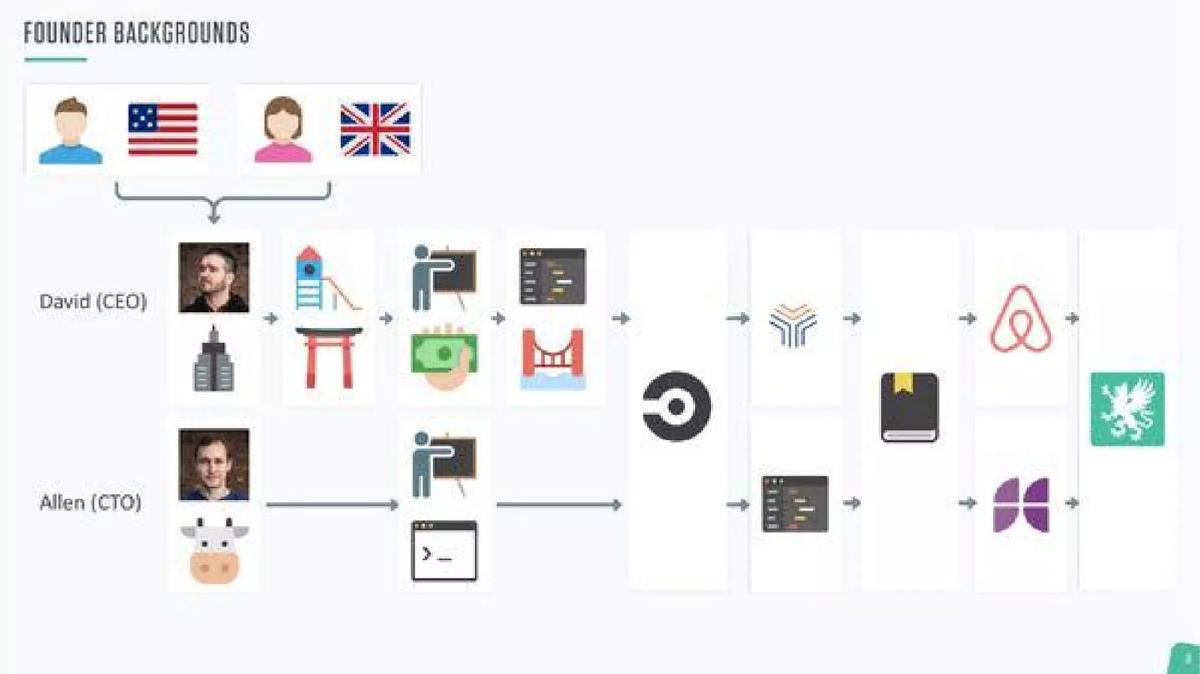
Slide 3: Founder Backgrounds This slide uses a visual timeline to show the paths of David (CEO) and Allen (CTO). It highlights their experience at companies like CircleCI, Airbnb, and Standard Treasury. The use of icons (flags, logos, and simple graphics) makes a complex career path easy to digest at a glance.
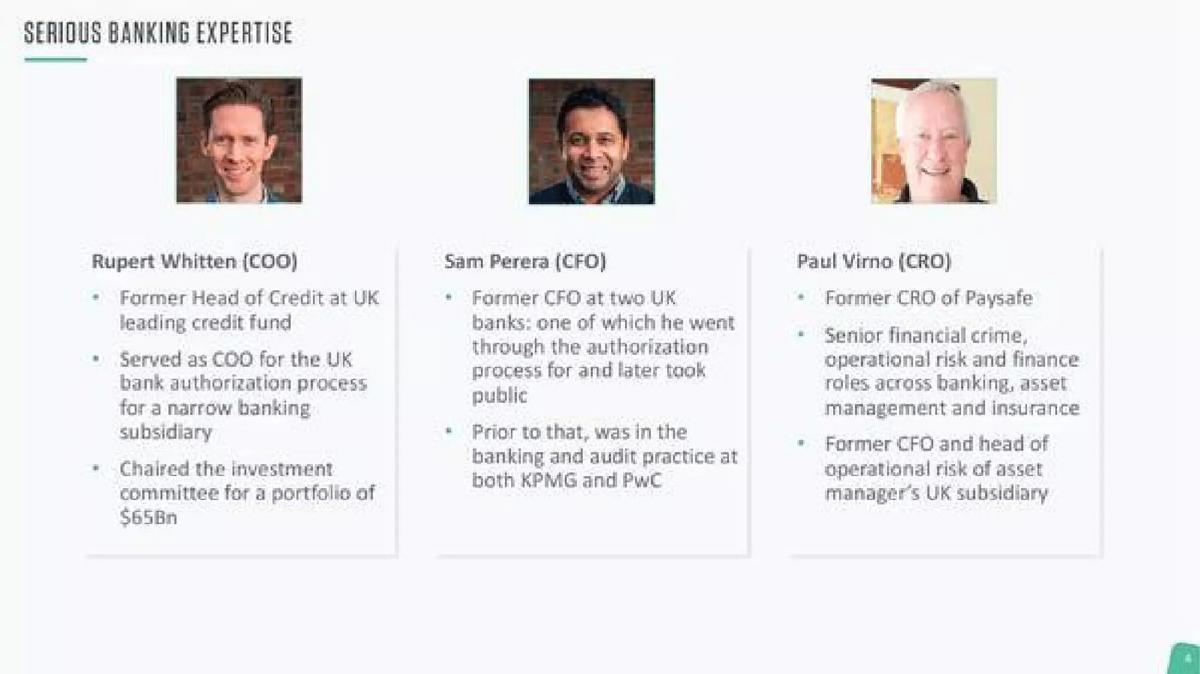
Slide 4: Serious Banking Expertise This is a critical slide for a BaaS company. Griffin showcases three key executives: Rupert Whitten (COO), Sam Perera (CFO), and Paul Virno (CRO). The bullet points emphasize massive scale and regulatory success, specifically mentioning Sam Perera’s experience taking a UK bank through authorization and public listing. This slide is designed to de-risk the 'regulatory approval' hurdle mentioned on the cover.
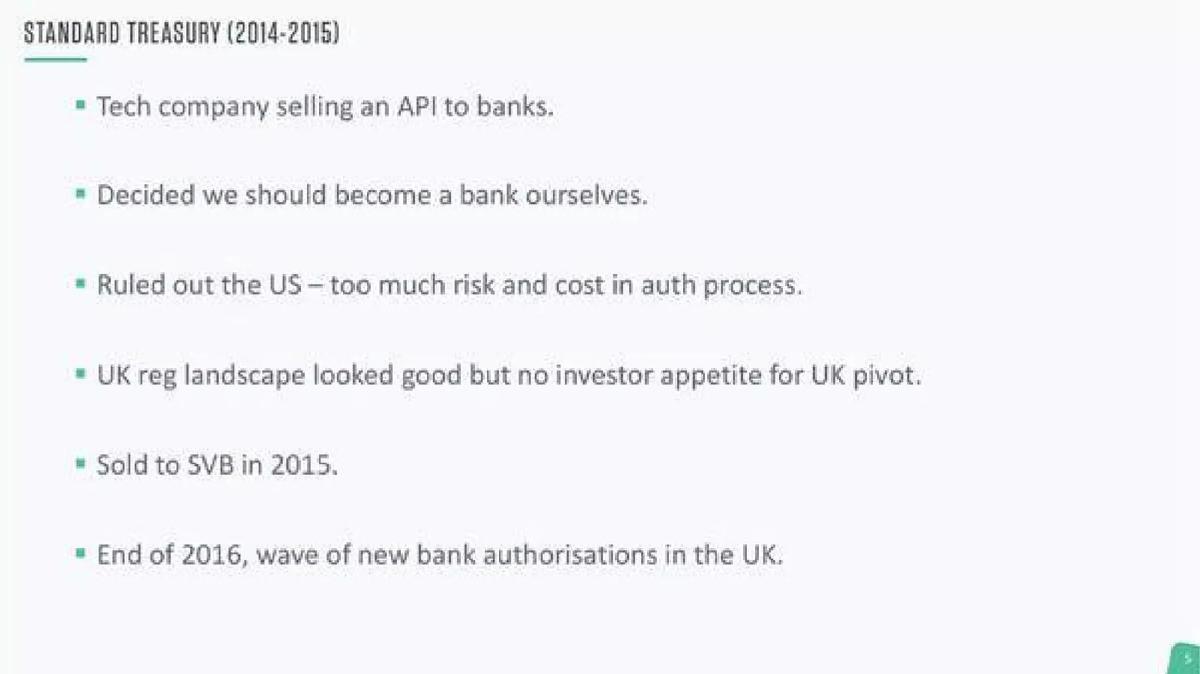
Slide 5: Standard Treasury (2014-2015) Griffin provides context on the founders' previous venture, Standard Treasury. It explains their pivot from selling APIs to banks to becoming a bank themselves. It also explains the strategic choice of the UK over the US, citing the 'wave of new bank authorisations in the UK' at the end of 2016.
Section 2: The Problem and Market
Slide 6: Problem Statement A simple transition slide: 'So, you want to offer a financial product.'
Slide 7: Context This slide educates the investor on the current regulatory landscape. It breaks down the requirements for EMIs (Electronic Money Institutions), PIs (Payments Institutions), and firms with custody permissions. It highlights the illegality of holding money without a partner bank, framing the 'partner bank' as the ultimate bottleneck.
Slide 8: Addressable Market Griffin categorizes their market into three buckets: Fintechs & traditional financials (Wealthfront, Revolut, Stripe), Digital marketplaces (Uber, Airbnb, Etsy), and Brands motivated by data (Google, Facebook, Mercedes-Benz). A disclaimer at the bottom clarifies that these names are examples, not current commercial agreements.
Slide 9: Lots of Infrastructure Complexity This slide identifies the technical 'pain.' Most clearing banks only provide pooled accounts, forcing startups to build their own ledgers and undergo 3-6 month audits. The most damning point is the final bullet: 'Did I mention that there’s a 50% chance the "API" is just a file uploaded to an FTP server?'
Section 3: The Griffin Solution
Slide 10: Example Relationship Diagram A complex but necessary flow chart showing how Griffin sits between 'Nested Customers' (the end users), 'Neobanks' (Griffin’s customers), and the broader financial ecosystem (Bank of England, Mastercard/Visa, Regtech providers).
Slide 11: Reduce Complexity While Adding Value Griffin presents their fix: individually segregated accounts with an integrated ledger. By offering 'compliance as a service,' they claim they can accelerate time to market from months to days or weeks.
Slide 12: Speed Up Time to Market This slide emphasizes the developer experience, mentioning a 'sandbox environment' where customers can self-serve and gain instant access to bank accounts and payment rails after a due diligence process.
Slide 13: Why This? Why Now? This slide summarizes the investment thesis. The 'Moat' is the 2-year process and capital intensity of becoming a bank. The 'Why Now' section cites the rise of embedded finance and pro-competition regulatory bodies in the UK.
Section 4: Business Model and GTM
Slide 14: Business Model Griffin is transparent about their revenue mix. 70%+ comes from transaction and account fees. They also mention using SaaS-based products (core banking) as a sales tactic to build a pipeline.
Slide 15: Lending Products This slide details a high-margin lending strategy. Griffin plans to lend to fintechs at ~12% interest (secured by invoices/assets) while funding those loans via term deposits at ~2%. They argue their data-rich underwriting process gives them an edge over traditional debt funds charging 15%.
Slide 16: GTM (Go-To-Market) The strategy involves identifying 'challengers early' by working with first-round funds and accelerators. They also plan to use platform credits (£25-100K) to create lock-in, similar to the strategies used by AWS or GCP.
Section 5: Progress and Technical Depth
Slide 17: Progress to Date This slide covers tech infra (Kafka, Kubernetes), resourcing (exec team in place), and financial runway (£1.8M remaining from the last round). Notably, the 'Authorisation work' column is covered by a large 'CONFIDENTIAL' stamp.
Slide 18: Timeline - Major Dates This slide is entirely redacted with a 'CONFIDENTIAL' stamp. While frustrating for a teardown, this is common in decks shared publicly after the fact to protect sensitive regulatory milestones.
Slide 19: Thank You A simple closing slide with a prayer hands emoji.
Slide 20: Systems Architecture An appendix slide showing a highly detailed technical diagram of the Griffin platform, including public zones, semi-private zones, and private zones. This serves as 'proof of work' for technical due diligence.
What Works in This Deck
1. The 'Moat' Argument: Griffin doesn't hide from the fact that their business is hard to build. By framing the 2-year regulatory process as a barrier to entry for competitors, they turn a weakness into a primary strength. Investors love businesses that are difficult to replicate.
2. Team Credibility: In fintech, the team is everything. Slide 4 is exceptionally strong because it lists specific regulatory wins (taking a bank through authorization) rather than just generic 'experience.' This directly addresses the biggest risk in the deck: failing to get the bank license.
3. Technical Specificity: Slide 9 and Slide 20 speak directly to the CTO/Technical Partner at a VC firm. By mocking the 'FTP server' reality of current banking and showing a modern Kafka-based architecture, Griffin positions itself as the only modern choice for developers.
What is Missing
1. The Ask: The deck does not state how much money they are looking for or what the specific milestones for the next 18-24 months are. While the catalogue data says $27.7M, a founder using this as a template should include a clear 'Ask' slide.
2. Unit Economics: While Slide 14 and 15 discuss revenue streams, there is no mention of Customer Acquisition Cost (CAC) or Lifetime Value (LTV). Given the 'platform credit' strategy mentioned on Slide 16, understanding the payback period on those credits would be vital for an investor.
3. Competitive Landscape: The deck mentions 'competing banks' generally but does not name other BaaS players (like Solarisbank or ClearBank). A competitive matrix would have helped define Griffin's specific niche within the BaaS market.
What a Founder Should Copy
1. The 'Context' Slide: Slide 7 is a perfect example of how to educate an investor on a complex regulatory environment without being boring. It uses clear categories (Regulated vs. Unregulated) to explain why the company's product is legally necessary.
2. Visual Timelines: The founder background slide (Slide 3) is much more engaging than a list of bullet points. It tells a story of progression and shared history between the founders.
3. The 'FTP' Insight: Finding a specific, slightly embarrassing industry standard (like banks using FTP servers instead of APIs) and highlighting it is a great way to create an 'aha' moment for investors. It proves the founder has 'earned secret' knowledge of the industry's flaws.
4. Relationship Diagrams: Slide 10 is essential for any B2B2C or infrastructure company. If you sit in the middle of a complex value chain, you must show exactly who pays whom and how data flows. Griffin does this cleanly and professionally.
Frequently asked questions
- What is Griffin's core value proposition to fintech companies?
- Griffin positions itself as an all-in-one solution for embedded finance. According to Slide 11, they eliminate the pain points of reconciliation by offering individually segregated accounts with an integrated ledger. This allows fintechs to bypass the 3-6 month audit and integration process required by traditional clearing banks, potentially launching in days or weeks instead.
- How does Griffin plan to generate revenue?
- As detailed on Slide 14, the business model is two-pronged. The majority of revenue (70%+) comes from transaction and account fees. The second pillar is lending; Slide 15 explains they will lend to fintechs against assets or invoices at a 12% rate, utilizing their own deposits (costing 2%) to achieve a superior cost of capital compared to debt funds.
- Why did the founders choose the UK market over the US?
- Slide 5 provides a historical context for the company's predecessor, Standard Treasury. The founders ruled out the US market due to 'too much risk and cost in the auth process.' They noted that by late 2016, a wave of new bank authorisations in the UK made the regulatory landscape more favorable for their pivot.
- What makes Griffin's team qualified for this venture?
- The deck emphasizes 'Serious Banking Expertise' on Slide 4. The executive team includes a COO who managed a $65Bn portfolio, a CFO who has already successfully navigated the UK bank authorization process and an IPO, and a CRO who was the former Chief Risk Officer at Paysafe. This addresses the 'scarce human expertise' requirement mentioned later in the deck.
- What are the primary risks or barriers mentioned in the deck?
- The deck is very transparent about the difficulty of their path. Slide 13 notes that becoming a bank is 'hard, capital-intensive, and requires scarce human expertise.' Furthermore, Slide 9 points out that clearing banks often view fintech startups as high-risk, leading to unfavorable charging structures and lengthy audit requirements that Griffin must overcome.