Trumid’s 20-slide deck is a masterclass in institutional storytelling for a complex B2B financial product. The company targets a specific 'dysfunctional' credit market where buy-side firms hold 99% of inventory but struggle with liquidity due to shrinking dealer balance sheets. The deck relies heavily on the team’s 150 years of combined experience at firms like Goldman Sachs and Barclays to build credibility. Rather than just promising a better UI, Trumid introduces a proprietary 'Swarm' protocol—8-minute session-based trading—to solve the fragmentation problem. While the deck lacks tradition…
Key takeaways
- The deck identifies a specific market bottleneck where dealer inventory has shrunk while outstanding debt has grown to approximately $10 trillion (Slide 2).
- Trumid positions itself as a FINRA-approved broker-dealer and SEC-approved ATS operator to establish regulatory legitimacy (Slide 4).
- The founding team features six senior executives with backgrounds at Salomon Brothers, Goldman Sachs, and Citadel, totaling 150 years of experience (Slide 8).
- The core product innovation is 'Swarm' trading: 8-minute sessions designed to aggregate liquidity at specific times (Slide 11).
- Minimum order sizes are strictly defined at $2MM for High Yield/Distressed and $3MM for Investment Grade securities (Slide 12).
- The revenue model avoids subscription fees, instead charging a markup/markdown of 0.3-0.5 bps for IG and 1/16 point for HY/Distressed (Slide 15).
- The deck provides a technical clearing diagram involving Pershing, State Street, and DTCC/FICC to prove back-office viability (Slide 16).
- There is no mention of current revenue, user growth numbers, or a specific funding 'Ask' amount within the slides.
The Institutional Approach to Fintech Fundraising
Trumid’s pitch deck is a departure from the typical Silicon Valley 'problem-solution' template. It is a highly technical, relationship-driven document designed for the institutional credit market. The deck focuses on market structure, regulatory compliance, and proprietary trading protocols. With a $53M raise attributed to this narrative, it serves as a blueprint for startups tackling 'unsexy' but massive financial infrastructure problems.
Section 1: The Macro Problem and Regulatory Foundation
Slide 1: Title The deck opens with a clean, minimalist title slide: 'A New Frontier for Corporate Bond and Credit Default Swap Trading.' It immediately identifies the two specific asset classes the platform serves.
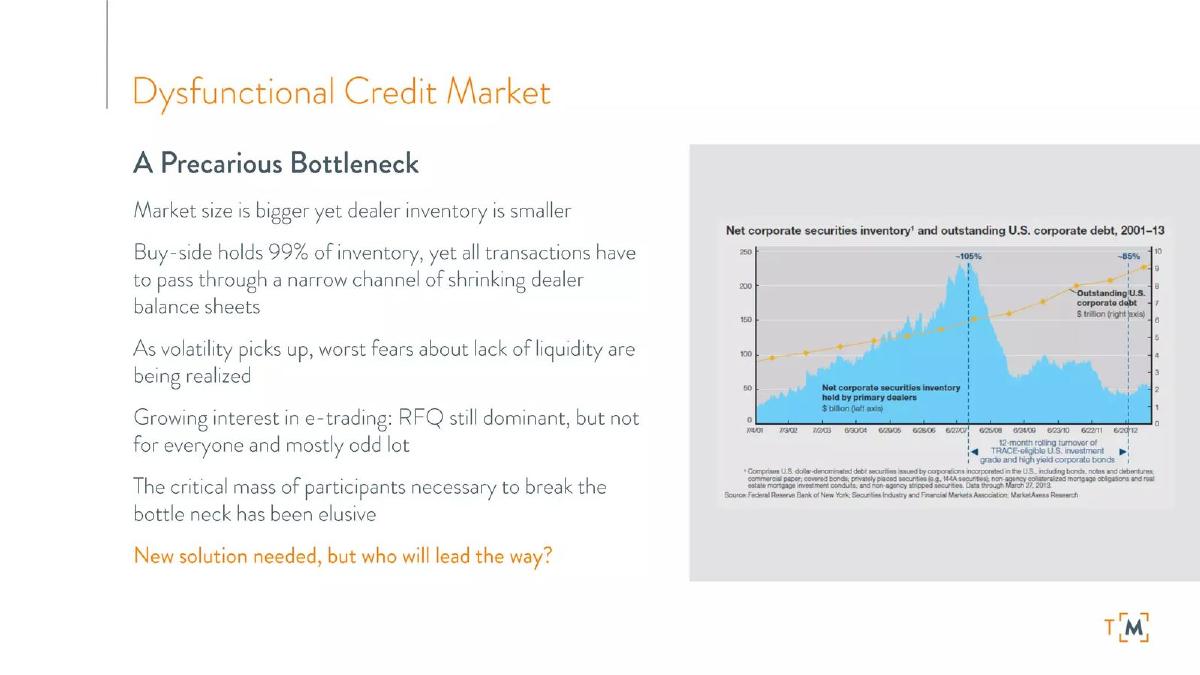
Slide 2: Dysfunctional Credit Market This is the 'Problem' slide, but it uses hard data rather than anecdotes. It features a chart showing 'Net corporate securities inventory and outstanding U.S. corporate debt, 2001-13.' The core argument is a 'Precarious Bottleneck': while the market size has grown (outstanding debt is shown climbing toward $10 trillion), dealer inventory has plummeted by approximately 85% from its peak. This creates a liquidity crisis that Trumid intends to solve.
Slide 3: Transition - Real Liquidity A simple divider slide emphasizing the company's primary value proposition.
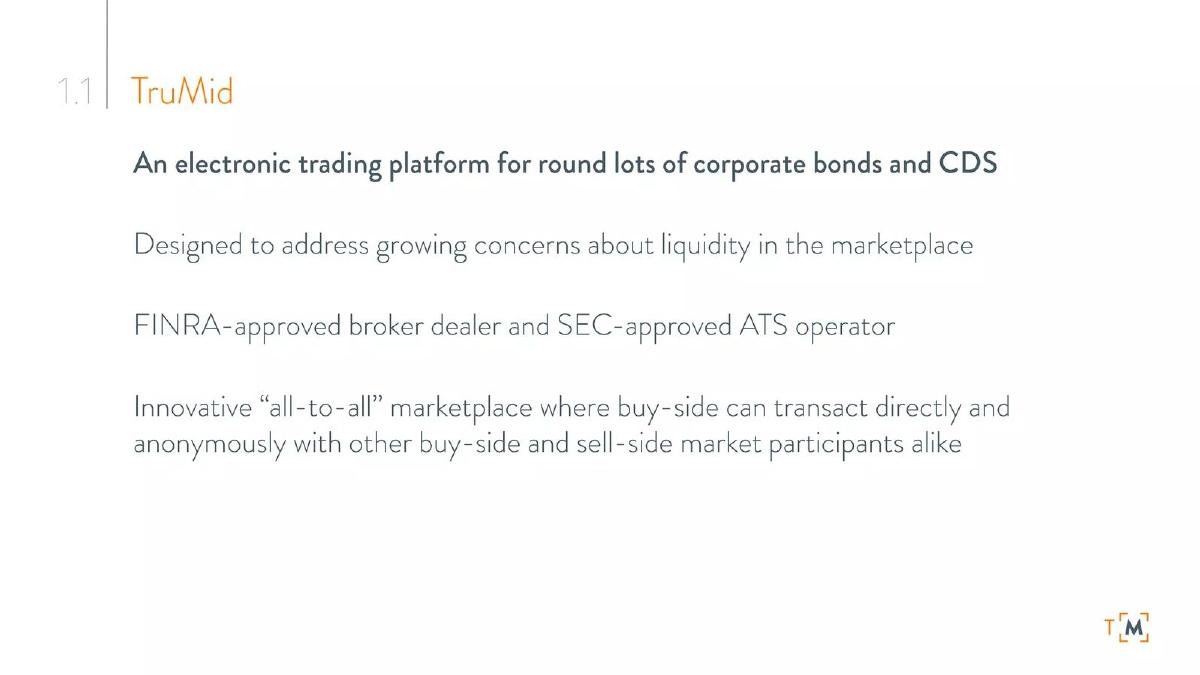
Slide 4: The Solution - Trumid Trumid defines itself as an 'electronic trading platform for round lots of corporate bonds and CDS.' Crucially, it lists its regulatory credentials: 'FINRA-approved broker dealer and SEC-approved ATS operator.' In the world of institutional finance, these approvals are the ultimate 'moat' and validation of the business model.
Section 2: The Pedigree of the Team
Slide 5: Transition - Essential Experience Another divider slide, setting the stage for the team introduction.
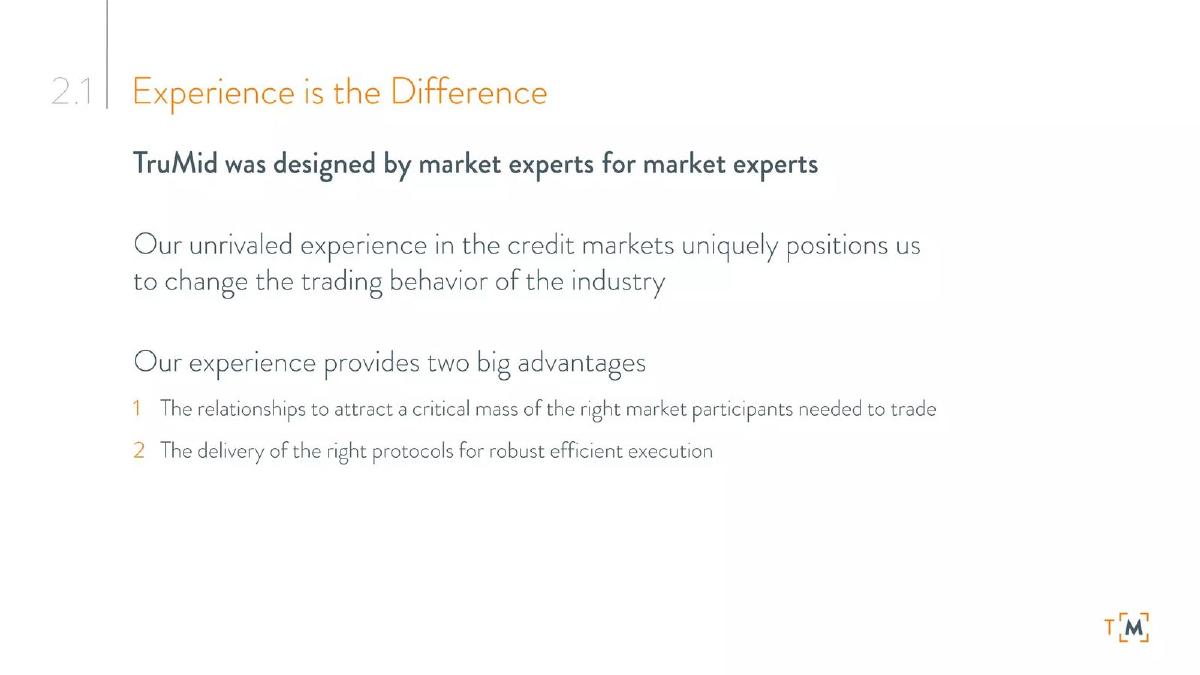
Slide 6: Experience is the Difference The slide claims Trumid was 'designed by market experts for market experts.' It argues that experience provides two advantages: the relationships to attract participants and the ability to deliver the right protocols for execution.
Slide 7: Meet the Team This is one of the most important slides in the deck. It lists six key members: Ron Mateo (Salomon Brothers/Citibank), Ravi Singh (Goldman Sachs/Credit Suisse), Josh Hershman (Barclays/Goldman Sachs), Mike Martinic (Citadel/Citigroup), Mike Sobel (Lehman Brothers/Barclays), and Chris Ruggiero (Goldman Sachs/Blackstone). The cumulative weight of these logos is intended to remove any doubt about the team's ability to navigate Wall Street.
Slide 8: Transition - Deep Relationships Reinforcing the theme that in credit trading, who you know is as important as what you build.
Slide 9: Relationships Matter The slide quantifies the team's value: '150 years of combined team experience.' It claims this has already led to 'unprecedented onboarding momentum,' though it does not list specific client names or numbers here.
Section 3: Product Mechanics and the 'Swarm' Protocol
Slide 10: Transition - Open Access A divider slide leading into the technical details of the platform.
Slide 11: The Right Protocols Trumid breaks down its liquidity drivers into three pillars: Session-Based Trading (Swarms), Anonymity (no data leakage), and Efficient Execution (democratically determined mid-market pricing). This is the 'How' of the platform.
Slide 12: How Swarms Work This slide provides a screenshot of the interface and technical constraints. It notes that 'Trumid professionals select' securities and initial midpoints. Most importantly, it defines the target trade size: 'Minimum order size is 2MM HY / Distressed and 3MM IG.' This confirms Trumid is not for retail investors; it is for institutional 'round lot' trading.
Slide 13: Swarm Types The deck details three types of trading sessions: Sectoral Swarms (industry-specific), Topical Swarms (relevant to a specific day), and Priority Axe Swarms (addressing less liquid securities). This shows a deep understanding of how bond traders actually work throughout a week.
Slide 14: Swarm Construction This slide walks through the three phases of a trade: First Order Phase (3.5 minutes), Active Phase (where users can hit/lift or counter), and the Trumid Phase (matching orders at an algorithmically determined price). It is a highly granular look at the user journey.
Section 4: Business Model and Operations
Slide 15: Pricing Trumid is transparent about its revenue. There are 'No subscription fees.' Instead, they take a spread. For Investment Grade (IG) bonds, it is 0.3-0.5 bps. For High Yield (HY), it is a 1/16 point. An example is provided: if a buyer and seller match at 100, Trumid buys at 99.9375 and sells at 100.0625. This is a classic market-maker revenue model.
Slide 16: Trade Settlements and Clearing For an institutional investor, the 'plumbing' is critical. This slide uses a flow chart to show how trades move from the Trumid ATS to clearing firms like Pershing or State Street, and finally to DTCC/FICC for matching and FINRA for TRACE reporting. This slide proves the platform is 'plug-and-play' with existing financial infrastructure.
Slide 17: Catalyzing Liquidity A summary slide that reiterates the 'tipping point' in the credit market and Trumid’s role as a catalyst for behavioral change through its 'all-to-all' platform.
Slide 18: Tutorial Video A placeholder for a demo video with a password provided ('trumidteam'). This indicates the deck was likely sent as a standalone file for review.
Slide 19 & 20: Closing The deck ends with the logo and a final call to action: 'BE THERE.'
What Works in the Trumid Deck
1. The 'Pedigree' Play: In industries with high barriers to entry like bond trading, the team slide is the most important asset. Trumid leans into this by listing 150 years of experience and top-tier bank logos. They aren't just building an app; they are institutional insiders fixing their own industry.
2. Specificity of the Problem: Slide 2 doesn't just say 'bond trading is slow.' It uses a Federal Reserve Bank of New York chart to show exactly why the market is broken (shrinking dealer inventory vs. growing debt). This makes the 'why now' argument undeniable.
3. Transparent Revenue Model: By explicitly stating the basis points (bps) they charge on slide 15, they answer the 'how do you make money' question immediately. This level of detail is refreshing and builds trust with sophisticated investors.
4. Operational Readiness: The clearing and settlement diagram on slide 16 is a 'boring' but vital inclusion. It proves that the founders haven't just thought about the UI, but also the complex back-office requirements of a regulated financial market.
What is Missing from the Trumid Deck
1. Traction Metrics: There are no slides showing the number of onboarded firms, total trading volume (ADV), or revenue growth. While the deck mentions 'unprecedented onboarding momentum,' it lacks the hard numbers typically required for a $53M raise. This suggests the deck was either used very early in the platform's life or for a round where the lead investors had already performed deep due diligence on the data room.
2. Competitive Landscape: The deck mentions that RFQ (Request for Quote) is the dominant model, but it doesn't name competitors like MarketAxess or Tradeweb. A founder using this deck would need to be prepared to answer how they differ from these established giants in a live Q&A.
3. The 'Ask': There is no slide stating how much money they are raising or what they will do with the capital. This is common in later-stage decks where the 'Ask' is handled in a separate term sheet or private conversation, but for a general teardown, its absence is notable.
What a Founder Should Copy
1. The 'Swarm' Concept: If you are building a marketplace where liquidity is fragmented, don't try to be 'always on.' Copy Trumid's approach of session-based trading to concentrate participants into a specific window. It’s a brilliant way to solve the 'chicken and egg' problem of new marketplaces.
2. Regulatory First: If you are in Fintech, put your licenses (FINRA, SEC, etc.) on the first few slides. It changes the conversation from 'Is this legal?' to 'How big can this get?'
3. Use Real Data for the Problem: Don't make up your own charts. Use reputable sources like the Federal Reserve or industry associations (as seen on Slide 2) to validate the market gap you are filling. It makes your argument feel like an objective truth rather than a sales pitch.
4. The Workflow Diagram: If your product has to integrate with existing legacy systems, include a slide like Slide 16. It shows you understand the 'plumbing' of your industry, which is often where fintech startups fail during implementation.
Frequently asked questions
- What is the 'Swarm' protocol mentioned in the deck?
- Swarm is Trumid's proprietary session-based trading method. Instead of a continuous market, it uses 8-minute windows to aggregate buyers and sellers. This concentrates liquidity into short bursts, which helps participants determine a 'true midpoint' price without the data leakage common in traditional Request for Quote (RFQ) systems.
- How does Trumid make money if there are no subscription fees?
- Trumid operates on a transaction-based model. According to slide 15, they receive a markup or markdown on every trade. For Investment Grade (IG) bonds, this is 0.3 to 0.5 basis points. For High Yield (HY) or Distressed bonds, they charge a 1/16 point spread between the buyer and seller.
- Why does the deck focus so much on the team's background?
- In the credit and bond markets, relationships and institutional trust are the primary barriers to entry. By highlighting 150 years of combined experience at top-tier banks (Slide 9), Trumid signals to investors that they have the 'rolodex' necessary to onboard the buy-side and sell-side participants required for a liquid marketplace.
- What regulatory hurdles does Trumid address?
- Trumid explicitly states on slide 4 that they are a FINRA-approved broker-dealer and an SEC-approved Alternative Trading System (ATS) operator. This is a critical inclusion for fintech decks, as it proves the company has already cleared the significant legal and compliance barriers required to facilitate bond trades.
- What is missing from this deck compared to a typical startup pitch?
- The deck is notably missing a 'traction' slide with growth charts, a 'competition' matrix, and a 'use of proceeds' slide. This suggests the deck was likely used for a later-stage round where investors were already familiar with the company's progress, or it was intended for a highly sophisticated audience that prioritizes market structure over standard SaaS metrics.