TrustBooks presents a highly specialized SaaS solution for the legal industry, specifically targeting the complexities of trust accounting. The deck utilizes a classic 'fear-based' opening, citing a 2015 North Carolina Bar Journal report that 74% of disbarments result from trust mismanagement. This sets a high-stakes stage for their simplified alternative to general-purpose accounting software. While the deck excels at establishing a clear problem-solution fit through visual metaphors and customer testimonials, it lacks critical investor data. There are no slides detailing the business model,…
Key takeaways
- The deck leads with a high-stakes problem: 74% of disbarments are due to trust mismanagement (Slide 2).
- TrustBooks positions its software as a simple, focused tool compared to 'Swiss Army Knife' competitors (Slide 3 and 4).
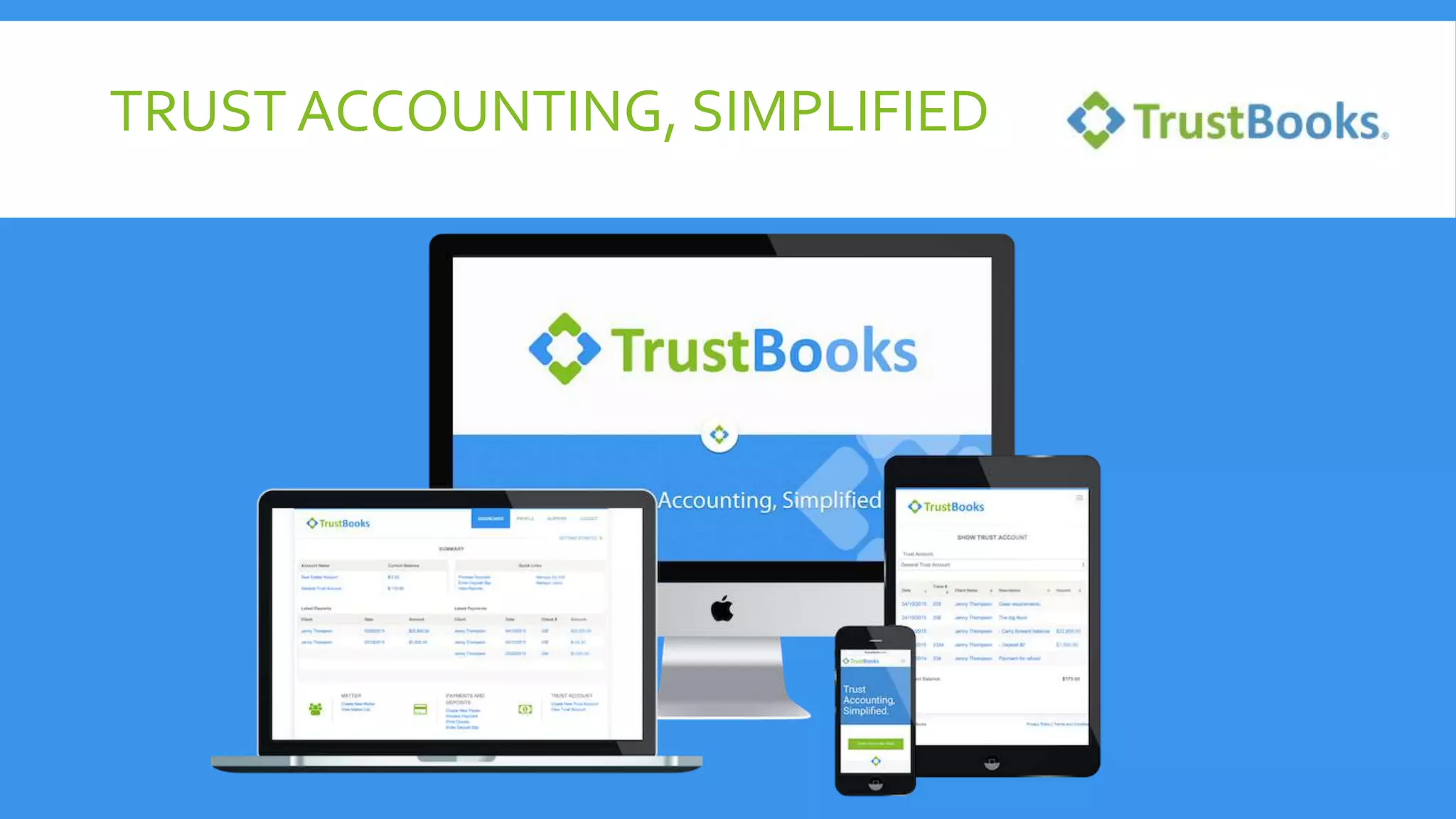
- The product is designed for cross-platform accessibility, showing interfaces for desktop, tablet, and mobile (Slide 1).
- Geographic traction is demonstrated via a map with approximately 20 pins across the United States (Slide 5).
- Customer testimonials explicitly name competitors like QuickBooks and iBank as sources of disappointment (Slide 6).
- The primary user persona is identified as busy lawyers with little to no accounting background (Slide 7).
- The deck omits all financial data, including revenue, churn, and customer acquisition costs.
- There is no mention of the founding team, their legal background, or their technical expertise.
TrustBooks: Solving the Legal Industry's Most Dangerous Problem
The TrustBooks pitch deck is a masterclass in niche positioning. Rather than attempting to be a general accounting platform for all businesses, it targets a specific, high-consequence pain point within the legal profession: trust accounting. In the legal world, mishandling client funds isn't just a financial error; it is a professional death sentence. By anchoring the entire pitch in this reality, TrustBooks creates an immediate sense of urgency that few SaaS products can claim.
Slide 1: Title and Product Vision
The deck opens with the tagline "Trust Accounting, Simplified." The visual includes the TrustBooks logo and a multi-device mockup showing the software running on an iMac, a MacBook, an iPad, and an iPhone. This immediately communicates that the solution is a modern, cloud-based SaaS platform accessible from anywhere. The interface shown on the screens appears clean and dashboard-oriented, reinforcing the "simplified" promise made in the header.
Slide 2: The Stakes of the Problem
Slide 2 is the most powerful slide in the deck. It uses a bold header: "#1 WAY TO GET DISBARRED." It cites a specific data point from the 2015 North Carolina Bar Journal stating that "74% of disbarments were the result of trust mismanagement." This is a classic 'fear-based' hook. For a lawyer, the risk of losing their license is the ultimate motivator. By quantifying this risk, TrustBooks moves the conversation from 'productivity software' to 'insurance for your career.'
Slide 3: The Complexity of Competitors
Slide 3 addresses the current state of the market using a visual metaphor. Under the heading "COMPETITORS' SOFTWARE," it shows a Swiss Army Knife with every tool extended. The implication is clear: existing solutions (like QuickBooks or Xero) are bloated with features that lawyers don't need, making the one thing they do need—trust compliance—harder to manage and more prone to error. This slide sets up the 'Complexity' half of the problem.
Slide 4: The TrustBooks Solution
Slide 4 provides the counter-metaphor. Under the heading "TRUSTBOOKS," it shows a simple, sharpened pencil. This is a bold choice for a software company, but it effectively communicates their philosophy: do one thing, and do it perfectly. It promises a focused tool that eliminates the distractions and dangers of the 'Swiss Army Knife' approach. It is a visual representation of the "Simplified" claim from the title slide.
Slide 5: Geographic Traction
Slide 5 asks "WHO IS USING TRUSTBOOKS?" and displays a map of the United States with green location pins. There are approximately 20 pins scattered across the country, with clusters in the Southeast and Northeast. While the slide lacks a specific customer count or revenue figure, it demonstrates that the product has moved beyond a local pilot and has achieved some level of national adoption. However, for a formal fundraise, this slide would need to be backed by hard numbers regarding user growth or MRR.
Slide 6: Social Proof - The Switcher
Slide 6 features a testimonial from Bill Cameron of Sherrill & Cameron, PLLC. The quote is strategically chosen: "Disappointed with QuickBooks and iBank. Setting up TrustBooks was a breeze." This directly validates the metaphors used in Slides 3 and 4. It proves that real law firms are actively looking for alternatives to the market leaders because those leaders are failing to meet the specific needs of trust accounting.
Slide 7: Social Proof - The Non-Accountant
Slide 7 features Joe Anderson from City of Oaks Law. His testimonial focuses on the user experience: "Easy for lawyers with little or no accounting background." This addresses a major barrier to entry for accounting software—the learning curve. It reinforces the idea that TrustBooks is a tool for the "busy lawyer," not just for a back-office bookkeeper. This slide completes the narrative that the software is both necessary for compliance and easy to use.
What Works in the TrustBooks Deck
The narrative arc of this deck is exceptionally strong. It follows a logical path: here is a problem that can end your career (Slide 2), here is why current tools make that problem worse (Slide 3), here is our simple solution (Slide 4), and here are the people who are already using it to stay safe (Slides 5-7). The use of visual metaphors instead of dense text makes the message memorable and easy to digest in a high-pressure environment like a "Startup Alley" pitch.
Furthermore, the focus on a specific niche is a strength. By narrowing their focus to trust accounting, they avoid a direct feature-war with giants like QuickBooks. Instead, they position themselves as a necessary 'add-on' or specialized replacement that provides peace of mind that a general tool cannot offer.
What is Missing from the TrustBooks Deck
While this deck is an excellent sales tool, it is an incomplete fundraising deck. The following critical elements are entirely absent:
Business Model: There is no information on how TrustBooks makes money. Is it a monthly subscription? Is it priced per matter or per user? · Market Size: The deck doesn't quantify the opportunity. How many small law firms exist in the US? What is the Total Addressable Market (TAM) for a specialized trust accounting tool? · The Team: Investors invest in people. This deck does not show who is building the software. Are the founders lawyers who experienced this pain? Are they fintech experts? · Financials and Projections: There are no mentions of revenue, growth rates, or future targets. · The Ask: The deck does not state how much money the company is looking to raise or what they intend to do with the capital.
Lessons for Founders
Founders can learn two major lessons from the TrustBooks approach. First, anchor your problem in a high-consequence reality. If your software solves a problem that could lead to a user losing their job or their professional license, lead with that. It turns your product from a 'nice-to-have' into a 'must-have.'
Second, use metaphors to explain your competitive advantage. The Swiss Army Knife vs. Pencil comparison is a brilliant way to explain why a simpler product is actually better. It reframes a lack of features as a deliberate design choice for safety and efficiency. However, founders should ensure that if they are using a deck for fundraising, they must supplement this strong narrative with the hard data and team credentials that investors require to conduct due diligence.
Frequently asked questions
- What is the core value proposition of TrustBooks?
- The core value proposition is risk mitigation and simplicity. By focusing exclusively on trust accounting, TrustBooks helps lawyers avoid the 'number one way to get disbarred.' It positions itself as a specialized, user-friendly alternative to complex general accounting software that often leads to compliance errors for non-accountants.
- Who is the target audience for this deck?
- Based on the testimonials and problem statement, the target audience is solo practitioners and small law firms. These users typically lack dedicated accounting staff and are most at risk of manual errors in trust management, making a simplified, automated compliance tool highly attractive.
- How does TrustBooks differentiate itself from QuickBooks?
- TrustBooks uses a visual metaphor of a Swiss Army Knife versus a pencil to argue that QuickBooks is overly complex for the specific task of trust accounting. Testimonials in the deck explicitly state that users were 'disappointed with QuickBooks' before finding TrustBooks to be a 'breeze' to set up.
- What critical information is missing from this pitch deck?
- The deck is missing almost all standard venture capital requirements: a team slide, a business model/pricing slide, market size (TAM/SAM/SOM), a competition matrix, and a clear financial ask. It focuses entirely on the product's utility and the severity of the problem it solves.
- Is the market traction shown in the deck significant?
- Slide 5 shows a map of the US with pins in roughly 15 states. While this indicates the product is live and has national reach, it lacks specific numbers. Without knowing if those pins represent 20 customers or 2,000, the traction remains qualitative rather than quantitative.