Trym positions itself as a specialized ERP and environmental monitoring solution for the cannabis cultivation industry. The deck effectively demonstrates traction by citing 2.3 million square feet of cultivation facilities managed across 15 states (Slide 4). It addresses the specific regulatory and operational hurdles of the sector through integrations with compliance software like Metrc (Slide 6). While the market size is projected to reach a $31B total market by 2024, the company focuses on a $1B+ TAM specifically for farm management software (Slide 5). The primary weakness of this specific…
Key takeaways
- The company manages 2.3 million square feet of cultivation facilities across 15 different states as of the time of the presentation (Slide 4).
- Trym projects the US cannabis farm management TAM will exceed $1B by 2024 (Slide 5).
- The software integrates with critical industry compliance tools like Metrc for California and Oregon, as well as hardware like TrolMaster (Slide 6).
- The product suite includes the Trym Grow App for task tracking and the Trym Explore App for compliance reporting (Slide 3).
- The company is seeking a $1.5M Series Seed Preferred Round (Slide 7).
- Existing major investors include 7thirty Capital, WelCan Capital, and Delta Emerald Ventures (Slide 7).
- The deck highlights that there are 4x more cultivation licenses than any other license type in the cannabis industry (Slide 5).
- A customer testimonial from Supernatural Gardens credits the software with consolidating all grow data into one place (Slide 3).
Executive Summary: Vertical SaaS for a High-Growth Niche
Trym's pitch deck is a focused look at vertical software-as-a-service (SaaS) tailored for the cannabis cultivation market. The deck moves quickly from product utility to market scale, emphasizing that cannabis farming is a data-heavy enterprise requiring specialized tools that generic agricultural software may lack. By focusing on the 'cultivator' license type—which they claim is the most prevalent in the industry—Trym makes a case for a high-ceiling niche market.
Slide 1: Title and Positioning
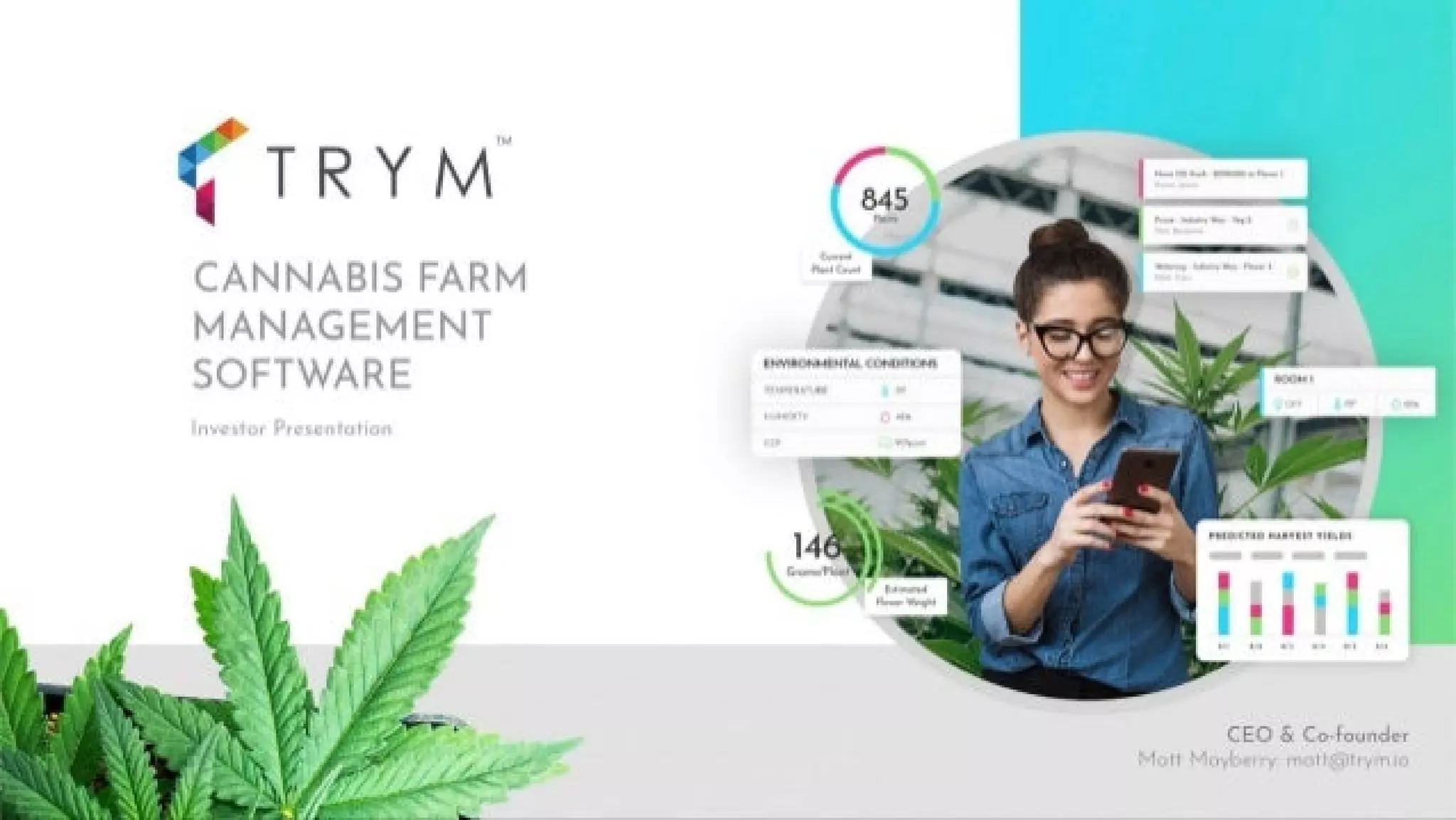
The opening slide establishes the brand identity and core value proposition immediately. Trym is described as "Cannabis Farm Management Software." The visual includes a mobile interface overlay showing environmental conditions (Temperature, Humidity, VPD) and plant counts (845 plants). This immediately signals to the investor that the product is a combination of data analytics and operational oversight. The slide identifies Matt Mayberry as the CEO and Co-founder.
Slide 2: Product Interface
Slide 2 provides a clean look at the software's dashboard on a laptop. The interface shows specific plant tracking (e.g., "OG Kush Plant 93") and metrics such as estimated flower weight and time remaining until harvest. The tagline "Meet Trym, cultivation software custom built for cannabis" reinforces the vertical SaaS strategy, suggesting that general-purpose agricultural tools are insufficient for the specific needs of cannabis growers.
Slide 3: How Trym Works and Social Proof
This slide breaks the product down into three functional pillars: Environmental Data, the Trym Grow App, and the Trym Explore App. Environmental Data integrates with control systems to link climate data to specific plant zones. The Grow App is the mobile component for tracking tasks and conditions in real-time. The Explore App serves as the administrative layer for scheduling, batch tracking, and compliance reporting. A testimonial from Daniel Tutor of Supernatural Gardens is included, stating that the software "consolidates all of my grow data into one place."
Slide 4: Traction and Geographic Reach
Traction is presented through physical scale rather than just revenue. The slide claims Trym is "Working with leading cultivators across 15 states" and manages "2.3 Million Sq. Ft. of Cultivation Facilities." The use of square footage as a metric is highly relevant in the cannabis industry, where production capacity is often capped or measured by canopy size. The slide features a grid of logos from partner cultivators, though many are blurred in this version of the deck.
Slide 5: Market Opportunity (TAM)
The market slide provides a comparative look at the industry in 2020 versus projections for 2024. It notes a total market size growth from $17B to $31B. More importantly for the business model, it tracks the number of cultivators, projected to grow from 39,015 to 71,145. The slide concludes that the 2024 cannabis farm management TAM is >$1B . A small footnote explains the math: 71,145 farms multiplied by a $1,200 monthly SaaS fee equals approximately $1.02B in Annual Recurring Revenue (ARR) potential.
Slide 6: Software Integrations
For a vertical SaaS company, integrations are a defensive moat. Slide 6 lists four key partners: Metrc (compliance tracking for CA and OR), Argus Controls , TrolMaster (environmental hardware), and Slack . The Metrc integration is particularly vital, as it automates the mandatory reporting required by state governments, which is a significant pain point for operators.
Slide 7: The Investment Opportunity
The 'Ask' slide details a $1.5M Series Seed Preferred Round . It lists notable institutional investors already involved: 7thirty Capital, WelCan Capital, and Delta Emerald Ventures. However, this slide is heavily redacted or uses placeholders for internal metrics. The "Pre-Money Valuation," "Runway months," and specific targets for "Paying Accounts" and "ARR" are all left as blank lines or placeholders. This suggests the deck was either a template or a version intended for wide distribution where sensitive financials were removed.
Slide 8: Closing and Contact
The final slide is a standard contact page featuring the founders' email address and social media handles (@trymtech) against a backdrop of a high-tech indoor cultivation facility. It maintains the professional, clean aesthetic found throughout the deck.
What Works in the Trym Deck
Specific Metrics: Using "Square Feet Managed" (Slide 4) is an excellent way to show market penetration in an industry where revenue might be lumpy or early-stage. · Compliance Focus: Highlighting the Metrc integration (Slide 6) shows a deep understanding of the customer's primary headache: regulatory compliance. · Clear Market Segmentation: By pointing out that there are 4x more cultivation licenses than any other type (Slide 5), Trym justifies why they are focusing on the farm rather than the dispensary or the laboratory. · Visual Clarity: The deck avoids clutter. The product shots are high-quality and the value proposition is explained in plain English without excessive jargon.
What is Missing from the Trym Deck
Financial Specifics: The most glaring omission is the lack of actual revenue or growth rates. While Slide 7 lists "Key Goals," the actual numbers are missing. An investor cannot evaluate the efficiency of the business without knowing the current ARR or CAC/LTV. · Competitive Landscape: There is no slide addressing competitors. In the cannabis tech space, companies like MJ Freeway, LeafLink (in different segments), or other farm management tools exist. Failing to acknowledge them can be a red flag for investors. · Team Background: While the CEO is named on the first slide, there is no dedicated team slide. In a seed round, the pedigree and experience of the founders are often as important as the product itself. · Unit Economics: The deck mentions a $1,200 monthly fee in the TAM calculation, but it doesn't explain the pricing tiers or how much it costs to acquire a new farm customer.
Founder's Guide: What to Copy
The 'How it Works' Breakdown: Slide 3 is a great example of how to explain a complex multi-app ecosystem simply. Breaking it down into 'Grow' (worker) and 'Explore' (manager) functions makes the product's utility clear. · The Bottom-Up TAM: Instead of just citing a massive, vague industry number, Trym shows the math (Slide 5). They take the number of licenses and multiply it by their expected seat price. This is much more credible to sophisticated investors. · Hardware Integration: If you are a software company in a physical industry (like farming or manufacturing), showing that you play nice with existing hardware (Slide 6) is essential to prove you can be integrated into a customer's current workflow.
Frequently asked questions
- What is Trym's core product offering?
- Trym offers a cannabis-specific farm management platform that combines environmental data monitoring with task management and compliance reporting. According to Slide 3, the system includes a mobile 'Grow App' for workers to track tasks and environmental conditions, and an 'Explore App' for management to schedule tasks, track batches, and report compliance data to Metrc.
- How does Trym handle the complex regulatory requirements of the cannabis industry?
- Trym addresses regulation through direct software integrations. Slide 6 highlights a key integration with Metrc, the primary track-and-trace system used by regulators in states like California and Oregon. By linking cultivation data directly to compliance reporting, Trym reduces the manual labor and risk associated with state-mandated reporting.
- What is the scale of Trym's current operations?
- As shown on Slide 4, Trym has achieved significant geographic and operational reach, managing 2.3 million square feet of cultivation facilities. Their software is active in 15 states, and the slide displays logos for approximately 18 different cultivation partners, though some logos are blurred for confidentiality.
- What are the specific financial terms of the fundraising round?
- The deck specifies a target of $1.5M for a Series Seed Preferred Round. However, Slide 7 contains several placeholders where specific figures have been omitted or redacted, including the pre-money valuation, the number of months of runway the capital provides, and the specific ARR targets for their key goals.
- How does Trym calculate its Total Addressable Market (TAM)?
- Trym uses a bottom-up calculation based on license counts. Slide 5 notes that by 2024, there will be an estimated 71,145 cultivators. By applying a projected $1,200 monthly SaaS fee per license, they arrive at a farm management TAM of over $1B, within a broader $31B cannabis market.