Tulipshare’s 14-slide Seed deck is a masterclass in narrative-driven fundraising. Instead of leading with complex unit economics or total addressable market (TAM) spreadsheets, the company focuses on the moral imperative of 'voting with your money.' The deck highlights a highly efficient 113-day build-to-launch timeline and the acquisition of a UK Broker Dealer authorization, which serves as a significant moat for a Seed-stage startup. By showcasing early interest in specific activist campaigns against Amazon, Coca-Cola, and Apple, Tulipshare demonstrates product-market fit through social sen…
Key takeaways
- The company secured a UK Broker Dealer authorization from the FCA within its first five months of operation (Slide 7).
- Product development was exceptionally rapid, moving from the first line of code to a launched trading platform in 113 days (Slide 7).
- The business model relies on two primary revenue streams: transaction commissions and FX fees for USD conversions (Slide 12).
- Tulipshare leverages a third-party infrastructure stack including DriveWealth for clearing and Onfido for KYC (Slide 13).
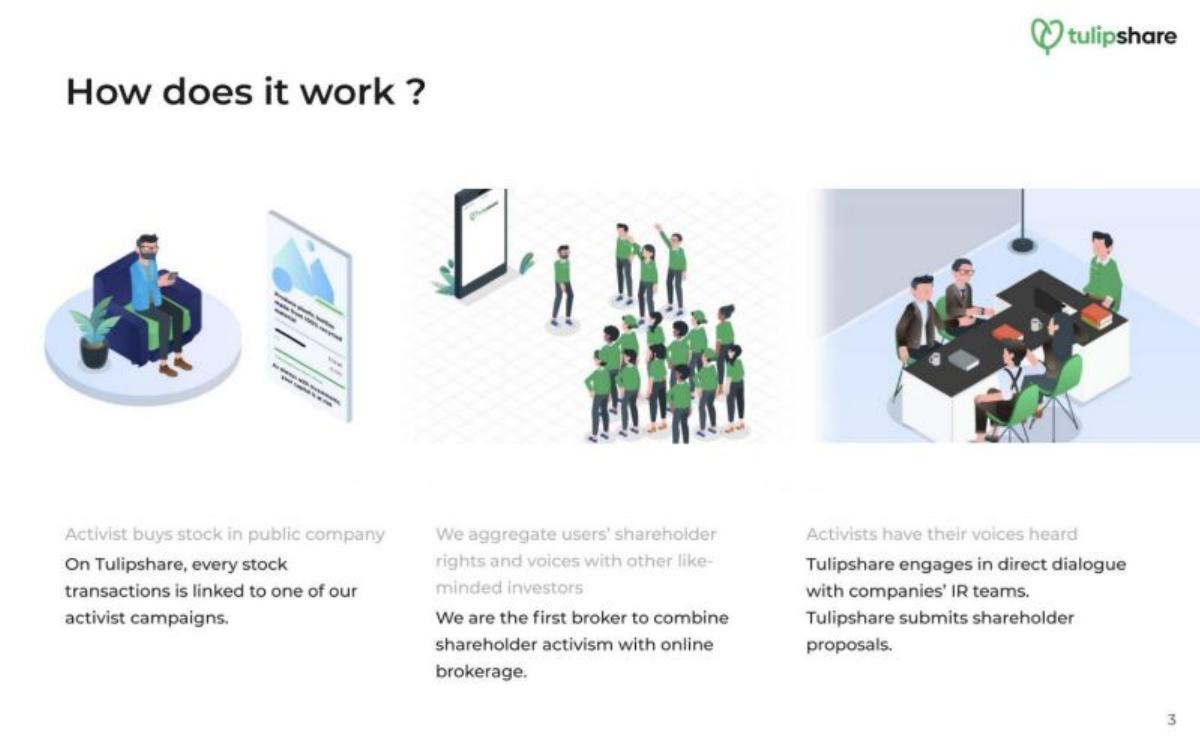
- The platform aggregates retail shares to submit formal shareholder proposals and engage in direct dialogue with IR teams (Slide 3).
- Early traction is measured by 'interest' in specific campaigns, such as 1,923 people interested in a Coca-Cola recycling initiative (Slide 8).
- The founder previously co-founded Lumen, a dating app for over-50s that was acquired by Blackstone (Slide 5).
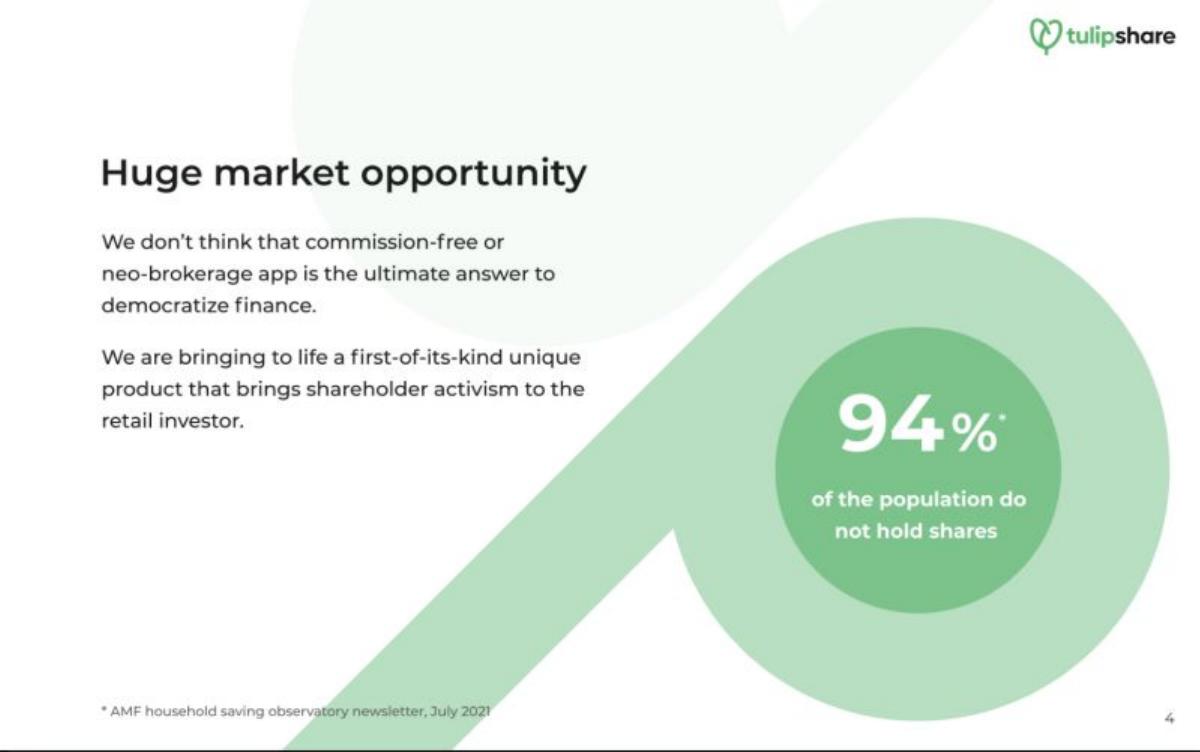
- The deck identifies a massive untapped market, citing that 94% of the population does not currently hold shares (Slide 4).
The Activist Brokerage: A New Category in FinTech
Tulipshare’s 2021 Seed deck represents a shift in how FinTech companies pitch. Rather than focusing on the 'democratization of wealth' through lower fees—a narrative already dominated by Robinhood and Freetrade—Tulipshare pitches the 'democratization of power.' The deck is visually clean, utilizing a consistent green palette that reinforces its ethical and environmental focus. With 14 slides, it moves quickly from the philosophical 'why' to the technical 'how,' leaning heavily on the credibility of its founders and early regulatory wins.
Slides 1-2: The Vision and The Product
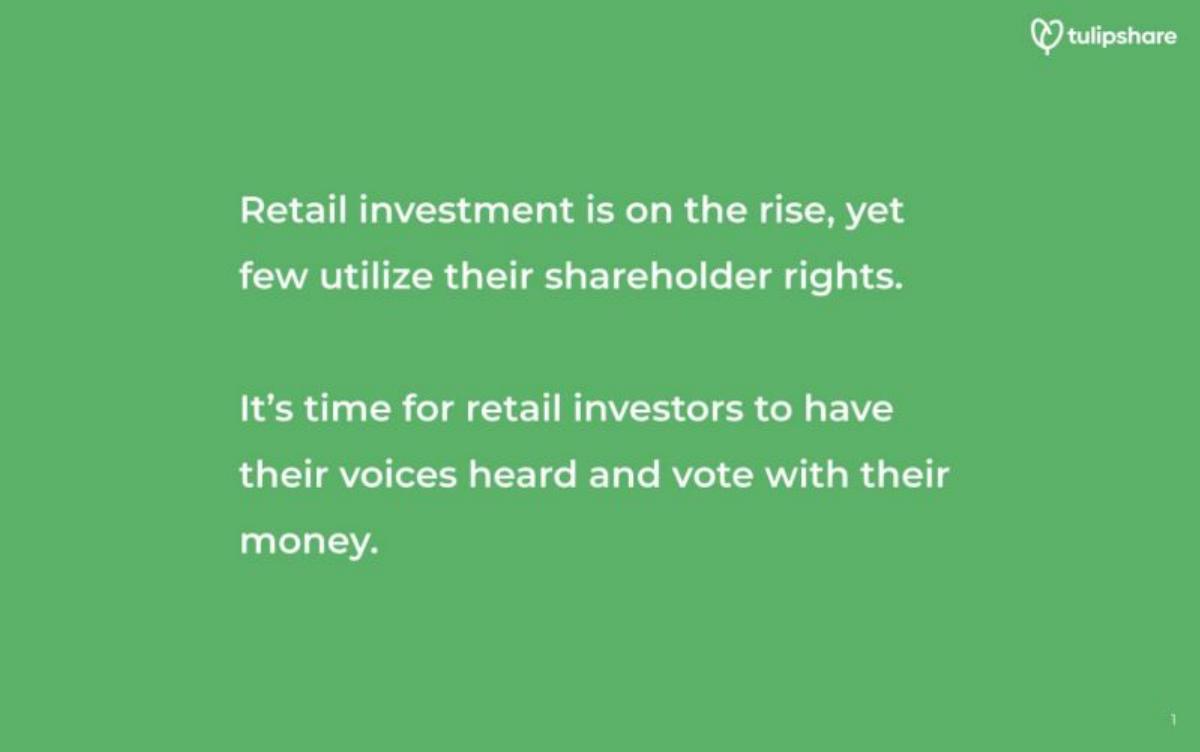
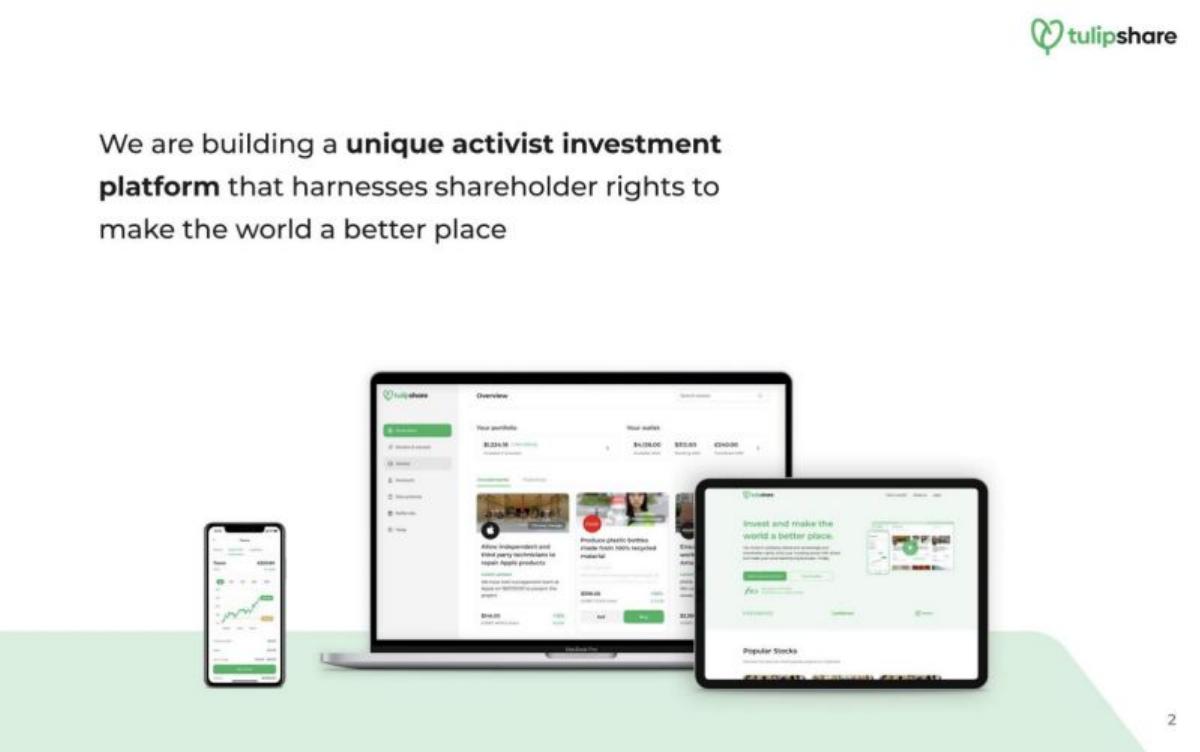
The deck opens with a simple title slide followed by a problem/mission statement on Slide 1 : 'Retail investment is on the rise, yet few utilize their shareholder rights.' This immediately identifies the gap in the market. It isn't that people aren't investing; it's that their investment is passive. Slide 2 introduces the solution: a 'unique activist investment platform.' The slide features a MacBook, iPad, and iPhone mockup showing a clean, dashboard-style interface. The messaging is clear: this is a functional trading tool, not just a petition website.
Slides 3-4: The Mechanism and The Market
Slide 3 answers the most critical question for an activist platform: 'How does it work?' It breaks the process into three steps: buying stock linked to a campaign, aggregating those rights with other users, and Tulipshare engaging in direct dialogue or submitting proposals to companies. This slide is vital because it moves the concept from 'social media noise' to 'legal corporate action.' Slide 4 addresses the market opportunity. Interestingly, it doesn't use a standard TAM/SAM/SOM chart. Instead, it cites a July 2021 AMF newsletter stating that '94% of the population do not hold shares.' This suggests that Tulipshare isn't just fighting for existing traders; they are looking to onboard a massive demographic of non-investors who might be motivated by social change.
Slides 5-6: Team and Early Backing
Slide 5 presents a 'World class exec team.' The pedigree here is high: CEO Antoine Argouges has a successful exit to Blackstone (Lumen), CPO Timur Garifzianov comes from Bumble, and Caitlin Smith brings heavy-duty compliance experience from Credit Suisse. For a Seed round, this level of seniority reduces execution risk significantly. Slide 6 doubles down on this credibility by listing Pre-seed investors. Raising £722k in February 2021 from the likes of Tom Blomfield (Monzo founder) and Speedinvest provides a 'stamp of approval' that often carries more weight with Seed investors than early revenue figures.
Slides 7-8: Execution Speed and Initial Traction
Slide 7 is perhaps the most impressive slide for a professional investor. It details what was achieved in just five months: a 10-person remote team, an FCA UK Broker Dealer authorization, and a 113-day timeline from the first code to launch. Regulatory approval is a notorious bottleneck in FinTech; showing this as 'done' is a major de-risking event. Slide 8 showcases the first three activist campaigns (Amazon, Coca-Cola, Apple). It lists 'interest' numbers: 1,880 for Amazon, 1,923 for Coca-Cola, and 431 for Apple. While these aren't transaction volumes, they demonstrate that the specific causes chosen resonate with a potential user base.
Slides 9-10: Social Proof and The Future
Slide 9 displays press coverage from Fast Company, Forbes, and City A.M. This reinforces the 'newsworthy' nature of the business model. Slide 10 outlines the 2021/2022 Roadmap. The goals are ambitious: US and EU broker-dealer licenses, pension manager authorization, and the launch of iOS/Android apps. The inclusion of 'Pension manager authorization' suggests a long-term play to capture much larger pools of capital than just individual retail trades.
Slides 11-13: The Business Model and Tech Stack
Slide 12 (labeled as 12, though the deck is 14 slides total including the cover and end-cap) clarifies the revenue model. It is a standard brokerage model: commissions on transactions and FX fees. This is a smart move; it tells investors that while the mission is social, the mechanics are a proven, scalable financial business. Slide 13 shows the tech stack. By using DriveWealth, Currencycloud, and Onfido, Tulipshare admits they are 'standing on the shoulders of giants.' They aren't building a clearinghouse from scratch; they are building the activist layer on top of existing FinTech infrastructure.
What Tulipshare Does Well
Regulatory De-risking: Most Seed-stage FinTechs have a slide saying they will get licensed. Tulipshare’s Slide 7 says they already have the FCA authorization. This is a massive competitive advantage and justifies a higher valuation.
Founder-Market Fit: The team slide (Slide 5) is exceptionally strong. Having a founder who has already exited a company to a major private equity firm (Blackstone) and a Head of Legal from a global investment bank (Credit Suisse) addresses the two biggest fears in this niche: user acquisition and regulatory compliance.
Specific Use Cases: Instead of talking about 'ESG' in the abstract, Slide 8 gives three concrete examples of what a user can actually do on the platform. This makes the product tangible.
What is Missing from the Deck
Unit Economics: While Slide 12 explains how they make money, there is no mention of the amount. There are no projections for Average Revenue Per User (ARPU) or Customer Acquisition Cost (CAC). For a $10.8M Seed round, investors likely saw these in a separate data room, but their absence in the deck is notable.
Retention Strategy: Activism is often episodic. A user might join for the Apple campaign and then leave. The deck doesn't explain how they plan to keep users engaged between major corporate votes or how they will prevent the platform from becoming a 'one-and-done' utility.
Competitive Landscape: There is no slide addressing competitors. While Tulipshare claims to be the 'first,' they are competing for the same retail dollars as Robinhood, Public.com, and Say Technologies (which was acquired by Robinhood to handle similar shareholder communication features).
Founder's Guide: What to Copy
The '113 Days' Metric: If you have built your MVP quickly, highlight the exact number of days. It signals a high-velocity engineering culture that investors love.
Infrastructure Transparency: Don't be afraid to show your third-party stack (Slide 13). It shows you are focused on building your unique value proposition (the activist layer) rather than wasting time and capital rebuilding standard FinTech plumbing like KYC or FX wallets.
The 'Interest' Proxy: If you don't have revenue yet, use 'Interest' or 'Sign-ups' for specific features as a proxy for demand. Slide 8 does this effectively by showing that nearly 2,000 people are specifically interested in the Coca-Cola recycling campaign, proving there is a 'market' for that specific product offering.
Frequently asked questions
- How does Tulipshare actually make money?
- According to slide 12, the business model is built on two pillars. First, they charge a commission based on the investment value of each transaction. Second, they charge an FX fee for converting funds to and from USD. This is a traditional brokerage revenue model applied to a non-traditional activist investment platform.
- What is the core value proposition for a retail investor?
- The platform allows retail investors to aggregate their shares with others to reach the threshold required for shareholder activism. Slide 3 explains that Tulipshare submits shareholder proposals and engages in direct dialogue with Investor Relations teams, giving small-scale investors a 'voice' they wouldn't have individually.
- What regulatory hurdles did the company clear before the Seed round?
- Tulipshare emphasized its regulatory speed on slide 7, noting they obtained a UK Broker Dealer authorization from the Financial Conduct Authority (FCA) within five months. This is a significant barrier to entry that the team cleared early in their lifecycle.
- Who are the key members of the leadership team?
- The team (Slide 5) includes CEO Antoine Argouges, who previously exited a company to Blackstone; CPO Timur Garifzianov, a former product lead at Bumble; and Caitlin Smith, Head of Legal & Compliance, who was previously a VP at Credit Suisse Global Markets Compliance.
- What specific activist campaigns did the company launch first?
- Slide 8 highlights three initial campaigns: ensuring fair working environments for Amazon workers, pushing Coca-Cola to use 100% recycled plastic bottles, and advocating for 'right to repair' at Apple to allow third-party technicians to fix products.