Turbo Boom, developed by Tyre Bytes, represents a specific niche in fundraising: the indie game project seeking micro-capital. The deck, produced in 2019, outlines a rally racing game with 'explosive obstacles' and 'drifty physics.' Unlike traditional venture-backed startups seeking millions, founder Tim Beaudet asks for exactly $5,000 to cover music, sound effects, visuals, and marketing. The deck is highly transparent about its solo-developer nature, citing Beaudet's 15+ years of programming experience and 5+ years in the industry. While it lacks traditional financial projections or a large…
Key takeaways
- The company is seeking a total investment of $5,000 to finalize the game (Slide 7).
- The founder, Tim Beaudet, has over 15 years of programming experience and 5+ years in the game industry (Slide 8).
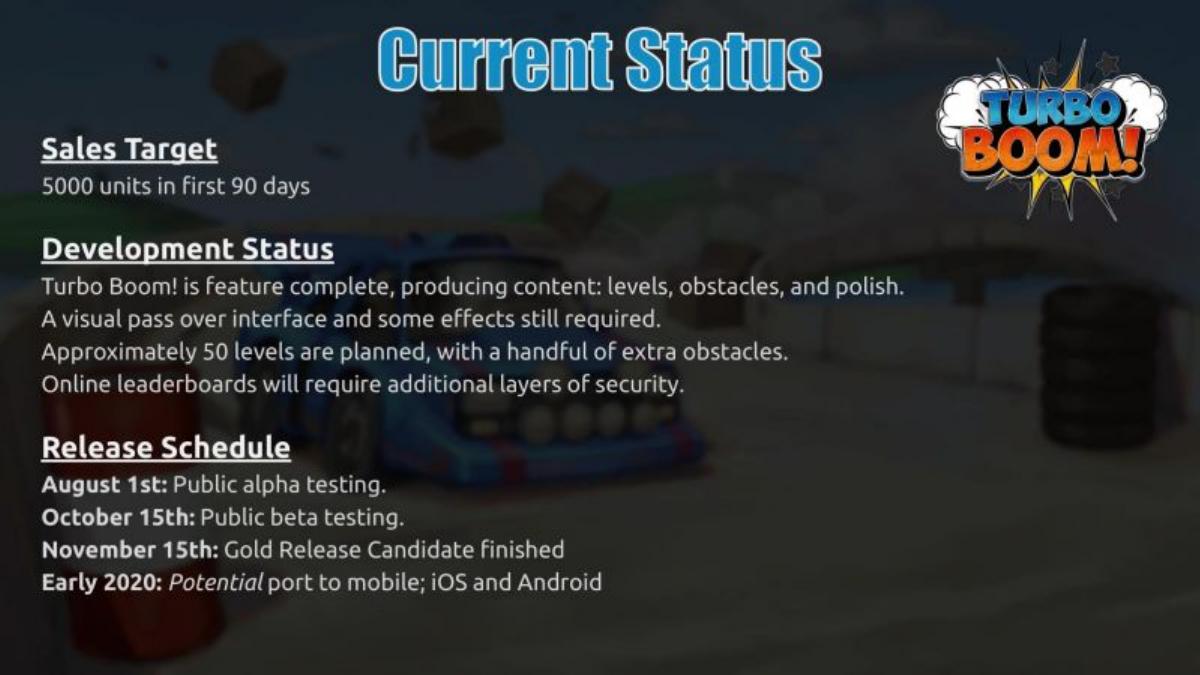
- The game targets a sales goal of 5,000 units within the first 90 days of release (Slide 6).
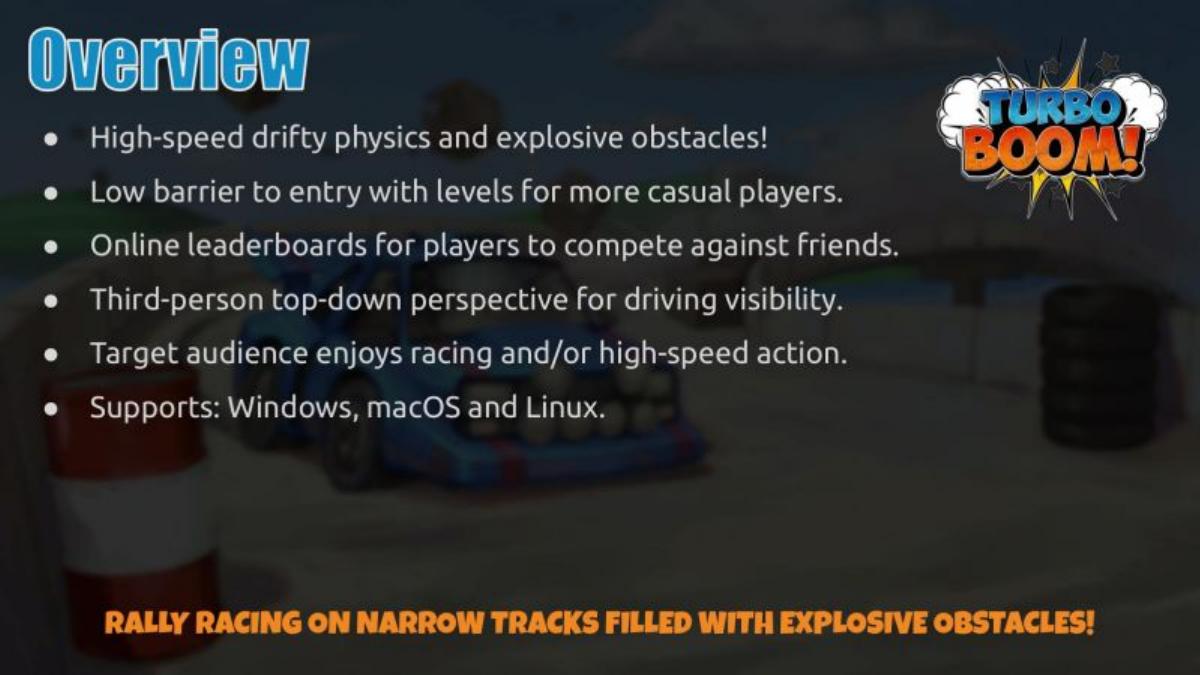
- Turbo Boom features a third-person top-down perspective and supports Windows, macOS, and Linux (Slide 2).
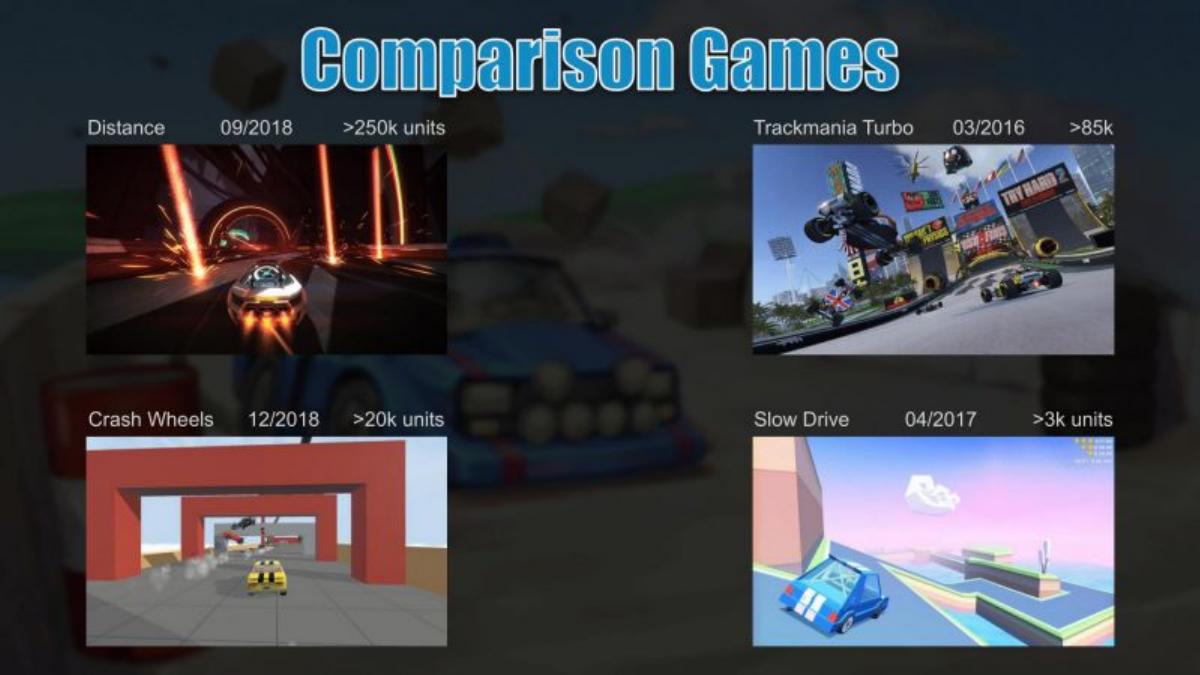
- The deck uses specific competitor benchmarks, citing unit sales for games like 'Distance' (>250k units) and 'Slow Drive' (>3k units) (Slide 3).
- The development roadmap included a public alpha in August and a 'Gold Release Candidate' by November 15th (Slide 6).
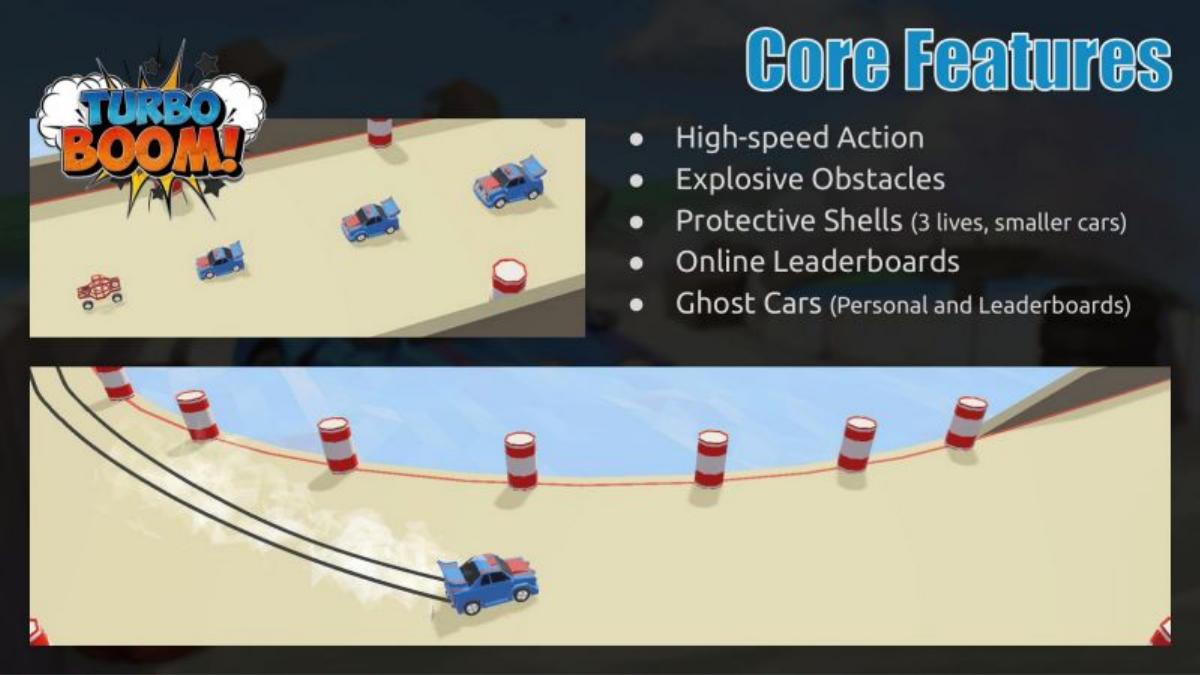
- The game mechanics include 'Protective Shells' which grant the player 3 lives (Slide 5).
- Marketing plans involve seeking media, press, and influencer outreach with a dedicated $3,000 budget (Slide 7).
Turbo Boom: The Micro-Budget Indie Pitch
Turbo Boom is a rally racing game developed by Tyre Bytes, a studio based in Miami, FL. The pitch deck for Turbo Boom is a fascinating artifact because it operates outside the traditional venture capital ecosystem. Instead of seeking millions for a 'disruptive' platform, this deck is a targeted request for $5,000 to finish a specific creative product. It is a 'project pitch' rather than a 'company pitch,' providing a clear look at how solo developers approach the final stages of production and marketing.
Slide 1: Title and Concept
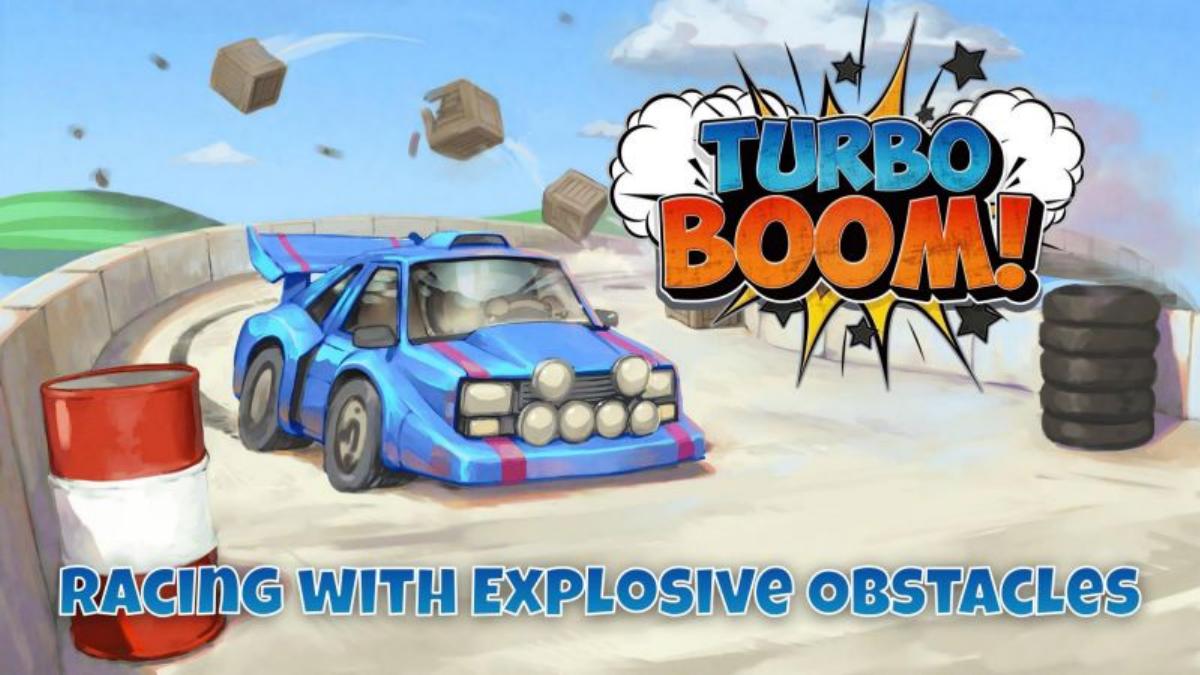
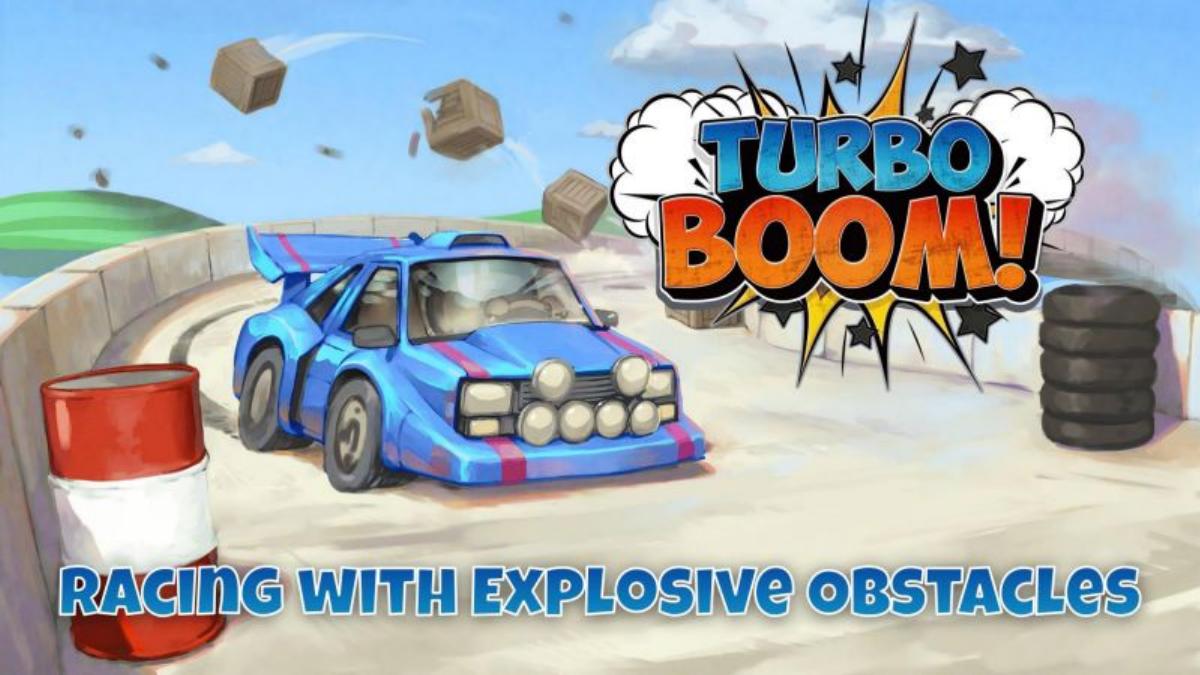
The opening slide introduces the game's logo and a piece of stylized key art. The car shown is a blue, rally-style vehicle, and the tagline 'Racing with Explosive Obstacles' immediately defines the core gameplay loop. The art style is cartoonish and vibrant, signaling a casual or arcade-style experience rather than a simulation-heavy racing game. This slide does its job by setting the tone and genre instantly.
Slide 2: Overview and Technical Specs
Slide 2 provides a bulleted list of the game's high-level features. It mentions 'high-speed drifty physics,' 'low barrier to entry,' and 'online leaderboards.' Crucially, it lists the supported platforms: Windows, macOS, and Linux. This is important for investors or partners to understand the addressable market on PC platforms. The mention of a 'third-person top-down perspective' further clarifies the gameplay style, distinguishing it from first-person or behind-the-car racers.
Slide 3: Market Validation via Comparison
Instead of a traditional 'Market Size' slide with billions of dollars in TAM, Turbo Boom uses 'Comparison Games.' This is a standard practice in the indie game industry. The slide lists four titles with their release dates and estimated unit sales: Distance (09/2018, >250k units), Trackmania Turbo (03/2016, >85k units), Crash Wheels (12/2018, >20k units), and Slow Drive (04/2017, >3k units). By showing a range of outcomes, the founder demonstrates a realistic understanding of the market, positioning Turbo Boom somewhere in the middle of these benchmarks.
Slide 4: Gameplay Visuals
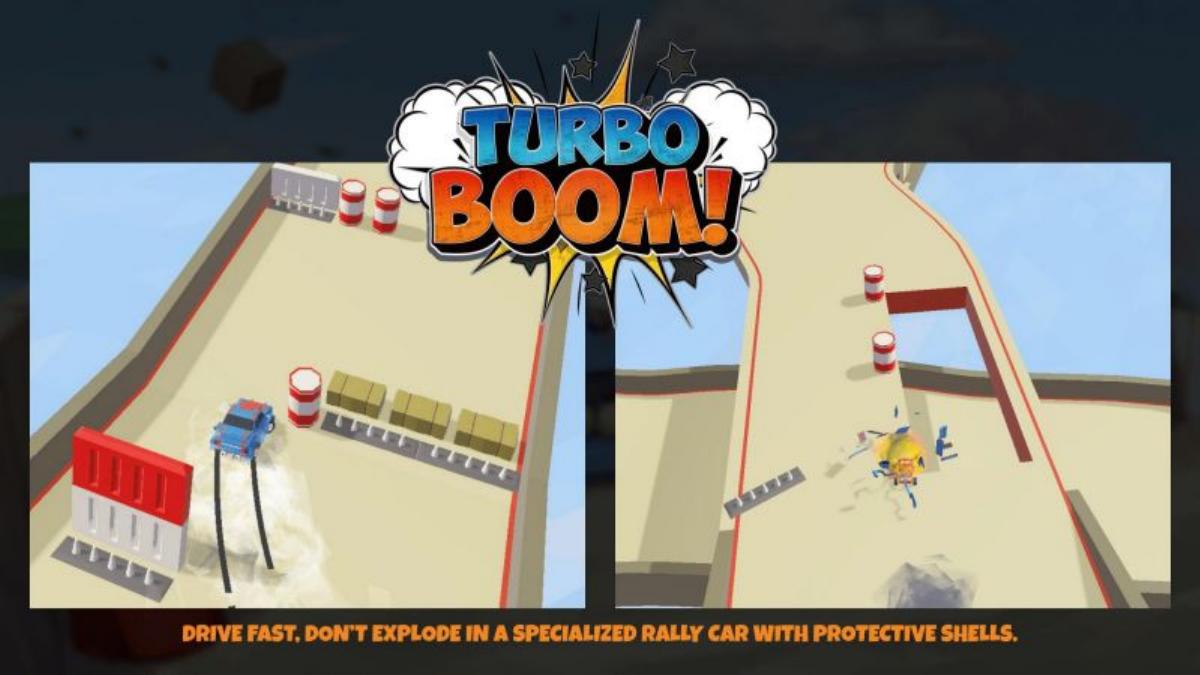
This slide features two screenshots of the game in action. The visuals are minimalist, using low-poly models and a clean, bright color palette. The car is shown navigating tracks with red-and-white barrels and wooden crates. The text at the bottom, 'Drive fast, don't explode in a specialized rally car with protective shells,' reinforces the primary objective and the unique 'lives' mechanic.
Slide 5: Core Features
Slide 5 expands on the gameplay mechanics. It lists 'High-speed Action,' 'Explosive Obstacles,' and 'Protective Shells (3 lives, smaller cars).' The inclusion of 'Ghost Cars' for both personal bests and leaderboards is a vital detail for racing game fans, as it suggests a competitive, replayable experience. The visuals on this slide show multiple cars on a track, hinting at the 'ghost' mechanic where players race against their own or others' previous times.
Slide 6: Current Status and Roadmap
This is one of the most important slides for a project-based pitch. It sets a clear Sales Target of 5,000 units in the first 90 days. It also details the Development Status , stating the game is 'feature complete' but needs a visual pass on the interface and effects. The Release Schedule is specific: Public alpha on August 1st, Public beta on October 15th, and a Gold Release Candidate by November 15th. This timeline shows the project is near the finish line, reducing the risk for a potential investor.
Slide 7: The Ask (Seeking)
Slide 7 is the 'Seeking' slide. It is remarkably specific and modest. The founder is looking for 'Marketing and Promotional Opportunities,' including media outreach and platform contacts. The financial investment requested is exactly $5,000 , broken down as follows:
$1,500 for music and sound effects. · $500 for visuals, title screen, and interface art. · At least $3,000 for a solid marketing plan.
A note at the bottom clarifies that audio and art are already in the current build, implying these funds are for professional upgrades rather than initial creation.
Slide 8: The Team (Tyre Bytes)
The 'Who is Tyre Bytes?' slide introduces Tim Beaudet. It positions him as a 'programmer at heart' who handles art, design, and production. His credentials are the primary source of credibility for the deck: 15+ years of programming and 5+ years in the game industry working on major titles like Rock Band 3 and Darkest of Days . The mention of '2+ years streaming game development' suggests he has already built a small community or audience through platforms like Twitch.
Slide 9: Contact Information
The final slide provides contact details, including an email address and links to Twitch, YouTube, Twitter, and the official website. This reinforces the founder's presence in the gaming community and provides multiple avenues for due diligence.
What Turbo Boom Does Well
The Turbo Boom deck excels at transparency and scope . Many founders fail by asking for too much money without a clear plan, or by being vague about their progress. Tim Beaudet does the opposite. By asking for only $5,000, he makes the 'yes' very easy for a micro-angel or a small indie publisher. The breakdown of costs is logical; in the indie world, $1,500 can indeed secure a high-quality soundtrack from a freelance composer.
The use of specific competitor data on Slide 3 is also a major strength. It shows the founder isn't just dreaming of a million-seller; he has looked at the 'long tail' of the Steam market and identified that even a modest success (20k units) would be a significant win for a solo project. This grounded perspective is rare in pitch decks and highly valued by experienced investors.
What is Missing from the Deck
While the deck is excellent for its specific purpose, it lacks a few elements that a larger investor might look for. First, there is no mention of pricing . If the sales target is 5,000 units, is the game $5.00 or $20.00? This drastically changes the revenue projections. Second, there is no discussion of the 'Long Tail' or DLC . Most successful indie games today rely on post-launch updates or downloadable content to keep sales alive; the deck focuses entirely on the initial 90-day launch window.
Finally, the marketing plan is vague . While $3,000 is allocated to marketing, the deck doesn't explain how that money will be spent. Will it go to Facebook ads, influencer sponsorships, or a PR agency? Given that marketing is the largest line item in the ask, a few more details on the strategy would have strengthened the proposal.
Founder's Playbook: What to Copy
Solo founders and indie developers should look at Slide 6 and Slide 7 as a template for de-risking a project . By stating the game is 'feature complete,' the founder removes the biggest fear in game investing: that the game will never be finished. If you are pitching a project, show exactly how close you are to the finish line.
Additionally, the Team slide (Slide 8) is a masterclass in 'leveraging past wins.' Even though Tyre Bytes is a new studio, Beaudet highlights his work on Rock Band 3. If you have worked at a major company or on a successful project, that brand equity is your most valuable asset. Use it to prove that you have the professional discipline to deliver a commercial product.
Final Thoughts
Turbo Boom is a refreshing example of a 'right-sized' pitch. It doesn't pretend to be a billion-dollar company; it presents itself as a high-quality indie game that needs a small push to reach the market. For founders in creative industries, this deck proves that you don't need a 50-page business plan to get noticed—you just need a clear product, a realistic budget, and a proven track record.
Frequently asked questions
- How much money is Turbo Boom actually asking for?
- Turbo Boom is seeking a total of $5,000. According to Slide 7, this is broken down into $1,500 for music and sound effects, $500 for visuals and interface art, and at least $3,000 for a marketing plan. This is an exceptionally low 'ask' compared to typical tech startups, reflecting the project's scope as a solo-developed indie game.
- What is the primary revenue model for this game?
- The deck does not explicitly detail a long-term business model, but Slide 6 sets a 'Sales Target' of 5,000 units in the first 90 days. This implies a premium B2C model where players pay a one-time fee to purchase the game on platforms like Steam, rather than a free-to-play or subscription-based model.
- Who is the team behind Turbo Boom?
- Turbo Boom is developed by Tyre Bytes, which is essentially a solo operation by Tim Beaudet. Slide 8 identifies him as a programmer who also handles art, design, and production. He leverages his 15+ years of programming and past experience on titles like Rock Band 3 to build the core product while outsourcing specific assets.
- What platforms does the game support?
- As stated on Slide 2, the game supports Windows, macOS, and Linux. Slide 6 also mentions a 'Potential port to mobile; iOS and Android' scheduled for early 2020, though the primary focus at the time of the deck was the desktop release.
- How does the game differentiate itself from other racing titles?
- The deck emphasizes 'explosive obstacles' and 'drifty physics' as core differentiators (Slide 2). It also highlights a 'third-person top-down perspective' and a 'protective shell' mechanic that gives players three lives, aiming for a balance between high-speed action and casual accessibility.