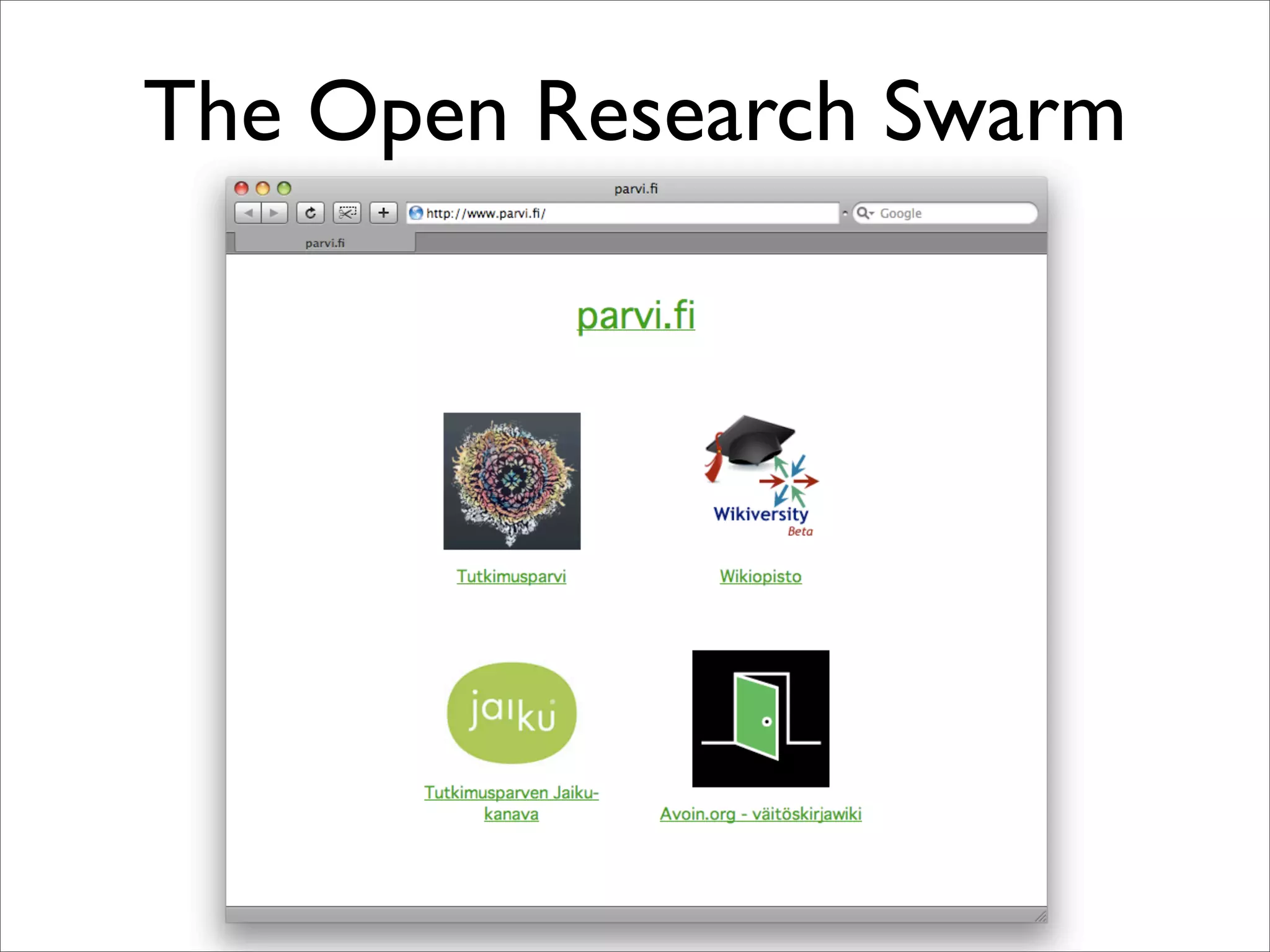
Tutkimusparvi, presented at an Mlab Demo Day, is less a traditional startup pitch and more a manifesto for a new way of conducting academic research. The deck, consisting of 15 slides (8 provided for analysis), introduces the concept of a 'Swarm like organization' that sits between individual effort and formal community structures (Slide 4). By utilizing a suite of open tools—including a dedicated wiki for the SOMUS project (Slide 6), a Jaiku channel for real-time communication (Slide 8), and the Wikiversity platform (Slide 7)—the project demonstrates a functional ecosystem for open-source sc…
Key takeaways
- The project defines its operational model as a 'Swarm like organization,' positioning itself on a spectrum between the individual and the community (Slide 4).
- Tutkimusparvi utilizes a multi-platform approach, integrating parvi.fi, Wikiversity, Jaiku, and Avoin.org (Slide 1).
- The deck highlights the SOMUS project, specifically a research application for the Academy of Finland's MOTIVE program dated April 25, 2008 (Slide 6).
- Real-time social networking was a core component, evidenced by a Jaiku channel featuring dozens of active members (Slide 8).
- The initiative is rooted in the 'Wealth of Networks' philosophy, explicitly referencing Yochai Benkler’s work on social production (Slide 3).
- The project emphasizes open learning through 'Wikiopisto,' a Finnish-language community for free education hosted on Wikiversity (Slide 7).
- Visual evidence of the 'swarm' is provided through a group photo of the research team at JohtoCafe, published under a Creative Commons license (Slide 5).
- The deck is highly academic and collaborative, omitting traditional startup elements like a revenue model, market size, or exit strategy.
The Open Research Swarm: A Decentralized Academic Manifesto
The Tutkimusparvi deck, presented at an Mlab Demo Day, represents a specific era of the internet where the promise of 'social production' was beginning to influence the rigid structures of academia. The name itself, Tutkimusparvi, translates from Finnish to 'Research Swarm,' signaling a departure from the 'lone genius' model of scholarship toward a collective, open-source approach. This teardown examines the 8 slides provided from the 15-slide deck to understand how this group sought to redefine collaborative work.
Slide 1: The Gateway to the Swarm
The title slide, 'The Open Research Swarm,' sets the stage by displaying a browser window for parvi.fi . This slide functions as a directory, showing four primary pillars of their ecosystem: Tutkimusparvi , Wikiopisto (Wikiversity), Tutkimusparven Jaiku-kanava (a Jaiku channel), and Avoin.org . By using a browser mockup as the central visual, the founders emphasize that their organization exists primarily in the digital commons. There is no corporate logo in the traditional sense; instead, there are links to collaborative platforms.
Slide 2: Contextualizing the Digital Landscape
Slide 2 shows a YouTube page titled 'Nelosen uutiset nettisensuuri 08-03-04.' The video appears to depict a protest against internet censorship. While the slide lacks explanatory text, its inclusion in a demo day deck suggests the project is rooted in the digital rights and open-information movements of the time. It establishes a 'why now' or a cultural context: the swarm is a response to a world where information flow is a site of political and social struggle.
Slide 3: Theoretical Foundations
The deck moves from the 'what' to the 'why' by referencing Yochai Benkler and his seminal work, The Wealth of Networks . The slide displays Benkler's Harvard faculty page and a list of his publications, including 'Commons in Information and Communications Systems' and 'Exclusive Rights Regimes.' This is a classic academic 'appeal to authority.' By aligning with Benkler, Tutkimusparvi is signaling that they are an implementation of 'commons-based peer production' applied to the field of research.
Slide 4: The Organizational Model
Slide 4 is perhaps the most critical for understanding the project's structure. Titled 'Swarm like organization,' it features a simple horizontal line with three points: Individual , Swarm , and Community . The 'Swarm' is positioned in the center. This suggests that Tutkimusparvi views itself as a hybrid—more coordinated than a collection of individuals working in parallel, but more agile and less bureaucratic than a traditional academic community or department. It is a pitch for a middle-way organizational logic.
Slide 5: The Human Element
To ground the abstract 'swarm' concept, Slide 5 provides a Flickr photo of the team meeting at JohtoCafe . The photo shows eight individuals, providing a face to the digital handles seen elsewhere in the deck. Notably, the slide includes a Creative Commons (CC-BY) license badge at the bottom. This is a small but significant detail; it demonstrates that the team practices what they preach regarding open licensing, even for their own promotional imagery.
Slide 6: The SOMUS Project Case Study
Slide 6 provides a concrete example of the swarm in action. It shows a wiki page for 'Somus-final,' which is described as a research application for the Academy of Finland's MOTIVE program , dated April 25, 2008 . The project title is 'SOMUS - Social Media for Citizens and Public Sector Collaboration.' This slide proves that the swarm isn't just a theoretical concept; it is a functional unit capable of producing formal academic grant applications and structured research objectives (Vision 2015, Case studies, etc.) in a transparent, public-facing environment.
Slide 7: Wikiopisto and Open Learning
Slide 7 focuses on Wikiopisto , the Finnish branch of Wikiversity. The text describes it as a 'web community for open and free learning.' The slide lists news from 2008, including a course on bicycle maintenance and the establishment of a Jaiku channel. This slide broadens the scope of the project from 'research' to 'education,' suggesting that the swarm model is intended to facilitate the entire lifecycle of knowledge, from discovery to dissemination.
Slide 8: The Social Graph
The final slide in this set shows the Jaiku channel for Tutkimusparvi. It displays a grid of profile pictures for dozens of members, such as 'tommi,' 'pe3,' 'Tuija,' and 'jarira.' By showing the 'Contacts' page, the deck provides proof of traction. It demonstrates that a significant number of people have opted into this network. In 2008, Jaiku was a major competitor to Twitter, particularly in the Nordic regions, and its use here highlights the project's commitment to real-time, micro-collaborative communication.
What Tutkimusparvi Does Well
The deck excels at philosophical consistency . Every tool mentioned—Wikiversity, Jaiku, Flickr, Creative Commons—is part of the open-web ecosystem. They aren't just talking about open research; they are performing it. The use of actual browser screenshots rather than polished marketing graphics lends an air of authenticity and technical readiness . It shows that the infrastructure is already built and being used for real projects like SOMUS.
What is Missing from the Deck
As a 'pitch' in the modern startup sense, this deck is missing almost every standard component. There is no problem/solution statement that addresses a market pain point. There is no business model , no mention of how the domain or the researchers' time is funded beyond a single grant application. There is no competitive analysis —though one could argue their 'competitor' is the traditional closed-university model, this is never explicitly stated. Finally, there is no 'Ask.' It is unclear if they are looking for more researchers, funding, or simply awareness.
Founder's Takeaway: The Power of the 'Middle Way'
Founders building in the 'Future of Work' or 'Decentralized Science' (DeSci) space should look at Slide 4. The concept of the 'Swarm' as a midpoint between the individual and a formal community is a powerful way to describe decentralized autonomous organizations (DAOs) or open-source collectives. While the Tutkimusparvi deck lacks the polish of a Silicon Valley pitch, its ability to define a new organizational category is a lesson in clear, conceptual positioning. If you are building something that doesn't fit into traditional buckets, use a simple spectrum to show exactly where you sit.
Frequently asked questions
- What is the primary goal of Tutkimusparvi?
- Based on the slides, the goal is to create an 'Open Research Swarm.' This involves moving away from siloed, individual research toward a decentralized, collaborative model. They use open-source tools and public wikis to document research processes in real-time, as seen in the SOMUS project documentation on Slide 6, which details social media collaboration for citizens and the public sector.
- What technology stack did the Open Research Swarm use?
- The deck shows a reliance on Web 2.0 tools prevalent in the late 2000s. This includes Jaiku for microblogging and community contact (Slide 8), MediaWiki (via Wikiversity and their own index.php site) for documentation (Slides 6 and 7), and Flickr for hosting team imagery (Slide 5). The central hub was the domain parvi.fi.
- Who is the target audience for this presentation?
- Given the 'Mlab Demo Day' context and the heavy emphasis on academic frameworks like Yochai Benkler’s 'The Wealth of Networks' (Slide 3), the audience likely consisted of academic researchers, media lab students, and proponents of open-source culture rather than traditional venture capitalists looking for a high-growth ROI.
- Is there a business model included in the deck?
- No. The provided slides contain no mention of revenue, pricing, or monetization. The project appears to be funded through academic grants, such as the Academy of Finland's MOTIVE research program mentioned on Slide 6. It functions as a non-profit or commons-based peer production initiative.
- What does 'Swarm like organization' mean in this context?
- Slide 4 illustrates this as a midpoint on a horizontal axis between 'Individual' and 'Community.' In practice, this suggests a structure that is more organized than a lone researcher but less rigid than a formal institution. It implies a fluid, self-organizing group where members contribute to a shared goal (like the SOMUS project) without traditional hierarchical management.