Circles secured $16.5M in Series A funding in 2024 to expand its professional-led group support platform. The deck focuses heavily on the structural advantages of group counseling over traditional 1:1 therapy, specifically highlighting a business model where facilitator costs are split across multiple members. By positioning itself alongside billion-dollar mental health incumbents like BetterHelp and Talkspace, Circles argues that 'Mental health ≠ Therapy,' carving out a niche in the $132.4B behavioral health market. The presentation balances emotional resonance through user stories with a cl…
Key takeaways
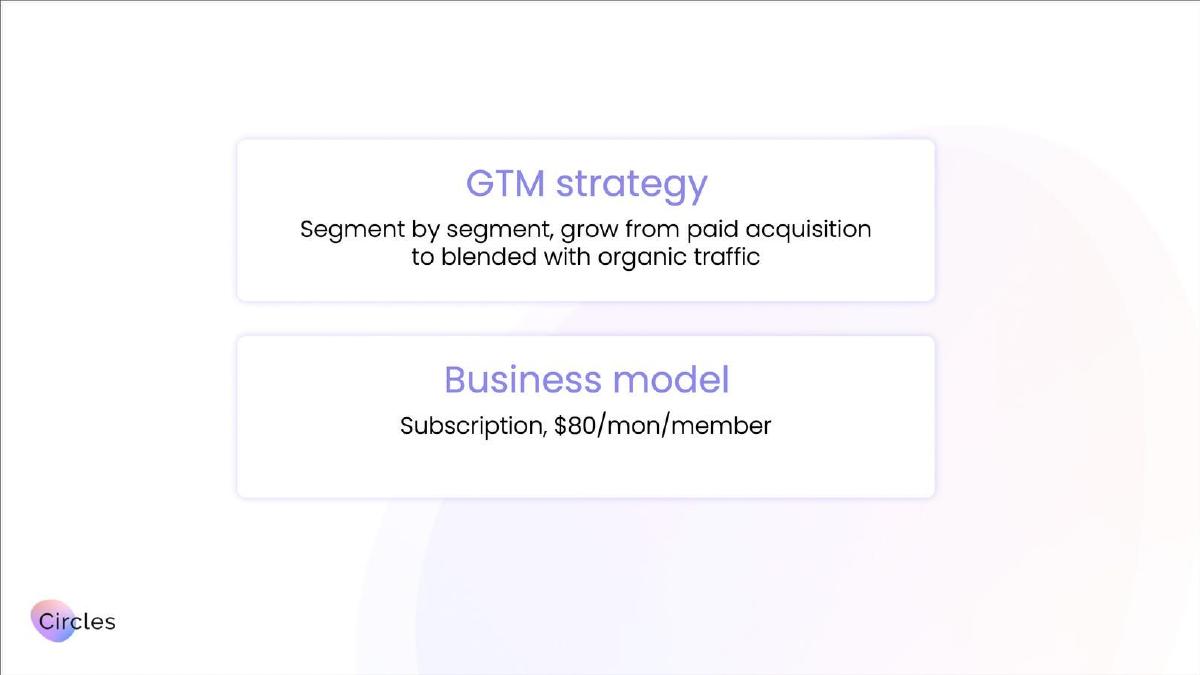
- The company defines a clear pricing model of $80 per month per member on slide 2.
- Circles positions itself in the 'Groups' category, contrasting with 1:1 therapy, coaching, and family support on slide 4.
- The business model relies on dividing the cost of a facilitator by 7 to ensure affordability and scalability, as noted on slide 5.
- The U.S. behavioral health market is projected to be worth $132.4B by 2027, according to slide 4.
- Go-to-market efforts are focused on three specific life-challenge segments: Grief, Relationships, and Caregivers (slide 8).
- The platform utilizes a matching algorithm to connect users without geographical restrictions (slide 5).
- Circles leverages a 'blended' acquisition strategy, moving from paid performance marketing to organic traffic (slide 2).
- The deck features high-profile advisors including the CEO of Waze and the former Global Head of Community at Airbnb (slide 9).
The Series A Narrative: Moving Beyond 1:1 Therapy
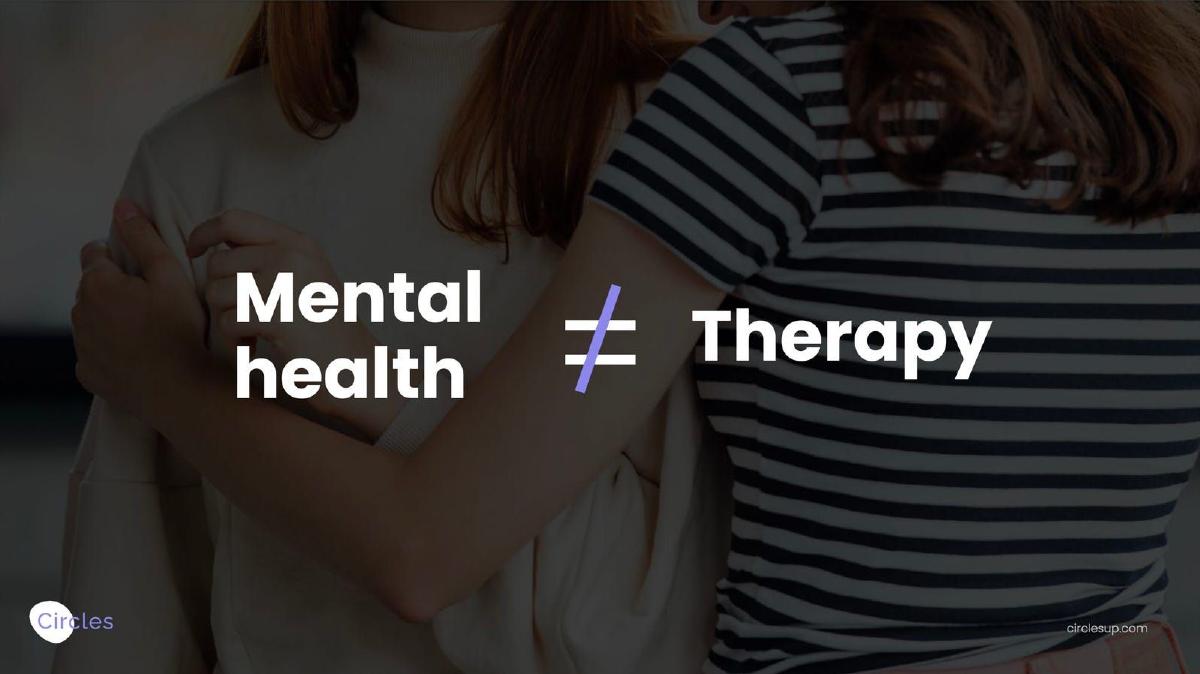
Circles raised $16.5M in 2024, as reported by Business Insider, to tackle a specific inefficiency in the mental health market: the high cost and limited scalability of one-on-one therapy. The deck is a masterclass in category creation, explicitly stating that 'Mental health ≠ Therapy' to carve out a space for professional-led group support. By focusing on the unit economics of a group—where one facilitator serves seven members—Circles presents a compelling case for a high-margin, scalable healthcare business.
Slide 1: The Emotional Hook
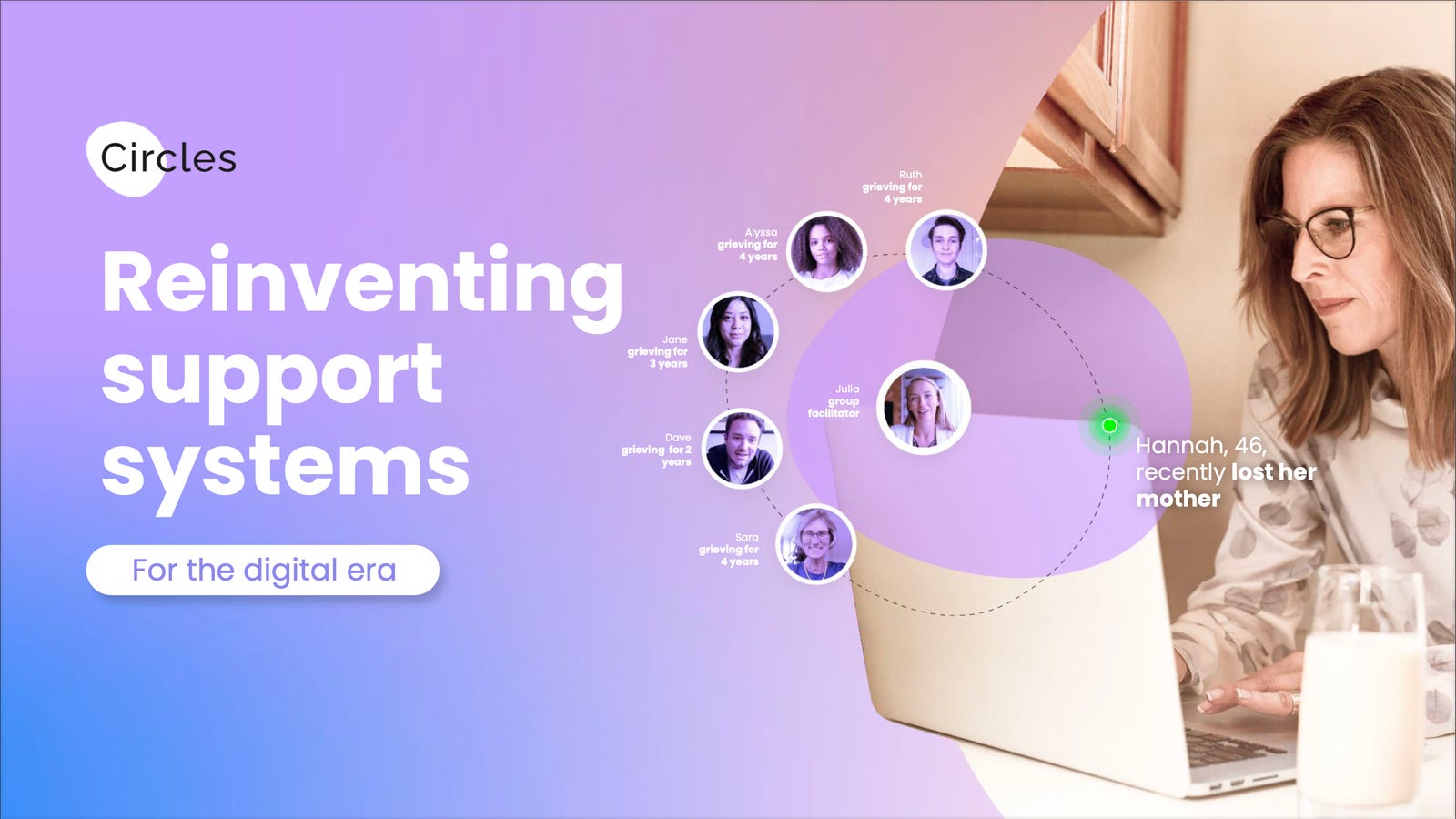
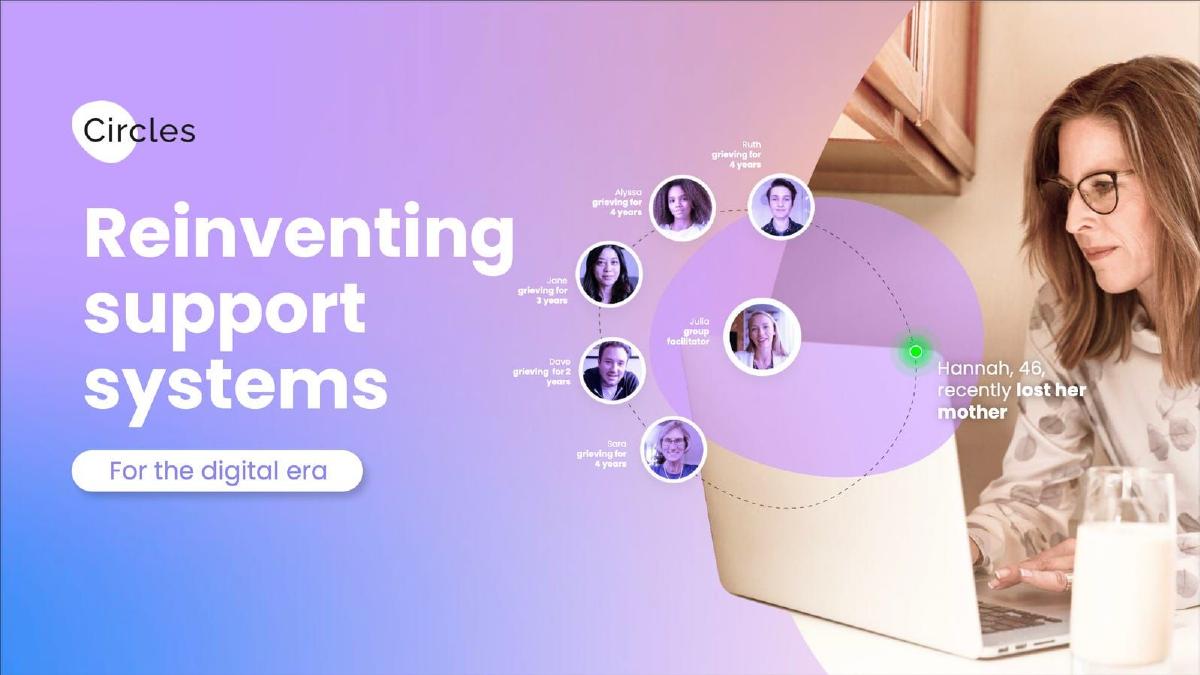
The cover slide sets a somber but hopeful tone. It features 'Hannah, 46, recently lost her mother,' visualizing the product interface where she is connected to four other peers (Jane, Dave, Sara, and Alyssa) and a professional facilitator, Julia. The tagline 'Reinventing support systems for the digital era' immediately identifies the company as a tech-enabled service provider in the social/health space.
Slide 2: The Business Fundamentals
Unusually early in the deck, Circles presents its GTM strategy and Business Model. They define their model as a 'Subscription, $80/mon/member.' The GTM strategy is described as 'Segment by segment,' moving from paid acquisition to a 'blended with organic traffic' approach. This slide serves to ground the emotional pitch of the cover in hard financial reality for investors.
Slide 3: The Thesis Statement
Slide 3 is a minimalist 'bridge' slide with the text 'Mental health ≠ Therapy.' This is the core philosophical argument of the deck. It suggests that the current market over-relies on a single modality (1:1 therapy) and that a significant portion of the 'mental health' market can be served through other means—specifically, the group model Circles offers.
Slide 4: Market Landscape and Opportunity
This slide provides the macro-economic justification for the round. It cites the U.S. Behavioral Health Market size as being worth '$132.4B by 2027.' More importantly, it maps the competitive landscape. It lists 1:1 Therapy (BetterHelp, Talkspace), Coaching (BetterUp, Sounding Board), and Family Support (Papa). By showing the massive valuations and exits of these peers (e.g., Talkspace's $1.3B IPO, BetterUp's $5B valuation), Circles implies that the 'Groups' category, which they currently occupy alone on this chart, is the next billion-dollar frontier.
Slide 5: The Business Opportunity (Unit Economics)
Slide 5 breaks down why the group model is superior to 1:1 therapy from a business perspective. It lists four pillars: Affordable (cost of facilitator divided by 7), Effective (peer support + professional), Sticky (people rely on each other), and Scalable (matching algorithm, no geographical restrictions). This is the most important slide for a Series A investor, as it explains the 'why now' and the 'how' of their projected margins.
Slide 6: The User Story
To ensure the deck doesn't become too clinical, slide 6 introduces 'Lacresha, 40, Lost Her Daughter.' This slide appears to be a placeholder for a video testimonial or a deep-dive case study. It reinforces the 'Grief' segment mentioned later in the GTM strategy and provides a human face to the data.
Slide 7: Product Deep Dive
The 'Circles App' slide showcases four key features: Weekly meeting (video interface), Ongoing support (chat interface), Personalized content (starting kits and guides), and Group empowerment (events and webinars). The UI is clean and emphasizes that the 'Circle' is always with the user, moving the service from a once-a-week appointment to a continuous support tool.
Slide 8: Go To Market Strategy
This slide details the execution plan. They focus on '3 core segments': Grief, Relationships, and Caregivers. Their acquisition engine is split between 'Performance marketing' (Google, FB, and Affiliates) and 'Brand & Organic' (Free support tools and lead nurturing). This provides a clear roadmap for how the $16.5M will be deployed to acquire users within specific, high-intent niches.
Slide 9: Institutional Credibility
The final slide in the provided sequence highlights their advisors. Rather than focusing on the founders, Circles leans on the reputation of 'World's Leading Experts.' This includes Douglas Etkin (Airbnb/Meetup), Guy Winch (TED speaker), Noam Bardin (CEO of Waze), and Dr. Haim Weinberg (Group support expert). The inclusion of the Waze CEO and Airbnb's community head signals to investors that the company has access to top-tier expertise in both hyper-growth scaling and community building.
What Works in the Circles Pitch Deck
The deck's greatest strength is its clarity of category . By explicitly separating 'Mental Health' from 'Therapy,' Circles avoids being compared directly to the crowded 1:1 therapy market on a feature-by-feature basis. Instead, they frame themselves as the leader of a new, more efficient category.
The unit economic transparency on slide 5 is also highly effective. Most healthcare decks obscure how they actually make money or scale. Circles explicitly states that their margin comes from dividing a single facilitator's cost across seven paying members. This is a simple, digestible 'aha' moment for an analyst trying to understand the business's leverage.
Finally, the segmentation strategy on slide 8 shows discipline. Many startups try to be 'everything for everyone' in mental health. By naming three specific life challenges (Grief, Relationships, Caregivers), Circles demonstrates they understand how to target high-intent keywords and build specialized communities that increase user retention.
What is Missing from the Circles Pitch Deck
The most glaring omission in the provided slides is a Team Slide . While the advisors are impressive, investors fund founders, not just advisors. The absence of the core leadership team's background makes it difficult to assess the 'founder-market fit.' At a Series A level, one would expect to see the track record of the CEO and the technical lead.
There is also a lack of Historical Traction Metrics . While the deck mentions the GTM strategy, it doesn't show a 'hockey stick' graph of user growth, MRR (Monthly Recurring Revenue), or retention rates. For a $16.5M raise, these figures are usually mandatory. It is possible these were included in the 8 slides not provided in this set, but their absence here leaves the 'Scalable' claim on slide 5 as a theoretical exercise rather than a proven fact.
Lastly, the deck does not address Regulatory or Clinical Validation . In healthcare, especially professional-led counseling, investors typically look for clinical outcomes data or a discussion on HIPAA compliance and facilitator vetting. The deck focuses heavily on the 'business' and 'community' aspects, perhaps under-indexing on the 'clinical' rigor required for long-term healthcare partnerships.
Founder Takeaways: Copy the Logic, Show the Proof
Founders should emulate the way Circles visualizes the competitive landscape . Slide 4 doesn't just list logos; it groups them by business model and lists their valuations/outcomes. This tells a story of a maturing market where 'Groups' is the logical next step. It makes the investment feel like a thematic inevitability rather than a random bet.
Another takeaway is the use of personas . By starting with 'Hannah' and including 'Lacresha,' the deck keeps the human element front and center. In social-impact or health-tech, this emotional grounding is necessary to balance out the cold logic of 'facilitator cost divided by 7.'
However, founders must ensure they don't follow the 'expert' trap seen on slide 9. While having the CEO of Waze as an advisor is great, it cannot replace the story of the founders. If you are building a pitch deck, ensure your team's unique insights and past wins are the climax of the presentation, with advisors serving as the supporting cast, not the main attraction.
Frequently asked questions
- What is the core value proposition of Circles?
- Circles provides professional-led virtual group counseling. Its primary value proposition, as stated on slide 5, is providing an 'affordable' and 'effective' alternative to 1:1 therapy by dividing the cost of a professional facilitator among seven group members, while leveraging the 'power of peer support' to create a sticky user experience.
- How much does Circles cost for a user?
- According to slide 2, the business model is a subscription-based service priced at $80 per month per member. This is presented as a key component of their business model alongside a go-to-market strategy that transitions from paid acquisition to a blend of organic traffic.
- Who are the competitors mentioned in the deck?
- Slide 4 lists several companies in adjacent mental health spaces to illustrate market opportunity: BetterHelp and Talkspace (1:1 Therapy), BetterUp and Sounding Board (Coaching), and Papa (Family Support). Circles positions itself as the leader in the 'Groups' category.
- What are the primary customer segments for Circles?
- Slide 8 identifies three core segments for their go-to-market strategy: Grief, Relationships, and Caregivers. By focusing on these specific life challenges, the company aims to build targeted communities rather than a generic mental health platform.
- Does the deck include a team slide?
- The provided slides do not include a traditional 'Founding Team' slide with bios for the CEO or CTO. Instead, slide 9 highlights 'World's Leading Experts' who support the company, including Douglas Etkin (Airbnb/Meetup), Guy Winch (Psychologist), Noam Bardin (Waze), and Dr. Haim Weinberg.