Replit’s 2016 seed deck focuses heavily on the technical pedigree of its founders and early organic traction. At the time of the pitch, the platform already boasted 100,000+ monthly active users and 7 million programs run per month (Slide 10). The deck is notably light on financial projections and market sizing, choosing instead to lean into a 'Master Plan' (Slide 9) that transitions from an educational tool to a full-scale hosting platform. By highlighting that their open-source tech was already used by Codecademy and Udacity (Slide 3), the founders established immediate credibility. The dec…
Key takeaways
- The founders established immediate authority by citing their work as the first engineers at Codecademy and leads at Facebook (Slides 4-5).
- The platform had significant early traction with 100k+ monthly active users, 60% of whom were returning (Slide 10).
- Replit's technology was already powering industry leaders like Codecademy and Udacity before the formal company launch (Slide 3).
- The 'Master Plan' explicitly details a transition from education tools to a platform for hosting applications (Slide 9).
- Social proof is heavily utilized through screenshots of teachers and students using the product in real-world classrooms (Slides 14-15).
- The deck identifies a specific gap in the market: the lack of an 'incremental path from user to programmer' (Slide 8).
- Technical defensibility is anchored in a 'flexible, scalable and secure cloud sandbox infrastructure' (Slide 19).
- The deck completely omits a formal 'Ask' slide, financial forecasts, or a detailed competitor matrix.
The Foundation of Founder-Market Fit
Replit's 2016 seed deck is a textbook example of how to raise money when your team is your strongest asset. In the world of developer tools, credibility is everything. The founders didn't just claim to understand the problem; they showed they had already built the industry's infrastructure. By the time an investor reached Slide 6, the technical risk of the project had been effectively neutralized through the founders' resumes.
Slide 1: Title and Tagline
The deck opens with a minimalist logo and the tagline 'computing for everyone.' It is a broad, ambitious mission statement that suggests the company is looking beyond a simple niche tool. There are no decorative elements, signaling a focus on utility and engineering culture.
Slides 2-5: The Pedigree
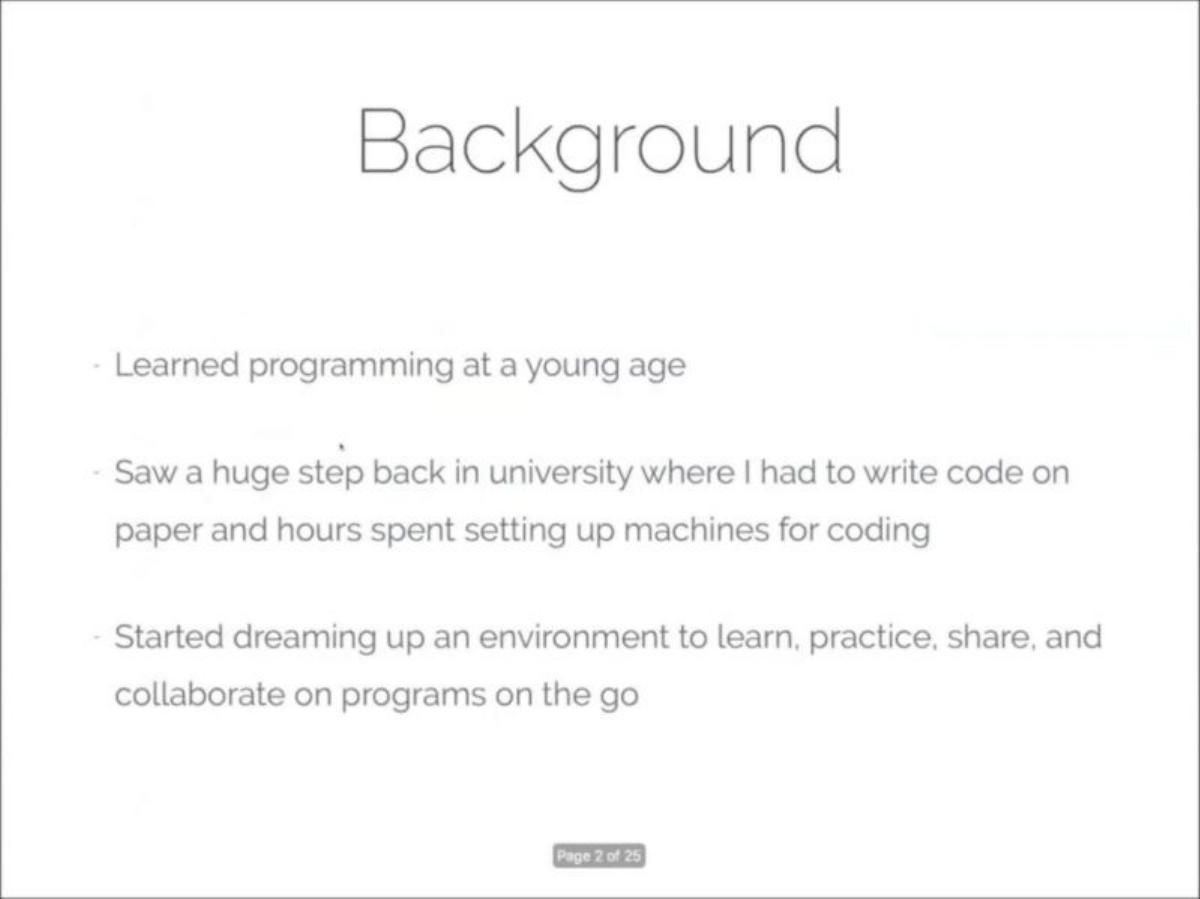
Slide 2, titled 'Background,' establishes the emotional 'why.' The founder mentions learning to program at a young age and the frustration of writing code on paper in university. This sets up the problem: the friction of setting up machines for coding.
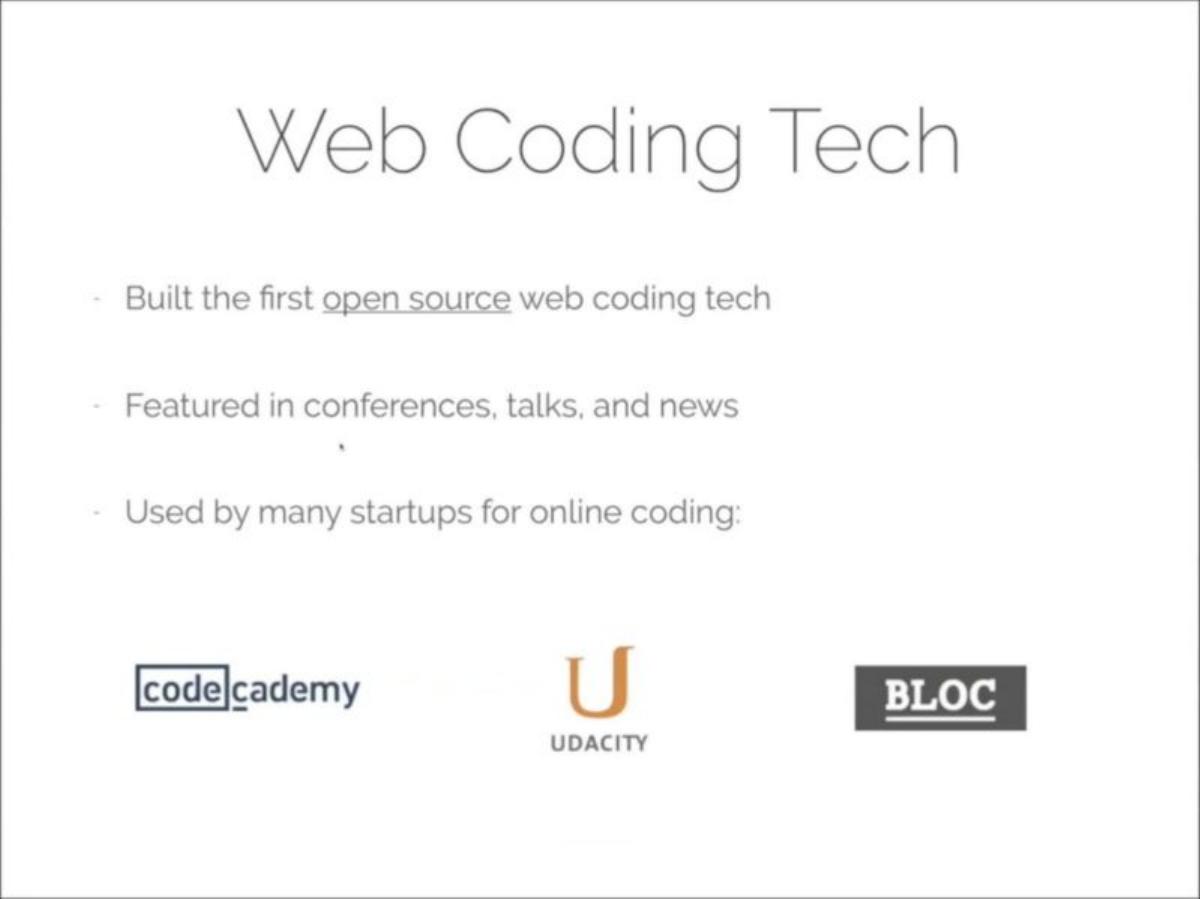
Slide 3, 'Web Coding Tech,' is a major credibility builder. It states they 'Built the first open source web coding tech' and lists Codecademy, Udacity, and Bloc as users. This proves that their technology was already market-validated by major players before they even sought seed funding.
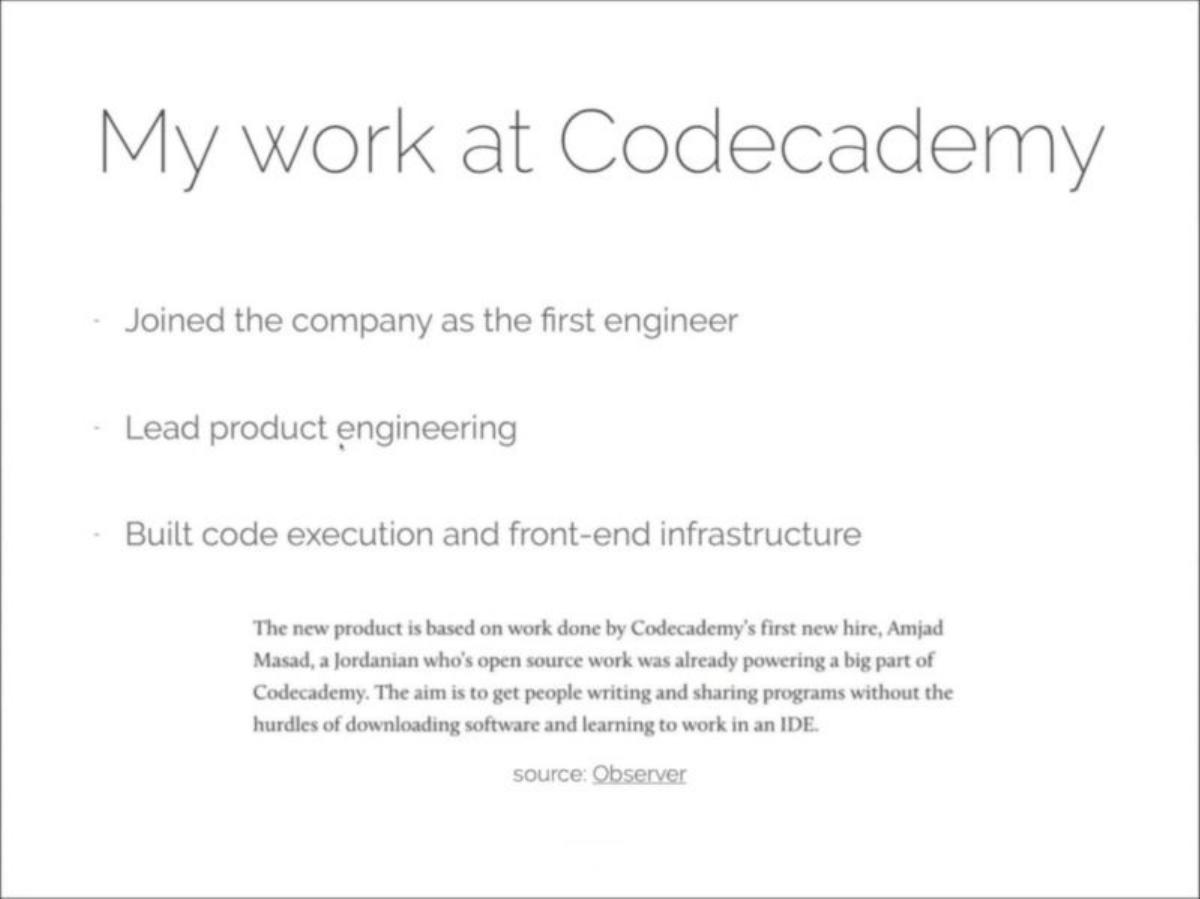
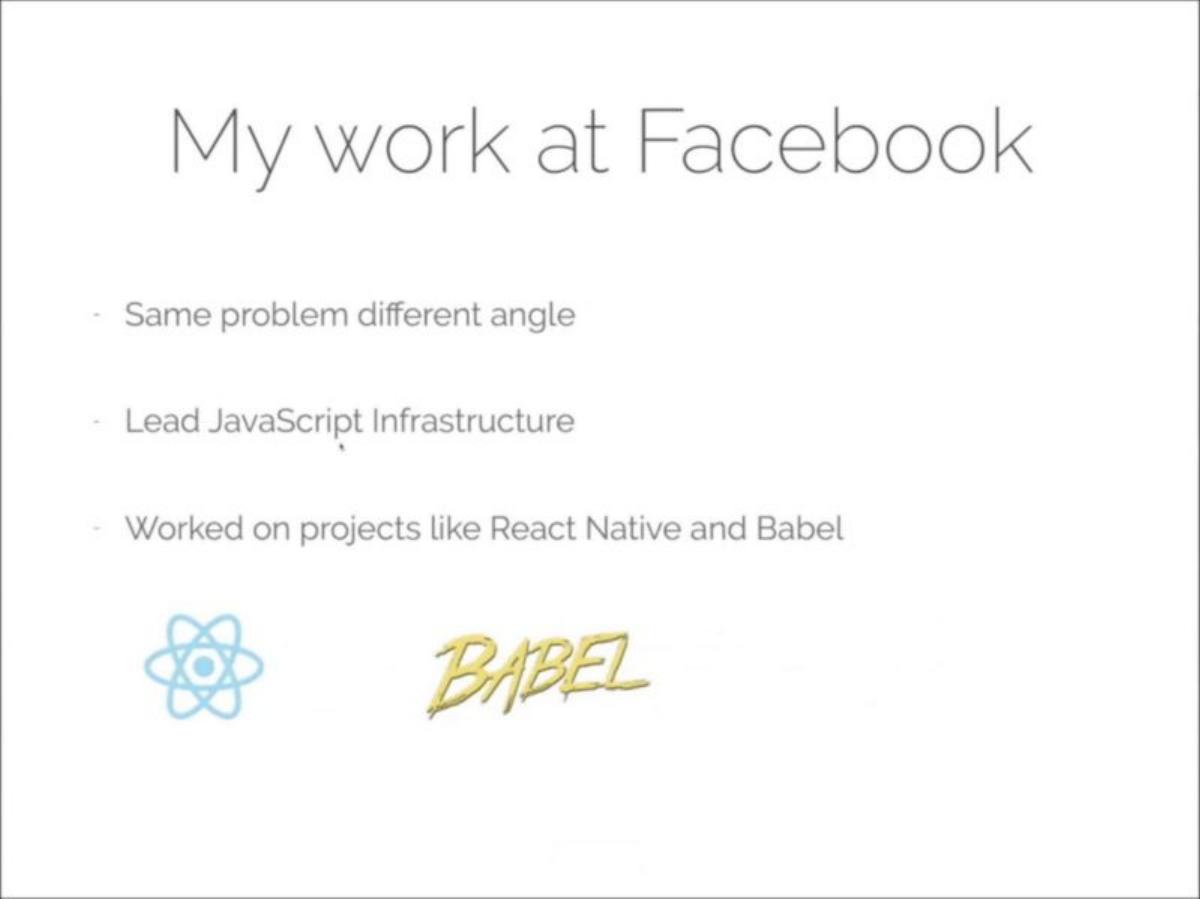
Slides 4 and 5 focus on Amjad Masad’s specific experience. Being the 'first engineer' at Codecademy and leading 'JavaScript Infrastructure' at Facebook (working on React Native and Babel) places the founder at the center of the modern web development ecosystem. For a technical investor, these are the highest possible signals of competence.
Slide 6: The Team
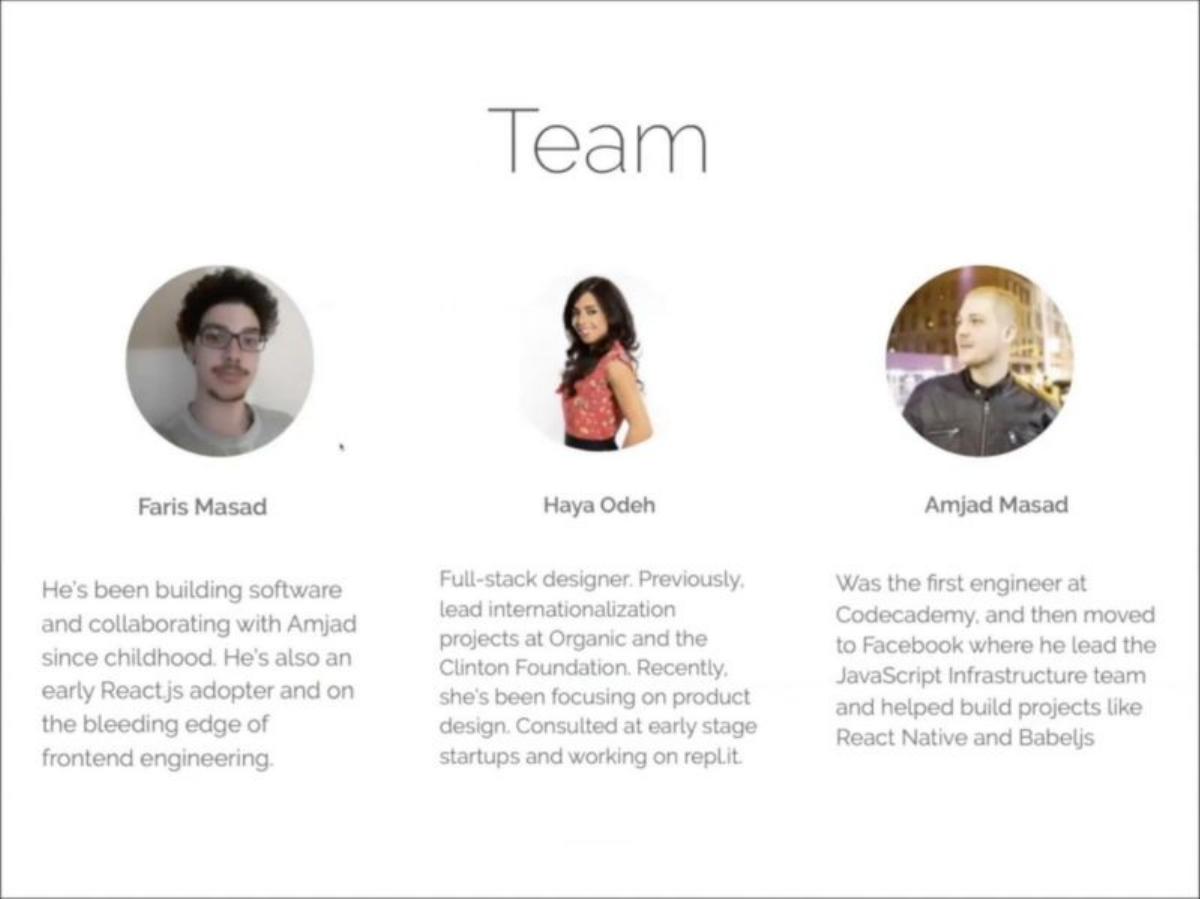
The team slide introduces Faris Masad, Haya Odeh, and Amjad Masad. Faris is noted as an early React.js adopter, and Haya is described as a full-stack designer with experience at the Clinton Foundation. The descriptions emphasize a long history of collaboration ('since childhood') and a mix of design and 'bleeding edge' engineering.
Slides 7-9: Mission, Thesis, and Master Plan
Slide 7 defines the mission: 'Make building and shipping basic software as easy as blogging is today.' This is a powerful analogy that clarifies the product's goal for non-technical investors.
Slide 8, 'Thesis,' identifies the market gap. It argues that 'there is currently no incremental path from user to programmer' and that 'contrived learning environments' (likely a jab at competitors) don't help people actually learn. This slide defines Replit's unique positioning: it is a real tool, not a toy.
Slide 9, the 'Master Plan,' is the strategic heart of the deck. It outlines a clear path from an educational tool to a hosting platform. This is crucial because it shows investors how a 'learn-to-code' site becomes a massive cloud infrastructure business.
Slides 10-11: Traction and Product
Slide 10 (which appears twice in the sequence) delivers the hard numbers. 100K+ monthly active users, all organic, with 60% returning. The fact that 7 million programs were run on their servers in a single month demonstrates significant scale and product-market fit.
Slide 12 and 13 show the interface. It is clean and functional, showing a language selection screen and a Python3 environment. The simplicity of the UI supports the mission of making coding accessible.
Slides 14-17: Social Proof and Market Validation
Slide 14, 'Social Media Love,' uses Twitter screenshots to show real-world usage. Slide 15 shows photos of an 'Hour of Code' event at Mountain View High School. These slides move the deck from abstract concepts to tangible reality. Slide 16 lists 'Top Bootcamp Users,' including App Academy and Flatiron School, showing that the professional training market has already adopted the tool. Slide 17 updates the 'Classroom product status,' mentioning they are 'moving really fast' and iterating with teachers.
Slides 18-21: Technology and Vision
Slide 18 is a placeholder for a 'Quick demo.' Slide 19 and 20 (identical) touch on the 'Technology.' They mention a 'flexible, scalable and secure cloud sandbox infrastructure' and the development of 'AI-assisted tools.' In 2016, mentioning AI-assisted error correction was forward-thinking and hinted at the generative AI features that would eventually become a core part of the Replit experience.
What Replit Got Right
1. Extreme Credibility: By highlighting that their open-source work already powered Codecademy and Udacity, the founders proved they could build production-grade software that others were willing to rely on.
2. Organic Growth: 100,000 MAUs with zero marketing spend is the ultimate proof of product-market fit. It suggests a 'pull' from the market that investors find irresistible.
3. The 'Blogging' Analogy: Comparing software development to blogging (Slide 7) is a brilliant way to communicate a complex technical vision in a way that anyone can understand. It frames the opportunity as the democratization of a previously elite skill.
What Was Missing
1. The Ask: There is no slide detailing how much money they are raising or what the milestones for the next 18 months are. While this information is often handled in the verbal pitch, its absence in the deck leaves the 'so what' of the presentation unanswered.
2. Business Model: The deck mentions 'SaaS' in the catalogue facts, but the slides themselves don't explain how Replit plans to make money. There is no mention of subscription tiers, hosting fees, or enterprise pricing.
3. Market Size (TAM): There is no attempt to quantify the total addressable market. While the 'Master Plan' hints at a large vision, the deck lacks the standard 'trillion-dollar market' slide that many VCs expect to see.
Founder's Playbook: What to Copy
Show, Don't Just Tell: Instead of saying 'teachers love us,' Replit included screenshots of teachers tweeting about the product and photos of students using it in classrooms. Real-world evidence is always more persuasive than bullet points.
Lead with Your Strengths: If you have a world-class engineering background, make it the first thing investors see. Replit spent the first 25% of the deck establishing that they were the best team in the world to build this specific product.
The Three-Step Evolution: Use a 'Master Plan' slide to show how a small, successful niche product (education) can evolve into a massive platform (hosting). This helps investors see the 'billion-dollar' potential without you having to make up questionable market size numbers.
Frequently asked questions
- How much did Replit raise with this deck?
- According to the catalogue facts, Replit raised $120k in a Seed round in 2016. The investors included Bloomberg Beta, Reach Capital, and Y-Combinator. Interestingly, the deck itself does not contain an 'Ask' slide or a breakdown of how the funds would be used.
- What was Replit's primary traction metric in 2016?
- On Slide 10, Replit reported 100,000+ monthly active users (MAU). They emphasized that this growth was 'all organic' and noted a high engagement level with 60% returning users and an average of 13 minutes spent on the site.
- Who were the target users identified in the pitch?
- The deck identifies a split user base on Slide 10: 70% students and 5% teachers. Slide 16 further specifies that 'top bootcamps' like Dev Bootcamp, App Academy, Flatiron School, and Fullstack Academy were daily users of the platform.
- What was the long-term vision for the company?
- Replit's 'Master Plan' on Slide 9 outlines a three-step evolution: first, building tools for teachers and students; second, creating an AI-assisted interface to blur learning and building; and third, evolving into a platform where people 'host applications.'
- How did the founders prove their technical expertise?
- The founders dedicated four slides (Slides 3-6) to their professional backgrounds. Amjad Masad highlighted his role as the first engineer at Codecademy and his leadership of the JavaScript Infrastructure team at Facebook, where he worked on React Native and Babel.