Renaissance's 2020 Pre-Seed deck is a study in brevity and metric-driven storytelling. Raising $1,000,000 on just 10 slides, the company focused heavily on the 'super fan' phenomenon, citing that millennials spend 39.7 hours per week listening to music. The deck leans on impressive early traction, showing a growth curve that reached 100 million songs played by July 2020, alongside a high DAU/MAU ratio of 35%. While the deck completely omits a business model, competition analysis, and a specific financial ask, it compensates with high-signal social proof through advisors from Spotify and TikTo…
Key takeaways
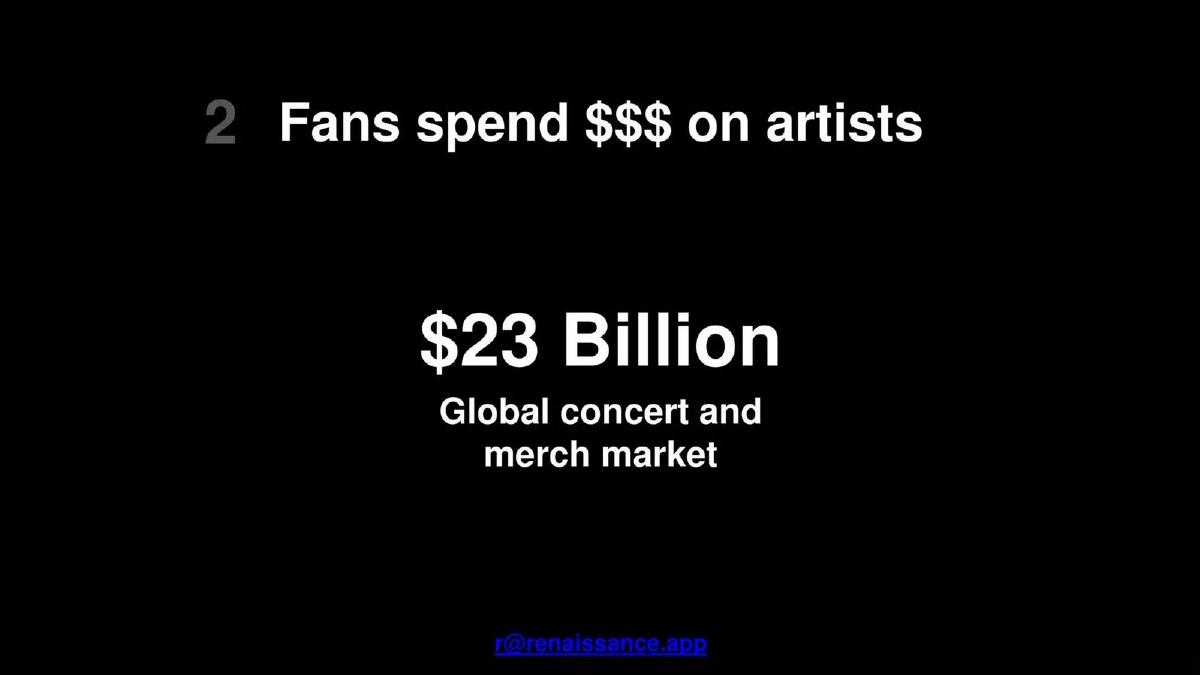
- The deck identifies a massive market opportunity by citing a $23 billion global concert and merch market on slide 3.
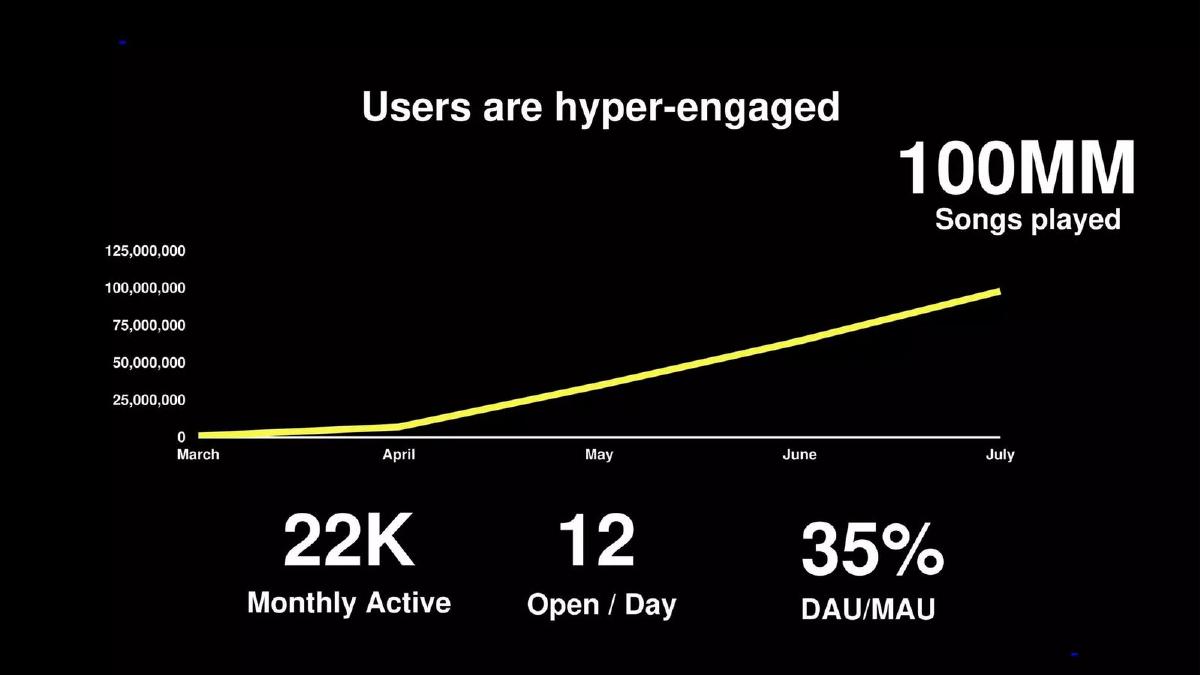
- User engagement is the core value proposition, with the app seeing 12 opens per day per user as shown on slide 5.
- Traction is demonstrated through a steep growth curve reaching 100 million songs played between March and July on slide 5.
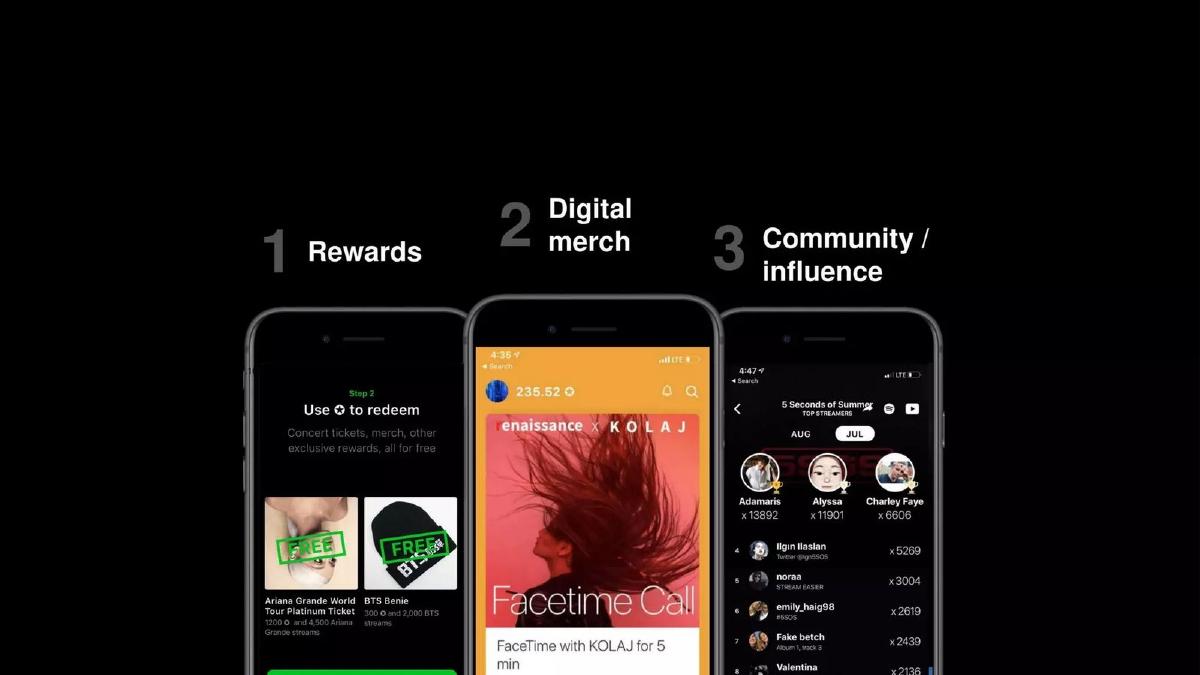
- The product strategy relies on a three-pillar approach: Rewards, Digital Merch, and Community/Influence, illustrated on slide 4.
- The deck leverages significant industry credibility by listing the former Head of Artist Partnership at Spotify as an advisor on slide 9.
- Global reach is visualized through a user heatmap on slide 8, showing active users across North America, Europe, and South America.
- There is no mention of revenue, unit economics, or a specific fundraising target anywhere in the 10 slides.
- The team slide (9) emphasizes technical roles like 'Frontend Ninja' and 'Backend Guru' alongside a CEO with a Facebook and Carnegie Mellon background.
The Power of Minimalist Traction
The Renaissance pitch deck is a 10-slide document that successfully secured $1,000,000 in Pre-Seed funding in 2020. In an era where decks often bloat to 20 or 30 slides filled with complex projections, Renaissance took the opposite approach. They bet on a single, compelling narrative: fans are spending more time and money on music than ever before, and Renaissance has the engagement data to prove they own that attention. By focusing on 'hyper-engaged' users and high-tier industry advisors, the deck bypasses traditional concerns about competition and monetization to focus on the raw utility of the platform for artists and fans alike.
Slides 1-3: The Macro Opportunity
Slide 1: Title The deck opens with a simple black background and white text: "renaissance: The next generation of fan-artist engagement." The branding is minimal, with a single red 'r' providing the only color. This sets a professional, tech-focused tone immediately.
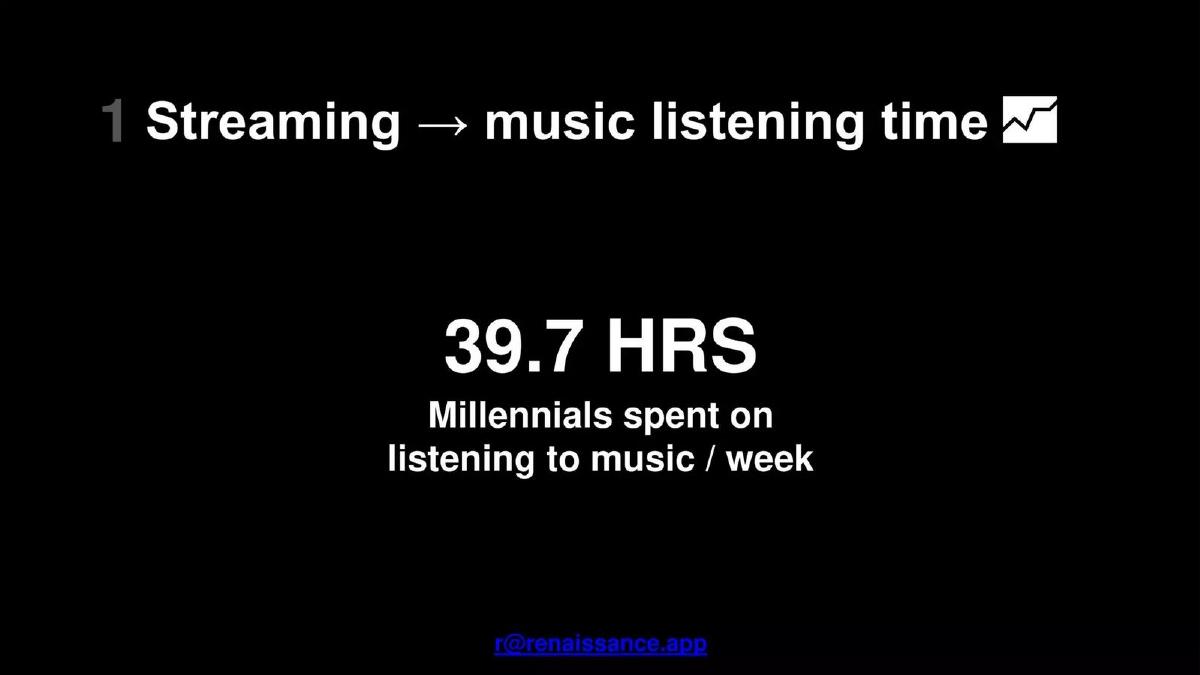
Slide 2: The Time Metric The founders lead with a staggering behavioral statistic. It states that Millennials spend 39.7 HRS listening to music per week. By starting with time spent rather than dollars, the deck argues that music is a primary lifestyle component for their target demographic, not just a secondary hobby. This slide establishes the 'attention' side of the marketplace.
Slide 3: The Dollar Metric Following the time metric, slide 3 introduces the financial opportunity. It cites a $23 Billion global concert and merch market. This is a classic 'Top-Down' market sizing approach. By pairing 40 hours of weekly listening with a $23B spend, the deck creates a logical bridge: fans have the time (attention) and the willingness to pay (capital). Renaissance positions itself as the layer that connects these two realities.
Slides 4-5: Product and Hyper-Engagement
Slide 4: The Three Pillars This slide introduces the app interface through three distinct features: 1. Rewards , 2. Digital Merch , and 3. Community / influence . The screenshots show fans redeeming 'stars' for items like an Ariana Grande World Tour Platinum Ticket or a 5-minute FaceTime call with an artist. This slide is crucial because it defines the 'loop' of the app: stream music, earn rewards, and gain status within a community. It moves the conversation from abstract 'engagement' to specific product utility.
Slide 5: The Traction 'Hockey Stick' This is the 'money slide' of the deck. It features a yellow line graph showing a sharp upward trajectory from March to July. The headline is 100MM Songs played . Below the graph, three specific metrics are listed to define what they call 'hyper-engaged' users: 22K Monthly Active , 12 Open / Day , and a 35% DAU/MAU ratio. In the world of social apps, a 35% DAU/MAU is considered excellent, and 12 opens per day suggests the app has become a daily habit for its users. This slide validates that the product described on slide 4 actually works in the wild.
Slides 6-8: Ecosystem Value and Global Reach
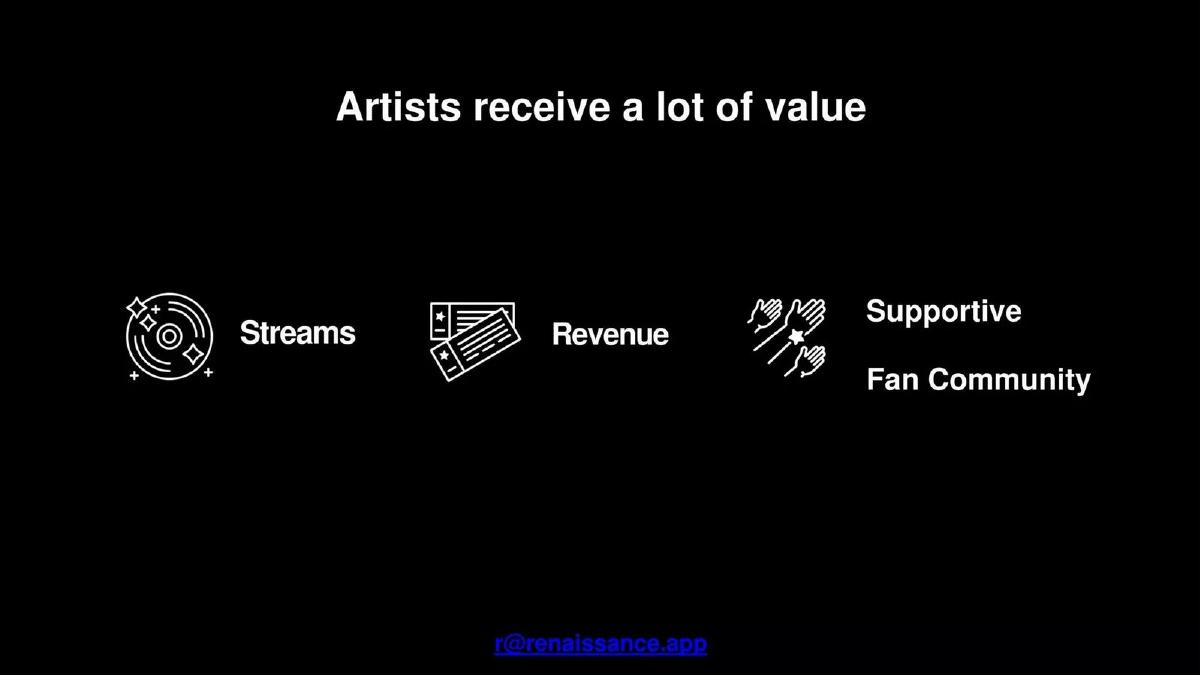
Slide 6: Artist Value Proposition The deck shifts focus from the fan to the artist. It lists three benefits: Streams , Revenue , and a Supportive Fan Community . This slide is light on detail but serves to show that Renaissance is a two-sided marketplace. By helping fans 'amplify' their streaming, they directly increase the royalty checks artists receive from platforms like Spotify.
Slide 7: Industry Logos Without using words, slide 7 provides massive social proof. It displays the logos of Capitol Records , Warner Music , Ticketmaster , and Apple Music . While the deck doesn't specify the nature of these relationships (partnerships, integrations, or just target platforms), the presence of these logos suggests that Renaissance is operating within the established music industry hierarchy rather than trying to disrupt it from the outside.
Slide 8: Global Social Marketplace A world map shows heatmaps of 'active users.' The concentration is heaviest in the United States , Western Europe (specifically the UK and Germany), and South America (Brazil). This visualizes that the 'super fan' phenomenon is not localized to a single country, suggesting that the business is infinitely scalable across geographic borders.
Slides 9-10: The Team and The Vision
Slide 9: The Team and Advisors The team slide is a mix of pedigree and industry expertise. CEO Ruthia He is backed by logos for Facebook , Carnegie Mellon , and Peking University . The technical team is described with colloquial titles: Lina Wang (Frontend Ninja) and Joey Lin (Backend Guru) . However, the real heavy lifting on this slide comes from the advisors. Mark Williamson (Former Head of Artist Partnership at Spotify) and Alex Hofmann (Former President at Tiktok) provide the 'insider' credibility needed to navigate the notoriously difficult music industry. For a Pre-Seed round, having the former President of TikTok as an advisor is a massive signal of potential.
Slide 10: Conclusion The deck ends with the tagline "Be part of the modern renaissance" and the CEO's email address. It is a clean, no-nonsense exit that maintains the minimalist aesthetic of the entire presentation.
What Works in the Renaissance Deck
The most effective element of this deck is its density of engagement . Most early-stage startups try to show they have a lot of users. Renaissance instead shows that they have intense users. The metric of 12 opens per day is far more impressive to a seasoned investor than a raw download count, as it proves the app has successfully captured a slot in the user's daily routine. Furthermore, the use of advisors is masterfully handled. In the music tech space, licensing and industry relationships are the primary 'moats.' By showing advisors from Spotify and TikTok, the founders signal that they have the keys to the kingdom without having to write a single bullet point about their 'go-to-market strategy.'
What is Missing from the Renaissance Deck
While the deck was successful in raising $1M, it leaves several critical questions unanswered. First, there is no business model. We see that fans get rewards and artists get streams, but we don't see how Renaissance captures value. Do they take a cut of digital merch? Do they charge artists for data? Second, there is no competitive analysis. The fan engagement space is crowded with players like Fave, Weverse, and various Discord-based communities. Renaissance ignores these entirely. Third, there is no 'Ask.' The deck doesn't state how much they are raising or what the milestones for the next 18 months will be. While this information is often omitted from 'teaser' decks, its absence in a full pitch deck usually requires the founder to be very persuasive in the live meeting.
What a Founder Should Copy
Founders should emulate the visual hierarchy of this deck. Every slide has one clear headline and one primary visual. There are no walls of text. The 'Traction' slide (Slide 5) is a perfect example of how to present data: a large, clear graph supported by three high-impact bullet points. Additionally, the way Renaissance framed their market size (Slide 2 and 3) by connecting 'Time Spent' to 'Market Dollars' is a sophisticated way to justify a new category. If you are building a social or consumer app, focus on your DAU/MAU and your 'opens per day'—these are the metrics that prove you've built something people actually want to use.
Final Verdict: This deck is a high-signal, low-noise presentation that relies on the strength of its early data and the reputation of its advisors to carry the weight of the investment thesis. It is a reminder that at the Pre-Seed stage, a clear 'hockey stick' graph and a world-class advisor list can often outweigh the need for a detailed 5-year financial plan.
Frequently asked questions
- How much did Renaissance raise with this deck?
- According to the catalogue facts, Renaissance raised $1,000,000 in 2020 during their Pre-Seed round. The deck itself does not state the amount raised or the terms of the investment, which is common for decks used in active pitch meetings where the 'ask' is delivered verbally or in a follow-up document.
- What are the primary engagement metrics shown?
- Slide 5 highlights four key metrics: 100 million songs played, 22,000 Monthly Active Users (MAU), 12 app opens per day, and a 35% DAU/MAU ratio. These figures are intended to prove that the user base is 'hyper-engaged' rather than just casually browsing.
- Who are the key people behind Renaissance?
- The team is led by CEO Ruthia He, who has experience at Facebook and an education from Carnegie Mellon and Peking University. The deck also highlights two high-profile advisors: Mark Williamson (Former Head of Artist Partnership at Spotify) and Alex Hofmann (Former President at TikTok).
- Does the deck explain how the company makes money?
- No. The deck completely omits a business model or revenue slide. While slide 6 mentions 'Revenue' as a value artists receive, it does not detail the platform's take rate, subscription fees, or advertising model. This suggests the Pre-Seed focus was entirely on user growth and engagement.
- What is the 'Digital Merch' mentioned in the product slide?
- Slide 4 shows a mobile interface featuring a 'FaceTime Call with KOLAJ for 5 min' as a form of digital merch. This indicates the platform focuses on experiential and digital rewards that fans can redeem using stars or stream counts, rather than just physical clothing.