Metafuels is a Swiss-based sustainability startup tackling the aviation industry's carbon footprint through its proprietary aerobrew technology. By converting green methanol into sustainable aviation fuel (e-SAF), the company claims a 90% reduction in lifecycle emissions compared to conventional jet fuel. Their 14-slide pitch deck successfully navigated a complex hardware-heavy sector by focusing on 'techno-economics'—specifically yield and scalability. The deck outlines a clear path from mini-pilots (1-2 liters/day) to massive growth plants (700 million liters/year). This strategic clarity,…
Key takeaways
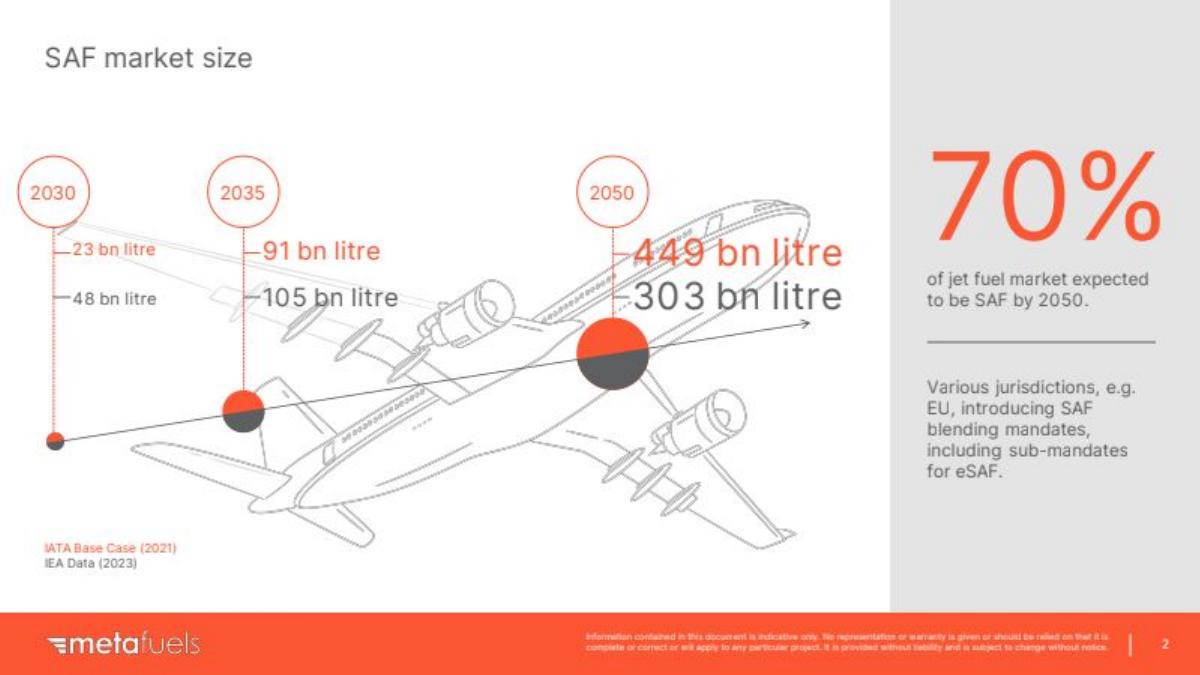
- The deck projects that 70% of the jet fuel market will be SAF by 2050, representing a massive regulatory-driven shift (Slide 2).
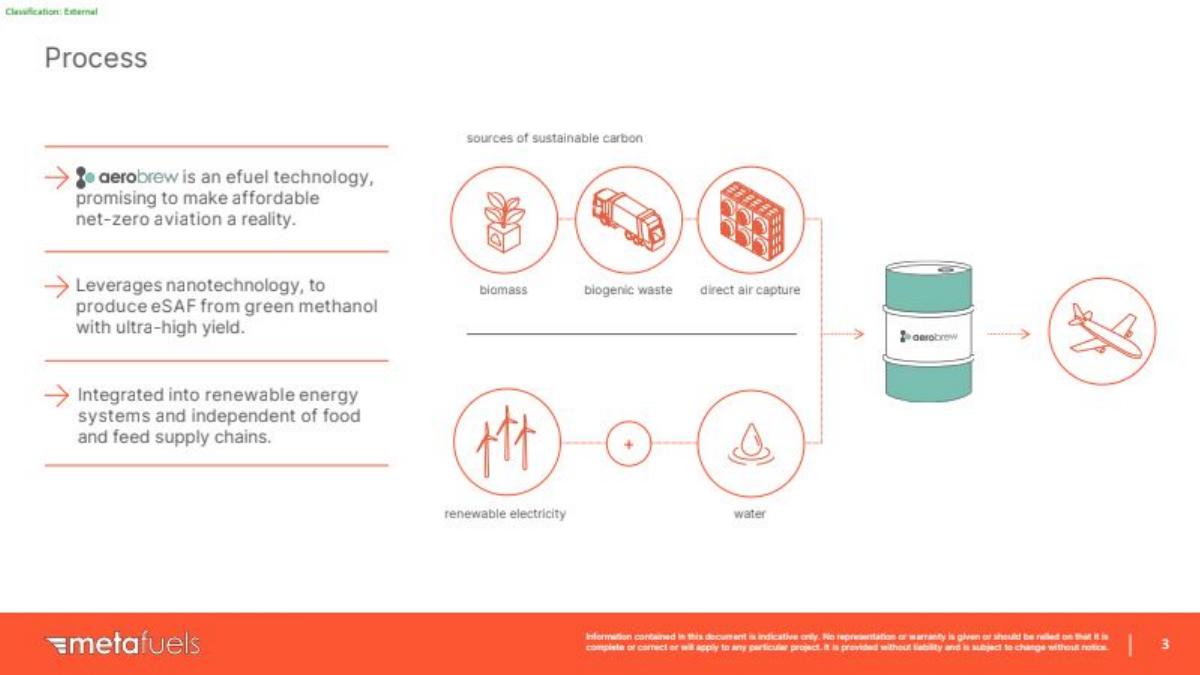
- Metafuels' proprietary 'aerobrew' technology uses nanotechnology to produce e-SAF from green methanol with 'ultra-high yield' (Slide 3).
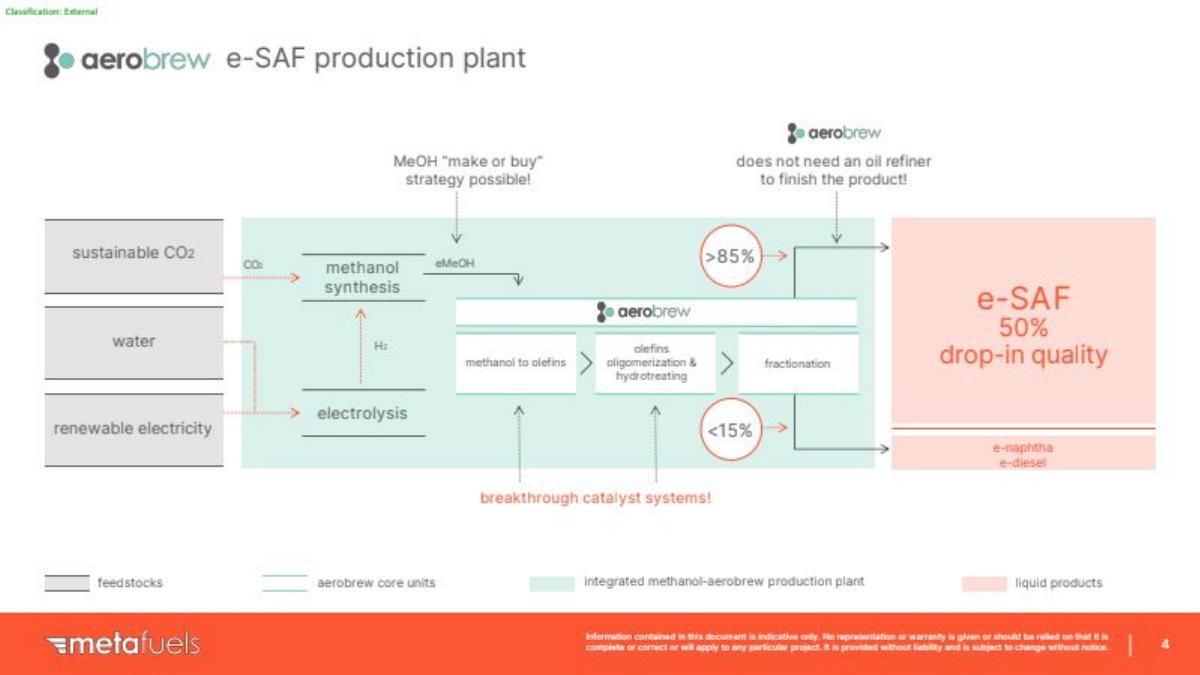
- The production process achieves a 50% drop-in quality fuel, requiring no oil refiner to finish the product (Slide 4).
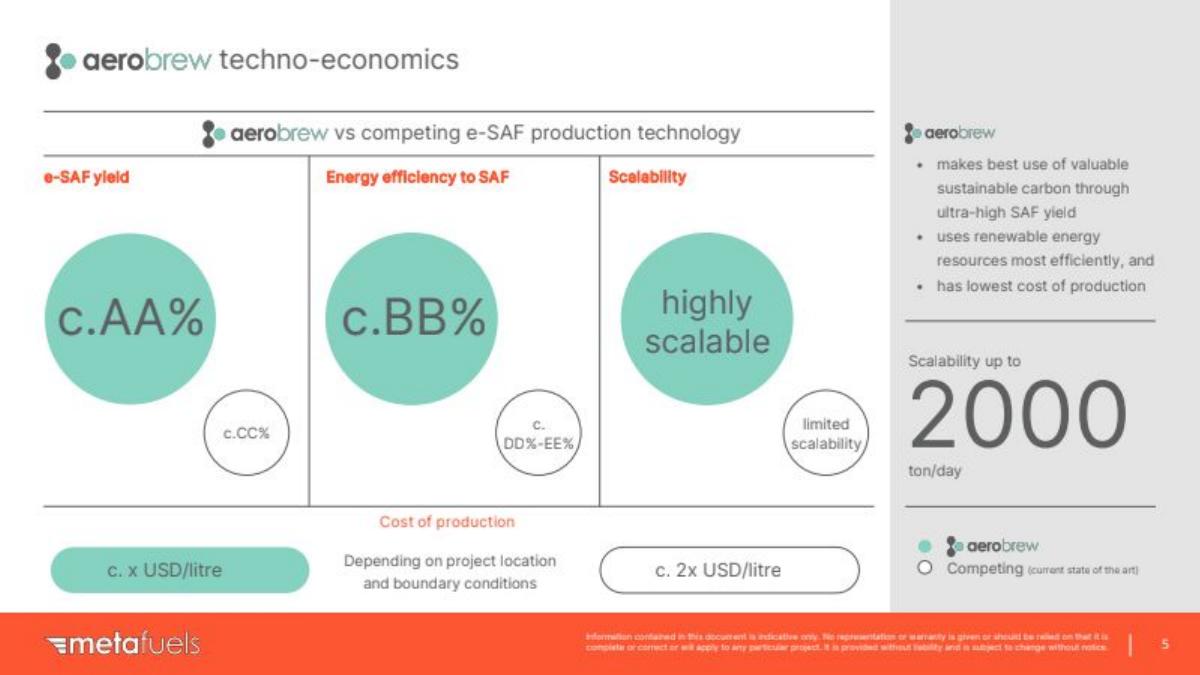
- A 'techno-economics' slide uses comparative circles to claim superior yield and energy efficiency over current state-of-the-art competitors (Slide 5).
- The company targets a production cost significantly lower than competitors, visualized as 'c. x USD/litre' vs 'c. 2x USD/litre' (Slide 5).
- A clear technology roadmap outlines a transition from a 2024 mini-pilot to a 50 liter/day pilot plant by 2025-2026 (Slide 7).
- The business model is split into two pillars: Pillar I focuses on owning/operating production plants, while Pillar II focuses on technology licensing (Slides 8-9).
- Metafuels highlights early market traction through a Memorandum of Understanding (MoU) with European Energy signed in June 2023 (Slide 11).
The Metafuels Pitch Deck: Navigating the Hard-Tech Fundraising Landscape
Fundraising for sustainable aviation fuel (SAF) is a high-stakes endeavor. It requires convincing investors to back massive capital expenditures (CapEx) based on laboratory-scale proofs. The Metafuels deck, which secured an $8M Seed round in 2023, is a masterclass in using 'techno-economics' to bridge the gap between a scientific breakthrough and a commercial opportunity. With a 14-slide presentation, the Swiss startup managed to articulate a complex chemical process as a scalable, high-margin business model.
Slide 1: The Vision
The cover slide is minimalist, featuring the Metafuels logo and the tagline: "Powering the future of air travel with sustainable aviation fuel." It establishes the sector immediately. The use of a wireframe airplane graphic suggests an engineering-first approach rather than a marketing-heavy one. The URL www.metafuels.ch is clearly displayed, grounding the company in the Swiss innovation ecosystem.
Slide 2: Market Size and Regulatory Tailwinds
Metafuels frames the opportunity through the lens of total market transformation. They cite IATA and IEA data to show a trajectory where SAF grows from a negligible share today to 70% of the jet fuel market by 2050 . The slide highlights specific volumes: 23 billion liters by 2030, scaling to 449 billion liters by 2050 . Crucially, they mention the introduction of SAF blending mandates in jurisdictions like the EU, which provides the regulatory certainty investors need for long-term infrastructure plays.
Slide 3: The 'aerobrew' Process
This slide introduces the proprietary technology, aerobrew . It defines it as an "efuel technology" that uses nanotechnology to produce eSAF from green methanol. The diagram shows the inputs: sustainable carbon (biomass, biogenic waste, or direct air capture) and renewable electricity/water. By positioning themselves as "independent of food and feed supply chains," they preemptively answer ESG concerns regarding land use.
Slide 4: Production Plant Architecture
Slide 4 dives deeper into the engineering. It shows an integrated methanol-aerobrew production plant. Key technical claims include a ">85%" yield for the core aerobrew process and the fact that it "does not need an oil refiner to finish the product." The output is described as "e-SAF 50% drop-in quality," with byproducts like e-naphtha and e-diesel. This slide is intended for the technical due diligence team, proving the founders understand the industrial requirements of fuel synthesis.
Slide 5: Techno-economics
This is perhaps the most important slide in the deck. It uses a comparative visualization to show how aerobrew stacks up against "Competing (current state of the art)" technology. Using circles of varying sizes, it claims superior e-SAF yield and energy efficiency . Most strikingly, it claims a cost of production of "c. x USD/litre" compared to "c. 2x USD/litre" for competitors. While the actual dollar amounts are redacted in this version, the 2:1 cost advantage is a powerful hook. It also notes a scalability of up to 2,000 ton/day .
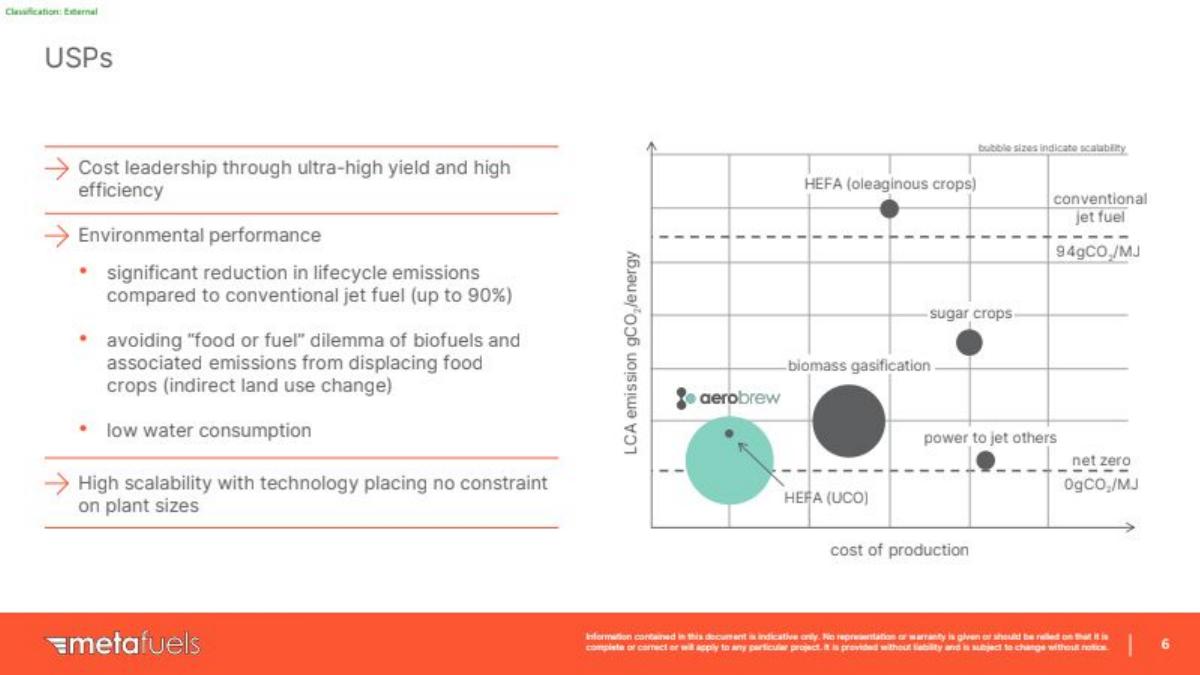
Slide 6: Unique Selling Points (USPs)
Metafuels uses a quadrant graph to plot LCA (Life Cycle Assessment) emissions against the cost of production. Aerobrew is positioned in the bottom-left corner—the "holy grail" of low cost and low emissions (approaching net zero). They claim a 90% reduction in lifecycle emissions compared to conventional jet fuel (94gCO2/MJ). This slide reinforces the message that they aren't just cleaner; they are more efficient than other "power to jet" alternatives.
Slide 7: Technology Development Roadmap
For a Seed stage company, the roadmap is vital. Metafuels shows a clear progression: 2020-onwards for IP development; 2024-2026 for a "Mini pilot" producing 1-2 liters per day; and 2025-2026 for a "Pilot plant" producing approximately 50 liters per day. This transparency about current low volumes is necessary to build trust; it shows they are following a rigorous scientific method before attempting to build a commercial-scale facility.
Slides 8 & 9: The Dual-Pillar Business Model
Metafuels presents a sophisticated revenue strategy. Pillar I (Slide 8) is the "Production Plants" model, involving project development, pioneer projects, and ownership participation. This is the high-reward, high-CapEx side of the business. Pillar II (Slide 9) is "Technology Licensing," which offers a more scalable, lower-risk revenue stream through royalties, design packages, and catalyst sales. This dual approach allows them to capture the full value chain while providing a path to faster scaling through third-party partnerships.
Slide 10: Commercialisation Phases
This slide maps the business model to a timeline. From 2023-2028 , the focus is on "Pioneer plant(s)" with a capacity of 3.5 million liters per year . From 2028 onwards , they move into the "Growth" phase, targeting plants of up to 700 million liters per year . This shows investors the scale of the ambition: moving from a pilot to a major industrial player within five years.
Slide 11: Market Traction
Traction in the SAF space is measured in partnerships. Metafuels highlights a June 29th, 2023 announcement: a Memorandum of Understanding (MoU) with European Energy to develop a methanol-to-jet SAF project. This provides external validation that their technology is being taken seriously by established energy companies.
Slide 12: The Leadership Team
The team slide emphasizes deep technical and industrial experience. Saurabh Kapoor (CEO) holds a B. Eng. in Mechanical Engineering; Dr. Leigh A. Hackett (Chairman) is a Chartered Engineer and Fellow of the IChemE; Ulrich Koss (CTO) holds a Dipl. Ing. in Industrial engineering. The slide also prominently features their investors— Energy Impact Partners and Contrarian Ventures —and their technology partner, the Paul Scherrer Institut (PSI) . This is a "pedigree" slide designed to reduce perceived execution risk.
Slide 13: The Call to Action
The deck concludes with a group photo of the team on a bridge, with the text "Come join us!" It’s a standard closing that emphasizes the human element behind the chemical engineering. It frames the company not just as a technology, but as a growing organization.
What Metafuels Does Well
The Metafuels deck excels at quantifying the advantage . In a sector where many startups make vague claims about sustainability, Metafuels uses specific metrics—yield percentages, liters per day, and relative cost ratios—to make their case. They also do an excellent job of addressing the 'why now' by citing EU mandates and the global shift toward SAF. Finally, the dual-pillar business model is a clever way to appeal to different types of investors: those who want the asset-heavy returns of fuel production and those who prefer the high-margin scalability of software-like licensing.
What is Missing from the Deck
While the deck is technically strong, it omits a few key pieces of information that would typically be found in a Seed deck:
The Ask: The deck does not explicitly state how much they are raising or how the funds will be allocated (though we know from external sources it was $8M). · Unit Economics: While they show relative costs (x vs 2x), they don't provide the absolute target price per liter or the projected margins at scale. · Competitive Landscape: Slide 5 and 6 mention "competitors" and "state of the art," but they don't name specific companies. In a crowded field with players like LanzaJet or SkyNRG, naming names can help investors understand exactly where the company fits. · Feedstock Security: They mention using green methanol, but they don't detail how they will secure the massive quantities of feedstock needed for their 700 million liter growth plants.
Founder Takeaways: What to Copy
1. Use 'Techno-economics' to Simplify Complexity: If your product is a complex hardware or chemical process, don't just explain how it works. Explain why it is cheaper and more efficient than the current way of doing things. Slide 5 is a perfect template for this.
2. Map Your Roadmap to Volumes: Metafuels doesn't just say "we will scale." They provide specific output targets (1-2 liters, 50 liters, 3.5 million liters). This gives investors a clear set of milestones to track progress against.
3. The Dual-Pillar Strategy: If you are building an asset-heavy business, consider if there is a licensing or services component you can offer. This can make your company more attractive to VCs who might otherwise be wary of pure infrastructure plays.
4. Leverage Institutional Partnerships: Featuring the Paul Scherrer Institut (PSI) as a technology partner adds immense credibility. If you are a deep-tech startup, your ties to research institutions are often as important as your ties to investors.
Frequently asked questions
- What is the core technology behind Metafuels?
- Metafuels utilizes a proprietary technology called 'aerobrew.' According to Slide 3, this process leverages nanotechnology to convert green methanol into e-SAF (electro-sustainable aviation fuel). The process is designed to be integrated into renewable energy systems and remains independent of food and feed supply chains, avoiding the 'food vs. fuel' dilemma common in first-generation biofuels.
- How does Metafuels compare to existing SAF technologies?
- On Slide 5, Metafuels claims superior 'techno-economics' compared to the current state of the art. They assert higher e-SAF yield, better energy efficiency, and greater scalability (up to 2,000 tons/day). Most notably, they claim their cost of production is approximately half that of competing technologies, visualized as 'x' versus '2x' per liter.
- What is the company's go-to-market strategy?
- Metafuels employs a dual-pillar business model. Pillar I (Slide 8) involves developing, investing in, and operating their own production plants to sell fuel directly into SAF markets. Pillar II (Slide 9) focuses on technology licensing, where they generate revenue through royalties, design packages, catalyst sales, and equipment provision.
- What milestones has Metafuels achieved so far?
- As of the deck's publication, the company had signed an MoU with European Energy in June 2023 to develop a methanol-to-jet SAF project (Slide 11). Their roadmap (Slide 7) indicates they have been in product development since 2020 and are moving toward a mini-pilot phase (1-2 liters per day) scheduled for 2024-2026.
- Who are the key investors and partners?
- The deck lists Energy Impact Partners and Contrarian Ventures as investors (Slide 12). Additionally, they have a formal technology development partnership with the Paul Scherrer Institut (PSI), a leading Swiss research institute for natural and engineering sciences.