MetaHand's deck is 11 slides of confident dark-mode PowerPoint, exported on 18 April 2022, pitching 'touchable interactive video advertising' — a virtual hand that runs in any mobile browser with no app, tracking the user's real hand through the phone's front camera. It is a product introduction, not a fundraising deck: there is no problem slide, no competition, no go-to-market, no roadmap, no financials, no traction and no ask. What it does well is rare — the proposition is legible in four words on the cover, the format mockups let a media buyer picture the inventory instantly, and the final…
Key takeaways
- MetaHand's 11-slide deck, exported 18 April 2022, is a product introduction rather than a fundraising deck: no problem, competition, go-to-market, roadmap, financials, traction or ask appears anywhere in it.
- The load-bearing fact of the whole business — that the virtual hand is tracked using the phone's front camera — is delivered as a passing clause on slide 3, and the camera-permission rate it implies is never given. That single number determines whether the product works at scale.
- Four of the eleven slides (celebrity high-five, publisher banner, search results, social feed) are the same idea in four settings. They repeat the concept instead of proving it once with a measured test.
- The only performance claim in the deck — that interactive hand ads 'increase impression and interaction rates compared to traditional video advertisements' — carries no number, source, baseline or sample size, and it is the claim every media buyer will demand evidence for.
- The business model slide contains no business model: 'a small commission' with no unit, no payer, no take rate and no margin, anchored on a $0.02 pay-per-click figure that contradicts the 'premium ad feature' positioning on slide 5.
- The IP slide claims six granted patents, shows four cards, gives zero patent numbers or jurisdictions, and includes one card reading 'Status: Granted' above 'Expected (25/10/2020)' — a date already eighteen months in the past when the deck was made.
- The team slide lists four names and titles with no bios, and omits the strongest available fact: the founder appears to be the named inventor on the patent family shown one slide earlier.
- The closing slide is the best in the deck — 'Browser ready, no app required' plus a live demo link at metahand.io — because it converts every prior claim into a test the reader can run in thirty seconds. It belongs on slide 1 as well, and it should have carried an ask.
What this deck actually is
Eleven slides, 960 x 540 points — 16:9 , built in Microsoft PowerPoint for Microsoft 365 and exported on 18 April 2022 at 13:15 UTC , author field "DGJones" . Title slide: the MetaHand wordmark, a five-finger outline logo in cyan-to-magenta gradient, and one line of positioning — "Touchable Interactive Video Advertising."
Classify it honestly before analysing it: this is a product introduction deck, not a fundraising deck. There is no problem slide, no market sizing beyond a single headline number, no competition, no go-to-market, no roadmap, no financial model, no traction of any kind, no use of funds and no ask. Eleven slides in, nobody has been asked for anything. The closing slide sends the reader to a live demo at metahand.io, which tells you what the document is really for: it is a top-of-funnel explainer aimed at advertisers, agencies and partners, that also gets emailed to investors because it is the only deck the company has.
That distinction matters, because on its own terms the deck is competent. The design is confident, the idea is legible in ten seconds, the format mockups are convincing, and the closing call to action is the single smartest thing in the file. It fails only when you read it as what founders usually use it for — a document meant to get a cheque.
Slide-by-slide walkthrough
Slide 1 — Cover
Logo, wordmark, and the tagline "Touchable Interactive Video Advertising." Dark charcoal background, two soft gradient blobs, nothing else.
Four words that do real work. "Touchable" is the hook, "Interactive Video" is the category, "Advertising" is the business. A reader who stops here still knows which market this competes in and roughly what the product does — more than most cover slides achieve. What is missing is anything that dates or situates the document: no month, no stage, no round name, no company entity, no confidentiality line. For a deck that circulates by email attachment for years, the absence of a date is the standard, avoidable error.
Slide 2 — MetaHand Explained
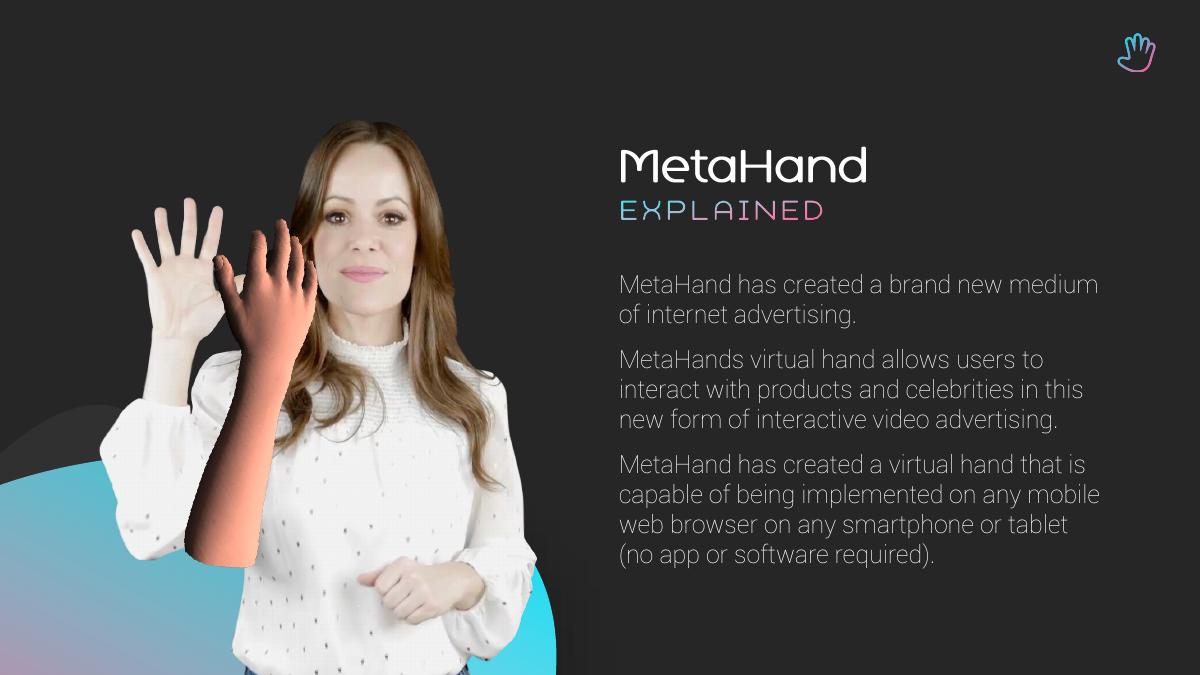
Three paragraphs beside a photo of a woman waving with a virtual hand overlaid: MetaHand "has created a brand new medium of internet advertising"; the virtual hand "allows users to interact with products and celebrities"; and it works "on any mobile web browser on any smartphone or tablet (no app or software required)."
The third sentence is the actual asset and it is buried third. "No app, no software, works in the browser" is the difference between a novelty that needs a download — which kills 90%+ of casual intent — and something a publisher can drop into an existing ad slot. That is the sentence the cover should carry and the sentence the whole deck should be organised around.
"A brand new medium of internet advertising" is the opposite: a claim of category creation stated in the first line, with no evidence behind it anywhere in the eleven slides. Investors read category-creation language as a liability unless the next slide proves it, because creating a medium means creating buyer behaviour, ad-ops standards, measurement, and a sales motion from zero — a much harder company than "a new interactive format inside existing programmatic supply." The deck never chooses which of those two companies it is.
Slide 3 — What MetaHand is
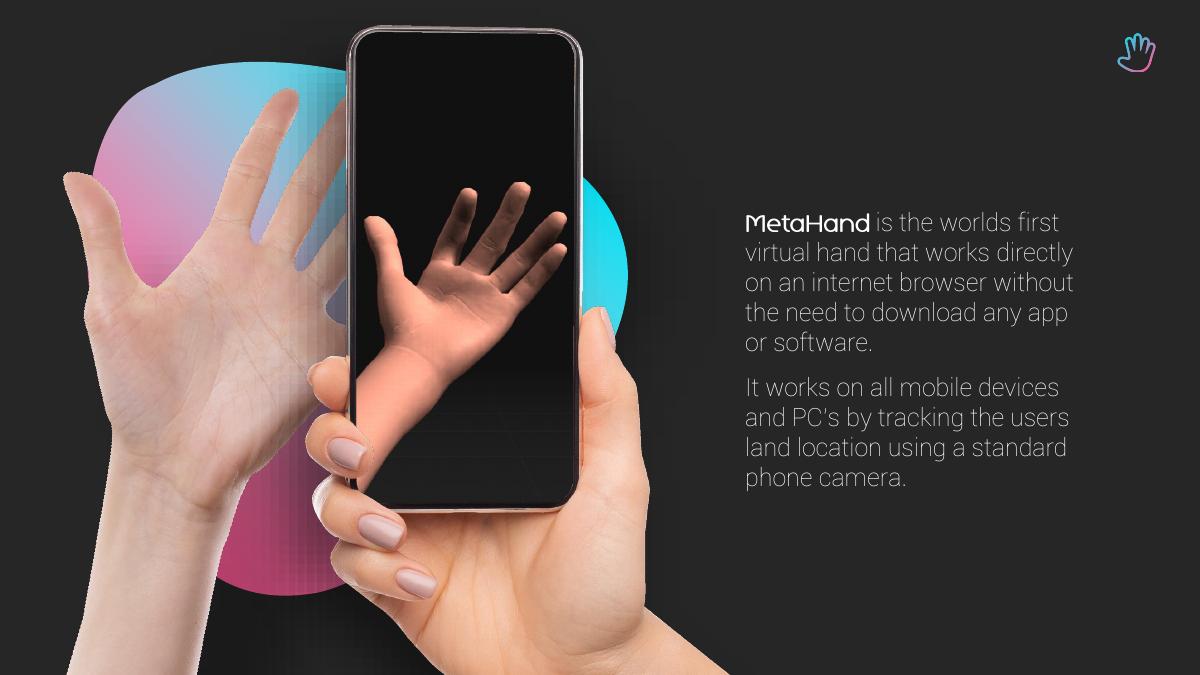
"The world's first virtual hand that works directly on an internet browser without the need to download any app or software. It works on all mobile devices and PC's by tracking the users hand location using a standard phone camera."
Here is the load-bearing sentence of the entire business, and it is delivered as a passing technical note: the product tracks the user's hand using the phone's camera. Every material risk in this company lives in that clause, and the deck never returns to it.
Permission. An advertisement must ask a user for camera access. Browser camera prompts are the highest-friction consent in mobile web, and one that most users decline on reflex for content they did not seek out. What percentage grant it? The deck does not say, and the number is the company. · Policy. Camera access from a third-party ad frame runs into publisher policies, iframe permission policies, and — since Apple's App Tracking Transparency and the tightening of Safari's media permissions — an OS-level climate that is moving against exactly this. April 2022 is well after that shift, so its absence from the deck is a choice, not an oversight. · Cost. Real-time hand tracking in a mobile browser is a compute and battery load carried on the user's device during an ad. No mention of latency, model size, frame rate or fallback behaviour on low-end Android. · Privacy. "Standard phone camera" plus "advertising" is a sentence a GDPR-jurisdiction advertiser's legal team will read very slowly. No word about on-device processing, retention, or whether any frame ever leaves the phone — which is a shame, because "nothing leaves your device" is very likely true and would be the strongest trust claim available.
"World's first" is also unqualified. Browser-based hand tracking via webcam had public, well-known implementations by 2022 — MediaPipe Hands and TensorFlow.js handpose both ran in a browser tab. The defensible version of the claim is narrower and stronger: first to deliver it inside a servable ad unit with patents on the interaction method. The deck claims the broad version, which any technically literate investor can puncture in one search, and skips the narrow version it could actually defend.
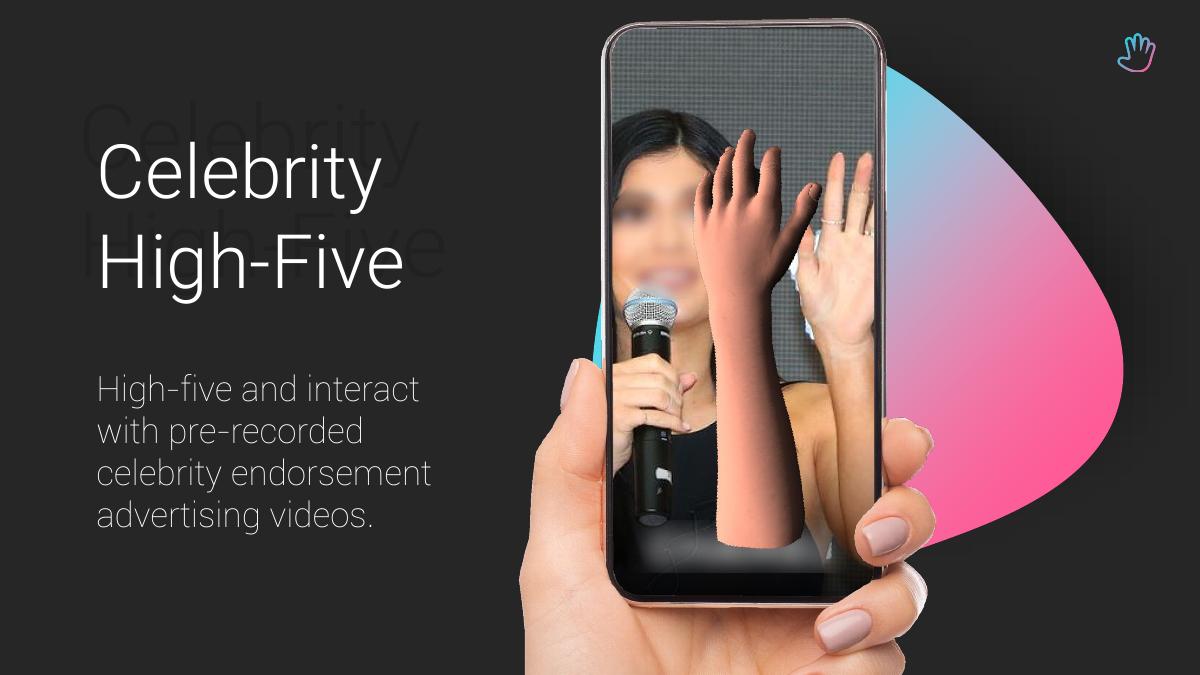
Slide 4 — Celebrity High-Five
"High-five and interact with pre-recorded celebrity endorsement advertising videos."
One sentence, one icon. It is the most emotionally legible use case in the deck and the one most likely to be remembered — and it opens a supply problem the deck does not acknowledge. Celebrity endorsement inventory has to be licensed, filmed to spec, and rights-cleared per market and per campaign. That makes this a three-sided business: advertisers, publishers, and talent. Nothing in eleven slides addresses who shoots the video, who owns it, what it costs, or whether a single celebrity has agreed to anything.
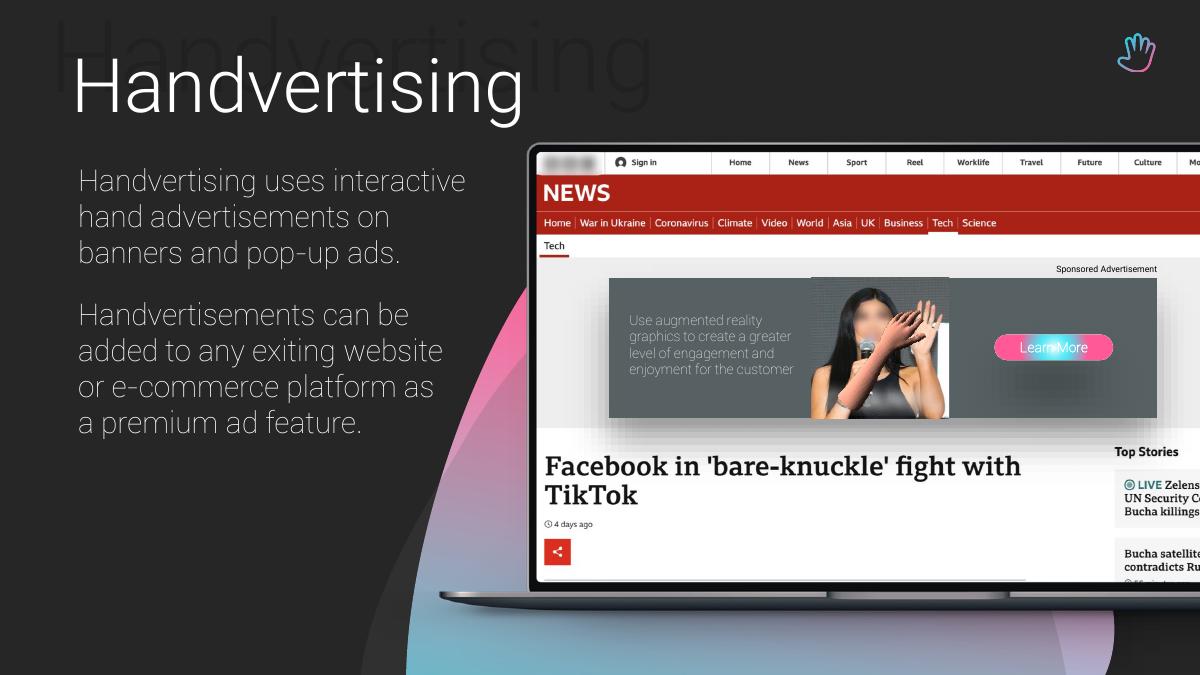
Slide 5 — Handvertising
A mocked-up BBC News article page carrying a "Sponsored Advertisement" unit, with the line: Handvertisements "can be added to any existing website or e-commerce platform as a premium ad feature."
"As a premium ad feature" is the most commercially important phrase in the deck, and it is doing pricing work in four words. Premium implies a CPM uplift over standard display — which is exactly the pitch a publisher needs to hear, and exactly the number the deck never gives. What uplift? Versus what baseline? On slide 8 the economics slide will instead anchor on $0.02 per click, which is not premium pricing at all.
The mockup itself is well made and, as a design artifact, works. As an investor document it carries an implicit risk: rendering your product live on the BBC's masthead, and on a Google results page one slide later, invites a reader to assume relationships that the deck nowhere claims to have. Mockups on real publisher brands should always be labelled as illustrative.
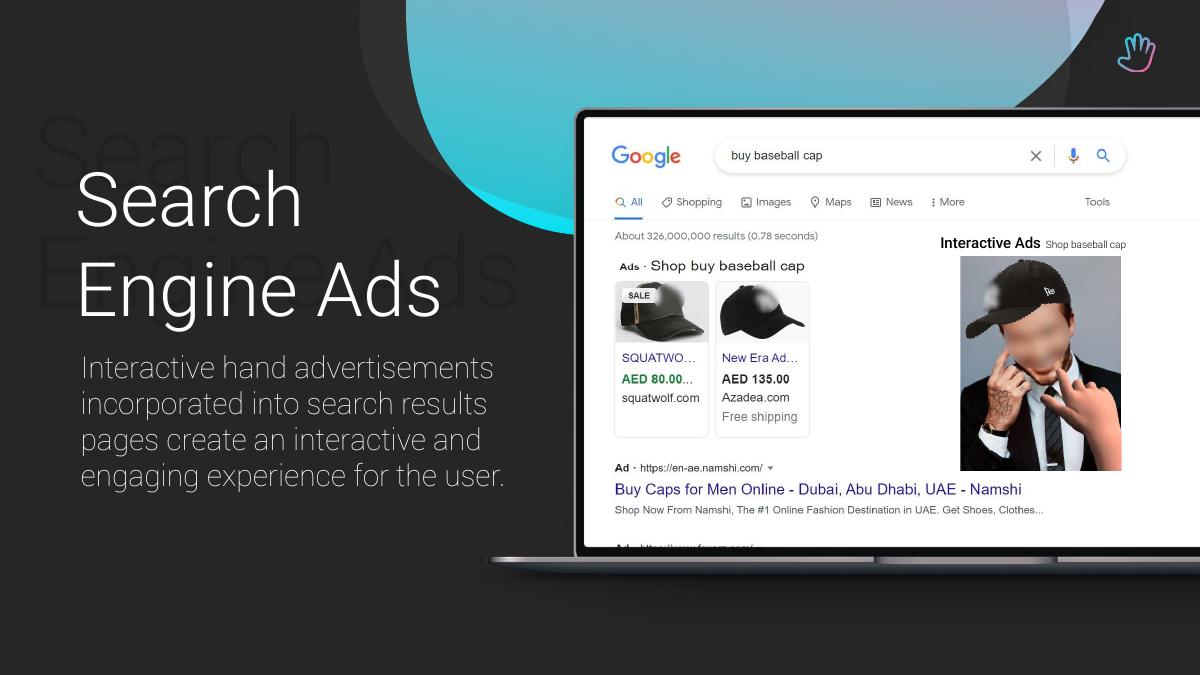
Slide 6 — Search Engine Ads
A Google results page for "buy baseball cap", showing 326,000,000 results and shopping ads with interactive hand elements, including a live retailer listing.
This is the weakest strategic slide in the deck, because the format is not MetaHand's to sell. Search ad units are controlled end to end by the search engine; a third party cannot add an interactive layer to a Google SERP without Google. Presenting it as a channel — rather than as "here is what a search partner integration could look like, which is a business-development ambition, not a product line" — signals to an investor that the company has not yet mapped who actually controls each surface it wants to appear on. The same slide would have been strong titled "What a platform partnership would unlock."
Slide 7 — Social Media Advertising
Two phone mockups showing sponsored MetaHand content in a social feed, with the claim that interactive hand advertisements "increase impression and interaction rates compared to traditional video advertisements."
This is the deck's only performance claim and it has no number, no source, no sample, and no test behind it. A comparative effectiveness claim is the one thing an ad-tech buyer will always ask to see evidence for, because the entire purchasing decision reduces to it. One real A/B test — even 5,000 impressions on one publisher, one campaign, one week — would have been worth more than slides 4, 5, 6 and 7 combined. And note that four of the eleven slides are format variations of the same idea: they repeat the concept in four contexts rather than proving it once.
Slide 8 — Advertising Business Model
Two numbers on gradient blobs: $175bn , "Worldwide mobile advertising spend (USD), est. 2022" and $0.02 , "Typical pay-per click commission." Text: MetaHand's model "works in the same way as traditional online advertisers" and "takes a small commission on every advert that a user interacts with or results in a customer following a link to the advertisers site."
The slide is titled business model and contains no business model. Walk through what is missing:
What is the commission a commission of? A percentage of media spend? A share of the publisher's revenue? A fee to the advertiser on top of the placement? The three imply completely different companies with different counterparties. · Who bills whom? MetaHand is not the ad network in any diagram in this deck. If the format sits inside somebody else's supply, that somebody else invoices the advertiser and MetaHand is a line item in their cost base — a licence, not a commission. · What is the take rate? "A small commission" is the only quantity given, and it is not a quantity. · The two numbers argue against each other. $175bn is total worldwide mobile ad spend — the deck's implied market — while $0.02 is a generic pay-per-click rate. Anchoring your revenue unit to two cents per click while positioning as a "premium ad feature" contradicts slide 5, and a small commission on two cents needs volumes in the hundreds of millions of interactions before the company has a payroll. The deck never runs that arithmetic, and running it is the entire point of a business model slide. · The market number is unsourced and, on the face of it, conservative. No provider, no methodology, no date. Widely cited 2022 estimates for global mobile ad spend sat well above $175bn, so the deck may be understating its own market while giving a reader no way to check. Cite the source and the year, always.
A usable version of this slide is five lines: unit of revenue, price per unit, who pays, gross margin per thousand impressions, and the number of impressions needed to hit £1M of revenue. That is a slide an investor can argue with. Two blobs are not.
Slide 9 — The Intellectual Property
Four cards around a central statement that MetaHand "owns the exclusive intellectual property rights to 6 mobile virtual hand interaction method patents." Patent No.1: Granted, Published 08/08/2018. No.2: Granted, Published 06/03/2021. No.3: Granted, Published 03/06/2019. No.4: Granted, Expected 25/10/2020. Two thumbnails show a patent figure captioned "using front facing video camera" with reference numerals 310, 216, 20, 218; a third shows the header of a United States Patent to Holmes , titled "Systems and Methods for Real-Time Composite Video from Multiple Source Devices."
This should be the strongest slide in the deck — a granted patent family covering the interaction method is genuinely the most defensible thing this company has, and it is what makes a small team credible against a large incumbent copying the format. Instead it is the sloppiest:
Six claimed, four shown. Where are patents 5 and 6? An unexplained gap between the headline number and the evidence invites an investor to discount both. · No patent numbers. Not one application or grant number appears, so nothing on this slide can be verified. A patent's whole value is that it is public and checkable; withholding the numbers converts an asset into an assertion. · No jurisdictions. One thumbnail is clearly a US grant. Are the others US, GB, EP, PCT? A patent granted only in one territory is a different asset from a family covering the US and EU. · No claim scope. "Virtual hand interaction method" says nothing about what is actually protected. One sentence in plain English — what a competitor cannot do — is worth more than four cards. · Patent No.4 is internally contradictory. "Status: Granted" above "Expected (25/10/2020)" cannot both be true, and an "expected" date eighteen months in the past on a deck dated April 2022 reads as a slide nobody updated. · Ambiguous, inconsistent dates. 08/08/2018, 06/03/2021, 03/06/2019 — two of those are unreadable without knowing whether the format is day-first or month-first, and the deck mixes "Published" with "Expected." Use ISO dates on any slide a lawyer will read. · "Owns the exclusive rights" is unexplained. The visible grant is to Holmes, a named individual who is the founder. Are the patents assigned to the company, or licensed to it? That is the first question in diligence and it is answerable in six words on the slide.
The irony is that the underlying asset appears to be real and easy to evidence. Public patent databases index a family of US patents titled "Systems and methods for providing real-time composite video from multiple source devices," later continuations adding "featuring augmented reality elements," naming an inventor Russell Holmes of Wetherby and later Otley, West Yorkshire — including US 9,729,820 (filed November 2016, granted August 2017), US 10,089,793 (granted October 2018) and US 10,636,215 (granted April 2020). We could not confirm from any public document that this is the same Russell Holmes named on slide 10, and these were read from patent-database mirrors rather than USPTO directly, so treat the linkage as strongly suggestive rather than proven. That is exactly the point: a reader had to go and reconstruct the company's best asset from outside sources because the slide withheld the three numbers that would have settled it in one glance.
Slide 10 — The Team
Four monochrome portraits: William McMurray, CTO; Russell Holmes, Founder; Andrew Makarov, Front End Developer; Patrick Richards, Business Development & IP.
Names and titles, nothing else. No bios, no prior companies, no shipped products, no years in ad tech, no advisors, no indication of who is full time or what anyone owns. For a company whose entire premise is that a hard computer-vision problem has been solved in a browser and wrapped in a patent portfolio, the team slide is where the credibility for both claims should live — the founder appears to be the named inventor on the patents, and the deck does not say so. That is an unforced error: the strongest fact about this team, that the founder invented and holds the IP, is on slide 9 in a thumbnail and absent from slide 10 entirely.
Layout compounds it. The founder is placed second, behind the CTO, and there is no CEO, no commercial lead beyond "Business Development & IP," and no one named for advertiser sales — in a company whose customers are media buyers.
Slide 11 — Browser ready
An iPhone home screen, "Browser ready — NO APP REQUIRED", then "Try the virtual hand demo…" over a gradient button reading www.metahand.io.
The best slide in the deck, and the reason the whole document is worth studying. Everything before this is a claim; this slide converts the claim into a test the reader can run in thirty seconds on the phone already in their hand. Deep-tech founders routinely close on "thank you" or a contact email when they are sitting on a live demo — a working demo is the highest-trust artifact available, and putting it on the final slide of an emailed deck is exactly right.
Two things would have made it decisive. First, the demo link belongs on slide 1 as well as slide 11, because a reader who bounces at slide 3 never tries it. Second, the slide asks for nothing else: no meeting, no round, no amount. A deck that gets a partner to grant camera access to an ad demo has earned the right to ask for a call in the same breath.
What this deck does better than most startup pitch decks
It is instantly legible. Cover to comprehension in about ten seconds, with no jargon. Most seed decks take three slides to say what they do; this takes four words. · It closes with a live product, not a thank-you slide. Inviting the reader to test the claim themselves is the highest-conviction close available to a technical founder, and almost nobody does it. · The friction removal is real and correctly identified. "Works in any mobile browser, no app, no download" is a genuine wedge in a category where every AR competitor asks for an install. · The format mockups do their job. Placing the unit in a news article, a search page and a social feed lets a media buyer picture the inventory immediately — far better than an abstract product diagram. · It owns a defensible asset. A granted patent family on the interaction method is the right moat for this business, and the deck at least knows it matters enough to give it a slide. · Design discipline. One typeface, one palette, one idea per slide, no bullet soup. It looks like a company, which for an ad-tech company selling creative formats is itself part of the pitch.
Where this deck would fail in an investor meeting
No ask. Eleven slides with no round size, no valuation, no use of funds, no milestones the money buys. An investor cannot say yes to a document that does not ask. · No traction of any kind. No pilot, no publisher, no advertiser, no letter of intent, no impressions served, no demo-completion rate — not even a waiting list. · The camera-permission rate is never mentioned. The single number that determines whether this product works at scale, and it is absent. Every experienced ad-tech investor asks it in the first two minutes. · An unevidenced comparative performance claim. "Increases impression and interaction rates" with no test, no baseline and no source is the claim buyers will demand proof of and the one thing the deck could have measured cheaply. · A business model slide with no model. No unit of revenue, no price, no take rate, no payer, no path from $0.02 to a P&L. · An unverifiable IP slide. Six patents claimed, four cards shown, zero patent numbers, no jurisdictions, no assignment, and one card that says granted and expected at the same time. · No competition slide. Interactive and playable ad formats, AR try-on and gesture SDKs all existed in 2022. Silence reads as unawareness, not absence. · No distribution story. Ad formats are sold into supply — SSPs, DSPs, ad servers, publishers, agencies. The deck names no integration path to any of them. · A team slide with no evidence. Four titles, no track record, and the founder's inventorship — the strongest fact available — left off the slide. · Naming risk left unaddressed. A deck dated April 2022 leading with "Meta" arrives six months after Facebook's rebrand to Meta Platforms. Investors will ask about trademark exposure and search-visibility collision; better to answer it in a footnote than be asked cold.
Product-introduction deck vs. investor deck
Question the reader is asking What this deck answers What an investor deck must answer
Who has a problem? Not addressed A named buyer with a budget and a measurable pain
Does it work at scale? Implied by a demo link Camera opt-in rate, latency, device coverage, completion rate
Does it perform better? Asserted, unmeasured A test with numbers, baseline and sample size
How does it make money? "A small commission" Unit, price, payer, take rate, gross margin
How big is the market? One unsourced $175bn figure Serviceable market for this format, built bottom-up
Why can't it be copied? Six patents, none identified Numbers, jurisdictions, claim scope, assignment
Who is building it? Four names and titles Why these four win this specific market
Who else does this? Not addressed Honest map, with the wedge stated
What do you want? Nothing is requested Amount, terms, milestones, runway
How you would rebuild this deck for a seed round
Lead with the demo, not the description. Put the metahand.io link on slide 1. A product this tactile should be tested before it is explained. · Add the missing first slide: the buyer's problem. Mobile video ad engagement, skip rates, and what an advertiser currently pays for attention. Make the pain a media buyer's pain, with a number attached. · Replace three of the four format slides with one evidence slide. Keep the strongest mockup; spend the reclaimed slides on a single measured test — impressions, camera opt-in rate, interaction rate, completion, versus a control video ad. · Turn slide 3 into the risk slide, on purpose. State the camera-permission rate you actually see, the device and browser coverage, the on-device privacy posture and the latency. Naming your hardest problem with data is the strongest possible signal that you understand your own product. · Rewrite the business model as arithmetic. Who pays, per what, at what price, at what margin, and how many interactions it takes to reach £1M of revenue. Drop the $0.02 anchor or explain why a premium format prices off a commodity CPC. · Make the IP slide checkable. Patent numbers, jurisdictions, grant dates in ISO format, one plain-English sentence on what a competitor is blocked from doing, and an explicit line confirming assignment to the company. Fix or remove the granted/expected card. · Add a distribution slide. Name the specific route to supply: which ad server, which SSP, which publisher pilot, which agency conversation — and what integration work each requires. · Rebuild the team slide around evidence. One line each on prior shipped work, and the sentence the deck is missing: the founder is the named inventor on the patent family. · Add competition, honestly. Playable and interactive formats, AR try-on SDKs, browser hand-tracking libraries — then state the wedge: patented interaction method inside a servable unit with no install. · End with the ask. Amount, what it buys, which milestones it reaches, and how long it lasts.
The transferable lesson
MetaHand's deck fails in the most common way that good products fail on paper: it is organised around what the product is rather than what a stranger would need to believe to write a cheque . Four of its eleven slides describe the same idea in different surroundings, while the four questions that decide the outcome — will users grant camera access, does the format outperform, who pays and how much, and what exactly do the patents block — get one unsourced number, one unmeasured assertion, one contradictory card and no answer at all.
The correction is cheap and it applies to every deck. For each slide, write down the question it answers and the evidence it offers. Where the evidence column is empty, either go and get the evidence — a five-thousand-impression test, a patent number, a single publisher pilot — or delete the claim. A deck with six proven slides beats a deck with eleven decorated ones every time, and the founder who already owns a working browser demo and a granted patent family is two evidence points away from the stronger document without building anything new.
Frequently asked questions
- Is the MetaHand deck a pitch deck for investors?
- Not in the fundraising sense. It has no problem slide, no market build-up, no competition, no go-to-market, no financials, no traction and no ask — eleven slides in, the reader is never asked for anything. It functions as a product introduction for advertisers, agencies and partners, closing on a live demo link. It is still instructive for founders because it shows how a clear, well-designed product explainer can still be unfundable.
- What is MetaHand?
- MetaHand describes itself as 'touchable interactive video advertising': a virtual hand that runs directly in a mobile web browser with no app or download, tracking the user's real hand through the phone's front camera so they can interact with ads — high-fiving a pre-recorded celebrity endorsement, or touching elements in a banner, search or social ad unit. The 2022 deck lists a four-person team led by founder Russell Holmes and claims six granted virtual-hand interaction patents.
- Which slides should founders copy?
- Two. The cover, which delivers the entire proposition in four words ('Touchable Interactive Video Advertising'), and the closing slide, which replaces a thank-you page with 'Browser ready — no app required' and a live demo link. Ending on a product a reader can test in thirty seconds is the highest-trust close available to a technical founder, and almost no deck does it.
- What is the biggest weakness in the MetaHand deck?
- Unaddressed camera permission. The product only functions if a user grants camera access to an advertisement — the highest-friction consent on mobile web, tightening further after Apple's App Tracking Transparency changes. The opt-in rate is the number the business lives or dies on, and the deck neither states it nor acknowledges the risk. A close second is the business model slide, which offers 'a small commission' and no unit, payer, price or margin.
- How should a startup present patents in a pitch deck?
- Make them checkable. Give the application or grant number, the jurisdiction, the grant date in ISO format, one plain-English sentence describing what a competitor is blocked from doing, and an explicit statement that the patents are assigned to the company rather than held personally by a founder. MetaHand's slide claims six patents, shows four, names none, and includes a card marked both 'Granted' and 'Expected (25/10/2020)' — turning its most defensible asset into an assertion a reader cannot verify.
- What should a business model slide contain?
- Five things: the unit of revenue, the price per unit, who is invoiced, the gross margin, and the volume needed to reach a meaningful revenue number. MetaHand's slide shows a $175bn worldwide mobile ad spend figure with no source and a $0.02 typical pay-per-click rate, then says the company takes 'a small commission' — which leaves an investor unable to tell whether this is a licence, a revenue share or a media margin, or how many interactions it takes to build a company.