TokenID's 8-slide deck, exported from Adobe Acrobat on 13 October 2016 as flattened images with no text layer, proposes that every e-wallet payment be converted on the phone into a one-time-use 16-digit card token so it can ride existing Visa and Mastercard acceptance, with TokenID taking a share of the interchange. The architecture diagram and five-step flow are among the clearest payments explainers you will find in a deck. Everything an investor needs is missing: no ask, no valuation, no use of funds, no team, no named person at all, no traction, no pilot, no pricing, no financials, no reg…
Key takeaways
- TokenID's 8-slide October 2016 deck has no ask, no team, no traction, no financials, no pricing, no competition slide and no named person anywhere - the closing slide is a company name and an info@ mailbox.
- The core proposition is strong and clearly drawn: turn every e-wallet payment into a one-time-use 16-digit card number so it rides existing Visa/Mastercard acceptance, monetised as a share of interchange.
- 'Unlimited scale using a single BIN' does not survive arithmetic - six BIN digits plus a Luhn check digit leave nine digits, or one billion one-time tokens in total, roughly 100 days at 10M transactions a day, and token recycling is never mentioned.
- '100% secure, using Inverted RSA Tokenization' is an absolute claim built on a coined term with no patent number, no filing date and no whitepaper, for a company whose only asset at this stage is IP.
- The revenue model is a rev-share of interchange - a merchant cost - so the deck's answer to wallet acceptance is to reimpose the card fees wallets were built to avoid, and it never argues why a merchant should accept that.
- The market chart undercuts the model: credit card volume is shown at $573B in 2014 and $577B in 2019, under 1% growth, and interchange on that flat pool is where TokenID gets paid.
- The 45-logo 'fragmentation' wall is a 2014 map used in 2016 - Clinkle and other dead brands are present while Alipay, WeChat Pay, Android Pay and Samsung Pay are all missing.
- The entire model depends on an issuer bank described twice as 'a TokenID strategic partner' and never named, with no LOI, no country and no term sheet anywhere in the file.
What this deck actually is
Eight slides. That is the whole file. TokenID Security Ltd exported it from Adobe Acrobat 7.05 on 13 October 2016 using the "Image Conversion Plug-in", which means every slide in the PDF is a flattened picture — there is no text layer at all. You cannot select a word, search the document, or copy an email address out of it. A machine reading this deck sees eight rectangles.
The pitch inside those rectangles is technically ambitious and commercially serious: e-wallets and other alternative payment instruments cannot get accepted everywhere, so TokenID makes each wallet transaction masquerade as an ordinary credit card transaction. The wallet approves the purchase on the phone, TokenID generates a one-time-use 16-digit card number, and that number rides the existing Visa/Mastercard rails to a partner issuer bank, which checks the token's authenticity against a TokenID server before settling back with the wallet. Revenue is a share of the interchange fee.
That is a real idea, explained in one slide, with a clean diagram. It is also the entire content of the file. There is no team slide. There is no ask. There is no traction, no pilot, no partner, no customer, no financial projection, no pricing, no roadmap, no competition slide, no use of funds and no valuation. Across eight pages not one human being is named — not a founder, not an advisor, not a contact. The closing slide is a company name, a generic info@ mailbox and a website URL.
Every slide carries the footer "The content of this presentation is proprietary and confidential information of TokenID Security Ltd. It is not intended to be distributed to any third party without the expressed written consent of TokenID Security Ltd." The file was then uploaded to a public slide-sharing site, where it has sat ever since.
Slide-by-slide walkthrough
Slide 1 — Cover
The TokenID wordmark and a single line: "Converging payment networks."
The tagline earns its place. Three words tell you the category (payments), the mechanism (convergence between networks) and the ambition (infrastructure, not an app). Most cover slides do not manage one of the three.
What is not on the cover is a date, a round, a stage, a geography or a person. The deck was assembled in October 2016 and nothing in the file says so; the only date is buried in PDF metadata that most readers will never open. For a payments company, where regulatory context and competitor timelines shift in six-month cycles, an undated deck is a deck that quietly expires without anyone noticing.
Slide 2 — The problem
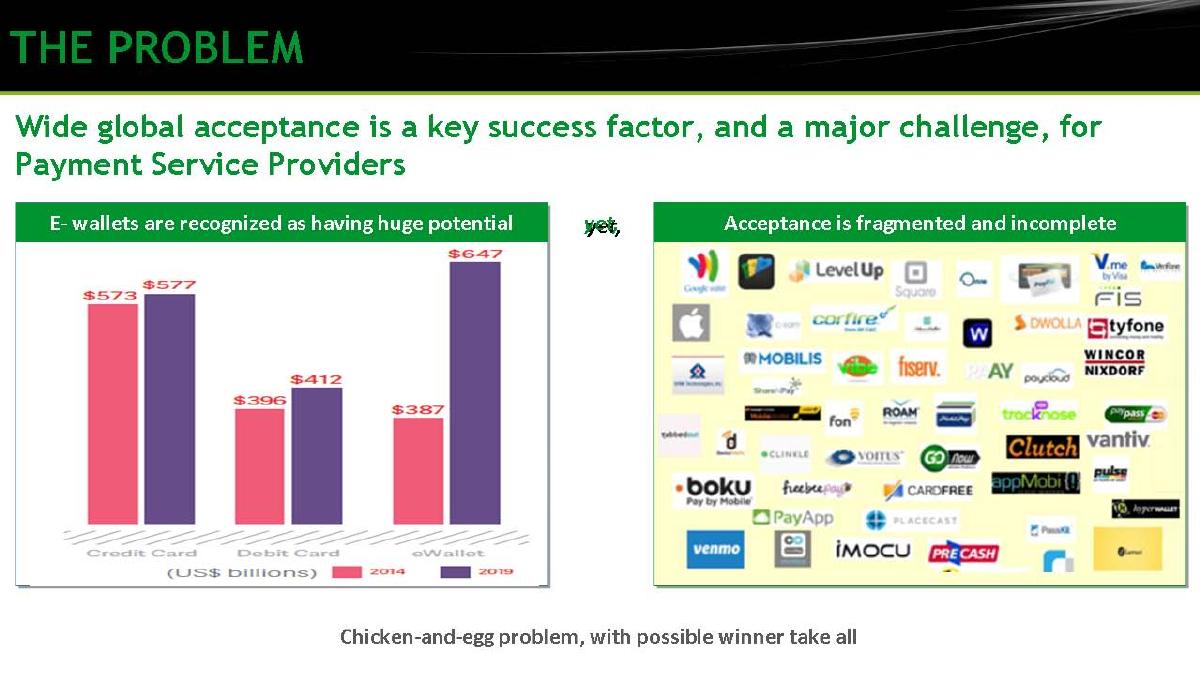
"Wide global acceptance is a key success factor, and a major challenge, for Payment Service Providers." Two panels sit underneath. On the left, a bar chart in US$ billions comparing 2014 and 2019: credit card 573 then 577, debit card 396 then 412, eWallet 387 then 647. On the right, a wall of roughly forty-five payment logos under the heading "Acceptance is fragmented and incomplete". Along the bottom: "Chicken-and-egg problem, with possible winner take all."
The structure of this slide is genuinely good. Two panels, one showing that the prize is large and growing, one showing that the field is a mess, joined by the word "yet". A reader understands the thesis in four seconds without reading a sentence.
Then the details start working against it. The chart has no source — no analyst house, no report title, no year of publication — and its own numbers make a point the deck does not want made. Credit cards grow from 573 to 577 across five years: four billion dollars, under one per cent, essentially flat. TokenID's revenue model is a share of credit card interchange. The slide chosen to prove the opportunity shows the pool TokenID gets paid from standing still while the pool it is bridging from grows 67 per cent. Nobody on the deck's side draws attention to this, but an investor who reads charts will.
The logo wall has a subtler problem: it is out of date on the day it was published. Clinkle, on the wall, had collapsed publicly in 2015. Softcard-era assets, Corfire, Google Wallet as a payment brand — all had been folded, sold or renamed before October 2016. Meanwhile the wall omits the four names that actually mattered in global wallet acceptance that year: Alipay, WeChat Pay, Android Pay and Samsung Pay. A slide arguing about global acceptance in 2016 that contains neither Chinese wallet is not a market map; it is a 2014 market map reused two years later, which also explains a chart whose baseline is 2014.
Slide 3 — The barriers to market expansion
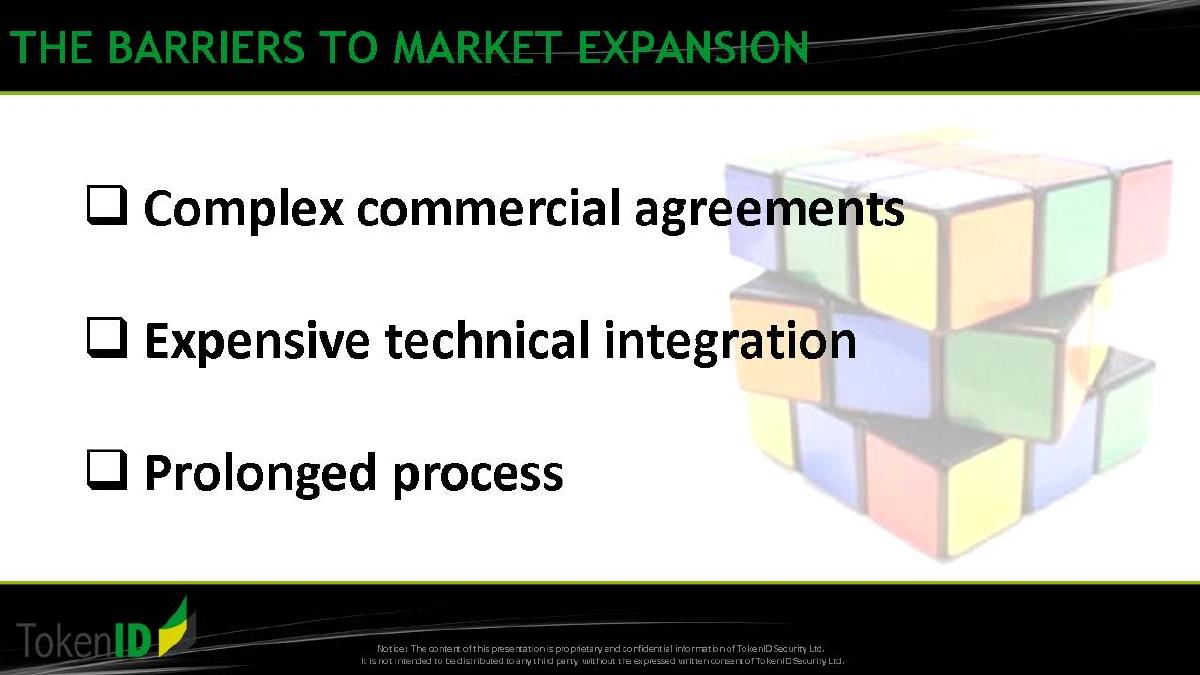
Three bullets on an otherwise empty page: complex commercial agreements; expensive technical integration; prolonged process.
These are the correct three barriers. Anyone who has tried to add a new payment method to a merchant estate will nod at all three, and reducing the problem to three words each is disciplined writing.
But there is not a number anywhere on the slide. How expensive is expensive — 20,000 dollars per integration, 200,000? How prolonged is prolonged — nine months, two years? What does a typical commercial agreement between a wallet and an acquirer take to close? These figures exist, they are quotable from public sources, and each one converts a bullet into an argument. As written, the slide asks the reader to supply the evidence for the company's own problem statement. The three barriers are also the exact costs TokenID claims to eliminate, so the size of those costs is the size of the value proposition. Leaving them blank leaves the value proposition blank too.
Slide 4 — The solution
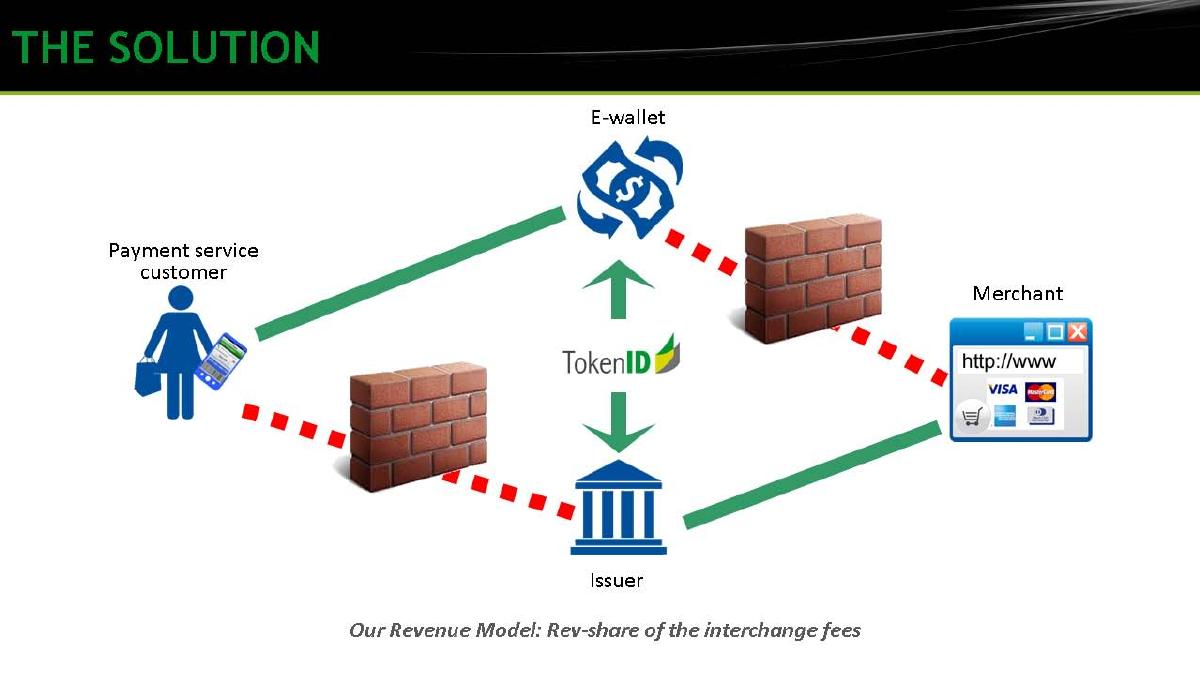
A diagram: a payment-service customer on the left holding a phone, an e-wallet at the top, an issuer bank at the bottom, a merchant on the right. Red dotted lines run into brick walls between customer and issuer, and between wallet and merchant. Green solid lines run customer-to-wallet, merchant-to-issuer, and wallet-to-TokenID-to-issuer. Caption: "Our Revenue Model: Rev-share of the interchange fees."
This is the best slide in the deck and one of the better payments diagrams you will see. The brick walls make the barrier physical; the green paths make the workaround obvious; the whole flow reads without a legend. Putting the revenue model as a caption on the architecture slide is also a smart economy — the reader learns how it works and how it earns in one glance.
The caption is where the strategic problem lives, though, and it is a big one. Interchange is a fee the merchant pays, on card rails, at roughly one and a half to three per cent in most markets. E-wallets exist in large part because merchants and consumers wanted out of that cost structure. TokenID's proposal is to solve wallet acceptance by converting every wallet payment back into a card payment and then taking a slice of the card fee. It is coherent — the merchant already accepts cards, so acceptance is genuinely instant — but it means the product's benefit to the merchant is convenience while its cost to the merchant is the full card interchange they were previously avoiding. That trade needs a slide arguing it. It does not get a sentence.
The diagram also contains a party the deck never staffs: the issuer. Every green line converges on a bank that must issue the BIN, accept a third party's authorisation decision, and share its interchange. That bank is the business.
Slide 5 — The solution essentials
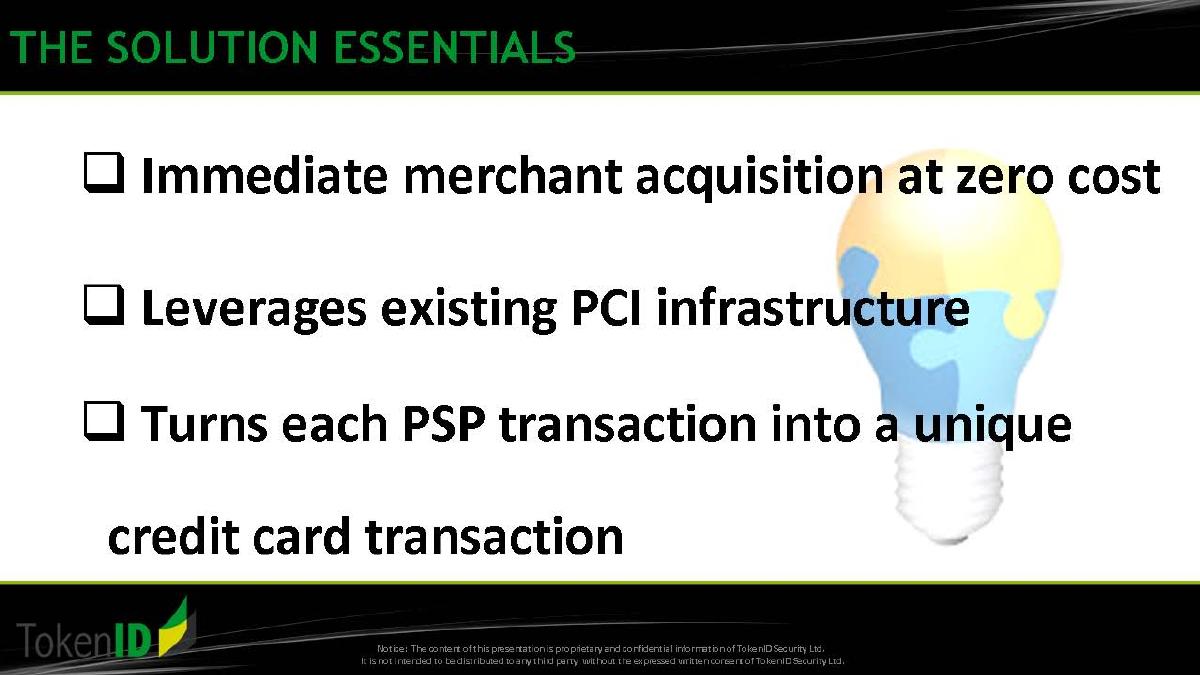
Three bullets: immediate merchant acquisition at zero cost; leverages existing PCI infrastructure; turns each PSP transaction into a unique credit card transaction.
The second bullet is the strongest single claim in the deck. Riding infrastructure that is already PCI-compliant, already deployed at every terminal and already trusted is a real and rare advantage, and it is why the idea deserves a hearing at all.
The first bullet overstates by one word. "Immediate merchant acquisition at zero cost" is true of integration — no merchant has to install anything — and false of acquisition, which still requires the wallet to persuade its users, the issuer to underwrite the programme and someone to absorb chargebacks, fraud losses and scheme fees. Zero-cost claims in payments invite the reader to go looking for the cost, and here the cost is sitting one slide later.
The third bullet, "turns each PSP transaction into a unique credit card transaction", is the crux of both the security model and, unremarked, the capacity model.
Slide 6 — Step by step, and competitive advantage
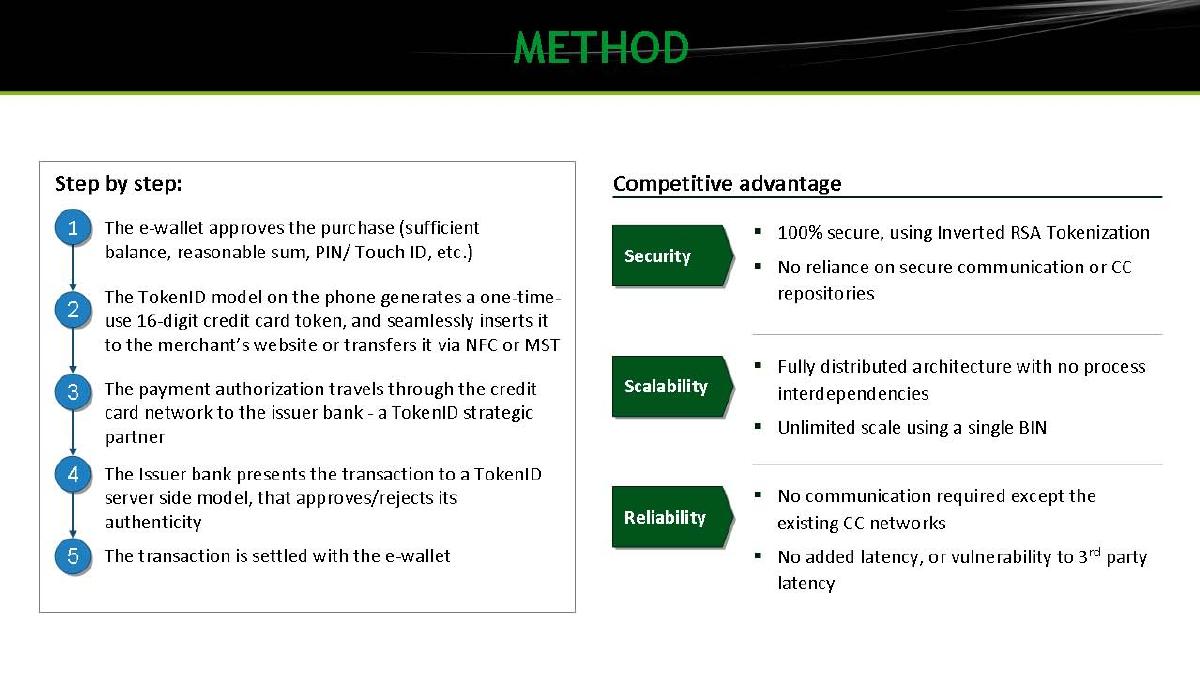
Five numbered steps down the left. The wallet approves the purchase on the phone using balance checks, sum limits and PIN or Touch ID. The TokenID model on the phone generates a one-time-use 16-digit credit card token and inserts it into the merchant's website or transfers it by NFC or MST. The authorisation travels the card network to the issuer bank, described as "a TokenID strategic partner". The issuer presents the transaction to a TokenID server-side model that approves or rejects its authenticity. The transaction settles with the wallet.
On the right, a three-row advantage table. Security: "100% secure, using Inverted RSA Tokenization", with no reliance on secure communication or credit card repositories. Scalability: fully distributed architecture with no process interdependencies, and "Unlimited scale using a single BIN". Reliability: no communication required except the existing card networks, no added latency or vulnerability to third-party latency.
The step sequence is well constructed. Five steps, each one sentence, in the order the money moves — this is how a technical flow should be written for a non-technical reader, and the detail about generating the token on the device rather than fetching it from a server is exactly the kind of specificity that separates a real architecture from a diagram.
"100% secure." No serious security engineer writes this, and no serious investor believes it. The correct claim was available and stronger: the token is single-use, so an intercepted number is worthless, and no card credentials are stored, so there is no repository to breach. Both are defensible. "100% secure" is not, and one absolute overstatement makes a reader re-examine every other line on the slide.
"Inverted RSA Tokenization." This is presented as the core technology, in initial capitals, as though it were an established primitive. It is not a term of art. There is no patent number on the slide, no application number, no filing date, no whitepaper reference and no external validation of any kind. For a company whose only asset at this stage is intellectual property, the absence of a single filing reference on the IP slide is the most consequential omission in the file.
"Unlimited scale using a single BIN." This one is arithmetically checkable, and it does not survive the check. A card number is sixteen digits: six are the BIN, the sixteenth is a Luhn check digit, which leaves nine digits — one billion possible account numbers under a single BIN. The tokens are, by the deck's own definition on the previous slide, unique and one-time-use. So a single BIN affords one billion transactions in total, ever, unless numbers are recycled after a cooling-off window — and recycling is precisely the mechanism the slide does not mention. One billion sounds enormous until you set it against the traffic the deck is bidding for: at ten million transactions a day, a rate below any of the mid-tier wallets on the slide-2 logo wall, a single BIN is consumed in under 100 days. The right answer is almost certainly a token lifetime measured in minutes and aggressive reuse, which is how the card schemes' own token vaults work. That is a fine answer. But "unlimited" is the wrong word for a nine-digit namespace, and using it on the scalability row of the competitive-advantage table is the kind of claim a payments-literate investor tests in thirty seconds.
Two more things go unsaid on this slide. MST — magnetic secure transmission — is the LoopPay technology Samsung acquired in 2015 and shipped exclusively in Samsung Pay; offering it as a transmission option implies a relationship the deck never claims. And the issuer bank, mentioned in step three as "a TokenID strategic partner", is never named, never counted, and never evidenced with a term sheet, a letter of intent or even a country. The whole model is a bridge with one end resting on an unidentified bank.
Slide 7 — The market points
A green banner — "Bridge any payment instrument to the global reach of the credit card networks" — with five branches beneath it: e-wallets, financial institutions offering payment services, mobile banking, remittance, and social networks. A decorative rising bar chart sits behind them with no axis, no labels and no values.
The banner is the sharpest positioning line in the deck. "Bridge any payment instrument to the global reach of the credit card networks" is what an infrastructure company should say about itself, and it is better than the cover tagline.
The five branches are the problem, and they are titled "The Market Points" on a slide with no market points on it. There is no size against any of the five, no revenue per transaction, no take rate, no transaction count, no growth figure and no indication of which one TokenID would start with. Remittance and mobile banking in particular carry completely different regulatory perimeters from an e-wallet — different licences, different KYC obligations, different scheme rules. Listing five verticals with no numbers and no beachhead reads as ambition rather than a plan, and it does the opposite of what the slide title promises.
The decorative growth chart is worse than nothing. A bar chart with no labels next to five unquantified verticals invites the reader to assume there was no data to put on it, which on this evidence is correct.
Slide 8 — Contact
"TokenID Security Ltd", an info@ mailbox and a website address.
Eight slides and the deck ends without naming a person. Nobody signs it. There is no founder, no CTO, no chairman, no advisor, no board member, no cap table and no indication of how many people work on this. For a company proposing to sit inside the authorisation path of the global card networks, the questions an investor cannot avoid are: who has issued a card programme before, who has shipped a token service, who has a relationship with a scheme, and who has been through a PCI audit. The deck answers none of them because it introduces nobody at all. A generic mailbox as the only contact point compounds it — a warm reply to info@ lands nowhere in particular.
What TokenID got right
A real insight, stated in one line. Wallet acceptance is a chicken-and-egg problem and the card networks already solved distribution. Riding them rather than replacing them is the correct strategic instinct. · The solution diagram. Brick walls for barriers, green paths for the workaround, four labelled parties, no legend needed. It communicates a payments architecture in one glance. · The revenue model in the caption. Mechanism and monetisation on the same page is an economy most decks miss. · The five-step flow. One sentence per step, in the order value moves, with real technical specificity — on-device token generation, insertion into the merchant's checkout, authenticity checked server-side at the issuer. · Leveraging existing PCI infrastructure. A genuine, hard-to-copy advantage, and correctly identified as an essential rather than a feature. · The positioning line on slide 7. "Bridge any payment instrument to the global reach of the credit card networks" belongs on the cover. · Brevity. Eight slides that never repeat themselves. The problem is what is missing, not what was padded.
What TokenID got wrong
No ask. No amount, no instrument, no valuation, no use of funds, no milestone. · No team. Not one person named in eight slides — the single largest omission for a deep-infrastructure payments company. · No traction. No pilot, no letter of intent, no lab result, no transaction ever processed, no testnet number. · The issuer partner is unnamed. The model cannot function without a bank, the bank is referenced twice as a "strategic partner", and no bank is identified. · "Unlimited scale using a single BIN." Nine digits of account space is one billion one-time tokens, not unlimited. Token recycling is never mentioned. · "100% secure." An absolute claim that costs credibility for a benefit the deck could have argued honestly. · "Inverted RSA Tokenization" is unsupported. No patent number, no filing, no whitepaper, no third-party review, for the company's only asset. · Interchange is a merchant cost, presented as free money. The deck never argues why a merchant should welcome card economics returning to a wallet payment. · No regulation slide. Card issuing, BIN sponsorship, scheme certification, PCI DSS scope and money-transmission licensing are all implicated and none appear. · No competition slide. Visa Token Service and Mastercard MDES both launched in 2014 and do adjacent work; neither is mentioned, and V.me by Visa is on the deck's own logo wall. · An uncited market chart. No source, no publisher, no date on the one quantitative exhibit in the file. · The chart argues against the revenue model. Credit card volume is shown growing under one per cent over five years, and interchange on that volume is where TokenID gets paid. · A stale logo wall. Brands that were dead by 2016 are present; Alipay, WeChat Pay, Android Pay and Samsung Pay are absent. · No numbers on the barriers slide. The cost and duration of integration is the size of the value proposition, and it is left blank. · "The Market Points" contains no market points. Five verticals, zero figures, no beachhead, and a decorative unlabelled bar chart. · MST implies a Samsung relationship that is never claimed or evidenced. · No pricing. "Rev-share" with no percentage, no floor, no split. · No financials. No forecast, no cost base, no headcount, no runway. · Undated. The only date lives in PDF metadata. · Flattened to images. No text layer, so the deck is unsearchable, uncopyable and invisible to any screen reader or diligence tool. · Confidentiality footer on a publicly posted file. A "not to be distributed" notice on every page of a deck uploaded to a public slide host.
How to fix it in eight slides
The remarkable thing about this deck is that it does not need to get longer. Eight slides is enough; they are the wrong eight.
Keep slides 4 and 6 almost untouched — the diagram and the five-step flow are the asset. Replace "100% secure" with the two claims that are true and testable: single-use tokens are worthless if intercepted, and no credential repository exists to breach. Replace "unlimited scale using a single BIN" with the real number and the real mechanism: token lifetime in minutes, recycling window, tokens per BIN per day at target volume, and how many BINs the programme would need at one hundred million transactions a day. Give "Inverted RSA Tokenization" a patent application number and a date, or stop capitalising it.
Put the numbers on slide 3 — what a wallet actually pays and waits today to add one acquirer in one market. That single figure is the entire value proposition and it is currently missing. On slide 2, re-cut the logo wall for the year the deck was written and cite the chart, or drop the chart and keep the logos.
Then spend the pages freed by tightening. One slide on the issuer: who they are, what stage the conversation is at, what has been signed, what a BIN sponsorship costs and how long scheme certification takes. One slide on the economics: interchange in the target market, TokenID's share of it, revenue per transaction, and the honest argument for why a merchant or wallet accepts that cost. One slide on the team, with the payments and cryptography track record, at the front rather than nowhere. And a closing slide with an amount, an instrument, and the three milestones the money buys — first issuer signed, first live transaction, first million tokens.
That is a fundable eight-slide deck built almost entirely from parts already in the file. What TokenID circulated was a technology explanation that had been mistaken for an investor presentation: clear about how it works, silent about who is building it, who has agreed to help, what it costs, what it earns, and how much money it wants.
Frequently asked questions
- What was TokenID?
- TokenID Security Ltd was a payments infrastructure company pitching in 2016 under the tagline 'Converging payment networks'. Its product generated a one-time-use 16-digit credit card token on the user's phone whenever an e-wallet approved a purchase, inserted that token into the merchant's checkout or transmitted it by NFC or MST, and routed the authorisation through the existing card networks to a partner issuer bank that verified the token's authenticity against a TokenID server. The stated revenue model was a share of the interchange fees.
- What is the biggest problem with the TokenID pitch deck?
- It explains a technology and forgets to be an investment proposal. Across eight slides there is no funding amount, no valuation, no use of funds, no revenue, no forecast, no pricing, no pilot, no customer, no competitor analysis and no regulatory discussion. Most striking of all, not one person is named - no founder, no CTO, no advisor - which is disqualifying for a company proposing to operate inside the authorisation path of the global card networks.
- Why does 'unlimited scale using a single BIN' not work?
- A payment card number is sixteen digits. Six are the bank identification number and the last is a Luhn check digit, which leaves nine digits of account space - one billion possible numbers under a single BIN. Because TokenID's tokens are by definition unique and single-use, a single BIN affords one billion transactions in total unless numbers are recycled after expiry, and the deck never mentions recycling. At ten million transactions a day the namespace is exhausted in under 100 days. Short token lifetimes with aggressive reuse is the standard answer and would have been an easy fix in the slide.
- Does the TokenID deck have a funding ask?
- No. There is no amount, no instrument, no valuation, no use of funds and no milestone anywhere in the eight slides. The deck ends on a contact page carrying the company name, a generic info@ mailbox and a website URL, with no person, phone number or next step attached.
- Which slides should founders copy from this deck?
- Two. Slide 4's solution diagram is excellent - brick walls for the barriers, green paths for the workaround, four labelled parties, comprehensible in one glance, with the revenue model stated as its caption. And slide 6's five-step flow, which explains a payments architecture in one sentence per step, in the order the money moves, with real specificity about where the token is generated and who verifies it.
- What would make this deck fundable?
- Keep the diagram and the flow, then rebuild around them without adding pages. Replace '100% secure' with the two true claims - single-use tokens are worthless if intercepted, and no credential repository exists to breach. Replace 'unlimited scale' with the token lifetime, recycling window and BIN count needed at target volume. Give the tokenization method a patent application number. Put a cost and a duration on the barriers slide. Then add three slides the file does not have: the issuer partner and what has been signed, the unit economics of the interchange share, and the team's payments and cryptography track record - closing with an amount, an instrument and the milestones it buys.