How crypto and web3 startups present the solution: what changes for the user, measured against the problem, and what the blockchain part actually does.
Web3 Solution Slide: Show What Changes for the User
A web3 solution slide has two jobs: show what changes for the user, and explain what the blockchain part does that ordinary software couldn't. Investors check whether the solution answers the problem slide before it. This guide compares seven real solution slides from decks tagged web3 in our library, from an exchange aggregator that turns a ten-day problem into a twenty-second answer to a slide with three words.
TL;DR
Answer the problem with a before-and-after the user feels, and say what the blockchain does. Best Rate's problem slide says "10 Days"; its solution says "20 Seconds", "Best Price" and "Secure". Carbon Block says blockchain-backed technology "automates the environmental audit" to "decrease costs". TokenID says it "Leverages existing PCI infrastructure". SaTT explains what its smart contract governs. Bitdharma describes three products at once, Utrust gives "Cheaper, Faster, Safer" with no figures, and BioPane lists grid goals under a "Block Chain" heading without saying what the blockchain does.
Web3 solution slides from real pitch decks
Each example shows the exact stored slide above its analysis and links to the full teardown. The clearest slides come first; weaker ones follow for contrast. Claims are as shown on the slides; comments are ours.
Best Rate solution slide — slide 6
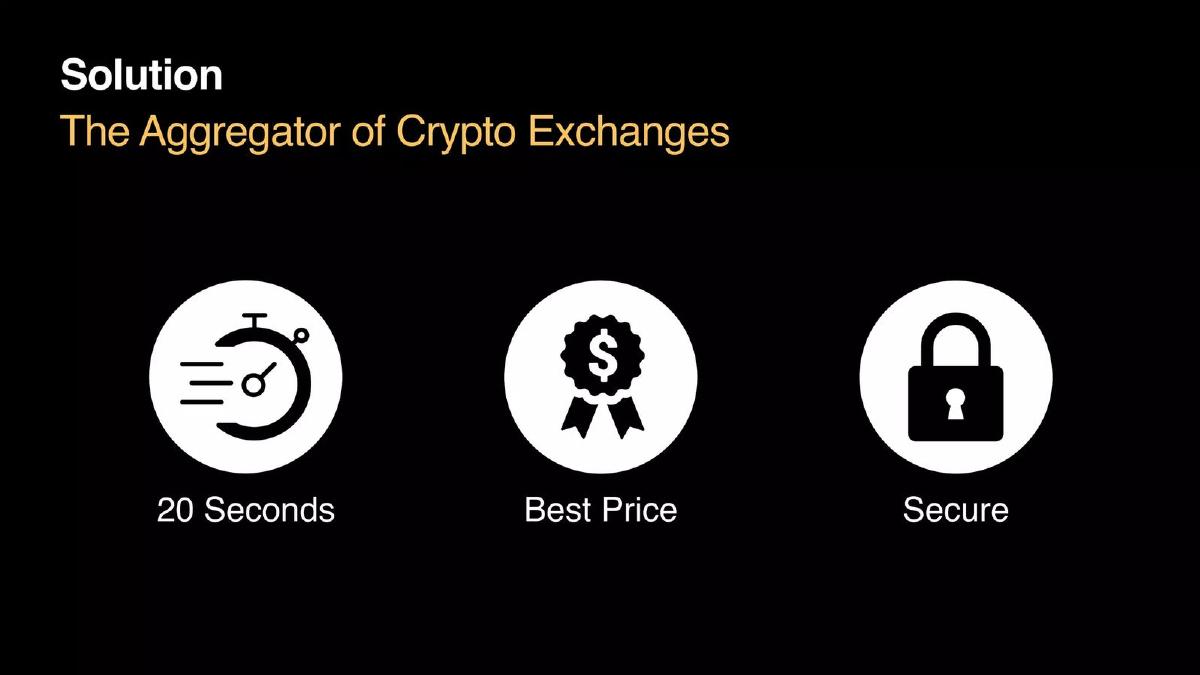
Crypto exchange rate aggregator. Slide titled "Solution: The Aggregator of Crypto Exchanges". The deck's problem slide (p5) reads "10 Days", "Friction & Manual Comparison" and "Risky".
Best Rate deck, slide 6. Exact stored slide matched to this analysis.
Our analysis: Read together, the two slides make a clear before-and-after: 10 days to 20 seconds, manual comparison to best price, risky to secure. The problem slide never said what the ten days measure, so the comparison is still unclear, and "Best Price" has no figure.
Evidence and limitation: Three answers that match the three problems on the previous slide, one with a number.
What a founder can adapt: Say what the ten days and twenty seconds measure, and how much better the price is.
Supporting analysis
What the deck claims: Three icons: "20 Seconds", "Best Price", "Secure".
Presentation choice: Matching the solution to the problem point by point lets an investor see the change at a glance.
When it does not fit: Numbers on the solution slide that the problem slide doesn't explain.
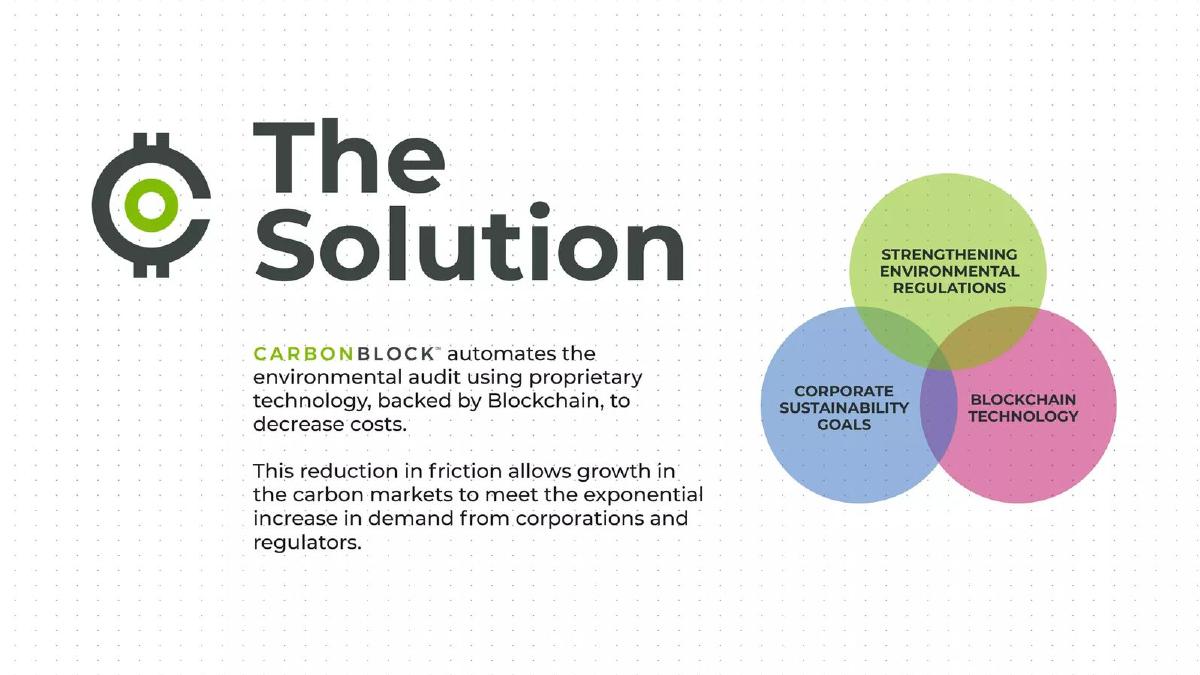
Carbon-market audit technology. Slide titled "The Solution".
Carbon Block deck, slide 4. Exact stored slide matched to this analysis.
Our analysis: The slide names the job (the environmental audit) and the effect (lower cost). It doesn't say how much cheaper or faster the audit becomes, or what the blockchain adds beyond "backed by".
Evidence and limitation: One named task automated, a stated result and a reason it matters.
What a founder can adapt: Add audit cost or time before and after, and say what the blockchain records.
Supporting analysis
What the deck claims: "CarbonBlock automates the environmental audit using proprietary technology, backed by Blockchain, to decrease costs." "This reduction in friction allows growth in the carbon markets to meet the exponential increase in demand from corporations and regulators." A diagram overlaps "Strengthening environmental regulations", "Corporate sustainability goals" and "Blockchain technology".
Presentation choice: Naming the specific task being automated makes the solution concrete.
When it does not fit: "Backed by Blockchain" without saying what it does.
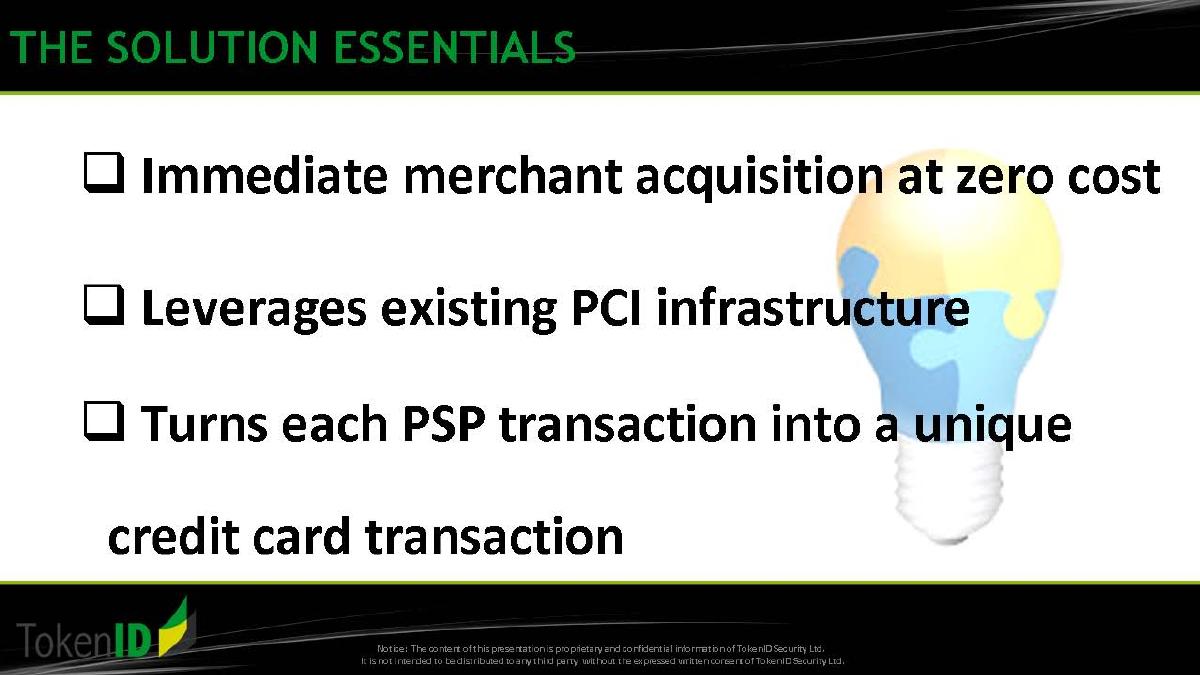
Payment tokenization. Slide titled "The Solution Essentials".
TokenID deck, slide 5. Exact stored slide matched to this analysis.
Our analysis: "Leverages existing PCI infrastructure" answers the adoption question: merchants and payment providers don't need new systems. The mechanism is stated, but the slide doesn't name the user or say what the unique transaction protects against.
Evidence and limitation: A cost claim, a statement about existing infrastructure and a one-line mechanism.
What a founder can adapt: Name the user and the problem each point answers.
Supporting analysis
What the deck claims: "Immediate merchant acquisition at zero cost"; "Leverages existing PCI infrastructure"; "Turns each PSP transaction into a unique credit card transaction".
Presentation choice: Using infrastructure buyers already have makes a payments product easier to adopt.
When it does not fit: Payment jargon (PCI, PSP) without saying who benefits.
Blockchain advertising token by Atayen. Slide titled "The Solution".
SaTT deck, slide 6. Exact stored slide matched to this analysis.
Our analysis: The slide says what the blockchain part does, which many web3 slides skip. The wording is technical, and the four benefits have no figures.
Evidence and limitation: A description of what the smart contract governs and four claimed benefits.
What a founder can adapt: Rewrite the paragraph in the advertiser's terms and add a cost or payment-time figure.
Supporting analysis
What the deck claims: "Thanks to the SaTT Smart Contract, ads and transactions are governed by oracles of autonomous beings secured by the Ethereum blockchain. In the event of a malfunction of a module or oracle, the integrity of other advertisers' ads is preserved." Four icons: "Lowest Cost", "Instant Payment", "Decentralized Governance", "Relevant Statistics".
Presentation choice: Explaining the chain's job answers why the product needs a blockchain.
When it does not fit: Phrases like "oracles of autonomous beings" that buyers won't follow.
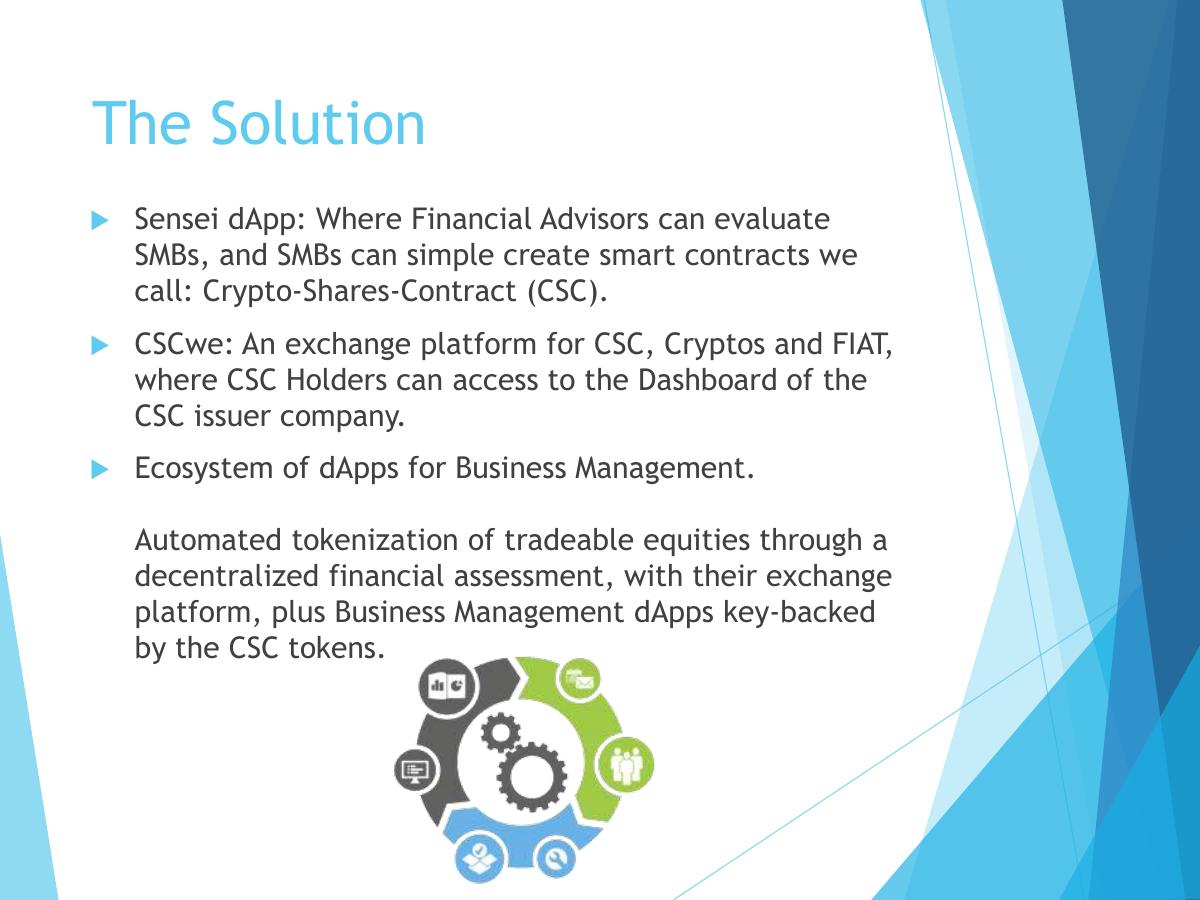
Tokenized equity platform for small businesses. Slide titled "The Solution".
Bitdharma deck, slide 4. Exact stored slide matched to this analysis.
Our analysis: The users are named, but three products and a new acronym on one slide make it hard to see the single change for a small business.
Evidence and limitation: Three products and a summary sentence, with named users (advisers, SMBs).
What a founder can adapt: Lead with what a small business gets and put the other products on a later slide.
Supporting analysis
What the deck claims: "Sensei dApp: Where Financial Advisors can evaluate SMBs, and SMBs can simple create smart contracts we call: Crypto-Shares-Contract (CSC)." "CSCwe: An exchange platform for CSC, Cryptos and FIAT..." "Ecosystem of dApps for Business Management." "Automated tokenization of tradeable equities through a decentralized financial assessment..."
Presentation choice: One clear change is easier to remember than three products.
When it does not fit: Introducing an acronym on the solution slide.
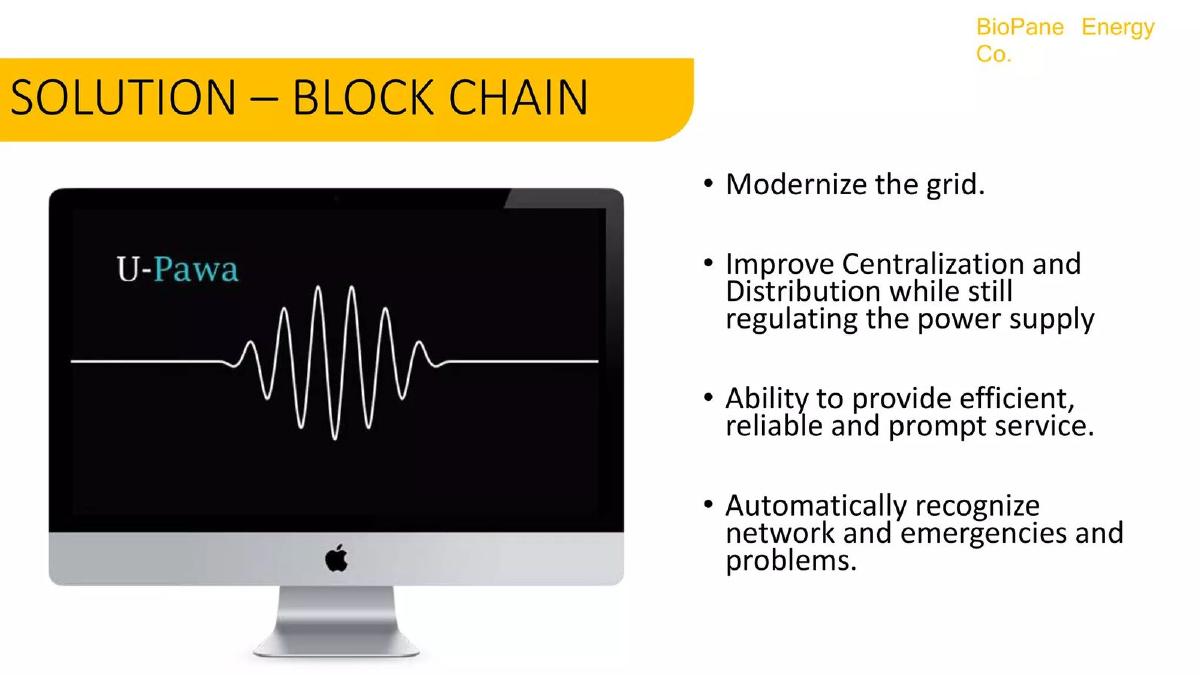
Energy grid project. Slide titled "Solution — Block Chain", with a screen showing "U-Pawa".
BioPane Energy deck, slide 6. Exact stored slide matched to this analysis.
Our analysis: The slide doesn't say what the blockchain records or controls, who uses U-Pawa, or what changes for them.
Evidence and limitation: Four goals; blockchain appears only in the title.
What a founder can adapt: Say what the blockchain does on the grid and give one measured change.
Supporting analysis
What the deck claims: "Modernize the grid." "Improve Centralization and Distribution while still regulating the power supply". "Ability to provide efficient, reliable and prompt service." "Automatically recognize network and emergencies and problems."
Presentation choice: A blockchain heading raises the question of why it's needed; the slide should answer it.
When it does not fit: Putting "Block Chain" in the title without explaining it.
Whether an investor can see what changes for the user and what the blockchain does.
Example
Business
Change for the user
Number
Blockchain's job
Best Rate
Exchange aggregator
Faster, best price
20 seconds
Not stated
Carbon Block
Carbon audits
Automated audit
Not stated
"Backed by" (unexplained)
TokenID
Payment tokenization
Zero-cost merchant sign-up
Not stated
Not stated
SaTT
Ad network
Lower cost, instant payment
Not stated
Governs ads and payments
Bitdharma
Tokenized equity
Three products
Not stated
Smart contracts for shares
Utrust
Crypto payments
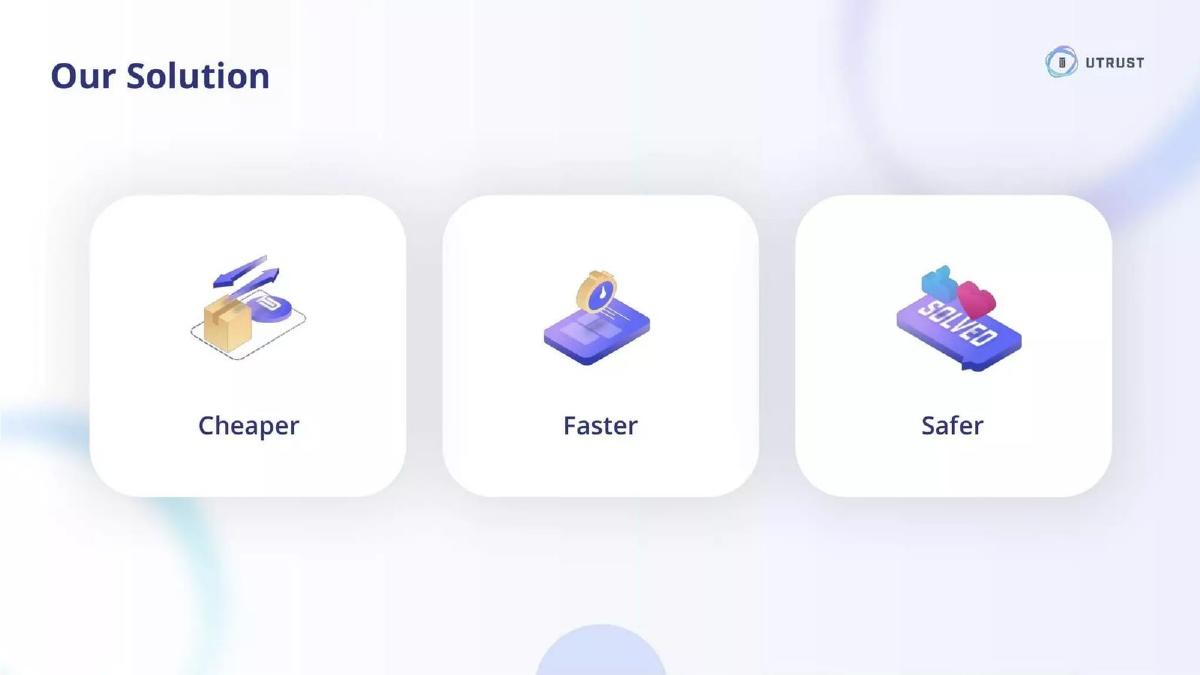
Cheaper, faster, safer
Not stated
Not stated
BioPane Energy
Energy grid
Not stated
Not stated
Not stated
Key Takeaways
Answer your own problem slide, point by point.
Give the change as a number: time, cost or steps.
Say what the blockchain does that a database couldn't.
Say what users keep using, so adoption looks easy.
One product per slide.
Build your web3 solution slide
Answer your problem slide with a measured change and say what the blockchain does.
Problem. What did your problem slide say, point by point?
Change. What changes for the user, as a number?
Chain. What does the blockchain do that a database couldn't?
Adoption. What do users keep using, so switching is easy?
Focus. What is the one product this slide is about?
Copyable framework: Headline: [user] goes from [before] to [after]. [Product] does this by [mechanism]; the blockchain [specific job]. Users keep [existing tool].
Illustrative example 1 — written by us
Before: Cheaper. Faster. Safer.
After: Merchants pay [fee] instead of [card fee] and settle in [time] instead of [time].
What improved: Our illustrative rewrite; the bracketed details are placeholders, not Utrust's facts. It gives each word a baseline and a number.
What this guide adds
The general solution slide guide covers any company. Web3 adds a question investors ask about every crypto pitch: why does this need a blockchain? A strong slide answers it by naming the specific job the chain or smart contract does.
Our library's web3 tag covers crypto exchanges and payments, tokenized assets, carbon markets, ad networks and energy projects that use a blockchain. We note each company's business in the examples.
How we read each slide
We quote the text on the stored slide images. We have not checked any speed, cost or technical claim.
Common mistakes
Not answering the problem. Match each problem point.
Adjectives without numbers. Give the before and after.
Blockchain unexplained. Say what the chain does.
Too many products. One product per slide.
Technical wording. Write in the user's terms.
Diagnostic checklist
Each problem point answered.
A measured before-and-after.
The blockchain's specific job.
What users keep using.
One product.
Frequently asked questions
What should a web3 solution slide show?
What changes for the user, measured, and what the blockchain does. Best Rate answers its "10 Days" problem with "20 Seconds".
Do I need to explain the blockchain?
Yes, briefly. SaTT says its smart contract governs ads and payments; BioPane puts "Block Chain" in the title without explaining it.
Are words like faster and cheaper enough?
No. Utrust's "Cheaper, Faster, Safer" doesn't say compared with what or by how much.
How we chose these examples
Corpus: published pitch deck teardowns on StartupFundraising.com. Founder-uploaded private decks are excluded.
Selection (2026-09-27): we searched extracted slide text in decks tagged web3 for slides that begin with "solution". 18 slides matched; we reviewed those with stored images and not used elsewhere.
Kept seven. Left out: JSEcoin, Koia and Twilight Coin (their decks are already in the web3 product guide), Genotik p5 (a list of regulatory duties, not a solution), Bitdharma LLC p4 (a duplicate of the Bitdharma slide), the betting app deck p5 (doesn't show a blockchain role), and slides whose solution isn't crypto-related (Icaro AI, PaperStreet, Seedefy, Pragati). Best Rate's and Carbon Block's decks also appear in problem guides with different slides. No uploads were requested.
Review: stored slide text and images were checked on 2026-09-27 and matched to company, deck and slide number (editorial model review). No person has yet completed an editorial review of this page.
Claims are as shown on the slides; we have not verified them. We make no claim that any slide caused a fundraising outcome.