Fintech Solution Slides: 7 Real Pitch Deck Examples
How fintech startups present their solution: invoice financing, payroll data, peer lending, debt relief, creator payments, business cards and crypto platforms.
Fintech Solution Slides: Real Pitch Deck Examples
Seven solution slides from fintech decks, shown in full. The strongest ones show where the money goes between the parties or what the customer sees on screen; the weakest list features that could belong to any crypto or finance app.
TL;DR
A fintech solution slide should show who the money moves between and what the customer can now do. Finvoice draws the two sides ("SMB" and "Investor") and states the trade in one sentence: "cash advances in exchange for discounted invoices". Pinwheel shows where it sits between apps (Cash App, Chime, Coinbase) and payroll providers (ADP, Paychex), and claims coverage of "nearly 80% of all paid Americans". SoLo Funds and Relief label real app screens. Lumanu groups features under three outcomes. Fundid packs three products into one slide, and Hoard lists six generic features; these are the weaker examples here.
Fintech solution slides
Each example shows the exact stored slide above its analysis and links to the full teardown. Stronger examples first. Figures are as shown on the slides; we have not verified them.
Finvoice solution slide — slide 4
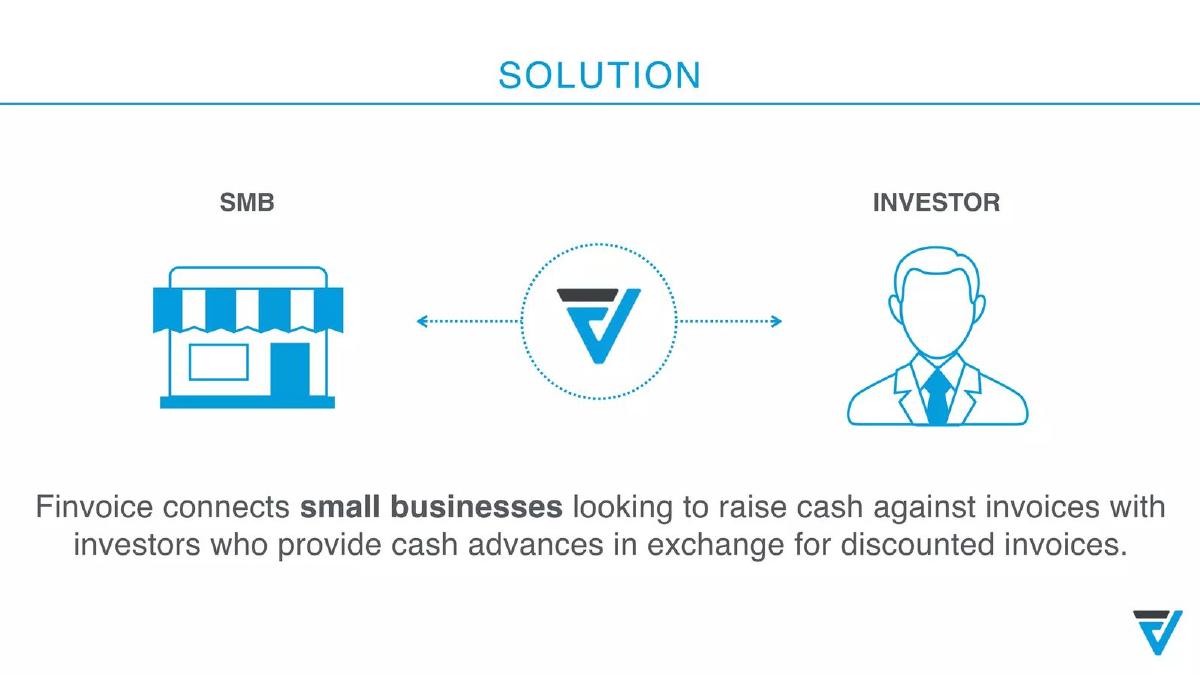
Invoice financing marketplace. Two-sided diagram with one sentence.
Finvoice deck, slide 4. Exact stored slide matched to this analysis.
Our analysis: Says exactly who gives what: businesses get cash now, investors get invoices at a discount.
Evidence and limitation: No figures; a clear statement of both sides and the trade.
What a founder can adapt: Write your trade as "[side A] gets [X]; [side B] gets [Y] in exchange for [Z]".
Supporting analysis
What the deck claims: "Solution." Diagram: "SMB" ↔ Finvoice ↔ "Investor". "Finvoice connects small businesses looking to raise cash against invoices with investors who provide cash advances in exchange for discounted invoices."
Presentation choice: An investor can repeat the model after one read, which is the main job of a marketplace solution slide.
When it does not fit: Add what it costs the business (the discount) and how fast cash arrives.
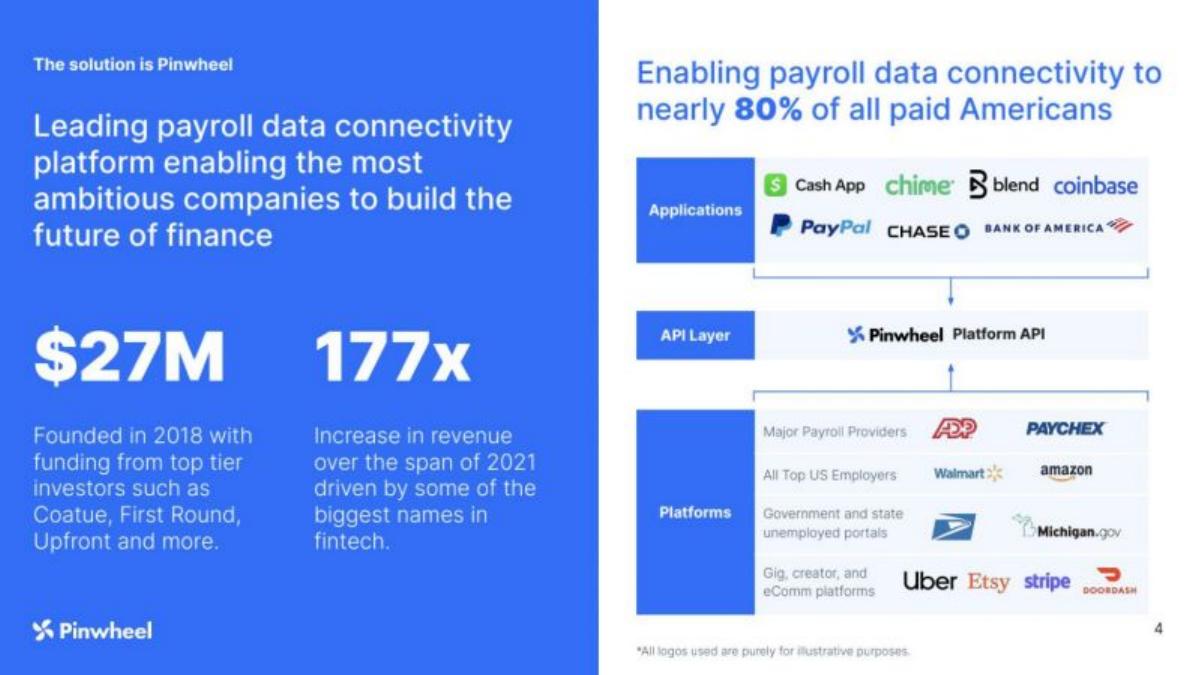
Payroll data connections for financial apps. Claim panel plus stack diagram.
Pinwheel deck, slide 4. Exact stored slide matched to this analysis.
Our analysis: Places the product precisely between two groups of well-known companies and says how much of the market it reaches.
Evidence and limitation: Coverage claim (~80% of paid Americans), revenue growth (177x in 2021), funding ($27M).
What a founder can adapt: For infrastructure, draw the layer above and below you and state your coverage.
Supporting analysis
What the deck claims: "The solution is Pinwheel." "Leading payroll data connectivity platform enabling the most ambitious companies to build the future of finance." "$27M Founded in 2018 with funding from top tier investors such as Coatue, First Round, Upfront and more." "177x Increase in revenue over the span of 2021." "Enabling payroll data connectivity to nearly 80% of all paid Americans." Diagram: Applications (Cash App, Chime, blend, coinbase, PayPal, Chase, Bank of America) → Pinwheel Platform API → Platforms (ADP, Paychex, Walmart, Amazon, Uber, Etsy, Stripe, DoorDash). Footnote: "All logos used are purely for illustrative purposes."
Presentation choice: The stack diagram answers "where does this sit?" at a glance; coverage is the key number for a data-connection business.
When it does not fit: The footnote says the logos are illustrative, so they don't show customers; funding and revenue belong on other slides.
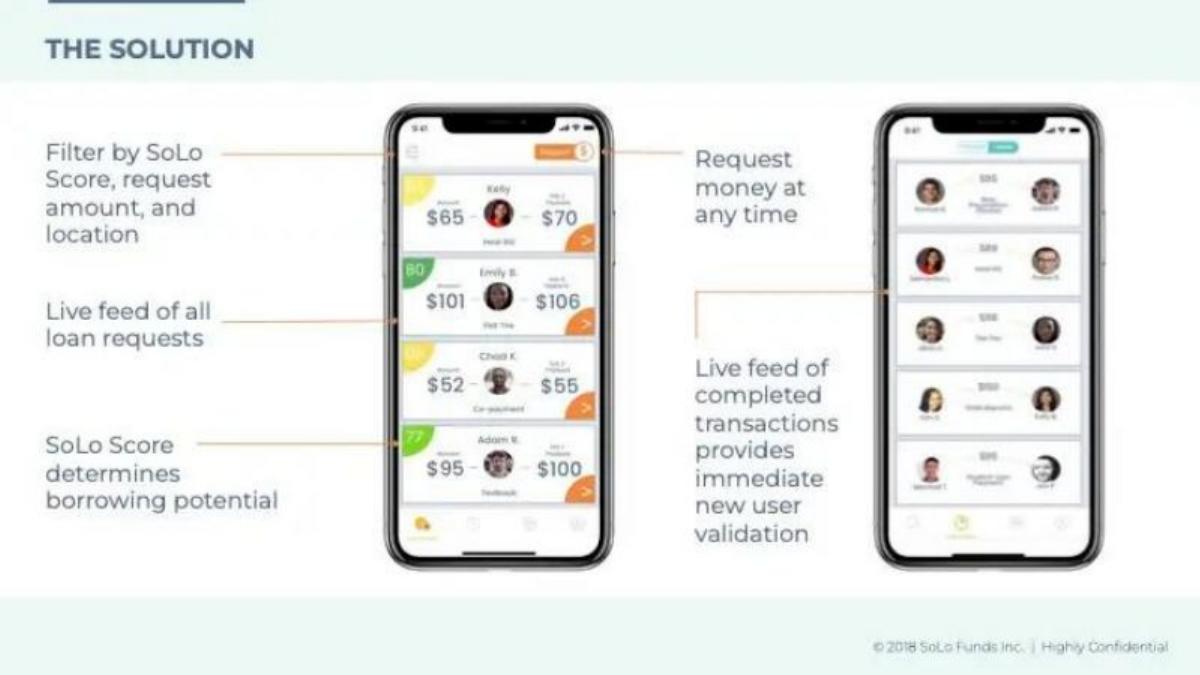
Peer-to-peer small loans. Two app screens with callouts.
SoLo Funds deck, slide 4. Exact stored slide matched to this analysis.
Our analysis: Shows both sides (lenders filtering, borrowers requesting) and how risk is judged (the SoLo Score).
Evidence and limitation: Real screens with loan amounts; no volumes.
What a founder can adapt: Label your screen with actions each side takes, and point to how you assess risk.
Supporting analysis
What the deck claims: "The Solution." Callouts: "Filter by SoLo Score, request amount, and location", "Live feed of all loan requests", "SoLo Score determines borrowing potential", "Request money at any time", "Live feed of completed transactions provides immediate new user validation". Screens show requests from $52 to $106.
Presentation choice: Loan sizes on screen make the product concrete: these are small, short-term loans between people.
When it does not fit: Say how the SoLo Score is calculated, or investors will ask straight away.
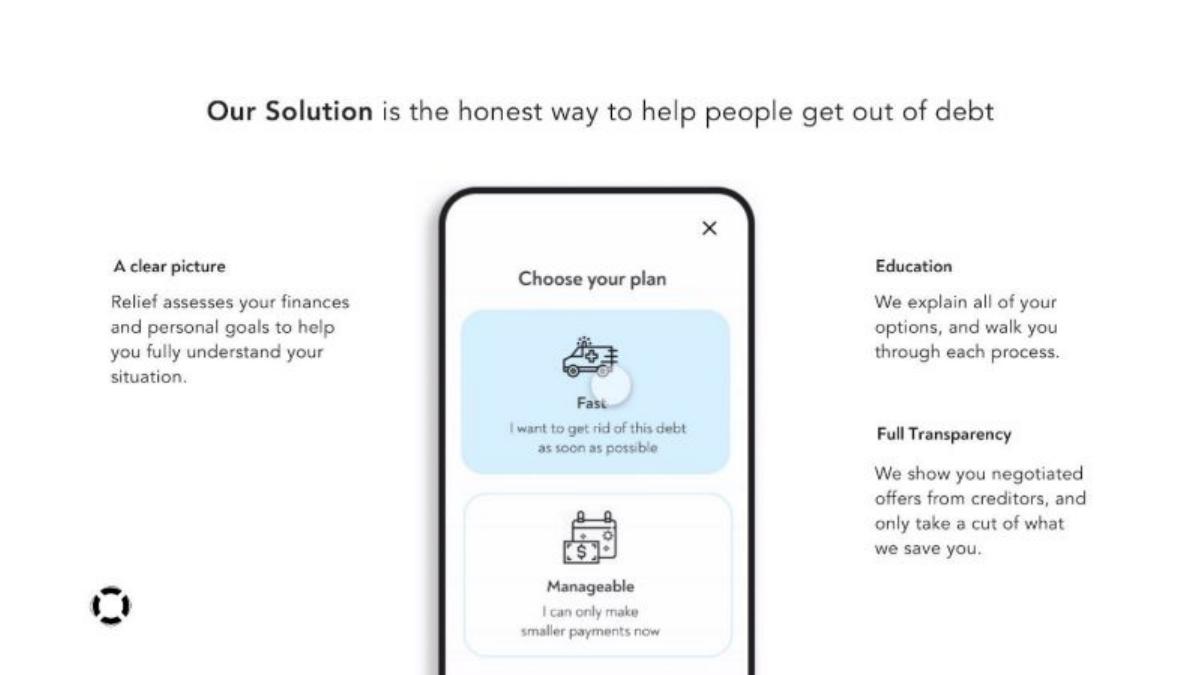
Debt settlement app. Central screen with four benefits.
Relief deck, slide 5. Exact stored slide matched to this analysis.
Our analysis: Leads with trust, which matters in debt settlement, and says how Relief is paid.
Evidence and limitation: No figures; states the fee model.
What a founder can adapt: If your market has a trust problem, put your fee model on the solution slide.
Supporting analysis
What the deck claims: "Our Solution is the honest way to help people get out of debt." "A clear picture: Relief assesses your finances and personal goals to help you fully understand your situation." "Education: We explain all of your options, and walk you through each process." "Full Transparency: We show you negotiated offers from creditors, and only take a cut of what we save you." Screen: "Choose your plan": "Fast", "Manageable".
Presentation choice: "Only take a cut of what we save you" explains both the business model and why the customer can trust it.
When it does not fit: Give the size of the cut and a typical saving.
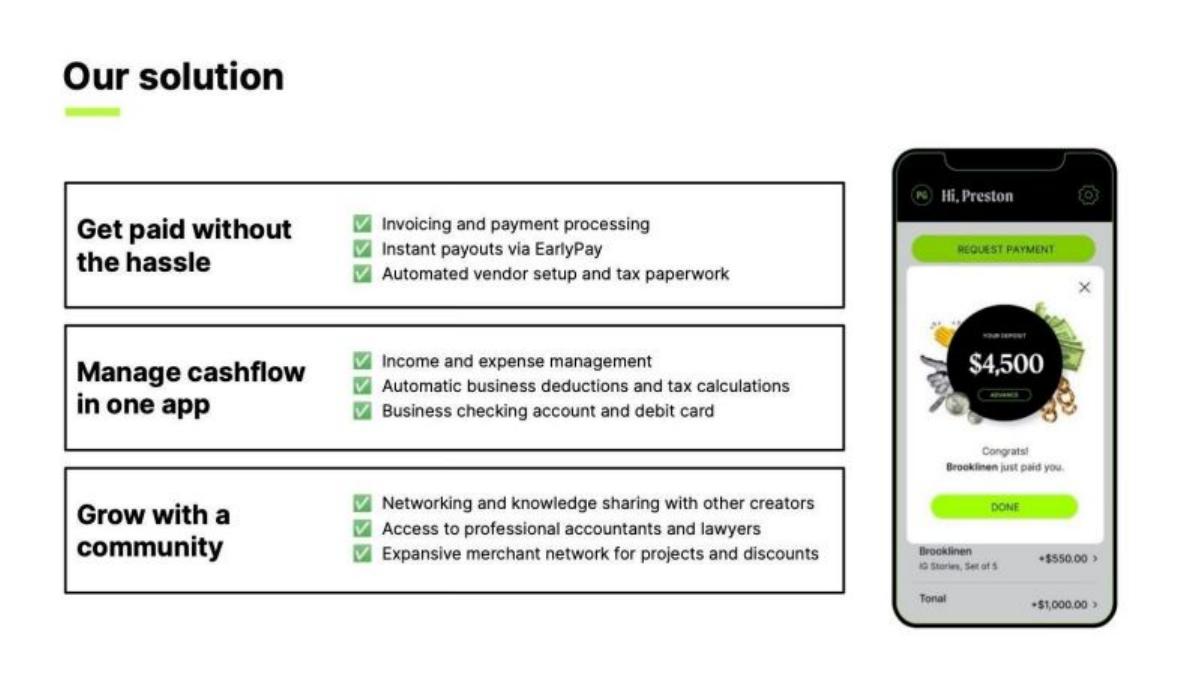
Payments and finance for creators. Three outcome rows plus app screen.
Lumanu deck, slide 5. Exact stored slide matched to this analysis.
Our analysis: Nine features, but grouped under three things a creator wants.
Evidence and limitation: No figures beyond the example payment.
What a founder can adapt: Group your features under two or three customer outcomes, most important first.
Supporting analysis
What the deck claims: "Our solution." "Get paid without the hassle": "Invoicing and payment processing", "Instant payouts via EarlyPay", "Automated vendor setup and tax paperwork". "Manage cashflow in one app": "Income and expense management", "Automatic business deductions and tax calculations", "Business checking account and debit card". "Grow with a community": networking, accountants and lawyers, merchant discounts. Screen: "$4,500" payment received.
Presentation choice: Outcome headings make a long feature list readable; the screen shows the moment of getting paid.
When it does not fit: The community row is weaker than the money rows; drop it or move it later.
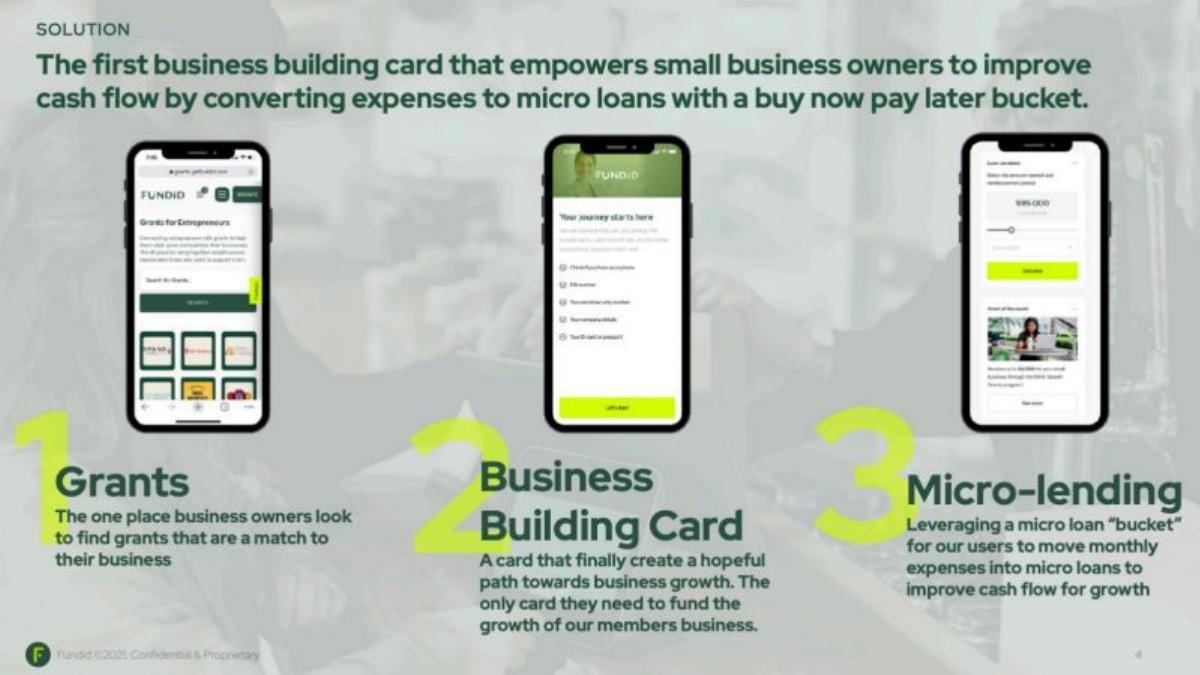
Small business card and micro-loans. Three products, three screens.
Fundid deck, slide 4. Exact stored slide matched to this analysis.
Our analysis: A weaker example: the headline promises a card, but the slide presents three products.
Evidence and limitation: No figures.
What a founder can adapt: Lead with the one product you're raising for; move the others to a roadmap.
Supporting analysis
What the deck claims: "Solution." "The first business building card that empowers small business owners to improve cash flow by converting expenses to micro loans with a buy now pay later bucket." "1 Grants: The one place business owners look to find grants that are a match to their business." "2 Business Building Card." "3 Micro-lending: Leveraging a micro loan 'bucket' for our users to move monthly expenses into micro loans to improve cash flow for growth."
Presentation choice: Included for contrast: grants, card and lending compete for attention, and small screens are unreadable over the photo.
When it does not fit: "The first" needs support; drop it if you can't prove it.
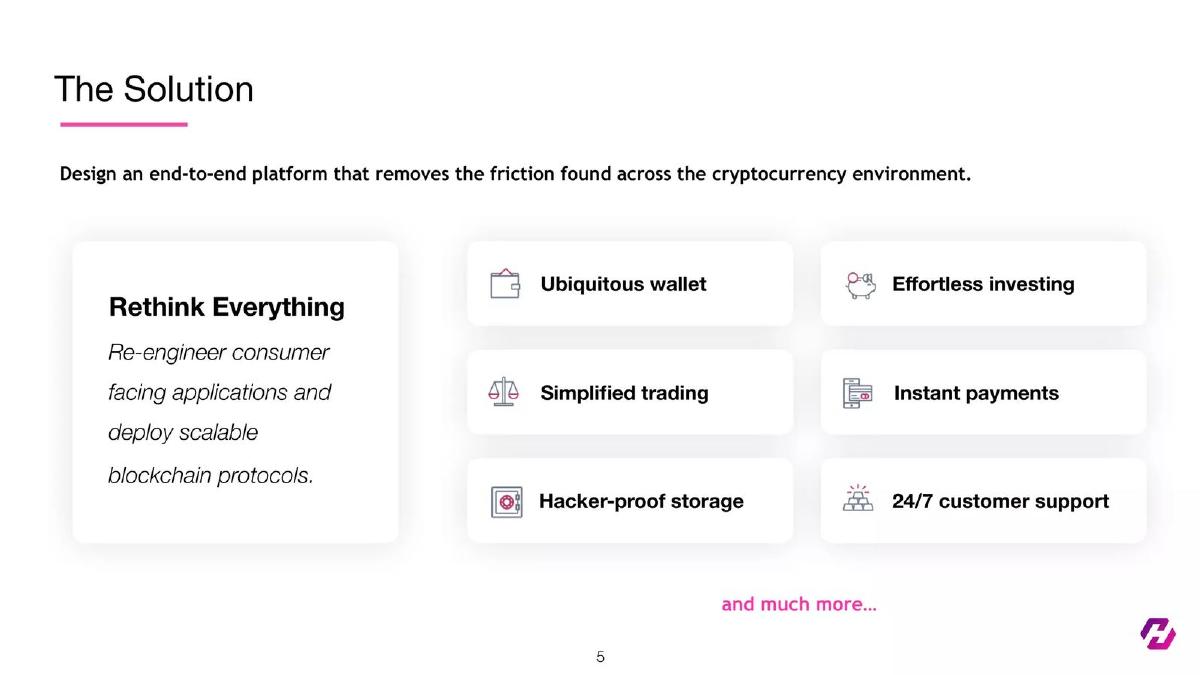
Crypto platform. Statement plus six feature tiles.
Hoard deck, slide 5. Exact stored slide matched to this analysis.
Our analysis: A weaker example: every crypto platform could claim these tiles.
Evidence and limitation: Six labels; no customer or figures.
What a founder can adapt: Pick the one tile that's true only of you and show it working.
Supporting analysis
What the deck claims: "The Solution." "Design an end-to-end platform that removes the friction found across the cryptocurrency environment." "Rethink Everything: Re-engineer consumer facing applications and deploy scalable blockchain protocols." Tiles: "Ubiquitous wallet", "Effortless investing", "Simplified trading", "Instant payments", "Hacker-proof storage", "24/7 customer support", "and much more...".
Presentation choice: Included for contrast: no customer, no screen, and "end-to-end" plus "and much more" signal no focus.
When it does not fit: "Hacker-proof" is a claim investors will test; don't use it without evidence.
How the solution is shown and whether the money flow or fee is stated.
Example
Fintech type
Format
Money flow or fee stated
Figures
Finvoice
Invoice financing
Two-sided diagram
Yes
No
Pinwheel
Payroll data
Stack diagram
Partly (where it sits)
Yes (~80%, 177x, $27M)
SoLo Funds
P2P lending
Labelled screens
Yes
Loan sizes only
Relief
Debt settlement
Screen + benefits
Yes (cut of savings)
No
Lumanu
Creator payments
Outcome rows + screen
No
No
Fundid
SMB card + loans
Three products
No
No
Hoard
Crypto platform
Feature tiles
No
No
Key Takeaways
Show who the money moves between.
State the trade in one sentence.
Label a real screen, not a stock icon.
Group features under customer outcomes.
One product per slide.
Build your fintech solution slide
Start from who the money moves between.
Parties. Who pays, who receives, and where you sit.
The trade. What each side gets, in one sentence.
Your fee. How you are paid on each transaction.
Proof on screen. One real screen, with labels for what the customer does.
Copyable framework: [Customer] gets [outcome] from [other party] through [product]; we earn [fee].
Illustrative example 1 — written by us
Before: Design an end-to-end platform that removes the friction found across the cryptocurrency environment.
After: New crypto buyers can buy, hold and send [coin] from one wallet in [X taps]; we earn [Y%] per trade. [Show the wallet screen.]
What improved: Our illustrative rewrite; not Hoard's wording. It names the customer, one action and the fee, with marked places for real figures.
What this guide adds
The library has a general solution slide guide, a solution-by-stage guide, and fintech guides for problem, product and traction slides. This page looks at how fintech decks describe the fix itself, where investors want to understand the flow of money and who carries the risk.
The seven decks cover invoice financing (Finvoice), payroll data connections (Pinwheel), peer-to-peer lending (SoLo Funds), debt settlement (Relief), payments for creators (Lumanu), small business cards and micro-loans (Fundid) and a crypto platform (Hoard). None of these decks appears in another guide.
Three ways fintech decks show the solution
Money-flow diagram (Finvoice, Pinwheel): the parties and what passes between them. Best when the diagram is simple enough to read in five seconds.
Labelled screens (SoLo Funds, Relief): the app with callouts explaining each part. Best when every label names something the customer does.
Feature groups (Lumanu, Fundid, Hoard): lists of capabilities. Works only when grouped under outcomes, as Lumanu does.
Common mistakes
No money flow. Show who pays whom.
Generic tiles. Features any competitor could list.
Several products. Lead with the one you're raising for.
Illustrative logos. Don't imply customers you don't have.
Unsupported superlatives. "First", "hacker-proof" need proof.
Diagnostic checklist
The parties and what passes between them.
One sentence stating the trade.
How you are paid.
A real, labelled screen.
One product in focus.
Frequently asked questions
How we chose these examples
Corpus: published pitch deck teardowns on StartupFundraising.com. Founder-uploaded private decks are excluded.
Selection (2026-09-25): we searched stored slide text for slides headed Solution that mention payments, banks, cards, loans, credit, investing or crypto, excluded decks already used in another guide (699 at the time), and kept slides with a stored image. Of 13 candidates checked, 40Seas had no stored image; IRAengine, Merge, TokenID, WealthKernel and Zevoy were readable but set aside as weaker or text-only. Fundid and Hoard are included as weaker examples for contrast.
Company descriptions come from the slides themselves.
Review: stored slide text and images were checked on 2026-09-25 and matched to company, deck and slide number (editorial model review). No person has yet completed an editorial review of this page.
Figures are as shown on the slides; we have not verified them. We make no claim that any slide caused a fundraising outcome.