Fintech Problem Slides: 7 Real Pitch Deck Examples
How fintech startups present the problem: payment fees, settlement delays, locked-out investors and fragmented mobile money.
Fintech Problem Slides: Real Pitch Deck Examples
Seven problem slides from fintech decks (card payments, bank transfers, mobile money, crypto payments and investing access), shown in full. The strongest ones put a cost, a delay or a minimum on the slide; the weakest list pains across several unrelated areas of finance.
TL;DR
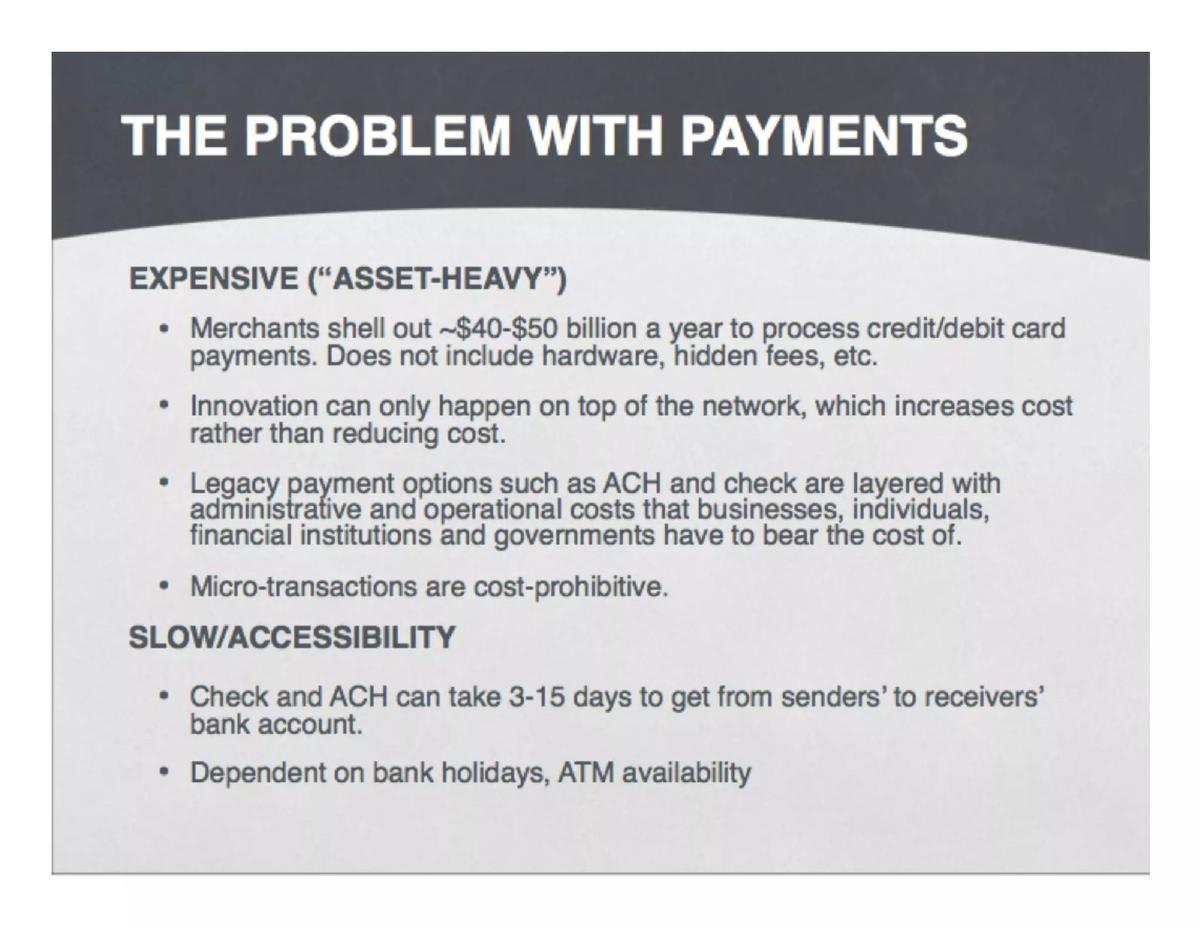
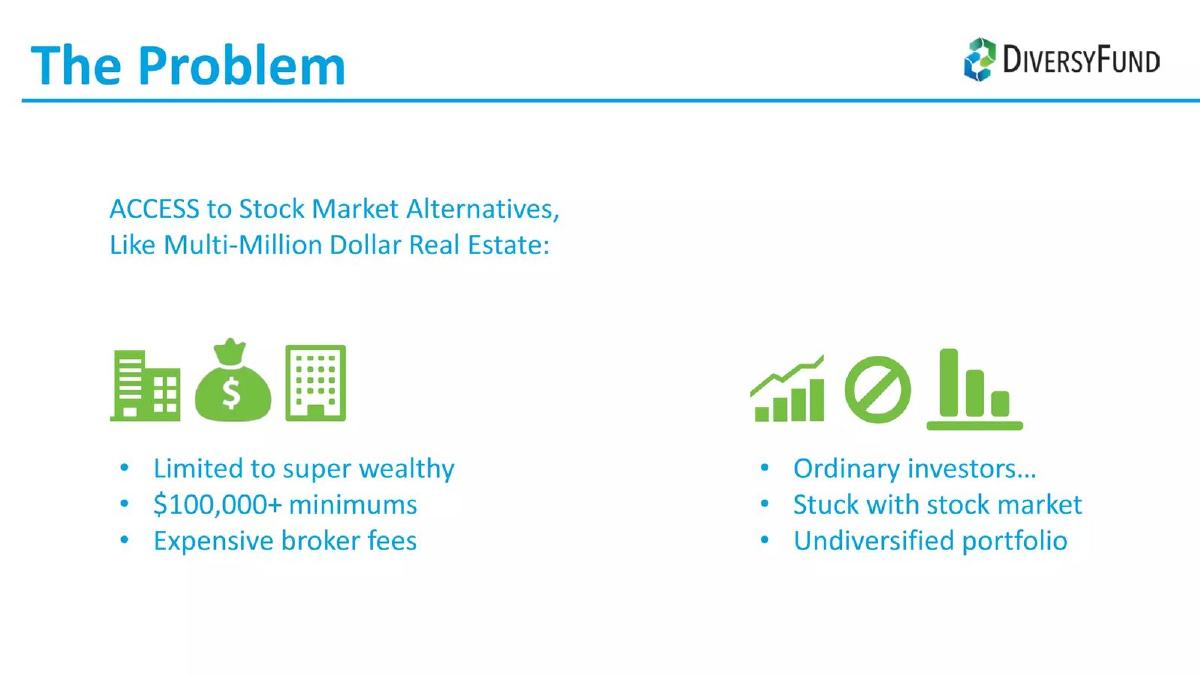
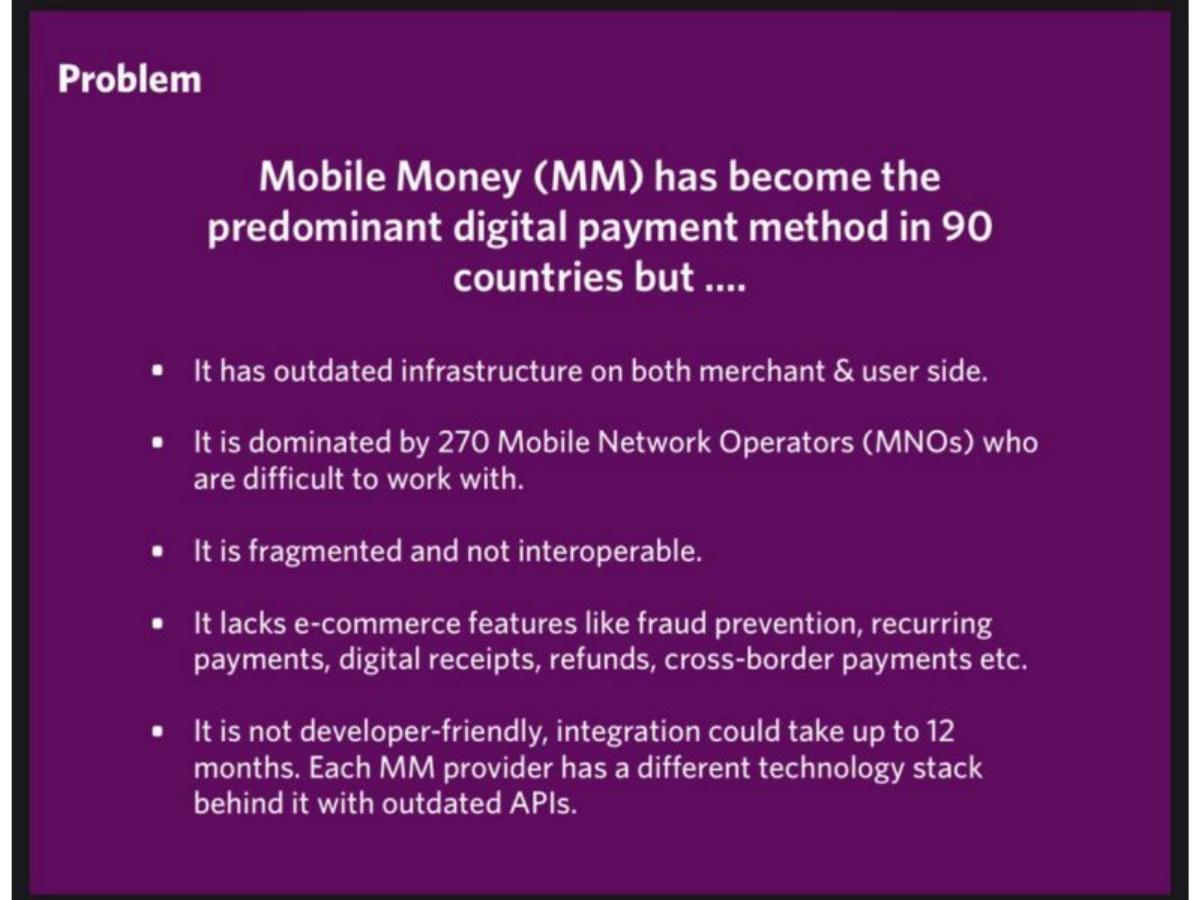
A fintech problem slide should state what the current system costs someone, in money or time. Dwolla puts a figure on it ("Merchants shell out ~$40-$50 billion a year to process credit/debit card payments") and a delay ("Check and ACH can take 3-15 days"). DiversyFund names the barrier ("$100,000+ minimums") and who is shut out ("Ordinary investors"). Dash Spektra explains why mobile money is hard to build on ("270 Mobile Network Operators", "integration could take up to 12 months"). Angage states one customer and one missing ability in a sentence. Coinleap and BitDharma list pains without figures, and Elite Financial spreads five areas of finance over one slide; these are the weaker examples here.
Fintech problem slides
Each example shows the exact stored slide above its analysis and links to the full teardown. Stronger examples first. Figures are as shown on the slides; we have not verified them.
Dwolla problem slide — slide 6
Bank payments network, US. Two-part problem: cost and speed.
Dwolla deck, slide 6. Exact stored slide matched to this analysis.
Our analysis: The clearest fintech problem here: it names who pays (merchants), how much, and how long money takes to arrive.
Evidence and limitation: An annual cost figure and a settlement time range; no source shown.
What a founder can adapt: Split your problem into cost and time, and give one number for each.
Supporting analysis
What the deck claims: "The Problem with Payments." "Expensive ('Asset-Heavy')": "Merchants shell out ~$40-$50 billion a year to process credit/debit card payments. Does not include hardware, hidden fees, etc." "Innovation can only happen on top of the network, which increases cost rather than reducing cost." "Micro-transactions are cost-prohibitive." "Slow/Accessibility": "Check and ACH can take 3-15 days to get from senders' to receivers' bank account." "Dependent on bank holidays, ATM availability".
Presentation choice: Two headings (expensive, slow) each backed by a number make the problem easy to remember and to check.
When it does not fit: Six dense bullets; cut to the two figures and add a source for the $40-$50 billion.
Real estate investing for ordinary investors. Two-column problem.
DiversyFund deck, slide 3. Exact stored slide matched to this analysis.
Our analysis: Contrasts who can invest today with who can't, and names the barrier as a number.
Evidence and limitation: One barrier figure ($100,000+ minimums); the rest is description.
What a founder can adapt: If your problem is access, show the two groups side by side and the rule or minimum that separates them.
Supporting analysis
What the deck claims: "The Problem." "ACCESS to Stock Market Alternatives, Like Multi-Million Dollar Real Estate:" Left: "Limited to super wealthy", "$100,000+ minimums", "Expensive broker fees". Right: "Ordinary investors...", "Stuck with stock market", "Undiversified portfolio".
Presentation choice: A minimum investment is a concrete, checkable reason people are excluded.
When it does not fit: "Expensive broker fees" needs a figure too; the icons add nothing.
Mobile money payments infrastructure, Africa. Headline plus five reasons.
Dash (Spektra) deck, slide 2. Exact stored slide matched to this analysis.
Our analysis: Opens with why the market matters, then explains in numbers why it is hard to build on.
Evidence and limitation: Market reach (90 countries), fragmentation (270 operators) and integration time (up to 12 months).
What a founder can adapt: For infrastructure, count the parties a developer must deal with and how long integration takes today.
Supporting analysis
What the deck claims: "Problem." "Mobile Money (MM) has become the predominant digital payment method in 90 countries but ...." "It has outdated infrastructure on both merchant & user side." "It is dominated by 270 Mobile Network Operators (MNOs) who are difficult to work with." "It is fragmented and not interoperable." "It lacks e-commerce features like fraud prevention, recurring payments, digital receipts, refunds, cross-border payments etc." "It is not developer-friendly, integration could take up to 12 months."
Presentation choice: "270 operators" and "12 months" make fragmentation concrete for investors who don't know mobile money.
When it does not fit: The headline is about the market's success; lead with who is hurt (merchants or developers) instead.
Mobile payment apps for small merchants. One-sentence problem with a stock banner.
Angage deck, slide 3. Exact stored slide matched to this analysis.
Our analysis: Names one customer and one missing ability, which is the core of a good problem statement.
Evidence and limitation: One sentence; no figures.
What a founder can adapt: Keep the one-sentence form, then add what it costs the merchant (lost sales, share of customers who want to pay by card).
Supporting analysis
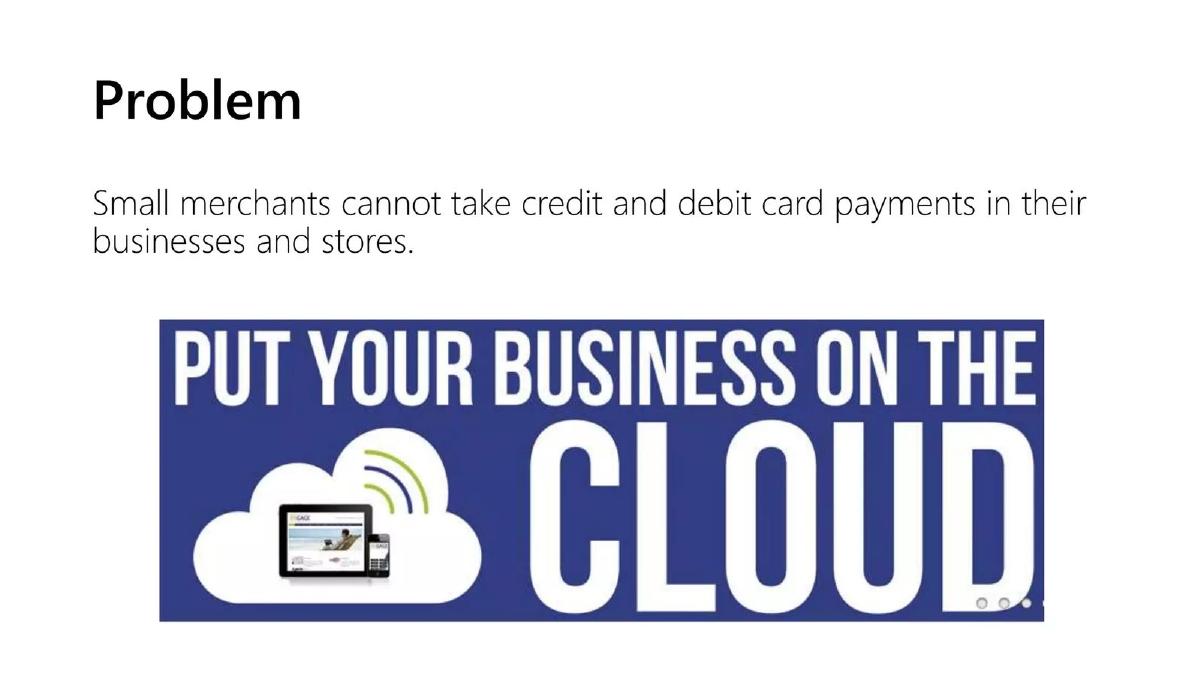
What the deck claims: "Problem." "Small merchants cannot take credit and debit card payments in their businesses and stores." Banner image: "Put your business on the cloud".
Presentation choice: A single clear sentence is easy to repeat; investors know immediately who the customer is.
When it does not fit: The banner is about cloud software, not payments; replace it with a figure or a photo of the merchant.
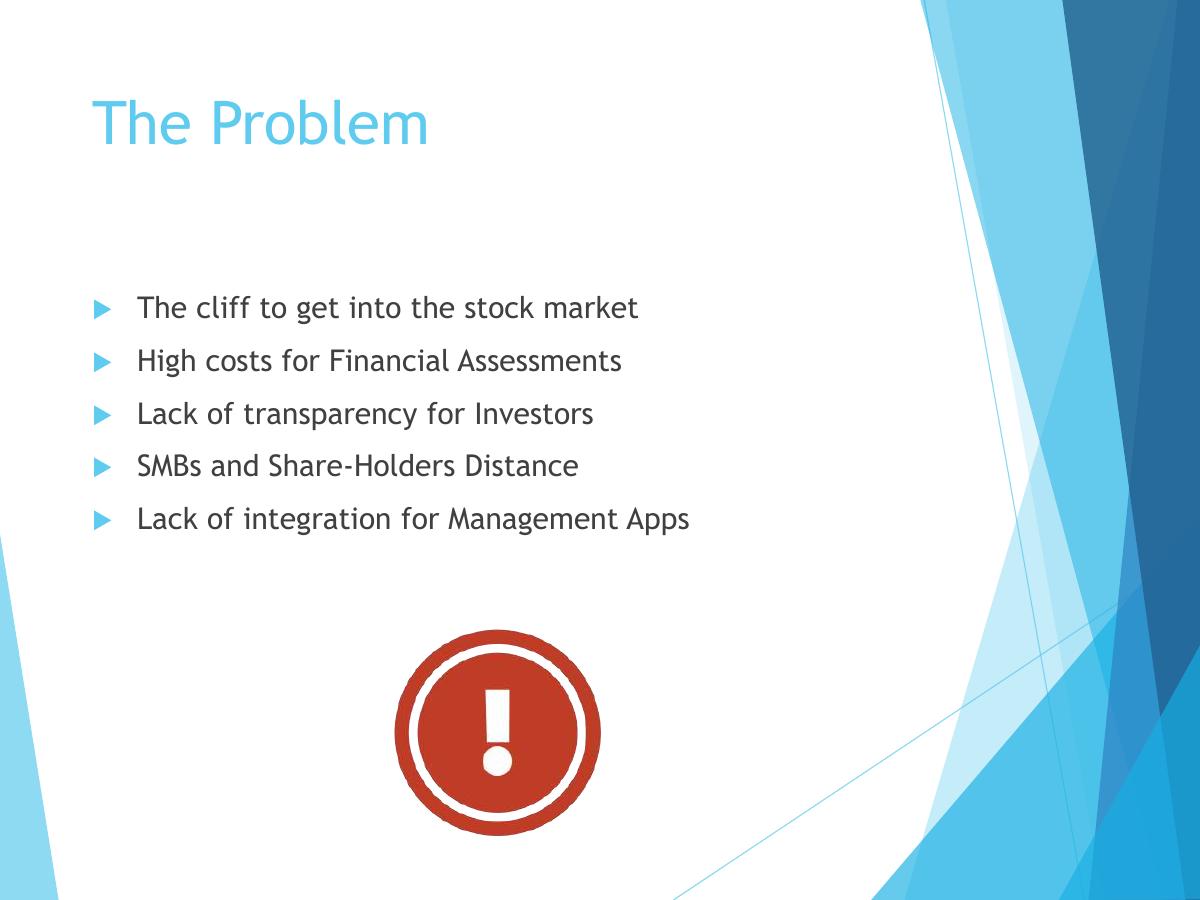
Share trading for small and medium companies. Five-bullet list.
BitDharma deck, slide 3. Exact stored slide matched to this analysis.
Our analysis: A weaker example: "the cliff to get into the stock market" is a vivid image, but the slide never says how high it is.
Evidence and limitation: Five phrases; no figures.
What a founder can adapt: Put a cost on the cliff: what a small company pays to list, or the minimum size to qualify.
Supporting analysis
What the deck claims: "The Problem." "The cliff to get into the stock market", "High costs for Financial Assessments", "Lack of transparency for Investors", "SMBs and Share-Holders Distance", "Lack of integration for Management Apps".
Presentation choice: Included for contrast: two groups (companies and investors) with five pains and no numbers.
When it does not fit: Don't address two customers with five bullets; pick one.
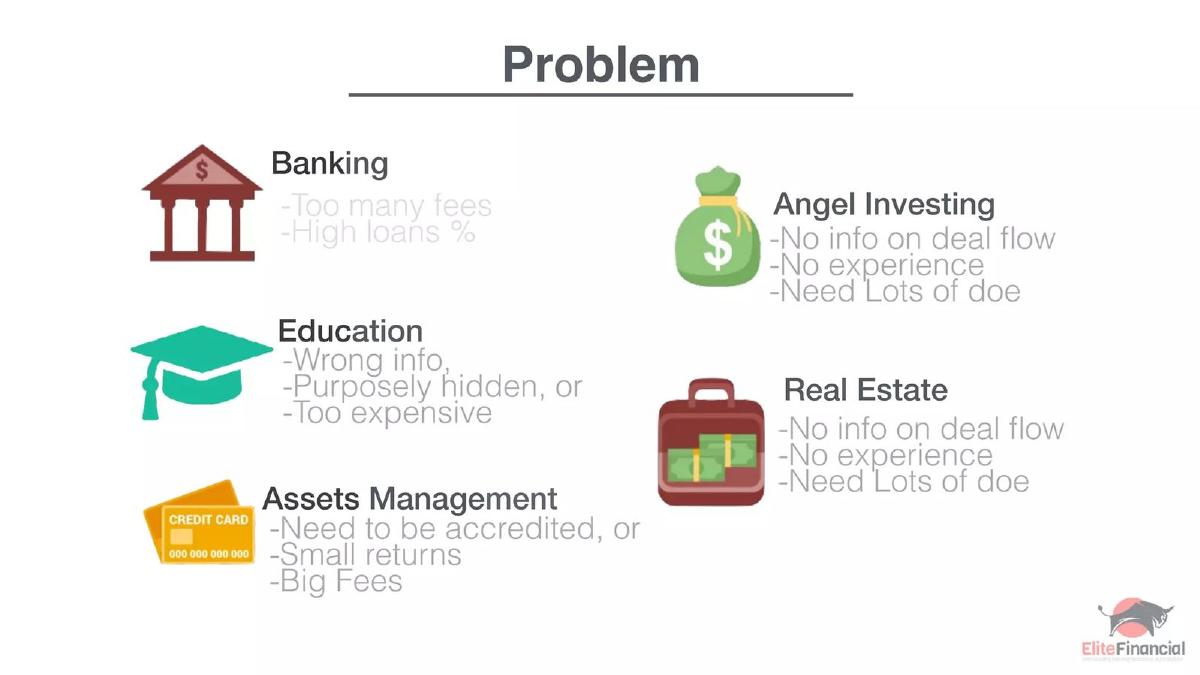
Personal finance and investing for new investors. Five-area grid.
Elite Financial deck, slide 5. Exact stored slide matched to this analysis.
Our analysis: A weaker example: five different markets on one slide, two with identical bullets.
Evidence and limitation: Fifteen short phrases across five areas; no figures.
What a founder can adapt: Choose the one area your product addresses and give it the whole slide.
Supporting analysis
What the deck claims: "Problem." "Banking: -Too many fees -High loans %"; "Angel Investing: -No info on deal flow -No experience -Need Lots of doe"; "Education: -Wrong info, -Purposely hidden, or -Too expensive"; "Real Estate: -No info on deal flow -No experience -Need Lots of doe"; "Assets Management: -Need to be accredited, or -Small returns -Big Fees".
Presentation choice: Included for contrast: spreading across banking, investing, education and real estate hides which problem the company solves.
When it does not fit: Pale grey text is hard to read; copied bullets suggest the list was filled in, not researched.
How the problem is framed, whether it is measured, and whether a customer is named.
Example
Fintech type
Framed as
Measured
Customer named
Dwolla
Bank payments
Cost + delay
Yes ($40-50bn, 3-15 days)
Merchants
DiversyFund
Alternative investing
Locked out
Yes ($100k minimum)
Ordinary investors
Dash (Spektra)
Mobile money
Hard to build on
Yes (270 operators, 12 months)
Merchants, developers
Angage
Card acceptance
Missing ability
No
Small merchants
Coinleap
Crypto payments
Pain list
No
No
BitDharma
SME share trading
Pain list
No
SMBs, investors
Elite Financial
Personal finance
Five-area grid
No
No
Key Takeaways
Put the cost or delay on the slide in money or days.
Name who pays it: merchant, investor, developer.
Explain why the current system can't fix it.
One area of finance per slide, not five.
Bullets without figures read as opinion.
Build your fintech problem slide
Start from one customer and what the current system costs them.
Customer. Who pays or waits (merchant, investor, developer, borrower).
Cost. The fee, rate or total spend, in money.
Delay or barrier. Days to settle, months to integrate, or the minimum to get in.
Why it persists. What in the current system stops incumbents from fixing it.
Copyable framework: [Customer] pays [cost] and waits [delay] because [current system]. [Source].
Illustrative example 1 — written by us
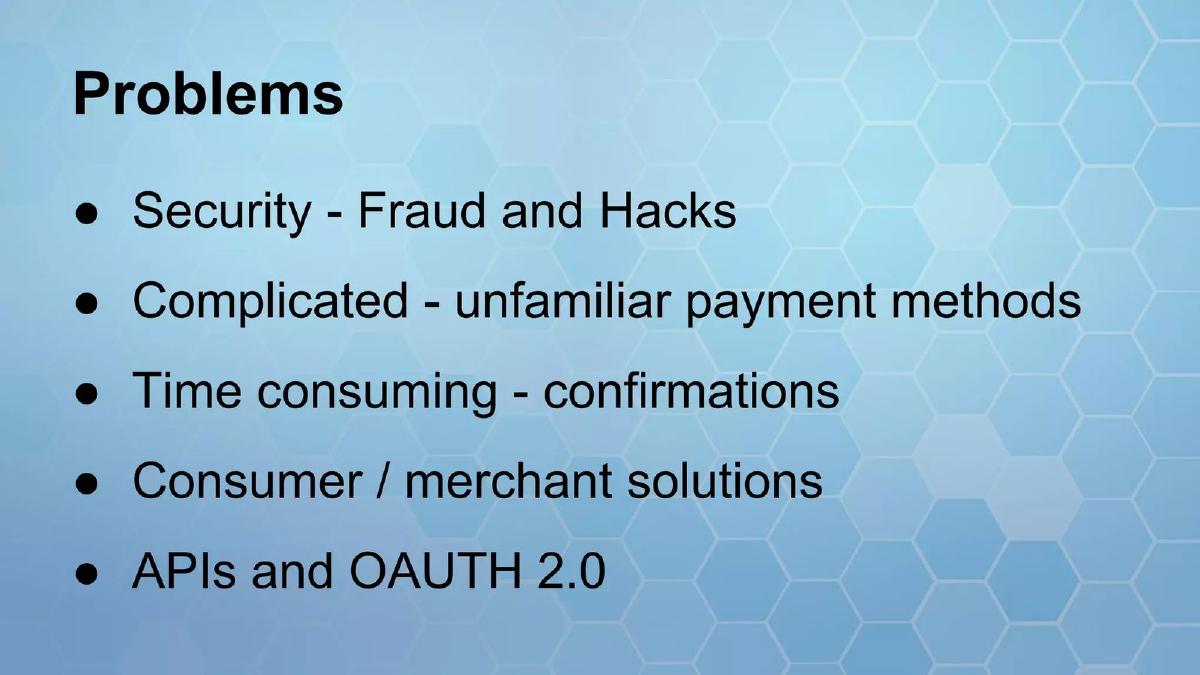
Before: Security - Fraud and Hacks. Complicated - unfamiliar payment methods. Time consuming - confirmations.
After: Online merchants who accept crypto wait [X minutes] for payment confirmation and lose [Y%] of checkouts. [Add a source.]
What improved: Our illustrative rewrite; not Coinleap's wording. It names the customer, turns one pain into a measured cost and leaves marked places for real figures.
What this guide adds
The library has problem-slide guides for thirty types of business, a general problem slide guide and a problem-by-stage guide. This page looks only at fintech decks, where the problem is usually a fee, a delay or a rule that keeps someone out, and investors expect it to be measurable.
The seven decks cover card acceptance for small merchants (Angage), bank and card payment costs (Dwolla), mobile money infrastructure (Dash Spektra), crypto payments (Coinleap), alternative investments (DiversyFund), small-company share trading (BitDharma) and personal finance for new investors (Elite Financial). None of these decks appears in another guide.
Three ways fintech decks frame the problem
Cost of the system (Dwolla): what the current rails charge in total and how long they take. Strong because both are numbers an investor can check.
Locked out (DiversyFund, Angage, BitDharma): who cannot use a financial product today and why: minimums, fees, missing card terminals. Strongest when the barrier is stated as a number, like a minimum investment.
Hard to build on (Dash Spektra, Coinleap): why the existing infrastructure is slow, fragmented or unfamiliar. Persuasive when it says how many parties are involved or how long integration takes.
Common mistakes
No number. State the fee, delay or minimum.
No customer. Say who pays or waits.
Several markets. One area of finance per slide.
Features in the problem list. Keep technology for the solution slide.
Decoration over evidence. Replace stock banners with a figure.
Diagnostic checklist
One named customer.
A cost in money.
A delay or barrier in days, months or a minimum.
Why the current system can't fix it.
A source for the main figure.
Frequently asked questions
How we chose these examples
Corpus: published pitch deck teardowns on StartupFundraising.com. Founder-uploaded private decks are excluded.
Selection (2026-09-25): we searched stored slide text for slides headed Problem that mention payments, banks, cards, loans, credit or investing. We excluded decks already used in another guide (including Finteum, Cachet, Card Blanch, DFS, Digitzs and dv01) and kept only slides with a stored image, leaving seven, all used here. Coinleap, BitDharma and Elite Financial are included as weaker examples for contrast.
Company descriptions come from the slides themselves.
Review: stored slide text and images were checked on 2026-09-25 and matched to company, deck and slide number (editorial model review). No person has yet completed an editorial review of this page.
Figures are as shown on the slides; we have not verified them. We make no claim that any slide caused a fundraising outcome.