The 2018 Dash (formerly Spektra) pitch deck is a masterclass in identifying a massive, fragmented market and proposing a unifying technical layer. Operating in the fintech space, Dash targeted the 690 million mobile money users across 90 countries who were hampered by outdated USSD-based infrastructure and a lack of interoperability. The deck uses a high-contrast comparison between 'Existing Solutions' and 'Our Solution' for both merchants and users, highlighting a reduction in checkout steps from ten to one. Despite a very lean 12-slide structure and the absence of detailed financial project…
Key takeaways
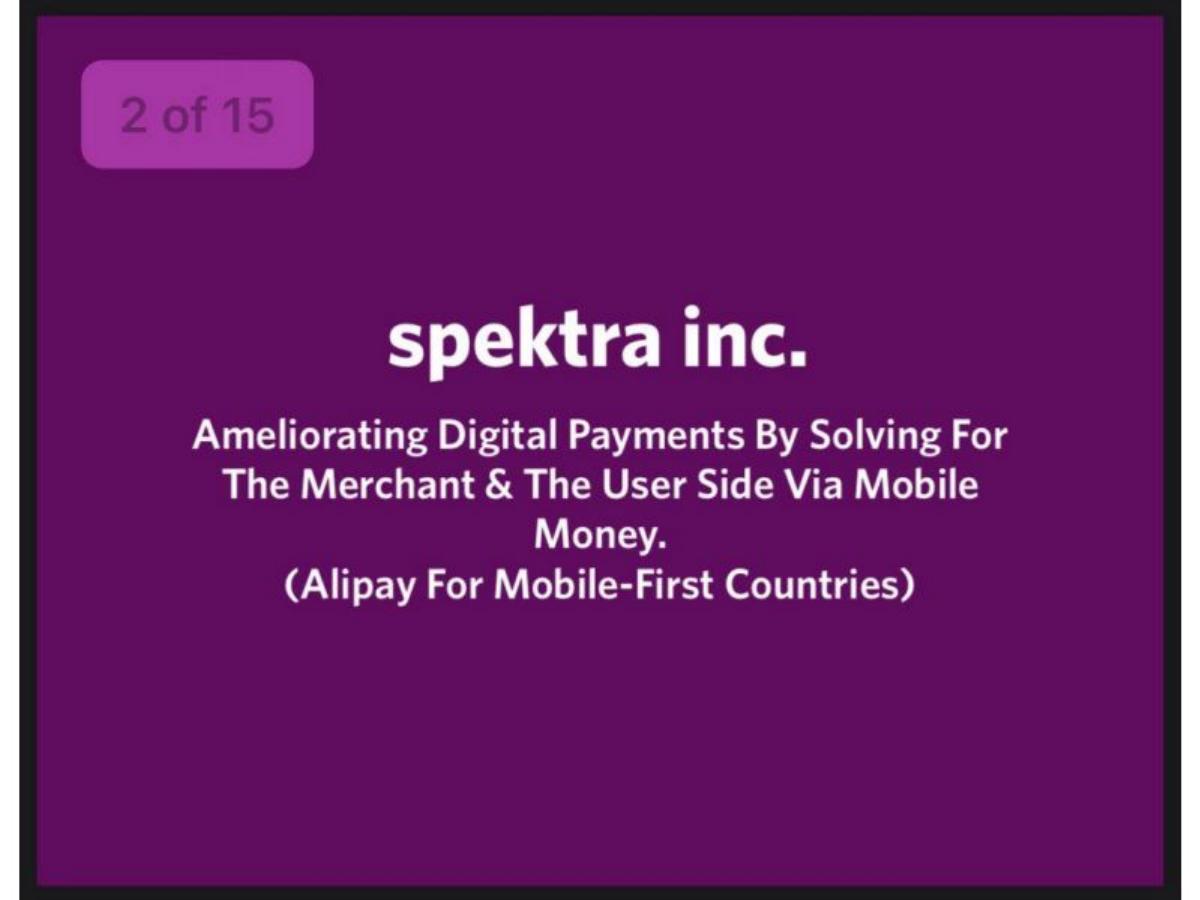
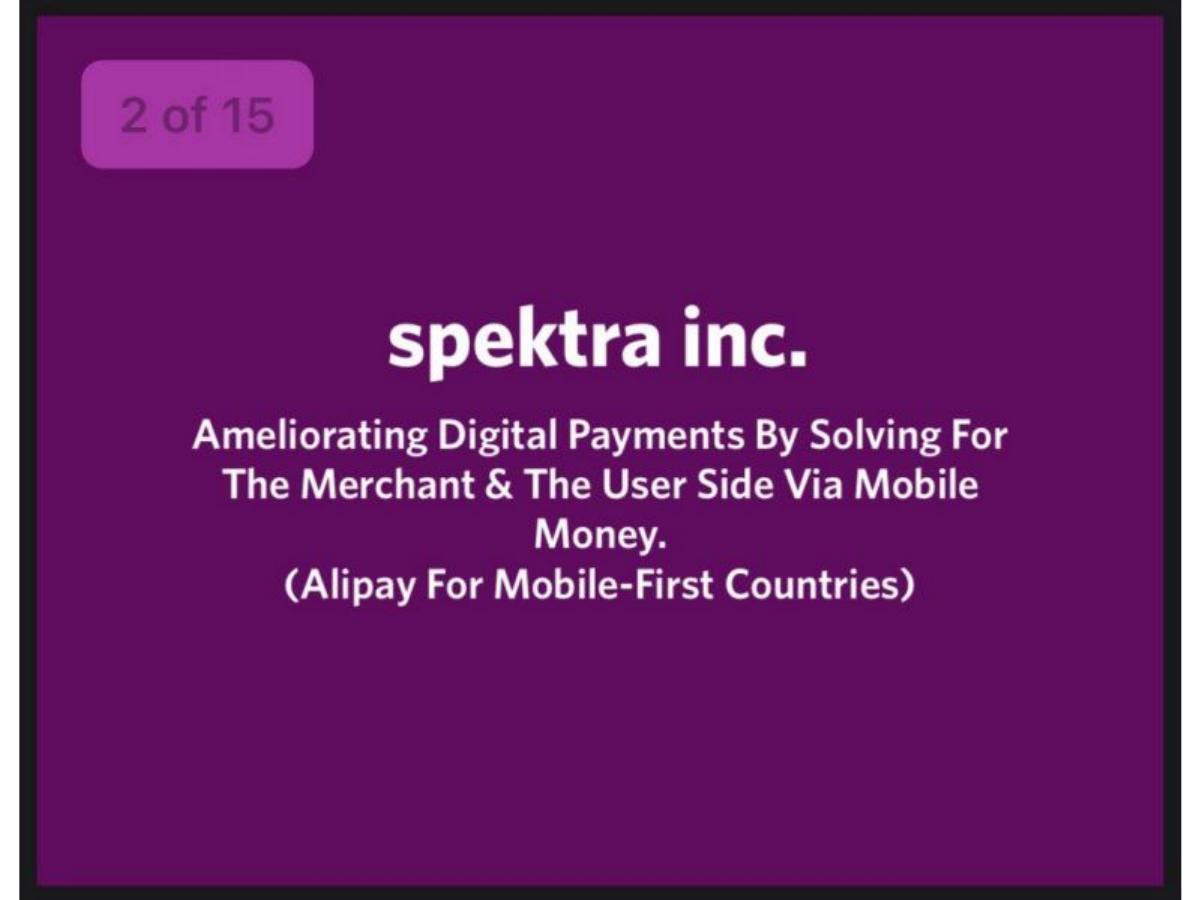
- The deck uses a powerful 'X for Y' analogy on slide 1, positioning the company as 'Alipay For Mobile-First Countries'.
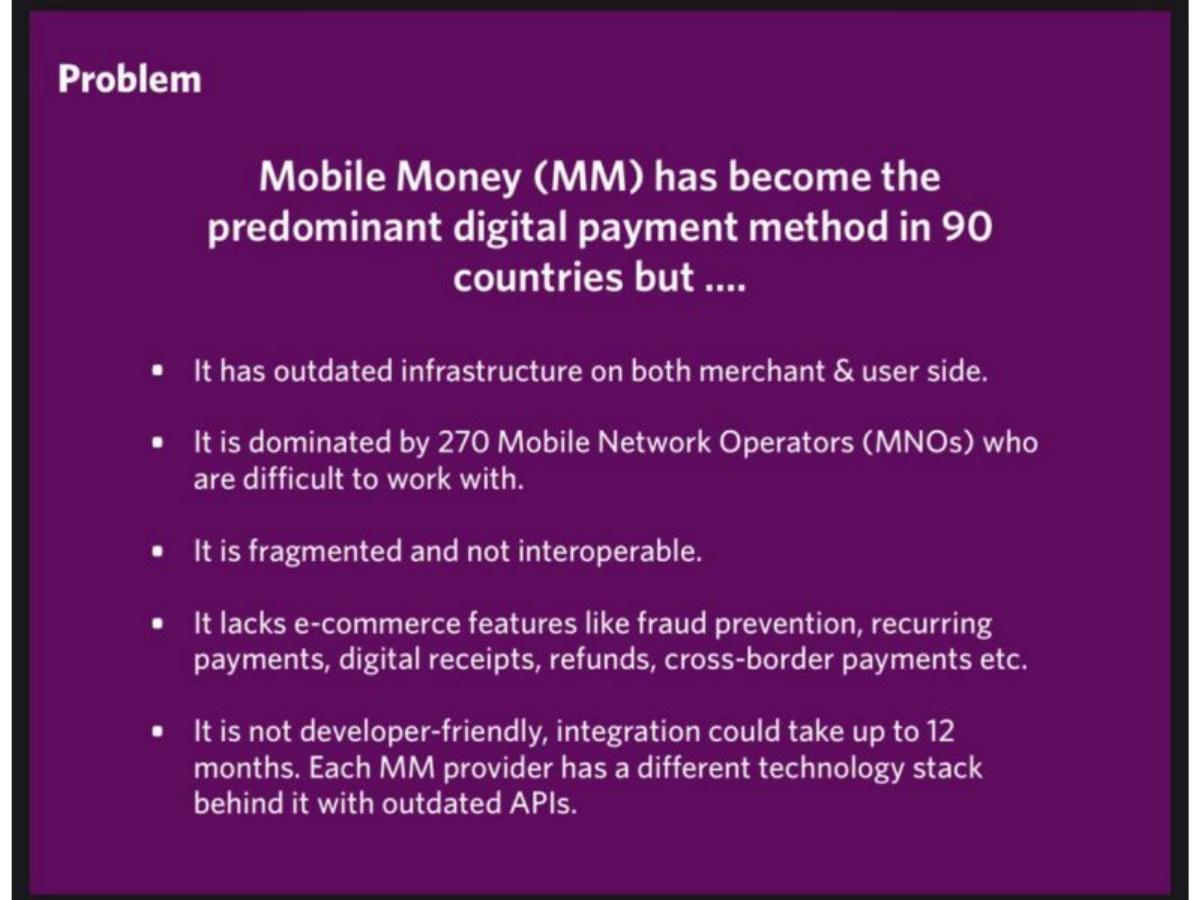
- Slide 2 identifies a specific technical bottleneck: 270 Mobile Network Operators (MNOs) creating a fragmented, non-interoperable ecosystem.
- Integration speed is a key value prop on slide 4, claiming a reduction from 12 months to just 10 minutes for merchants.
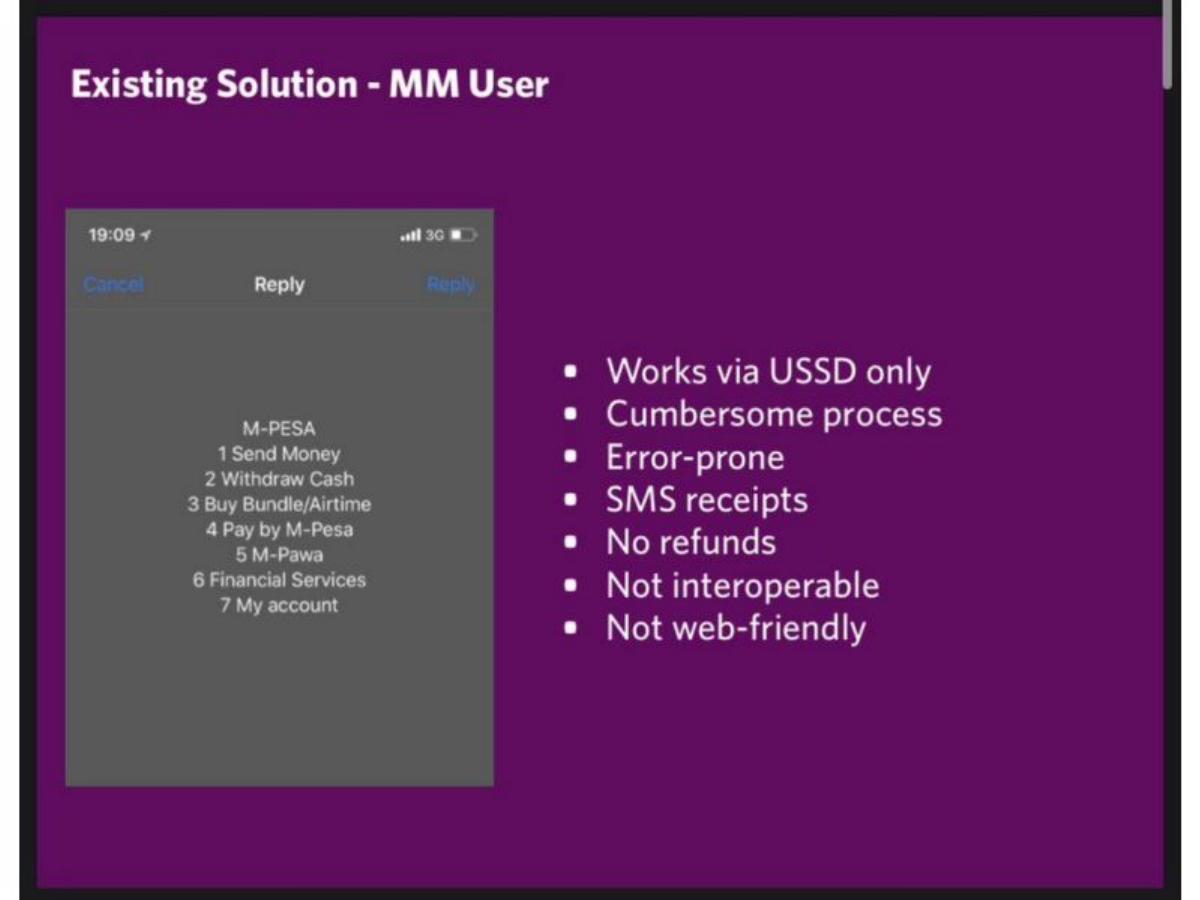
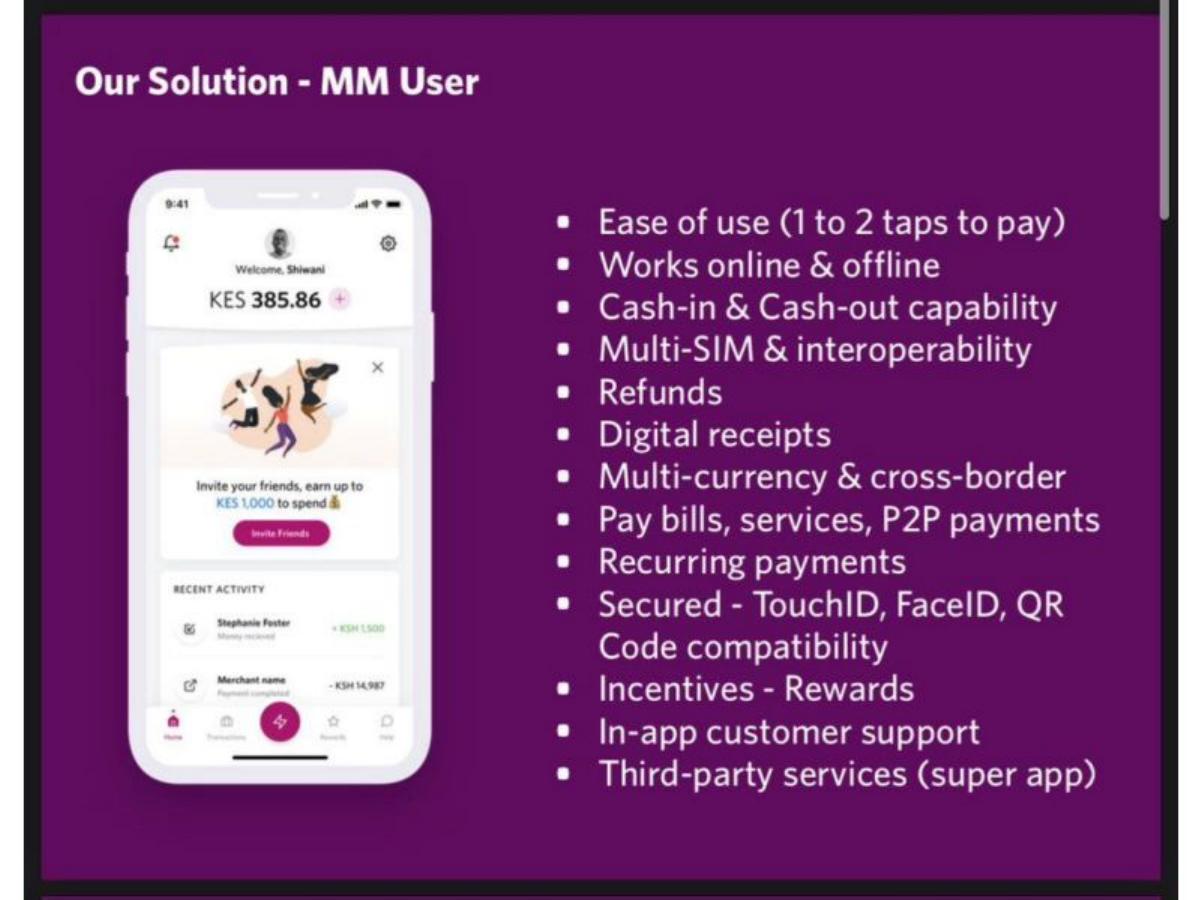
- The problem is visualized through screenshots of cumbersome USSD menus on slide 5, contrasting them with a modern app UI on slide 6.
- Market size is validated on slide 7 using 2017 GSMA data, citing $1 Billion in daily transactions across 690 million users.
- The competition slide (slide 8) is comprehensive, listing both local African players like Flutterwave and global giants like PayPal.
- Founder credibility is the deck's strongest asset, with slide 9 highlighting a previous Y Combinator (S16) founder/CEO role.
- The funding ask on slide 10 was originally $100,000 for regulatory clearance, though catalogue data indicates they eventually raised $500,000.
The Vision: Alipay for Africa
In 2018, the fintech landscape in Africa was characterized by high adoption of mobile money but low technical sophistication. Dash (then operating as Spektra) entered the market with a clear mission: to build a unified layer over the existing chaos. This teardown examines the 12-slide deck that articulated that vision and secured $500k in early-stage capital.
Slide 1: Title and High-Concept Pitch
The deck opens with a bold purple background and a clear sub-headline: "Ameliorating Digital Payments By Solving For The Merchant & The User Side Via Mobile Money." More importantly, it uses the high-concept pitch "(Alipay For Mobile-First Countries)" . This immediately tells an investor that the company aims to be a 'super app' that handles payments, commerce, and financial services in a region where traditional banking is bypassed by mobile-first solutions.
Slide 2: The Infrastructure Problem
Slide 2 identifies the core friction in the market. It notes that Mobile Money (MM) is the predominant payment method in 90 countries but suffers from "outdated infrastructure" and is "dominated by 270 Mobile Network Operators (MNOs) who are difficult to work with." The slide explicitly mentions that integration for developers can take up to 12 months due to fragmented technology stacks and outdated APIs. This sets the stage for a solution that simplifies this complexity.
Slide 3 & 4: The Merchant Experience Gap
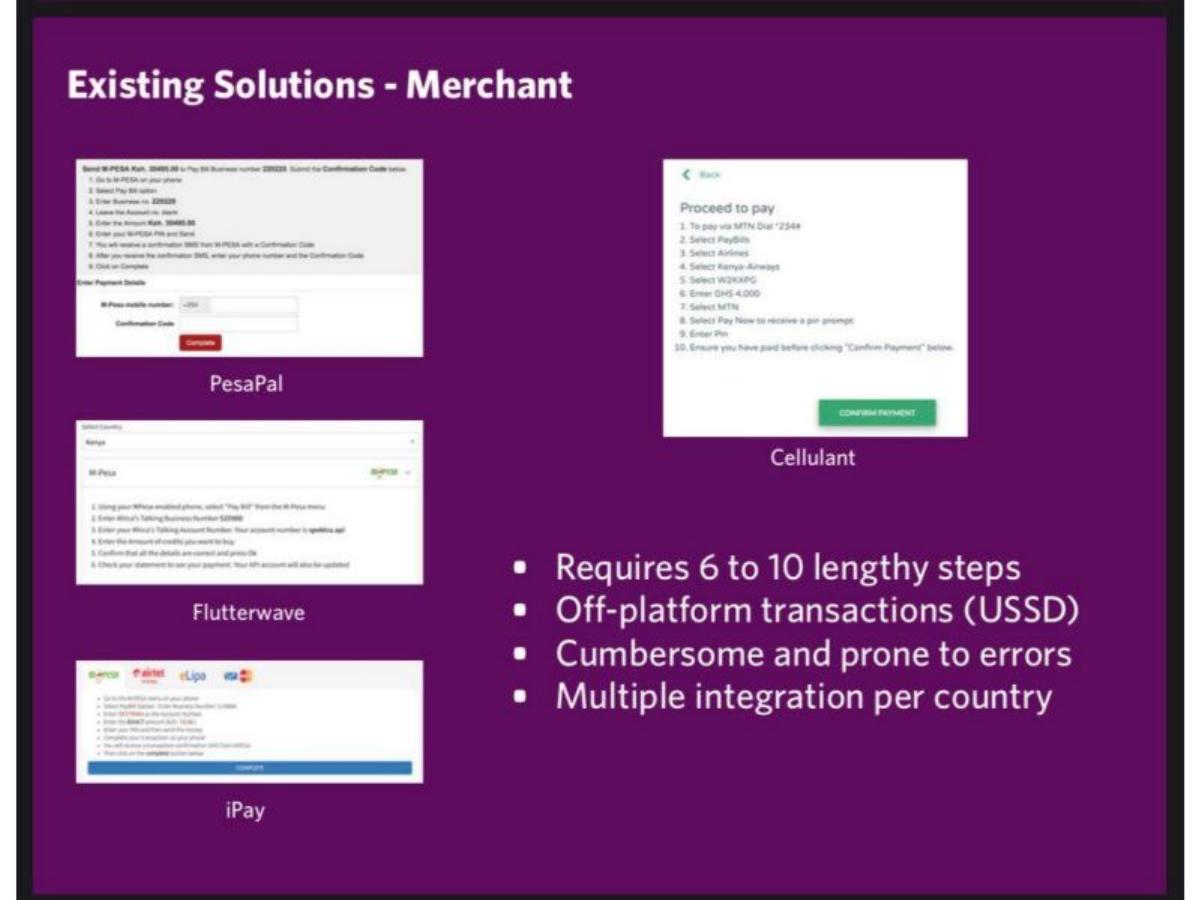
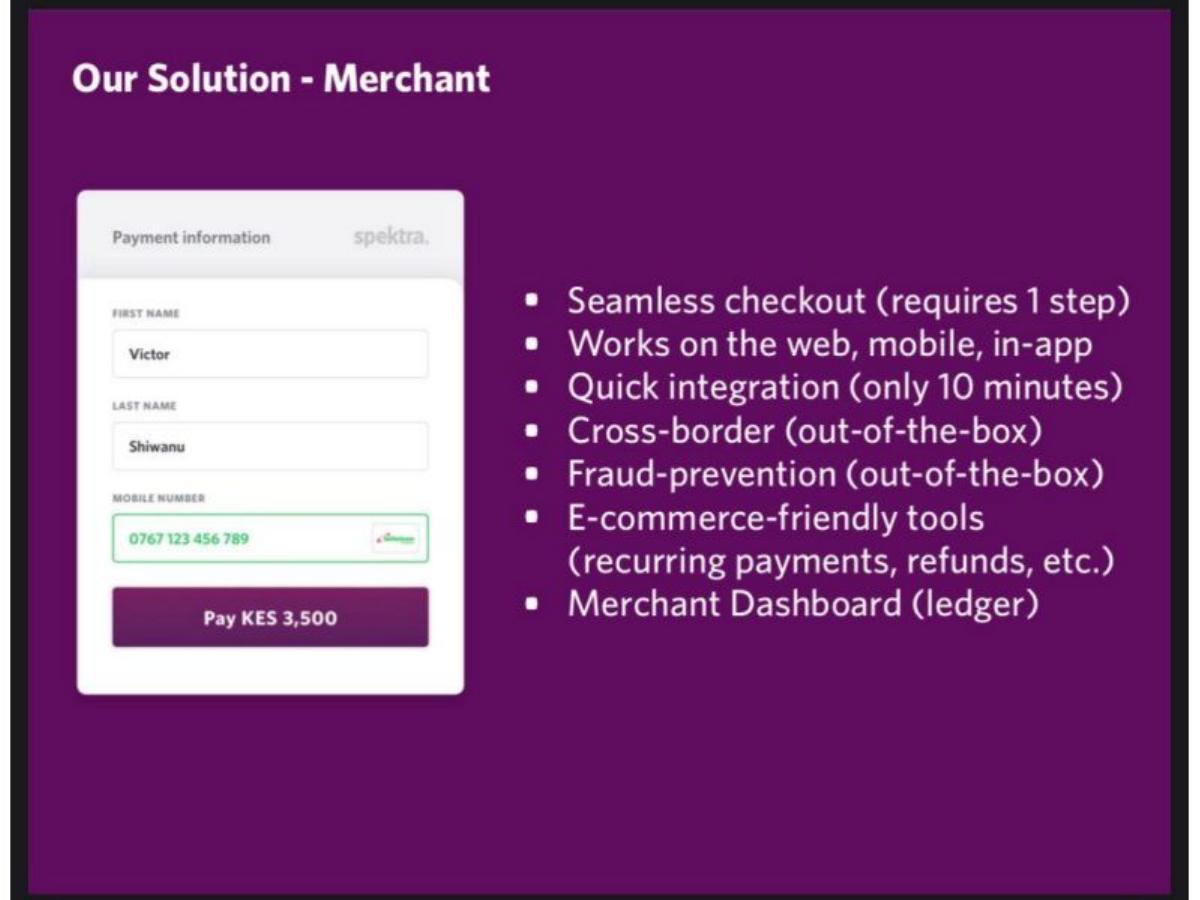
Slide 3, titled "Existing Solutions - Merchant," uses screenshots from competitors like PesaPal, Flutterwave, Cellulant, and iPay. It critiques them for requiring "6 to 10 lengthy steps" and relying on "off-platform transactions (USSD)." This is a classic 'before' state. Slide 4 presents the 'after' state: "Our Solution - Merchant." It promises a "1 step" checkout and a "10 minute" integration time. The contrast is sharp and focuses on efficiency and developer experience.
Slide 5 & 6: The User Experience Gap
The deck repeats this comparison for the consumer side. Slide 5 shows the "cumbersome process" of a standard USSD menu (the text-based interface used on older mobile phones). It lists flaws like "No refunds," "Not interoperable," and "Not web-friendly." Slide 6 introduces the Spektra app, which features a modern UI with "1 to 2 taps to pay," TouchID/FaceID security, and a rewards system. This slide effectively communicates the transition from a 1990s-style text interface to a 2010s-style smartphone experience.
Slide 7: Market Opportunity
To prove the scale, Slide 7 utilizes 2017 GSMA data. It highlights that "MM users transacted $1 Billion each day" and that there are "440 Million smartphone users in mobile-first countries." By citing a reputable source like the GSMA, the founders ground their ambitious claims in verifiable market reality. This slide answers the "Why now?" question by pointing to the rising tide of smartphone penetration.
Slide 8: Competitive Landscape
The competition slide is split into "Local Competitors" and "Global Competitors." It lists major players like Paystack, Flutterwave, and PesaPal on the local side, and PayPal, Mastercard, and Google Pay on the global side. While the slide doesn't include a feature-comparison matrix, listing these names shows that the founders are aware of the crowded field and are positioning themselves as the interoperable layer that connects these disparate services.
Slide 9: Team Pedigree
This is arguably the most important slide in a pre-seed deck. Prince Boakye Boampong is listed as the Founder & CEO with "12 Years Experience" as a software developer. Crucially, it mentions his previous role as Founder & CEO of OMG Digital, Inc (Y Combinator S16) . For a pre-seed investor, a founder who has already successfully navigated the YC ecosystem and built a company is a significantly lower risk than a first-time entrepreneur.
Slide 10: The Ask
Slide 10 outlines the "Funding Needs." It asks for "$100,000 Pre-Seed Funding" to get regulatory clearance and hit seed-funding milestones. It also notes that the founder had already invested $20,000 of his own money. While the slide asks for $100k, the catalogue data shows they closed $500k, suggesting that investor interest likely drove an oversubscription of the round.
What Works in This Deck
The Comparison Framework: By dedicating four slides (3 through 6) to direct 'Problem vs. Solution' visuals for both merchants and users, the deck makes the value proposition undeniable. · The 'Super App' Narrative: Using the Alipay analogy on the cover slide provides an immediate mental model for investors to understand the long-term scale of the project. · Founder-Market Fit: The team slide demonstrates both technical depth (12 years of dev experience) and entrepreneurial success (YC alum), which is the gold standard for early-stage fundraising.
What Is Missing
Business Model: There is no slide explaining how Dash intended to make money. While transaction fees are implied in fintech, a specific breakdown of take-rates or subscription fees for merchants is absent. · Unit Economics: There is no mention of Customer Acquisition Cost (CAC) or Lifetime Value (LTV). While expected to be thin at the pre-seed stage, some projection of how they would acquire users in a competitive market would have added depth. · Go-To-Market Strategy: The deck explains what they are building but not how they will get the first 10,000 users or 100 merchants. In a fragmented market, distribution is often harder than the technical build.
What a Founder Should Copy
The 10-Minute Rule: If your product solves a technical headache, quantify the time savings. Dash's claim of moving from a 12-month integration to a 10-minute one is a compelling hook for any investor. · Visualizing the 'Old Way': Don't just describe the problem; show it. The screenshot of the ugly USSD menu on slide 5 does more work than three paragraphs of text could ever do. · Lean Structure: At only 12 slides, the deck doesn't overstay its welcome. It hits the problem, the solution, the market, and the team, then stops.
Frequently asked questions
- What was the primary problem Dash aimed to solve?
- Dash addressed the fragmentation of Mobile Money (MM). According to slide 2, while MM was the predominant payment method in 90 countries, it was dominated by 270 difficult-to-work-with operators. This resulted in outdated infrastructure, a lack of interoperability, and a total absence of modern e-commerce features like recurring payments or digital receipts.
- How did Dash differentiate itself from existing merchant solutions?
- On slide 3, Dash pointed out that existing solutions like PesaPal and Flutterwave required 6 to 10 steps and often relied on off-platform USSD transactions. Slide 4 countered this by promising a 1-step seamless checkout, a merchant dashboard ledger, and 'out-of-the-box' fraud prevention and cross-border capabilities.
- What market data did the founders use to justify the opportunity?
- Slide 7 cites 2017 GSMA data to show the scale of the opportunity: 690 million mobile money users transacting $1 billion daily. It also highlights that there were 440 million smartphone users in these mobile-first countries, suggesting a massive audience ready to move from USSD to a smartphone-based 'super app'.
- Who was the founder and what was their background?
- The company was led by Prince Boakye Boampong. As shown on slide 9, he brought 12 years of software development experience and significant pedigree, having previously been the Founder and CEO of OMG Digital, Inc., which went through Y Combinator in the Summer 2016 batch.
- What was the initial funding goal versus the actual amount raised?
- Slide 10 lists a 'Funding Need' of $100,000 in pre-seed funding to get regulatory clearance and serve initial customers. However, the editorial context and catalogue facts from the listing confirm that the company successfully raised $500,000 in 2018.