DarioHealth (NASDAQ: DRIO) presents a mature digital health case centered on the transition from selling physical disposables to a high-margin 'SaaS of digital health' model. The deck highlights a $9M yearly sales run rate and a global footprint across six countries, with a specific focus on the ROI of $200 per user per month. By integrating a proprietary glucose monitor with real-time coaching and an open software platform, DarioHealth positions itself against competitors like Livongo and Omada. The presentation emphasizes regulatory readiness with four approvals and a robust executive team…
Key takeaways
- The company claims a concrete ROI of $200 per user per month for its digital health platform (Slide 2).
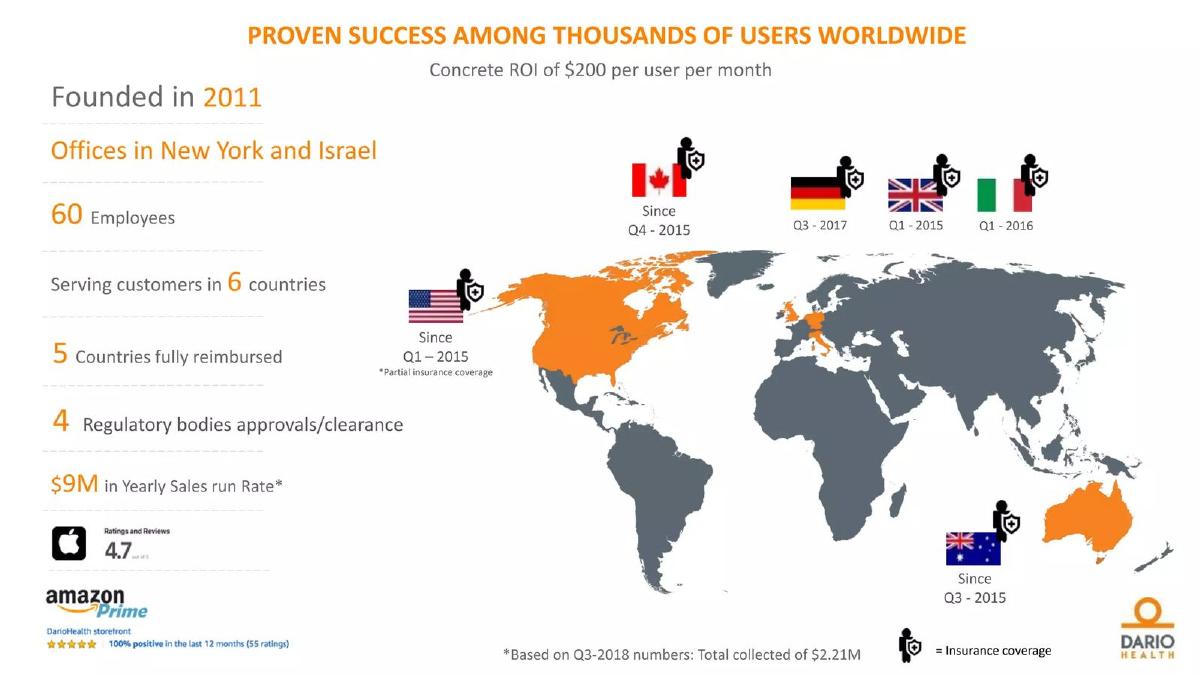
- DarioHealth reported a $9M yearly sales run rate based on Q3-2018 numbers, where they collected $2.21M (Slide 2).
- The product strategy is a 'Unique Experience' combining hardware, software, and digital/live coaching services (Slide 5).
- Competitive positioning highlights DarioHealth as the only provider offering a glucose monitor, app, open platform, and real-time coaching simultaneously (Slide 6).
- The business model is pivoting from selling disposables to a subscription-based 'Pro' and 'Premium' membership ranging from $25 to $70 per month (Slide 7).
- Long-term potential is calculated based on a $30 ARPU (Average Revenue Per User) model (Slide 9).
- The executive team includes a Medical Director who was the former Head of the Diabetes Unit at Hadassah University Hospital (Slide 10).
- Global expansion is already underway with reimbursement established in 5 countries and regulatory approvals from 4 bodies (Slide 2).
Slide-by-Slide Analysis
Slide 1: Title Slide
The cover slide establishes DarioHealth Corp. as a 'Global Digital Health Platform.' The imagery features a user in an outdoor setting interacting with a smartphone, surrounded by icons representing nutrition, activity, data tracking, and live support. Notably, the slide includes the 'NASDAQ: DRIO' ticker, signaling to investors that this is a public company presentation rather than an early-stage private pitch.
Slide 2: Proven Success and Traction
This is a data-heavy traction slide. It notes the company was founded in 2011 and has offices in New York and Israel with 60 employees. Key metrics include serving customers in 6 countries, full reimbursement in 5 countries, and 4 regulatory approvals. The financial highlight is a '$9M in Yearly Sales run Rate,' which a footnote clarifies is based on Q3-2018 numbers where $2.21M was collected. The slide also claims a 'Concrete ROI of $200 per user per month,' though the methodology for this ROI is not explained on this slide. Social proof is provided via a 4.7-star App Store rating and a 100% positive Amazon Prime storefront rating.
Slide 3 & 4: Transition Slides
Slide 3 ('Global market opportunity') and Slide 4 ('Product excellence') serve as section headers to organize the narrative flow of the presentation. They contain no data.
Slide 5: The Unique Experience
This slide visualizes the 'Combination Hardware, Software & Service' model. It shows the physical Dario glucose monitor plugged into a smartphone, the user interface of the app, and a professional coach on a laptop. The tagline 'REAL TIME – RIGHT TIME' emphasizes the immediacy of the data loop between the patient's physical testing and the digital/live coaching intervention.
Slide 6: Competitive Landscape
DarioHealth uses a standard 'check-mark' grid to compare itself against Livongo, mySugr, Glooko, WellDoc, and Omada. The categories are Glucose Monitor, App, Open Platform, and Real-Time Coaching. DarioHealth is the only company with 'Yes' in all four columns. Notably, it points out that Livongo uses a 'Dedicated handset' while Dario integrates with the user's existing smartphone, and that most other competitors lack a proprietary hardware component or real-time coaching features.
Slide 7: The Business Model Pivot
This slide is critical for the 'fundability' narrative. It explicitly states the strategy: 'Transforming the business from selling disposables to selling full package with physical and digital service.' It presents three membership tiers: Membership ($25/mo), Pro ($33/mo), and Premium ($70/mo). The 'Pro' plan is highlighted as the most popular. The shift is described as 'SAAS of the digital health, with higher contribution,' indicating a move toward recurring revenue and better margins than traditional medical device sales.
Slide 8: User Testimonials
The deck uses two personas, 'Ross' and 'Debbie,' to illustrate clinical and practical utility. Ross, a Type 1 Diabetic for 25 years, claims his HbA1C levels dropped from a 9-12 range to a 7.3-8.5 range using Dario. Debbie uses the device to monitor her handicapped son in real-time. These testimonials serve to humanize the data and provide anecdotal evidence of the 'Real-Time' value proposition mentioned earlier.
Slide 9: Long Term Potential
This slide presents a 'top-down' market analysis. It calculates revenue based on a 1% market share. For the US (30.3M people), 1% equals $120M. For the worldwide market (480M people), 1% equals $1.8B. A third calculation shows that 250K users would equal $100M in revenue. A footnote states these models assume a '$30 ARPU' (Average Revenue Per User), which aligns with the pricing tiers shown on Slide 7.
Slide 10: Executive Team and Board
The final slide in this selection showcases a 14-person team of executives and board members. Key figures include CEO Erez Raphael (20 years in systems/software), Chairman Yoav Shaked (formerly of Sequoia Capital), and Medical Director Professor Itamar Raz (former head of the Israeli National Council of Diabetes). The team includes specialists in clinical/regulatory affairs, marketing, and software, suggesting a balanced leadership structure capable of handling the complexities of a regulated health-tech business.
What DarioHealth Does Well
Clear Strategic Pivot: The deck does an excellent job of explaining why the business model is changing. By framing the shift from 'disposables' to 'SaaS,' they speak the language of modern investors who value recurring revenue and high margins over one-off hardware sales.
Regulatory and Reimbursement Clarity: In the healthcare space, 'regulatory bodies' and 'reimbursement' are the two biggest hurdles. Slide 2 addresses these head-on, showing that the company has already cleared these bars in multiple major markets, which significantly de-risks the investment.
Integrated Competitive Advantage: The competitive grid on Slide 6 is effective because it focuses on 'Open Platform' and 'Hardware Integration.' By showing that competitors often lack one or the other, DarioHealth positions itself as the only 'all-in-one' solution that fits into a user's existing digital life (via their smartphone) rather than requiring a separate, clunky medical device.
What is Missing from the Deck
Unit Economics: While the deck mentions a $30 ARPU and a $200 monthly ROI for the user/payer, it does not disclose the Customer Acquisition Cost (CAC) or the Lifetime Value (LTV). For a SaaS-style model, these metrics are essential to prove that the growth is sustainable and profitable.
Clinical Validation Details: Slide 8 provides two anecdotes, but for a company with a Medical Director and a VP of Clinical Affairs, the deck lacks a summary of peer-reviewed studies or large-scale clinical trial data. Investors in the health space usually require more than two testimonials to believe in the efficacy of a chronic disease management platform.
Specific Use of Funds: As this appears to be a general investor update or pitch, there is no 'Ask' slide in this 10-slide selection. It is unclear how much capital is being raised or exactly how that capital will be deployed to reach the 1% market share goals mentioned on Slide 9.
Founder Takeaways: What to Copy
The 'Hybrid' Model Narrative: If your startup involves hardware, follow DarioHealth's lead by emphasizing the software and service layers. Hardware is often seen as a 'commodity' or a 'burden' by investors; software and coaching are seen as 'scalability' and 'retention.'
Visualizing the Ecosystem: Slide 5 is a great example of how to show a complex product ecosystem (hardware + mobile app + desktop dashboard + human coach) in a single, easy-to-understand graphic. It avoids technical jargon and focuses on the 'Real Time' experience.
Top-Down Market Math with a Bottoms-Up Anchor: On Slide 9, the company doesn't just say 'the market is billions.' They anchor the billion-dollar projection to a specific, achievable ARPU ($30). This makes the massive numbers feel more grounded in the reality of their current subscription pricing.
Frequently asked questions
- What is DarioHealth's core product offering?
- DarioHealth offers a 'Global Digital Health Platform' that integrates proprietary hardware (a pocket-sized glucose monitor that connects to a smartphone), a mobile app for tracking and insulin calculation, and a service layer providing digital and live coaching. This combination is designed to provide real-time data to both the user and their healthcare providers.
- How does DarioHealth generate revenue?
- The company is transitioning to a SaaS-based membership model. As shown on slide 7, they offer three tiers: a basic Membership at $25/month, a Pro Membership at $33/month, and a Premium Membership at $70/month. These plans include the hardware, unlimited test strips, and varying levels of live coaching and expert guidance from Certified Diabetes Educators (CDE).
- What is the company's current scale and reach?
- As of the 2019 deck, DarioHealth was founded in 2011, employed 60 people, and operated in 6 countries. They held 4 regulatory approvals and were fully reimbursed in 5 countries. Financially, they stated a $9M yearly sales run rate based on Q3-2018 collections of $2.21M.
- Who are DarioHealth's primary competitors?
- The deck identifies several competitors in the diabetes management space, including Livongo, mySugr, Glooko, WellDoc, and Omada. DarioHealth differentiates itself by being the only one in their comparison table to offer the full stack: a proprietary monitor, a mobile app, an open platform, and real-time coaching.
- What are the key growth drivers mentioned in the deck?
- Growth is driven by market penetration in the US and worldwide. The deck projects that capturing just 1% of the US market (30.3M people) would result in $120M in revenue, while 1% of the global market (480M people) would yield $1.8B, assuming a $30 Average Revenue Per User (ARPU).