Daisy’s 9-slide Seed deck is a masterclass in brevity and traction-first storytelling. The company, which raised $3.9M in 2024 as reported by Business Insider, positions itself as the 'connective tissue' between influencer and performance marketing. By automating how verified creators engage with brand content—via comments, story shares, and reposts—Daisy solves the scalability issue of traditional influencer campaigns. The deck leans heavily on early momentum, citing $120k+ in monthly recurring revenue and a network of 1,200 registered creators with an aggregate reach of 500 million. While i…
Key takeaways
- The platform reports $120k+ in monthly recurring revenue (MRR) as of the time of the pitch (Slide 7).
- Daisy has built a network of 1,200 registered creators with an aggregate reach of 500 million followers (Slide 7).
- Engagement is high, with 70% of users performing a 'boost' within 4 hours of becoming eligible (Slide 8).
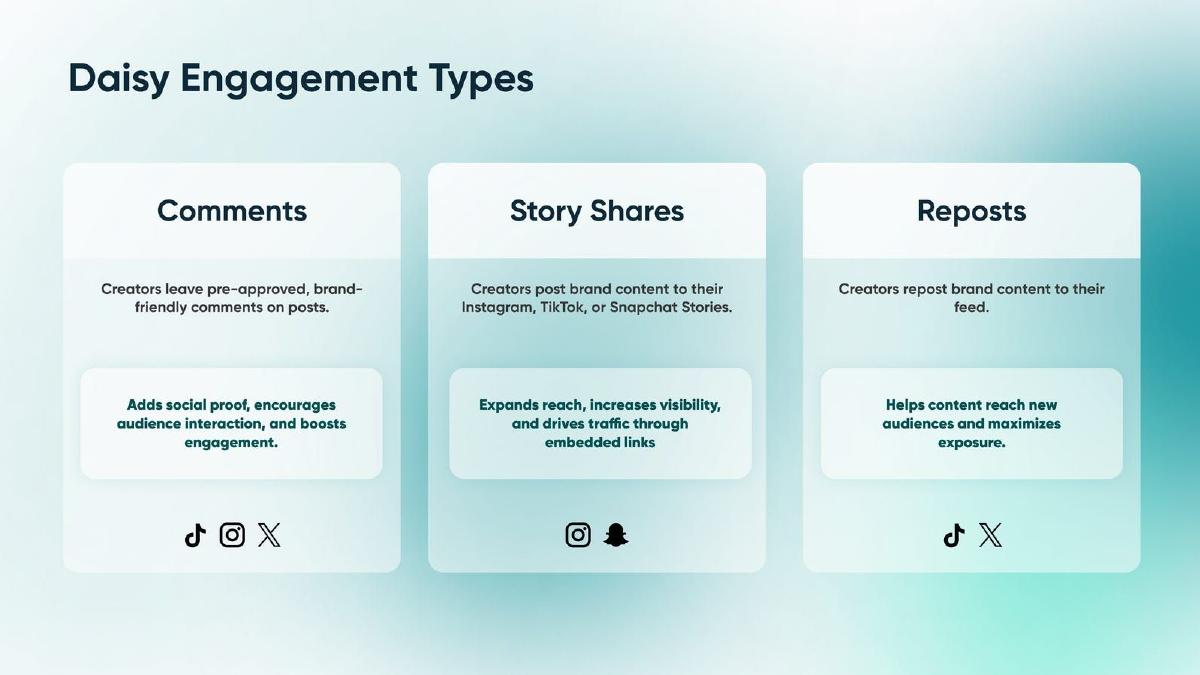
- The deck defines three core engagement types: Comments, Story Shares, and Reposts across Instagram, TikTok, Snapchat, and X (Slide 6).
- Growth metrics show a 300% increase in lifetime creator payouts and a 400% increase in earnings per top booster between October and January (Slide 9).
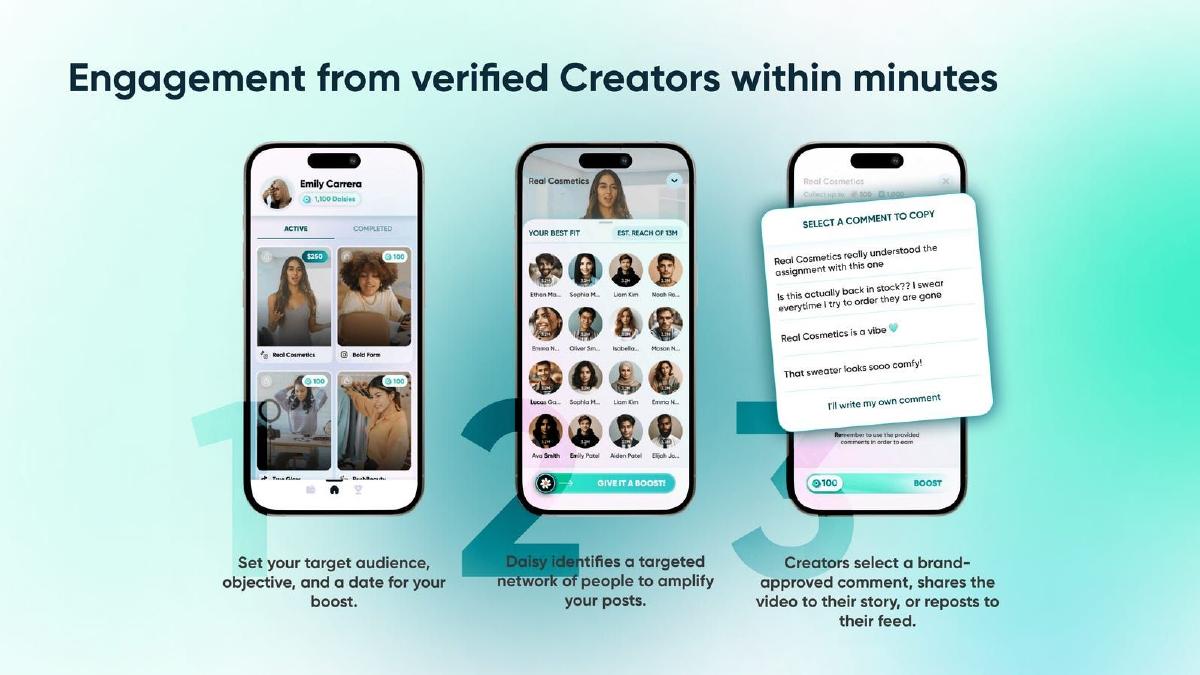
- The product workflow is simplified into a three-step process: targeting, identification, and creator action (Slide 4).
- The deck completely omits a team slide, a competitive landscape analysis, and a formal 'Ask' slide detailing the use of funds.
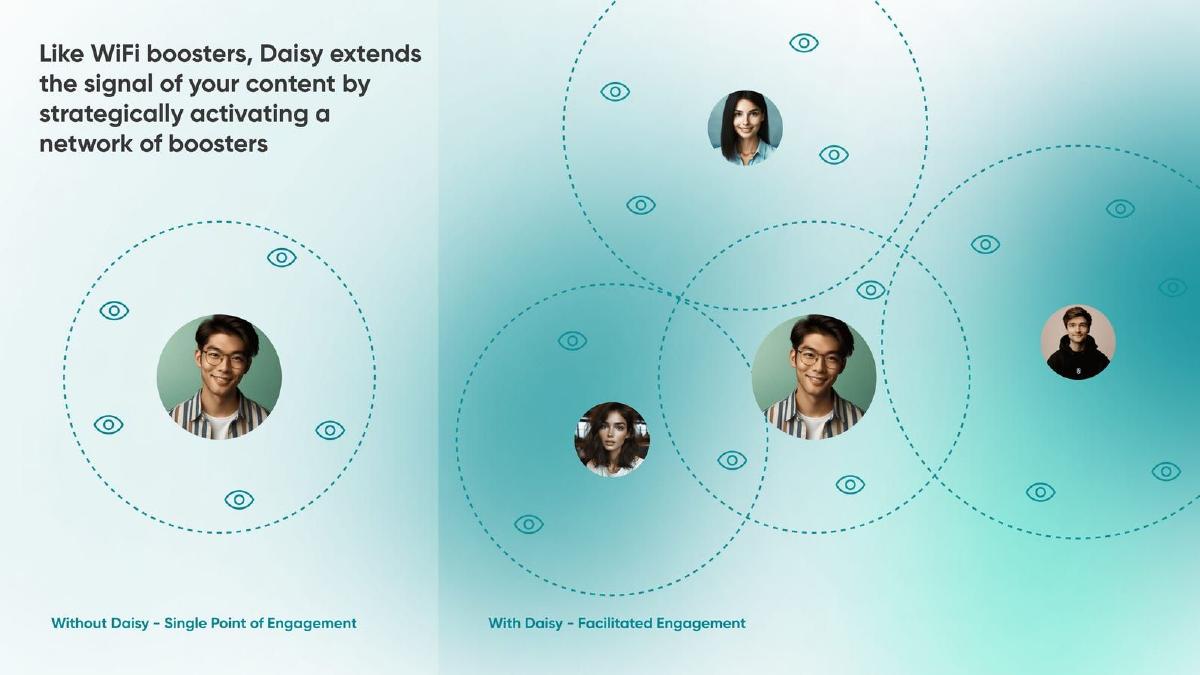
- Daisy uses a 'WiFi booster' analogy to explain how they extend the signal of brand content through facilitated engagement (Slide 3).
The 9-Slide Traction Play: Daisy’s $3.9M Seed Deck
Daisy, a Nashville-based startup, secured $3.9M in Seed funding in 2024. The deck they used is remarkably short, consisting of only nine slides. In an era where pitch decks often bloat to 20+ pages, Daisy’s approach is a reminder that strong traction metrics can often speak louder than exhaustive market research or complex technical diagrams. The deck focuses almost exclusively on the product’s mechanics and the immediate results it has generated for both brands and creators.
Slide 1-2: Branding and Visual Identity
The deck opens with a minimalist title slide featuring the Daisy logo—a simple white flower on a teal gradient background. Slide 2 repeats this branding with a centered logo. There is no mission statement or 'one-liner' on these initial slides, which is a bold choice that relies on the subsequent slides to immediately deliver the value proposition.
Slide 3: The WiFi Booster Analogy
Slide 3 introduces the core concept of 'Social Syndication.' It uses a simple analogy: 'Like WiFi boosters, Daisy extends the signal of your content by strategically activating a network of boosters.' The slide features a visual comparison between 'Without Daisy' (a single point of engagement) and 'With Daisy' (facilitated engagement through multiple nodes). This is an effective way to explain a complex programmatic advertising concept through a familiar physical world metaphor.
Slide 4: The Three-Step Workflow
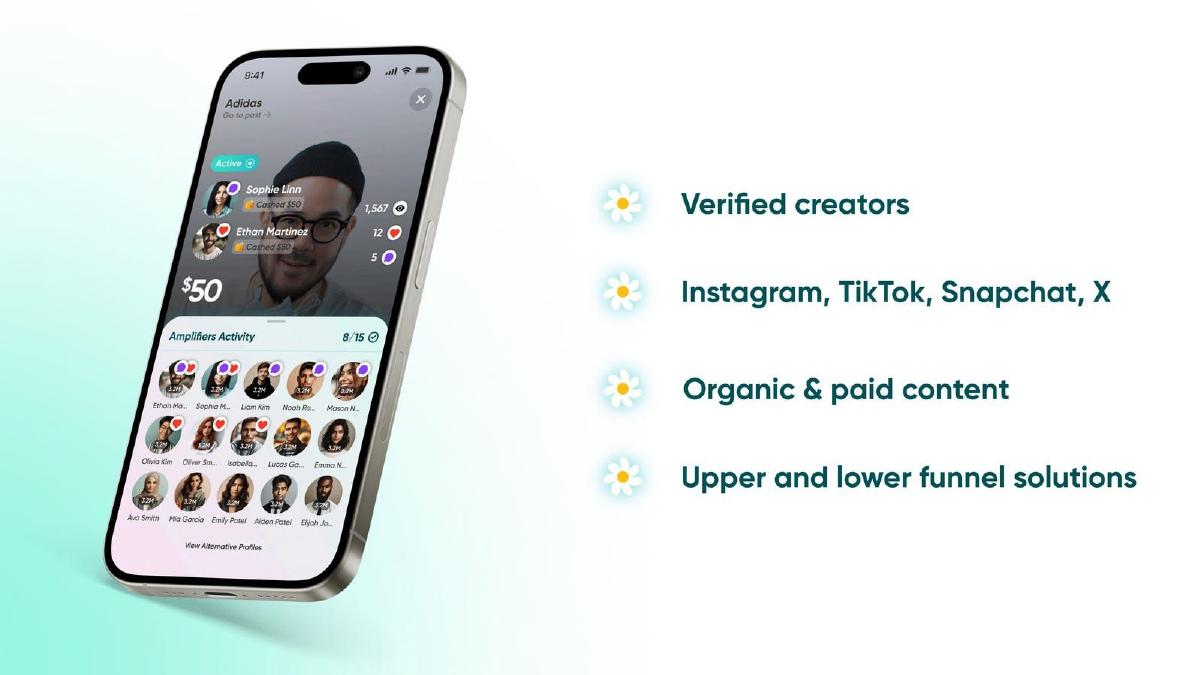
This slide breaks down the user experience for the brand. It outlines a three-step process: 1) Set your target audience, objective, and date. 2) Daisy identifies a targeted network of people to amplify your posts. 3) Creators select a brand-approved comment, share the video to their story, or repost to their feed. The visual includes a mobile app mockup showing a 'Select a comment to copy' interface, which highlights the platform's focus on brand safety and ease of use for the creator.
Slide 5: Positioning the 'Connective Tissue'
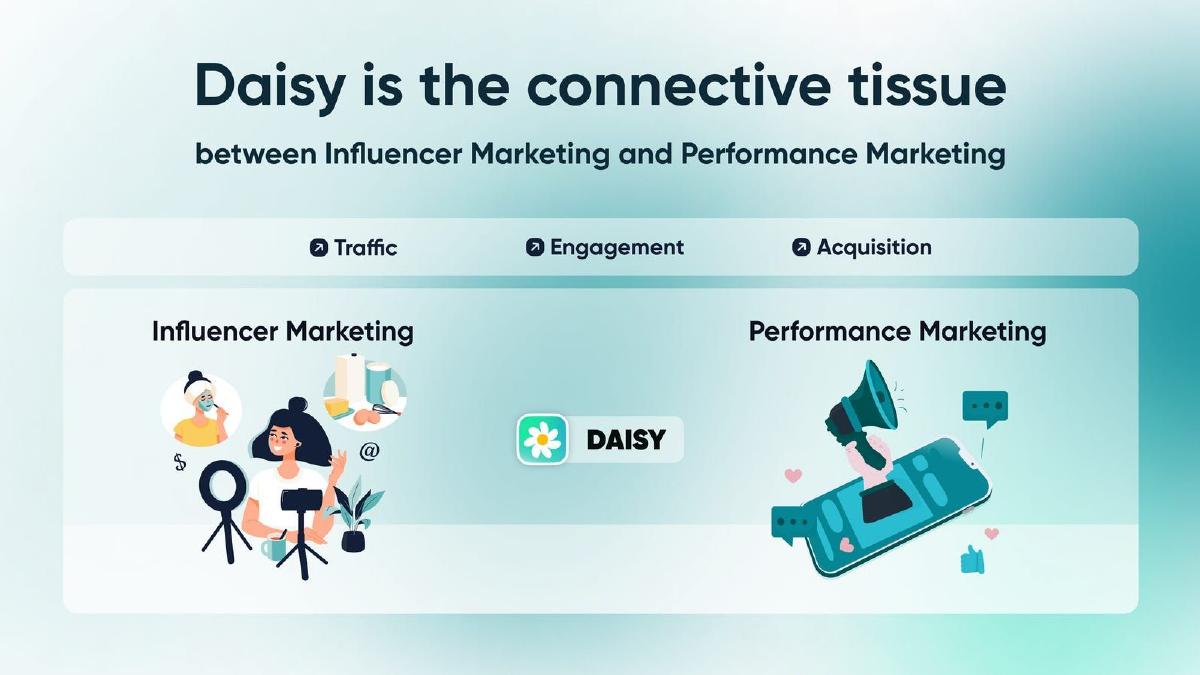
Slide 5 provides the strategic 'Why.' It positions Daisy as the 'connective tissue between Influencer Marketing and Performance Marketing.' It maps out three goals—Traffic, Engagement, and Acquisition—and shows how Daisy sits in the middle of these two multi-billion dollar industries. This slide is crucial for investors because it defines the market category Daisy intends to own: programmatic influencer engagement.
Slide 6: Engagement Types and Platforms
This slide details exactly what the product does. It lists three engagement types: Comments (for social proof), Story Shares (for reach and traffic), and Reposts (for new audiences). It also lists the supported platforms: TikTok, Instagram, X (formerly Twitter), and Snapchat. By explicitly stating that comments are 'pre-approved' and 'brand-friendly,' Daisy addresses a major pain point in influencer marketing: the risk of off-brand or negative creator interactions.
Slide 7: The Traction Slide
This is the 'money slide' of the deck. It presents four massive figures: $120k+ Monthly recurring revenue , 1,200 Creators registered , 50+ Live boost campaigns per month , and 20k+ Boost actions facilitated . It also mentions an aggregate reach of 500M followers. For a Seed round, $120k in MRR is an exceptionally strong signal of product-market fit, likely making the rest of the fundraising process significantly easier.
Slide 8: User Activity and Demographics
Slide 8 dives deeper into the creator side of the marketplace. It claims that 70% of users boost within 4 hours of eligibility , indicating high engagement and a 'sticky' product. It also notes that 100+ users boost more than once per week. A donut chart breaks down the follower counts of Daisy users: 57.9% have less than 50k followers, 24.6% have 50k to 500k, and 17.4% have over 500k. This shows that the platform is not just for 'micro-influencers' but has managed to attract significant creators as well.
Slide 9: Growth Momentum
The final slide focuses on recent growth from October to January. It shows an 87% increase in user growth , a 300% increase in lifetime creator payouts , and a 400% increase in earnings per top booster . These metrics are designed to show that the ecosystem is healthy; as more brands spend, creators earn more, which in turn attracts more creators. It’s a classic flywheel demonstration.
What Works in the Daisy Deck
Clarity of Product: By Slide 4, any investor understands exactly how the app works. There is no ambiguity about the 'how' or the 'what.' The use of app mockups to show the 'Select a comment' feature is a great way to demonstrate brand safety without using a wall of text.
Traction-First Strategy: Daisy leads with its strengths. With $120k+ in MRR (Slide 7), they don't need to spend five slides talking about how big the social media market is. They prove the market exists by showing people are already paying for the solution.
Speed of Engagement: The metric that 70% of users act within 4 hours (Slide 8) is a powerful indicator of a highly responsive network. For brands, this translates to 'virality on demand,' which is a highly sellable value proposition.
What is Missing from the Daisy Deck
The Team Slide: Perhaps the most glaring omission is the lack of a team slide. Investors at the Seed stage typically invest in people as much as products. While the traction likely compensated for this, it is highly unusual to omit the founders' backgrounds entirely.
Competitive Landscape: The deck does not mention competitors like Glewee, Aspire, or Grin. It assumes the investor is either already aware of the space or that Daisy’s 'Social Syndication' model is sufficiently unique to not require a comparison.
The Ask: There is no slide detailing how much money is being raised or how it will be spent. While we know from publisher reports that they raised $3.9M, the deck itself doesn't outline the roadmap for this capital (e.g., hiring, engineering, sales expansion).
Unit Economics: While MRR is stated, there is no mention of Customer Acquisition Cost (CAC) or Lifetime Value (LTV). For a platform that bridges performance marketing, investors would eventually want to see the efficiency of their own growth engine.
What Founders Should Copy
The Analogy Slide: Use a simple, non-technical analogy (like the WiFi booster on Slide 3) to explain your product's core function. It anchors the investor's understanding before you dive into the data.
Visualizing the Workflow: The 1-2-3 step breakdown on Slide 4 is a perfect template for any SaaS or marketplace startup. It removes the 'black box' feel of the technology.
Focusing on the 'Earning' Side: If you run a marketplace, show that your supply side (creators, in this case) is making more money over time. The 400% increase in earnings per top booster (Slide 9) is a fantastic way to prove that your platform provides real value to its users, which ensures long-term retention.
Brevity: If your metrics are strong, don't bury them. Daisy’s deck is proof that you can raise millions with fewer than 10 slides if the numbers are undeniable.
Frequently asked questions
- How does Daisy differentiate between influencer and performance marketing?
- On Slide 5, Daisy positions itself as the 'connective tissue' between the two. It suggests that while influencer marketing traditionally focuses on content creation, Daisy applies performance marketing principles—like traffic, engagement, and acquisition—to creator actions, making influencer engagement programmatic and measurable.
- What specific actions do creators take on the Daisy platform?
- According to Slide 6, there are three primary engagement types. Creators leave pre-approved, brand-friendly comments to add social proof; they share brand content to their Instagram, TikTok, or Snapchat Stories to drive traffic; and they repost brand content to their feeds to maximize exposure.
- What is the scale of the creator network mentioned in the deck?
- Slide 7 notes that Daisy has 1,200 registered creators. These creators range from 10k to 10M followers each. Slide 8 further breaks down the demographics, showing that 57.9% of users have fewer than 50k followers, while 17.4% have over 500k followers.
- What are the key growth indicators shown in the deck?
- Slide 9 highlights significant growth from October to January, including an 87% increase in user growth, a 300% increase in lifetime creator payouts, and a 400% increase in earnings per top booster. This suggests the platform is becoming a more significant income source for its most active users.
- Does the deck explain how the technology works?
- Slide 4 provides a high-level overview of the three-step process: brands set their target audience and objective; Daisy’s system identifies a targeted network of people to amplify the post; and creators select from brand-approved actions (like comments or shares) to earn rewards.