CollateralEdge's 2021 Seed deck is a masterclass in founder-market fit for the fintech sector. By focusing on a specific friction point in middle-market lending—where banks must often reject qualified borrowers due to rigid downside protection cushions—the company proposes a risk-transfer model that keeps the bank as the sole lender. The deck successfully leverages the founders' 40+ years of combined experience at institutions like Credit Suisse and Goldman Sachs to build immediate credibility. While the deck is light on specific unit economics and a formal 'ask' slide, it excels at defining…
Key takeaways
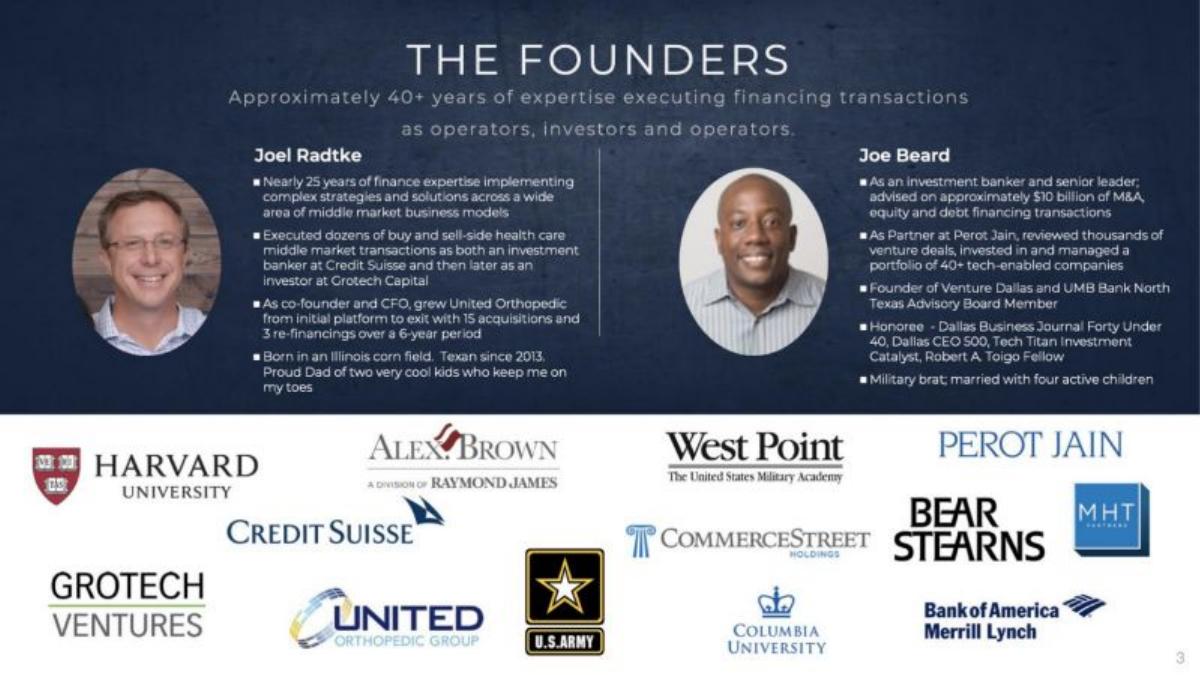
- The founders emphasize 40+ years of expertise in executing financing transactions to establish authority (Slide 3).
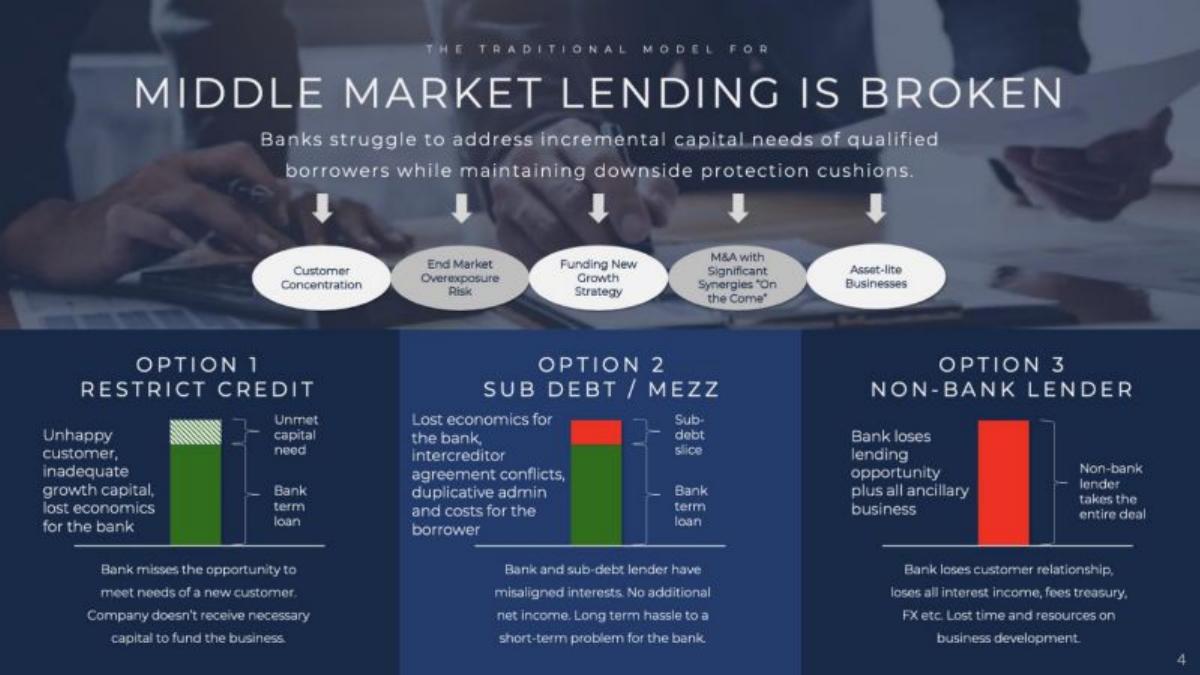
- The problem is defined as a 'broken' middle-market lending model where banks lose deals to non-bank lenders or restrict credit due to concentration risks (Slide 4).
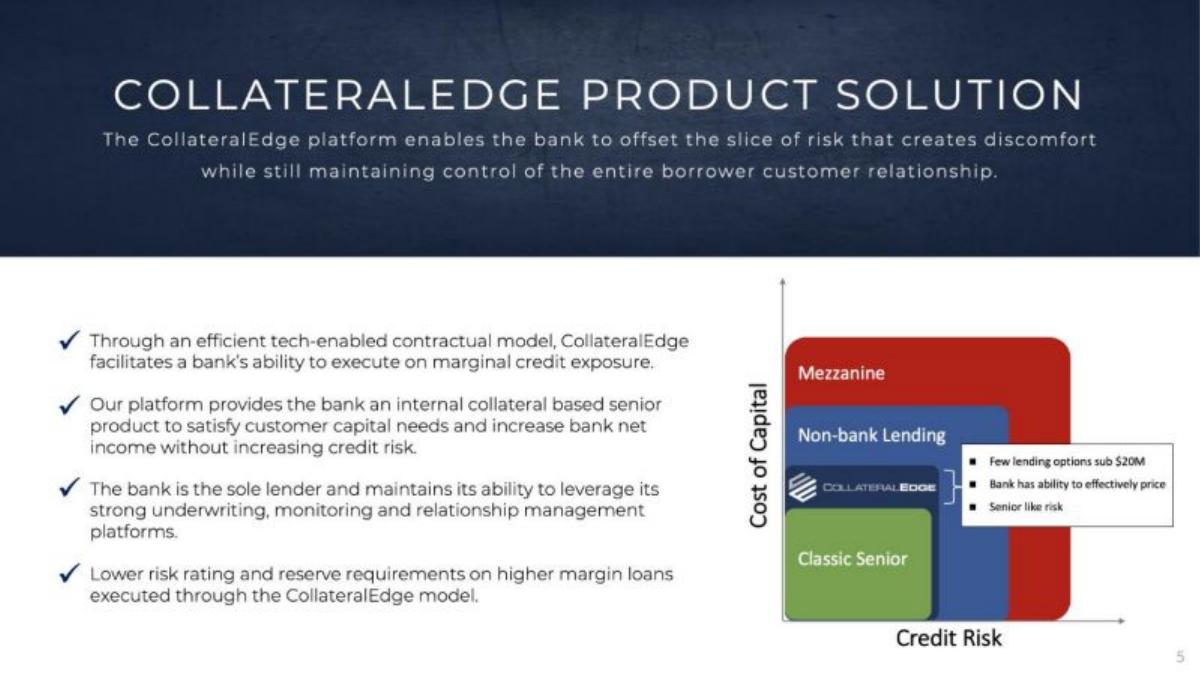
- The solution positions CollateralEdge as a way for banks to offset a 'slice of risk' while maintaining the full customer relationship (Slide 5).
- The platform targets the $2.6 trillion US C&I loan market, specifically banks with $1B to $50B in assets (Slide 8).
- CollateralEdge limits its own exposure by only covering up to 20% of a loan, ensuring the bank retains significant capital at risk (Slide 7).
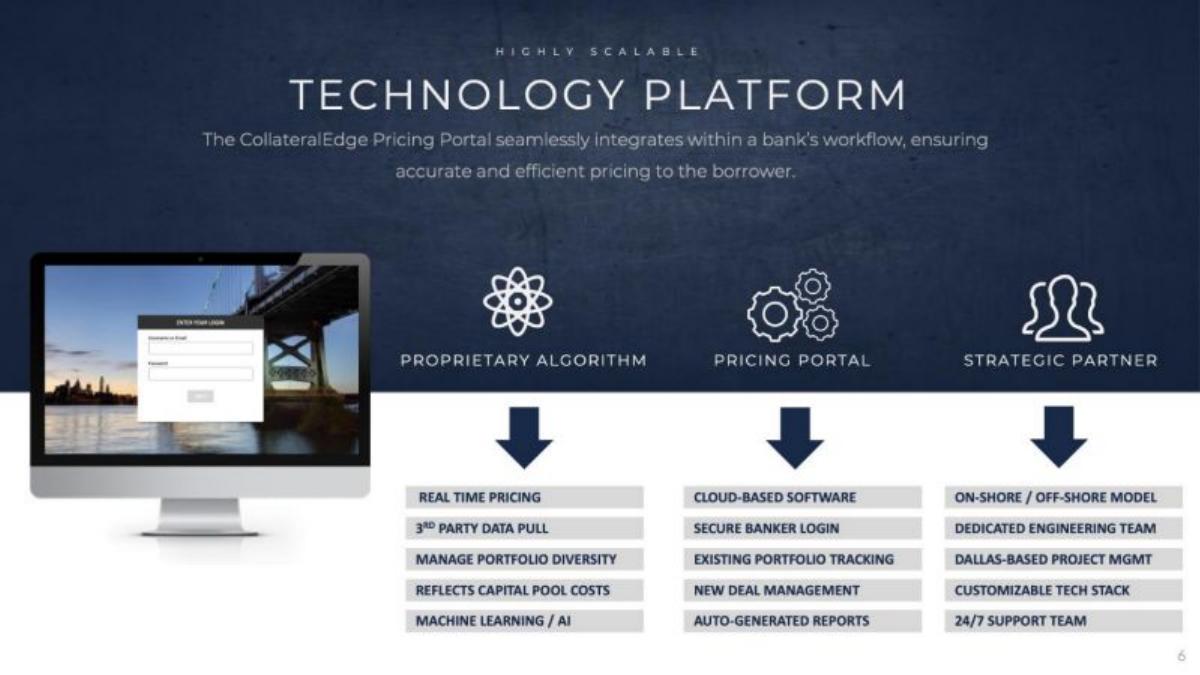
- The technology stack includes a proprietary pricing portal and machine learning for real-time pricing (Slide 6).
- The deck omits a specific financial 'Ask' slide, though catalogue data indicates a $3.5M Seed round was raised.
- The business model relies on 'Bank Channel Partnerships' to source lower middle-market loans (Slide 10).
Executive Summary: A Specialized Solution for a Trillion-Dollar Friction Point
CollateralEdge entered the market in 2021 with a highly specialized value proposition: helping regional and community banks compete with aggressive non-bank lenders without increasing their risk profile. The deck for their $3.5M Seed round is a professional, institutional-grade presentation that prioritizes credibility and market mechanics over flashy graphics. By focusing on the 'Middle Market,' the founders identify a specific segment of the $2.6 trillion C&I loan market that is underserved by traditional credit structures.
Slides 1-2: The Vision and High-Level Value Prop
The deck opens with a standard title slide featuring the company logo over a classic bank-style building, immediately signaling the industry focus. Slide 2 provides a concise mission statement: "CollateralEdge is Re-Envisioning Debt Capital Delivery for the Middle Market." It defines the product as a fintech platform that enables banks to increase lending capacity without compromising credit quality. This is a crucial distinction; they aren't replacing banks, they are augmenting them.
Slide 3: The Founders - A Study in Credibility
For a Seed stage company, the team slide is often the most important. CollateralEdge places theirs early. Joel Radtke and Joe Beard are presented with a combined 40+ years of expertise. The slide is dense with logos from prestigious institutions: Harvard, West Point, Credit Suisse, Bear Stearns, Goldman Sachs (via Alex. Brown), and Bank of America Merrill Lynch. This 'logo soup' is intentional; it tells investors that these founders understand the complex regulatory and financial plumbing of the banking world from the inside.
Slide 4: Defining the 'Broken' Traditional Model
Slide 4 identifies why banks lose business. It lists five triggers for bank discomfort: customer concentration, end market overexposure, new growth strategies, M&A synergies 'on the come,' and asset-lite businesses. The slide then visualizes three current 'bad' options for banks:
Option 1: Restrict Credit – The bank loses economics and the customer is unhappy. · Option 2: Sub Debt / Mezz – Leads to intercreditor conflicts and duplicative admin. · Option 3: Non-Bank Lender – The bank loses the entire relationship, including ancillary business like treasury and FX.
Slide 5: The CollateralEdge Product Solution
This slide introduces the 'how.' Through a 'tech-enabled contractual model,' CollateralEdge facilitates a bank's ability to execute on marginal credit exposure. A chart on the right side of the slide shows where they sit on the risk/cost spectrum: above 'Classic Senior' debt but below 'Non-bank Lending' and 'Mezzanine.' The key takeaway here is that the bank remains the sole lender , maintaining the customer relationship while CollateralEdge offsets the specific 'slice of risk' that creates discomfort.
Slide 6: The Technology Platform
Slide 6 moves from financial theory to technical implementation. It highlights a Proprietary Algorithm for real-time pricing, a Pricing Portal for secure banker access, and a Strategic Partner model. The slide mentions 'Machine Learning / AI' and '3rd Party Data Pulls,' though it remains vague on the specific data sources. The emphasis is on 'minimal friction,' suggesting the software is a lightweight layer on top of existing bank workflows.
Slide 7: Risk Mitigation Strategy
In fintech, investors are often most concerned with how the company avoids losing money. Slide 7 addresses this head-on with five pillars:
Asset Class: Only C&I loans with ~1.0% market loss rates. · Bank Selection: Screening for sound underwriting processes. · Capital Alignment: Covering only up to 20% of a loan. · Loan Structures: Only amortizing term loans. · Deal Analytics: Proprietary risk parameters.
The 20% cap is the most important figure on this slide, as it ensures the bank partner always has more to lose than CollateralEdge, aligning incentives.
Slide 8: Market Dynamics and Customer Profile
The deck quantifies the opportunity here. It cites a $2.6 Trillion US C&I Loan Market and notes there are 650 US banks with over $1B in assets. The 'Customer Profile' section is highly specific: they want US-domiciled banks with $1B to $50B in assets, focusing on non-syndicated term loans between $5M and $50M. This level of specificity is a hallmark of a mature pitch; they aren't trying to sell to everyone.
Slides 9-10: Demand and Uniqueness
Slide 9 argues for 'Significant Bank Demand' based on regulatory requirements and competition from non-bank lenders. It promises 'Better Economics' and 'Managed Risk.' Slide 10 summarizes the competitive advantage, emphasizing Bank Channel Partnerships and Scalability . It claims a 'first-mover' advantage in a completely new way of addressing debt capital delivery.
What Works in the CollateralEdge Deck
1. Founder-Market Fit: The deck does an exceptional job of proving that these specific founders are the right people to build this. The depth of their banking background (Slide 3) makes the 'proprietary algorithm' claims more believable.
2. Clear Problem/Solution Mapping: Slide 4 and Slide 5 work perfectly together. By showing exactly how a bank loses a deal today, the founders make the 'risk slice' solution feel like an obvious necessity rather than a luxury.
3. Risk Transparency: Many fintech decks try to hide the risk. CollateralEdge puts it on Slide 7, explaining exactly how they limit their exposure. This builds trust with institutional investors who understand that 'zero risk' is a myth.
What is Missing from the CollateralEdge Deck
1. The Ask: There is no slide detailing how much money they are raising, the valuation, or the intended use of funds. While we know from catalogue data they raised $3.5M, a pitch deck usually benefits from a clear 'Roadmap' or 'Use of Proceeds' slide.
2. Traction Metrics: The deck is very theoretical. There are no mentions of pilot programs, signed LOIs, or specific bank partners already in the pipeline. For a Seed round, some evidence of early market validation is usually expected.
3. Unit Economics: While the deck mentions 'Better Economics' for the bank, it doesn't explain how CollateralEdge makes money. Is it a SaaS fee? A percentage of the risk premium? A success fee on closed loans? The revenue model is entirely absent.
Founder Takeaways: What to Copy
Use Comparative Visuals for Complex Products: If your product is a financial instrument, don't just describe it. Use a chart like the one on Slide 5 to show where you sit relative to existing options (Senior vs. Mezzanine). It helps investors bucket your risk and return profile instantly.
Define Your 'Anti-Customer': CollateralEdge is very clear about who they are NOT for. They aren't for syndicated loans, they aren't for tiny community banks under $1B, and they aren't for international borrowers. This specificity makes their $2.6T market claim feel more grounded and achievable.
Align Incentives in the Deck: If your business involves a partnership (like with a bank), show how you protect that partner. The 'Capital Alignment' point on Slide 7—stating they only take 20% of the risk—is a powerful way to show investors that the company has a built-in safety mechanism against bad underwriting.
Frequently asked questions
- What specific problem does CollateralEdge solve for banks?
- According to slide 4, banks struggle to meet the incremental capital needs of qualified borrowers while maintaining downside protection cushions. This leads to three poor outcomes: restricting credit (losing economics), using mezzanine debt (creating intercreditor conflicts), or losing the deal entirely to non-bank lenders. CollateralEdge allows banks to say 'yes' by providing a collateral-based senior product that offsets marginal credit exposure.
- How does the CollateralEdge technology integrate with existing bank workflows?
- Slide 6 highlights a 'Pricing Portal' that is cloud-based and designed to integrate seamlessly into a bank's existing workflow. It features secure banker logins, new deal management, and auto-generated reports. The goal is to provide real-time pricing based on a proprietary algorithm and third-party data pulls without requiring the bank to implement expensive or disruptive IT systems.
- What is the target market for this fintech platform?
- Slide 8 defines the target customer profile as community and regional banks domiciled in the US with assets between $1 billion and $50 billion. They specifically target the $2.6 trillion Commercial and Industrial (C&I) loan market, focusing on non-syndicated term loans ranging from $5 million to $50 million.
- How does the company manage its own transaction risk?
- Slide 7 outlines a five-pillar risk management strategy. They only participate in C&I loans from regional/community banks with average loss rates of ~1.0%. Crucially, they only cover up to 20% of any single loan, ensuring the bank partner remains the primary stakeholder with 'skin in the game.' They also restrict participation to amortizing term loans to further de-risk coverage.
- Who are the founders and what is their background?
- The founders are Joel Radtke and Joe Beard, who together claim 40+ years of expertise (Slide 3). Radtke has 25 years of finance experience, including roles at Credit Suisse and Grotech Capital. Beard is a former investment banker who advised on $10 billion in M&A and was a partner at Perot Jain. Their backgrounds span Harvard, West Point, and major institutions like Bear Stearns and Bank of America.