Commercial MEDxCARE positions itself as a global IT SaaS solution acting as a 'multiservice digital Hospital platform.' The deck focuses heavily on the value proposition for three distinct groups: communities, care providers, and care seekers. While the vision is expansive—aiming to balance demand and supply in growth markets through 'CASH TO HEALTH' mechanisms—the deck lacks critical financial data, a formal team slide, and a specific funding ask. It relies on high-level conceptual frameworks and broad mission statements rather than operational metrics or a clear roadmap for technical implem…
Key takeaways
- The company identifies as a global IT SaaS multiservice digital hospital platform (Slide 4).
- The primary target market consists of 'growth markets' and 'emerging countries' (Slide 1, 4).
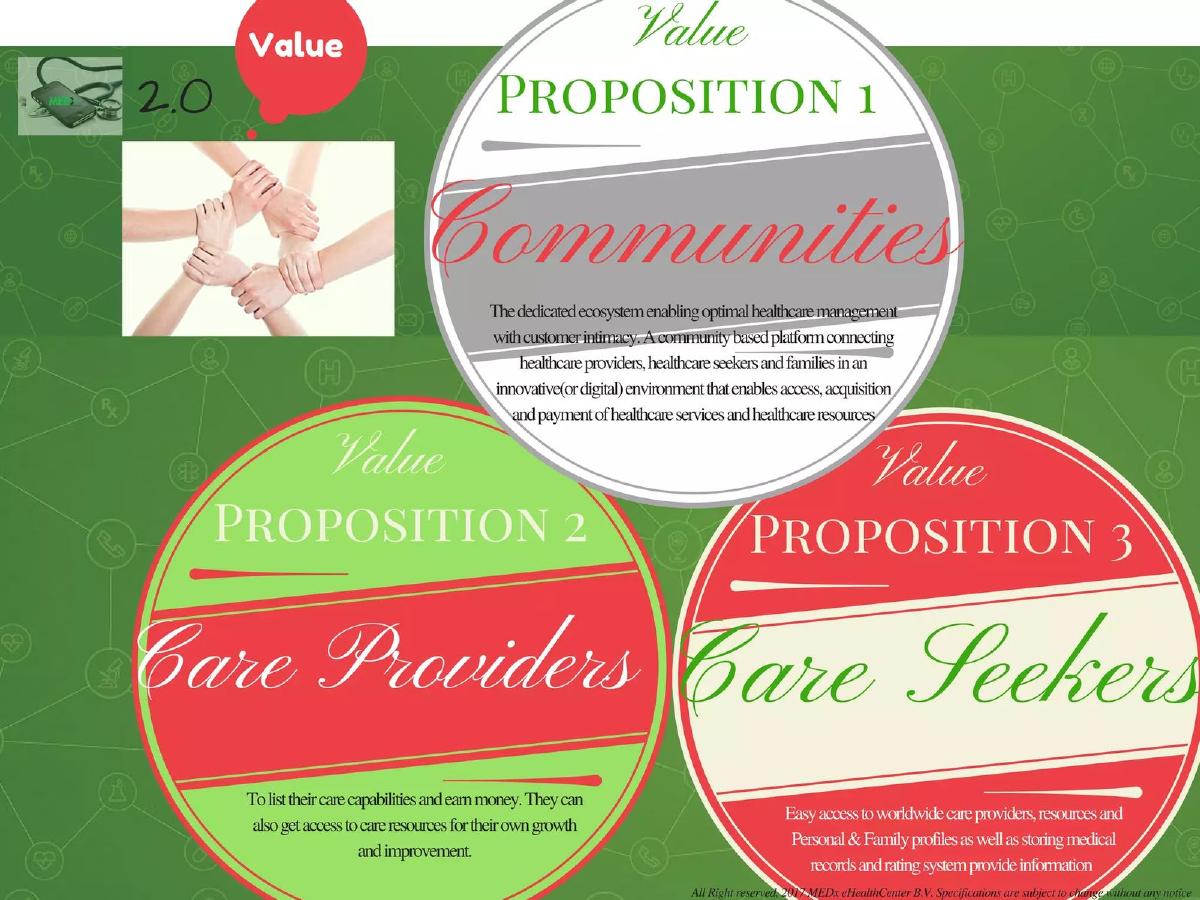
- Value Proposition 1 focuses on a community-based platform for healthcare management and payment (Slide 3).
- Value Proposition 2 targets care providers, allowing them to list capabilities and earn money (Slide 3).
- Value Proposition 3 offers care seekers access to worldwide providers and personal medical record storage (Slide 3).
- The 'Road to Success' involves fast engagement with both public and private hospitals (Slide 5).
- The deck mentions a specific payment or financial mechanism called 'CASH TO HEALTH' (Slide 4).
- The presentation includes a copyright notice for '2017 MEDx eHealthCenter B.V.' (Slide 3, 5, 6).
Deck Overview
The Commercial MEDxCARE deck, specifically labeled as '2.0,' is a conceptual presentation for a digital health ecosystem. The deck is dated 2017 and originates from a B.V. (Besloten Vennootschap), indicating a Dutch private limited liability structure. The primary focus is on the 'MEDx eHealthCenter,' a SaaS platform intended to revolutionize healthcare delivery in emerging markets. The deck uses a consistent green background with a network node pattern, symbolizing connectivity.
Slide 1: Title Slide
The title slide introduces the company's mission: "Making HealthTech a reality in Emerging Countries through the Digital Hospital." It features a small inset image of a smartphone with the MEDx logo next to a stethoscope. The large '2.0' text suggests this is an updated version of their initial concept or business model.
Slide 2: Visual Table of Contents
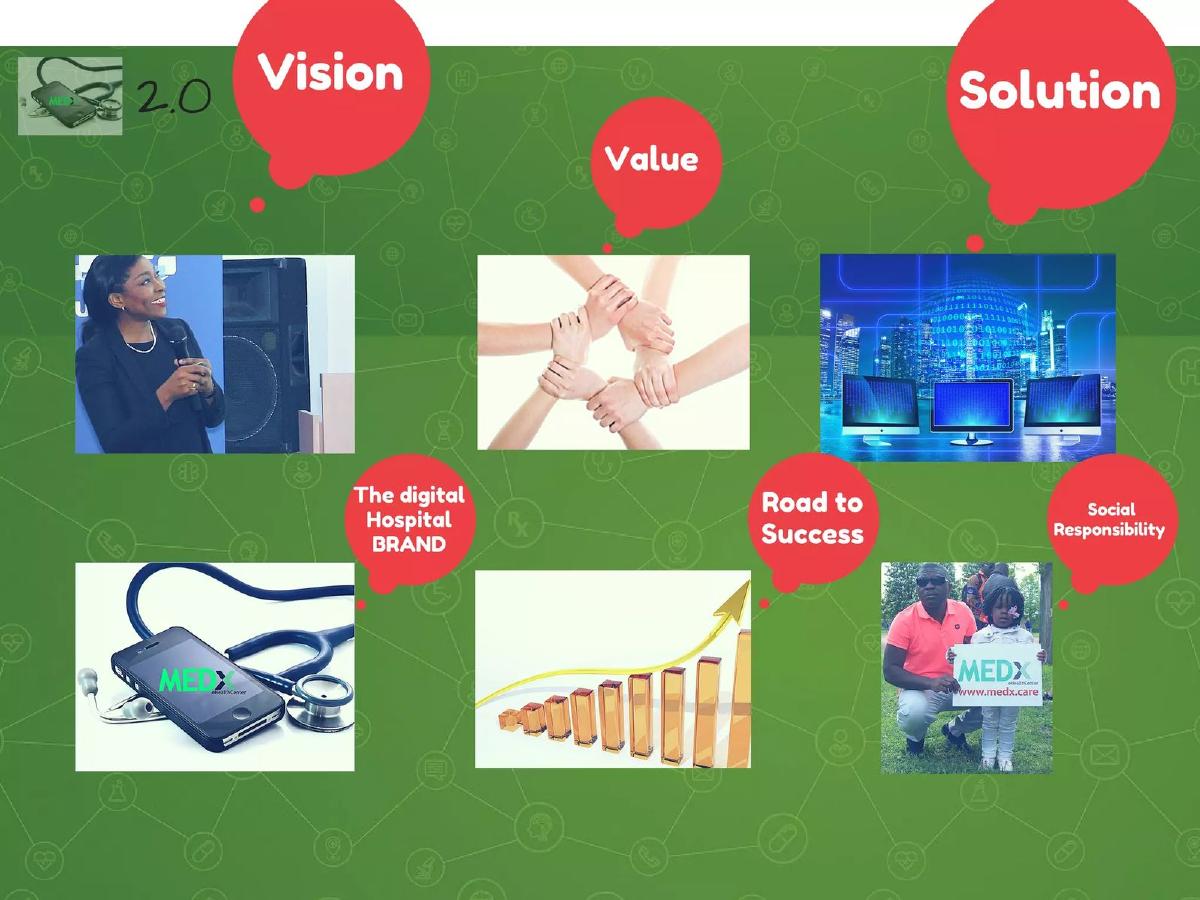
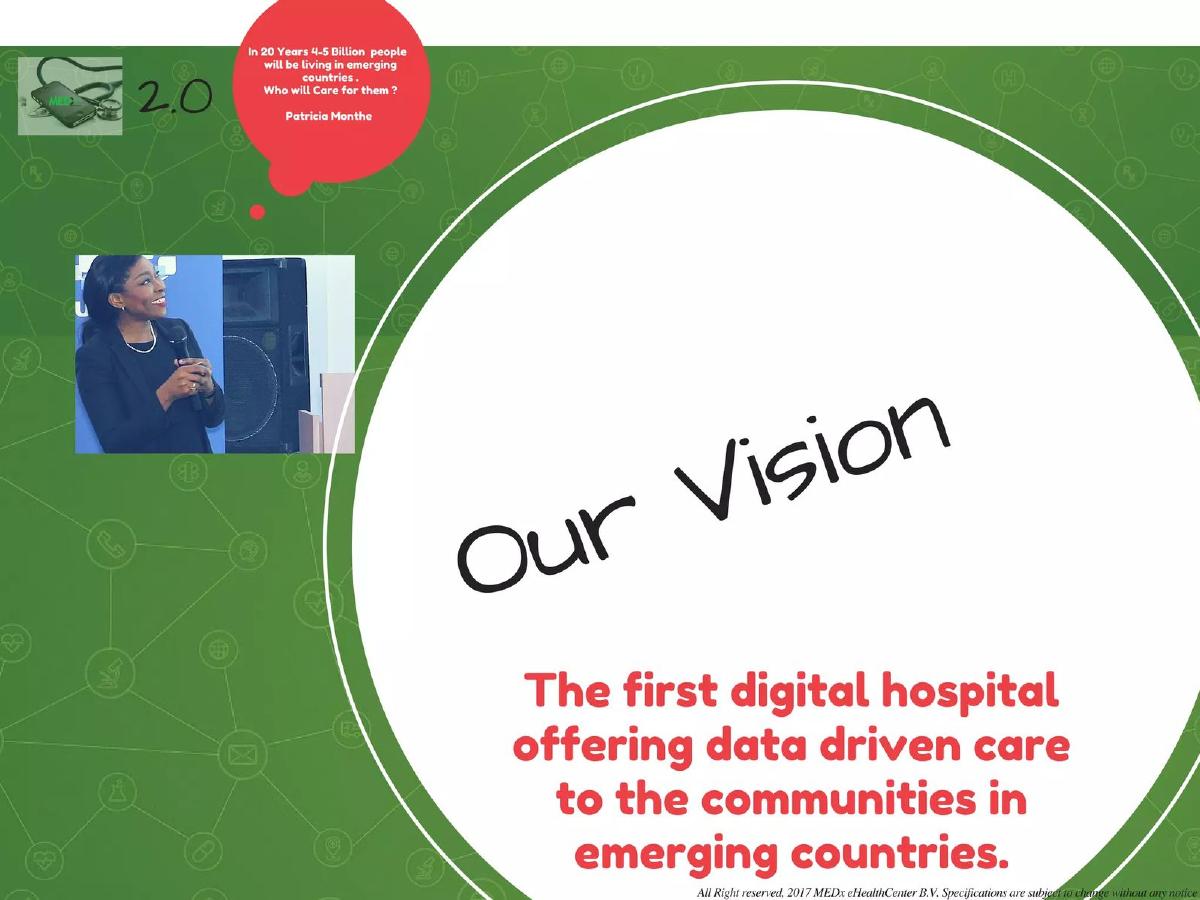
This slide serves as a visual map of the presentation, using red speech bubbles to highlight key sections: Vision, Value, Solution, The digital Hospital BRAND, Road to Success, and Social Responsibility. The images associated with these bubbles are stock-heavy, including a speaker at a podium, joined hands, a futuristic city skyline, and a photo of a man and child holding a MEDx sign. This slide establishes the broad scope of the company's ambitions but lacks specific data points.
Slide 3: The Three Value Propositions
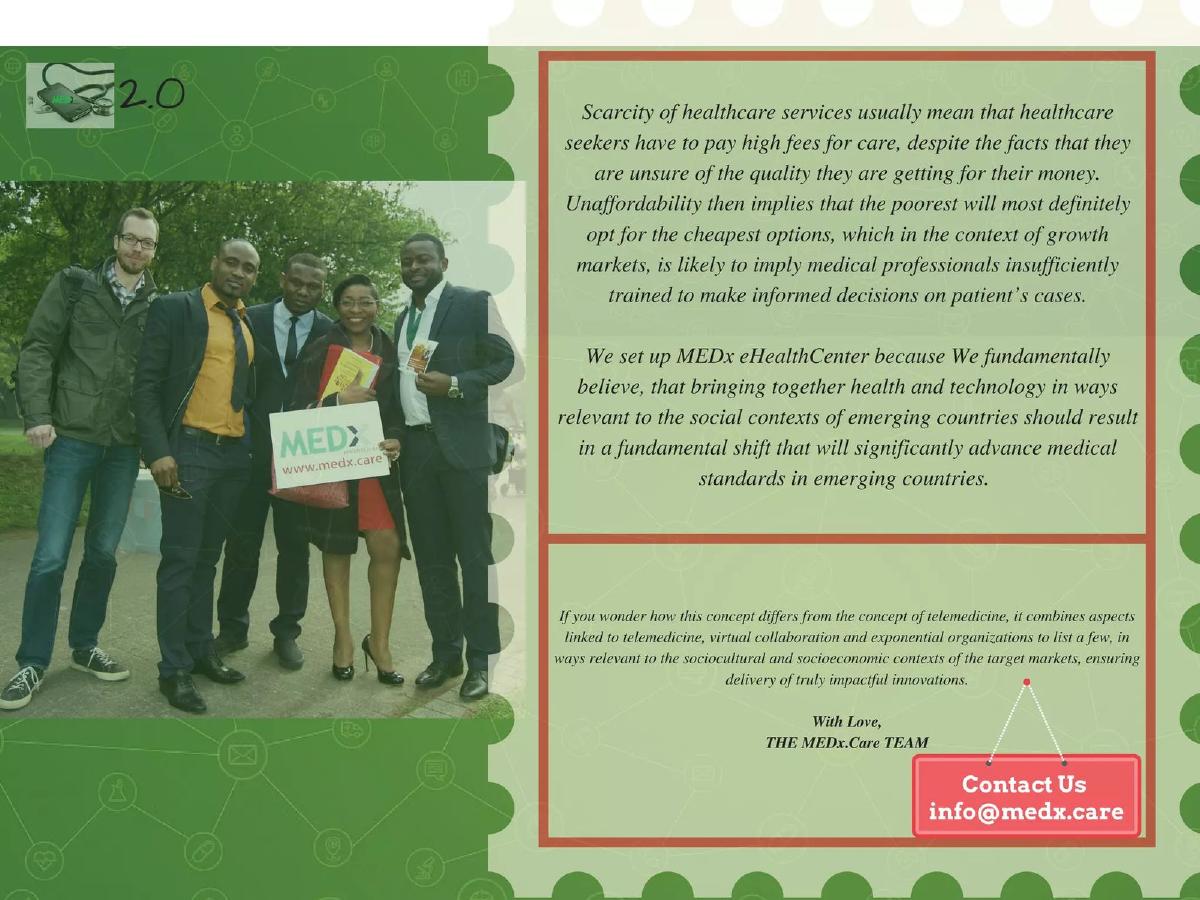
This is the most detailed slide in the deck, breaking down the platform's utility into three segments. Value Proposition 1 (Communities) is described as a dedicated ecosystem for healthcare management and payment. Value Proposition 2 (Care Providers) focuses on monetization for doctors and access to growth resources. Value Proposition 3 (Care Seekers) emphasizes easy access to worldwide providers and the storage of medical records. A copyright footer identifies the entity as '2017 MEDx eHealthCenter B.V.'
Slide 4: Our Solution In a Nutshell
Slide 4 defines the MEDx eHealthCenter as a "global IT SAAS (Software As A Service) solution." It claims to be the first of its kind, offering an end-to-end shop for self-care through tertiary care. A key term introduced here is "CASH TO HEALTH," which appears to be their proprietary financial or payment model for growth markets. The slide includes a specific use case: an African medical professional seeking a second opinion from an overseas peer to validate test results for an unfamiliar illness.
Slide 5: Road to Success
This slide outlines the go-to-market strategy. The focus is on "fast engagement" with both public and private hospitals. The goal is to implement digital health by creating dedicated ecosystems for each contract. A small graphic at the bottom shows a global map with various avatars (Cardiologist, Neurologist, etc.) connected to a central MEDx hub, reinforcing the network effect of the platform.
Slide 6: Product Showcase
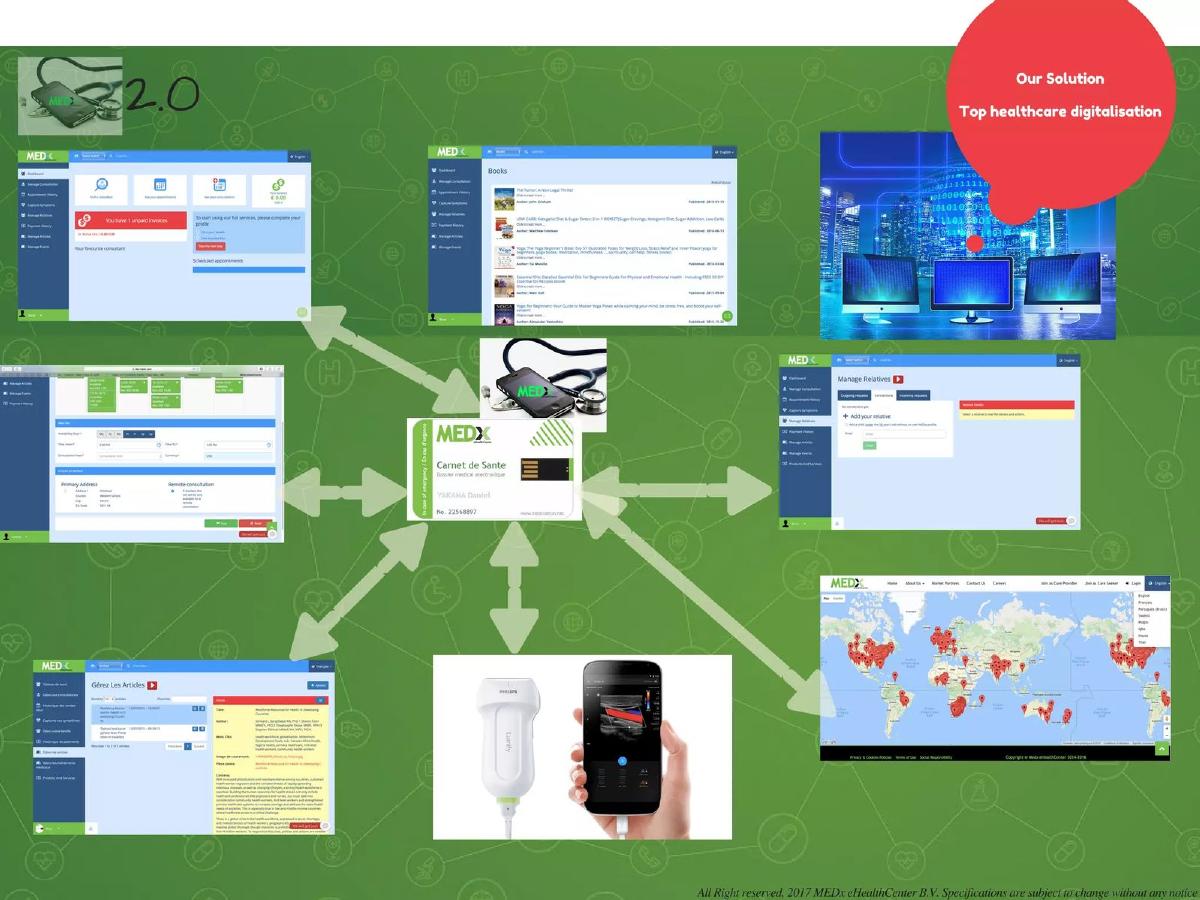
The final slide in this set shows a hand in a red glove holding a smartphone. The screen displays the MEDx interface with the word "INTERACTION" and a call to action: "Sign up as Consultant." This is the only slide that provides a glimpse of the actual user interface, though it is a static image and does not detail specific features or user flow.
What Commercial MEDxCARE Does Well
The deck is very clear about its target audience . By explicitly naming 'Emerging Countries' and 'growth markets,' the founders avoid the trap of trying to compete in highly saturated Western markets like the US or EU. The focus on Africa as a specific use case provides a tangible context for why a 'Digital Hospital' is necessary.
The segmentation of value on Slide 3 is also a strength. By breaking the platform down into benefits for communities, providers, and seekers, the deck demonstrates an understanding of the multi-sided marketplace dynamics inherent in healthcare platforms. The mention of 'CASH TO HEALTH' suggests they have thought about the specific payment challenges in regions with high unbanked populations, even if the mechanics aren't fully explained.
What is Missing from the Deck
The most glaring omission is the Team Slide . In early-stage HealthTech, the credentials of the founders (medical, technical, and regulatory expertise) are paramount. Without this, investors cannot assess the team's ability to execute a complex global SaaS platform.
There is also a complete lack of Financials and Metrics . The deck does not mention current user numbers, hospital partnerships already signed, or revenue projections. Furthermore, there is no Competitive Landscape analysis. Digital health is a crowded space, even in emerging markets, and failing to acknowledge competitors makes the 'first of its kind' claim on Slide 4 feel unsubstantiated.
Finally, the deck lacks a Clear Ask . An investor finishing this deck would not know how much money the company is looking for, what valuation they are targeting, or what specific milestones the funding would help them achieve.
Founder Takeaways
Define your 'Nutshell' early: Slide 4 does a good job of providing a concise definition of the product. Founders should ensure their 'Solution' slide can be summarized in one or two sentences that explain both the technology (SaaS) and the function (Digital Hospital). · Use specific use cases: The example of the African doctor seeking a second opinion is the most grounded part of the deck. Real-world scenarios help investors visualize the impact of the technology. · Avoid 'Stock Image Overload': Slides 2 and 5 rely heavily on generic stock imagery. Founders should replace these with actual product screenshots, data charts, or photos of the team in action to build credibility. · Address the 'How': While the deck explains 'What' the platform does, it glosses over 'How' it works technically and financially. Terms like 'CASH TO HEALTH' need at least one bullet point of explanation to move from marketing jargon to a business model.
Frequently asked questions
- What is the core product of Commercial MEDxCARE?
- The core product is the MEDx eHealthCenter, described on Slide 4 as a global IT SaaS multiservice digital hospital platform. It is designed as an end-to-end, one-stop-shop covering self-care, ePrimary, eSecondary, and eTertiary care. It aims to complement traditional healthcare services by providing a digital layer for validation, second opinions, and resource management.
- Which geographic regions does the company target?
- The deck specifically mentions 'Emerging Countries' on the title slide and 'growth markets' on Slide 4. A specific example on Slide 4 refers to a medical professional in Africa, suggesting a strong focus on the African continent or similar developing regions where digital infrastructure can bridge gaps in traditional medical access.
- How does the platform benefit healthcare providers?
- According to Slide 3, the platform allows care providers to list their capabilities to 'earn money.' Additionally, it provides them with access to care resources for their own growth and improvement. Slide 4 adds that it allows professionals to get second opinions from peers in neighboring or overseas countries, enabling them to 'do more in less time.'
- What is missing from this pitch deck?
- The deck is missing several standard venture capital requirements. There is no slide dedicated to the founding team's credentials, no financial projections or current revenue metrics, no competitive analysis, and no specific 'Ask' regarding the amount of capital being raised or the intended use of funds.
- What is the 'Road to Success' strategy outlined in the deck?
- Slide 5 defines the 'Road to Success' as speeding up the implementation of digital health through fast engagement with public and private hospitals. The strategy relies on creating a dedicated ecosystem for each contract that enables healthcare management with 'customer intimacy' within their specific communities.