Eaze’s 2020 pitch deck is a masterclass in explaining a business model pivot to later-stage investors. Facing the low-margin realities of a pure marketplace, Eaze detailed a transition toward becoming a vertical retail operator. By acquiring dispensaries and launching house brands like 'Circles,' the company projected a path to EBITDA profitability. The deck leans heavily on operational metrics, showing a 75% margin on house brands compared to 60% for third-party products. With $125M+ in projected 2020 revenue and a clear 'lift and shift' strategy for national expansion, the deck successfully…
Key takeaways
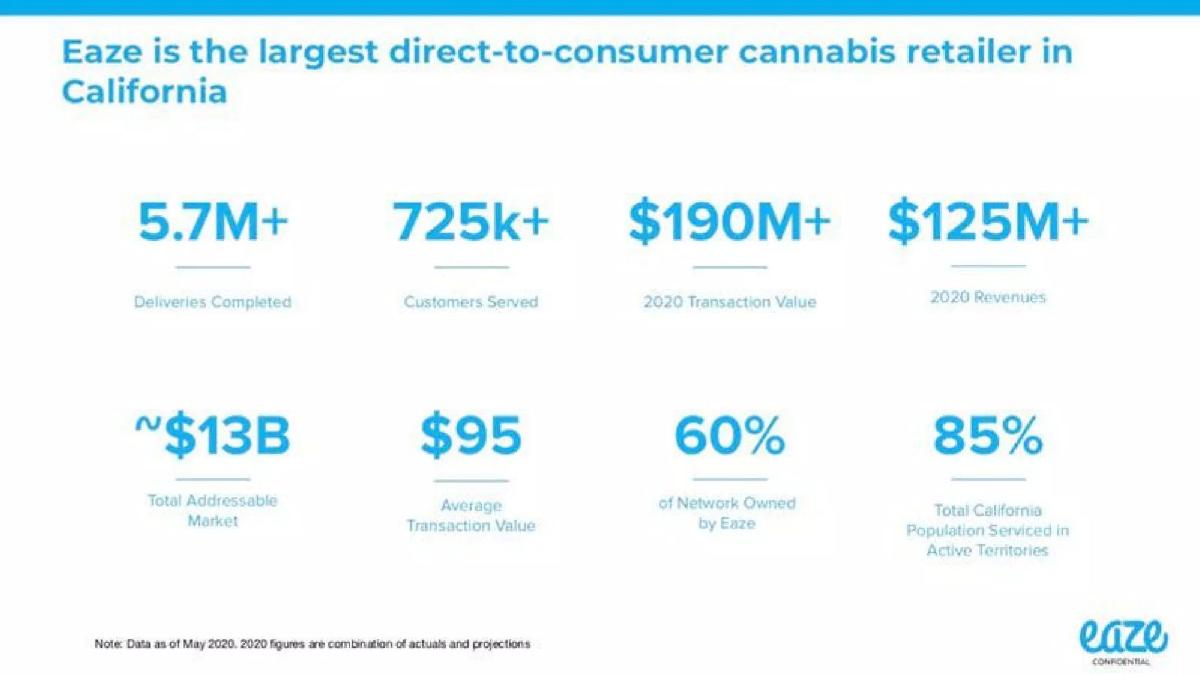
- Eaze projected $125M+ in 2020 revenue and $190M+ in transaction value (Slide 2).
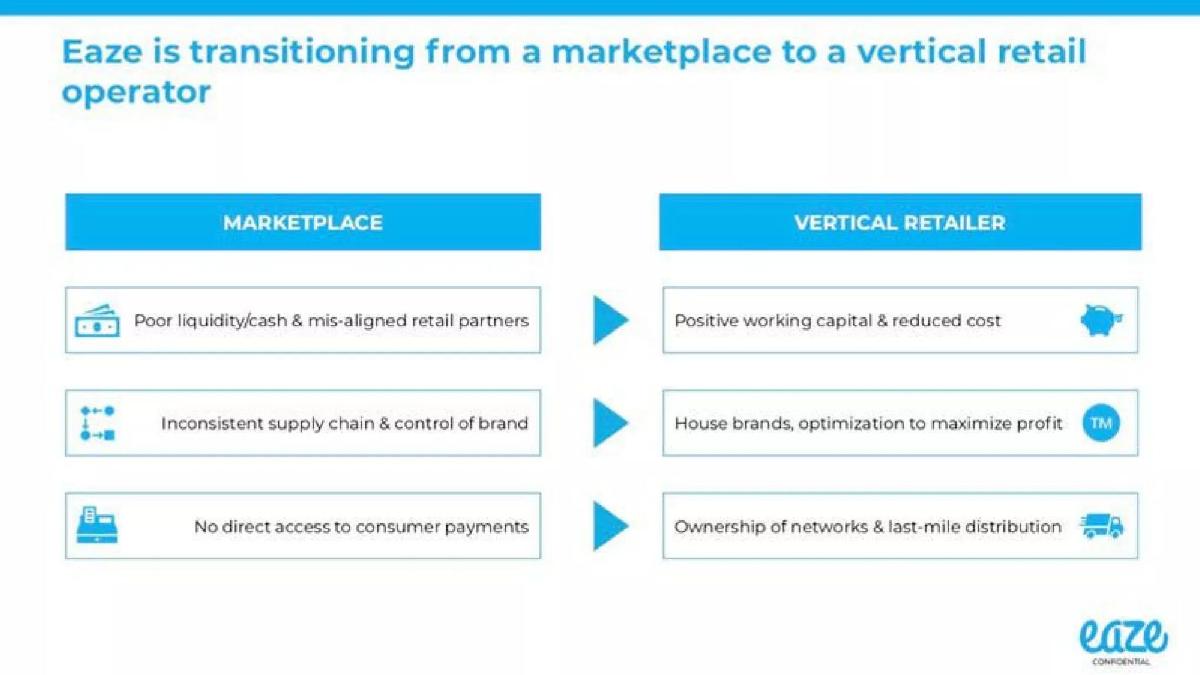
- The core strategy involves a pivot from a marketplace with 'poor liquidity' to a vertical retailer with 'positive working capital' (Slide 4).
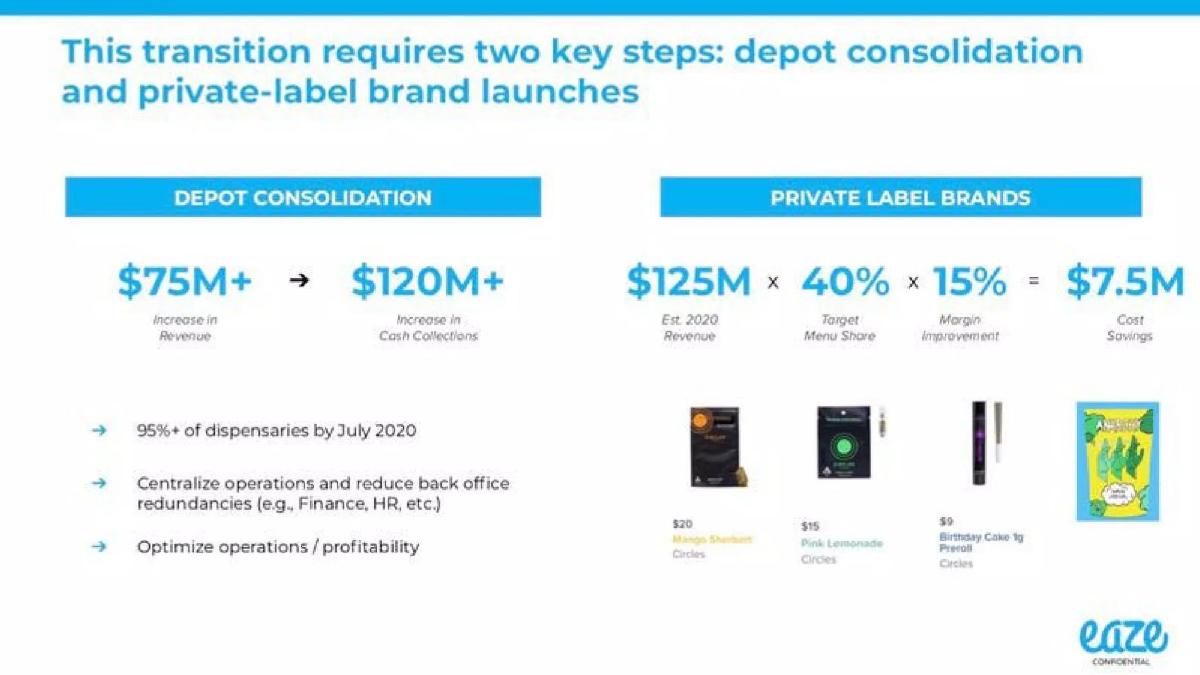
- Depot consolidation is a primary driver, with Eaze aiming to control 95%+ of dispensaries in its network by July 2020 (Slide 5).
- Private label brands offer a 15% incremental margin improvement over third-party products (Slide 7).
- The company achieved a 'historic low' cost per delivery of $11.51 (Slide 9).
- Eaze forecasts reaching EBITDA breakeven at a monthly Gross Transaction Value (GTV) of approximately $20M (Slide 10).
- The management team features leadership experience from BitTorrent, eBay, Lyft, and DocuSign (Slide 14).
- The deck omits a specific 'Ask' slide detailing the exact terms or valuation of the $20M round.
Executive Summary: The Vertical Pivot
Eaze’s 2020 pitch deck represents a critical moment in the company’s history. After establishing itself as the 'Uber of Weed' in California, the company faced the structural challenges inherent in high-volume, low-margin delivery marketplaces. This deck is not about introducing a new concept; it is about proving that an existing giant can become profitable through vertical integration. By the time this deck was circulated, Eaze had already completed over 5.7 million deliveries (Slide 2) and was projecting over $125 million in revenue for the year.
Slide 1: Title Slide
The deck opens with a minimalist title slide featuring the Eaze logo and the tagline 'Cannabis On Demand.' The background image of a consumer with a branded bag reinforces the lifestyle aspect of the brand, while a small 'Confidential' watermark in the corner signals the later-stage nature of the presentation.
Slide 2: The California Powerhouse
Slide 2 establishes Eaze's market dominance. It claims Eaze is the 'largest direct-to-consumer cannabis retailer in California.' Key metrics include 5.7M+ deliveries completed, 725k+ customers served, and a projected $190M+ in 2020 Transaction Value. Notably, it mentions that 85% of the California population in active territories is serviced by Eaze, highlighting the depth of their penetration in their home state.
Slide 3: 2019 Growth Momentum
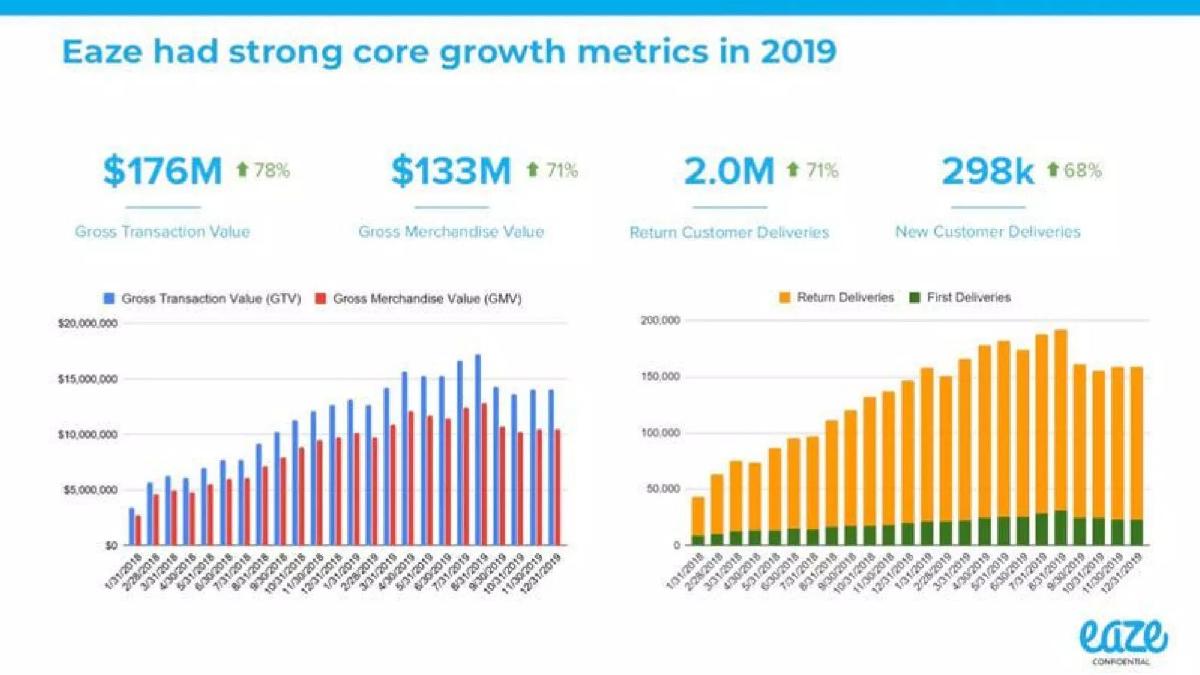
This slide provides historical context to justify the 2020 projections. Eaze shows a 78% increase in Gross Transaction Value (GTV) to $176M and a 71% increase in Gross Merchandise Value (GMV) to $133M. The charts show a steady upward trend in monthly deliveries, with a clear distinction between 'Return Deliveries' and 'First Deliveries,' emphasizing that the bulk of their volume comes from a loyal, recurring user base.
Slide 4: The Strategic Shift
This is arguably the most important slide in the deck. It outlines the transition from a 'Marketplace' to a 'Vertical Retailer.' Eaze identifies the weaknesses of the marketplace model: poor liquidity, inconsistent supply chains, and no direct access to consumer payments. The 'Vertical Retailer' model promises positive working capital, house brands to maximize profit, and ownership of the last-mile distribution network. This slide sets the stage for the operational changes described in the following pages.
Slide 5: Execution Steps
Slide 5 breaks down the transition into two actionable steps: Depot Consolidation and Private-Label Brand Launches. Under depot consolidation, Eaze aims for a $75M to $120M+ increase in cash collections by centralizing operations. For private labels, they provide a formula: $125M (Est. 2020 Revenue) x 40% (Target Menu Share) x 15% (Margin Improvement) = $7.5M in cost savings. This slide effectively quantifies the 'why' behind their strategic pivot.
Slide 6: Progress in Depot Consolidation
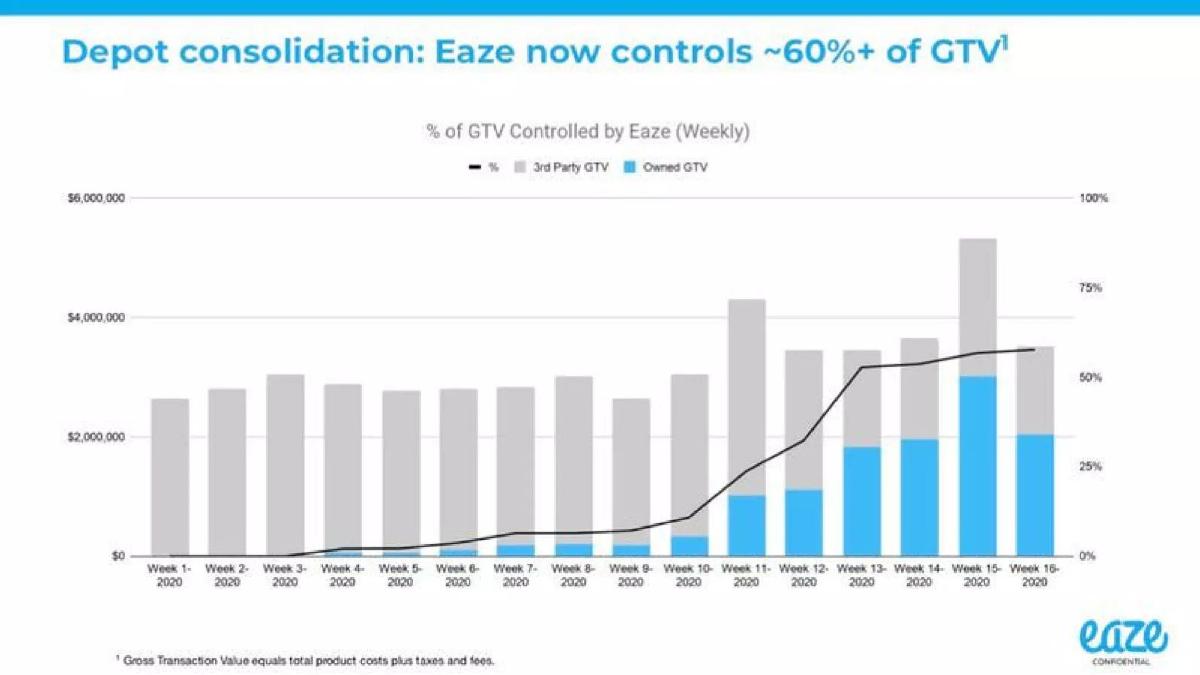
Eaze uses Slide 6 to prove they are already executing. A weekly chart for the first 16 weeks of 2020 shows the percentage of GTV controlled by Eaze-owned depots rising from near zero to over 60%. This rapid shift demonstrates operational agility and provides evidence that the transition is not just theoretical.
Slide 7: The Private Label Advantage
This slide focuses on unit economics. It compares 'House Brand' margins (75%) to '3rd Party' margins (60%). By capturing an additional 15% margin, Eaze significantly improves its path to profitability. The slide also includes a chart showing private label penetration growing to ~12% of GTV by the end of the period shown, suggesting strong consumer appetite for Eaze’s own products.
Slide 8: Category Penetration
To further validate their private label strategy, Slide 8 shows the performance of their 'Circles' brand in the vaporizer and flower categories. In both cases, the brand achieved ~25% category penetration within 14 days of launch. This data point is intended to convince investors that Eaze can successfully steer its massive customer base toward its higher-margin internal brands.
Slide 9: Unit Economics and Contribution Margin
Slide 9 provides a detailed waterfall chart of a single transaction. Starting with a $71.00 product value, it subtracts taxes, cost of goods, promotions, and delivery costs to arrive at a $21.45 contribution margin (25%+). A callout box highlights a 'Historic low of $11.51' for cost per delivery, a key efficiency metric for any delivery-based business.
Slide 10: The Path to EBITDA Positive
Building on the unit economics, Slide 10 shows the total monthly waterfall required to reach EBITDA positivity. The company identifies a target of ~$20M in monthly GTV to cover all expenses, including corporate overhead. At this level, they project a modest but significant profit of $31,633, proving the model can scale to break even.
Slide 11: Forecasting the Future
Slide 11 maps out the timeline for reaching that $20M GTV milestone. The forecast shows Eaze hitting the breakeven line in Q4 2020. This slide is crucial for setting investor expectations regarding the timing of their return to profitability following the heavy investment in depot acquisitions.
Slide 12: National Expansion: 'Lift and Shift'
Once the California model is proven, Eaze plans to 'lift and shift' to other states. A map of the US highlights several 'green' states (WA, NV, AZ, NM, CO, IL, MI, OH, PA, NY, MA, FL) as potential targets. This slide shifts the narrative from 'fixing California' to 'dominating the US,' providing the 'venture scale' story investors look for.
Slide 13: The Competitive Moat
Slide 13 identifies three pillars of Eaze's competitive advantage: Differentiated Tech, a Recognizable Brand (citing a 75 Net Promoter Score), and Data-Driven Marketing. They claim to have the 'largest customer database' in the industry, which provides a significant advantage when entering new, regulated markets.
Slide 14: Management Team
The team slide features a heavy-hitting roster of executives with experience at major tech firms. CEO Ro Choy (BitTorrent, eBay), COO Megan Miller (Loggly, DocuSign), and CLO Andrea Lobato (Lyft) provide the 'adult supervision' and scale-up experience necessary for a later-stage company navigating a complex regulatory environment.
Slide 15: Closing
The deck concludes with a repeat of the title slide, maintaining brand consistency and ending on a visual of the consumer experience.
What Works in This Deck
Clear Strategic Pivot: The transition from marketplace to vertical retailer is explained with brutal honesty regarding the flaws of the previous model. · Data-Backed Claims: Almost every strategic claim is supported by a chart showing real-world progress (e.g., the rapid rise in owned GTV on Slide 6). · Granular Unit Economics: Slide 9’s waterfall chart is a model for how to present contribution margin. It doesn't hide the 'red' bars (costs), which builds trust with sophisticated investors. · Focus on Profitability: For a later-stage round in 2020, the focus on EBITDA breakeven was exactly what the market demanded.
What is Missing
The Ask: There is no slide detailing how much money is being raised, the valuation, or the specific use of proceeds. · Competitive Landscape: While Eaze claims to be the largest, there is no direct comparison to other California or national players like Weedmaps or Curaleaf. · Regulatory Risk: In a highly regulated industry like cannabis, a slide addressing legal hurdles or the impact of potential federal legalization (or lack thereof) is a notable omission. · Board of Directors: While the management team is strong, later-stage decks often benefit from showing the institutional investors already on the board.
What a Founder Should Copy
The 'Marketplace vs. Vertical' Comparison: If you are pivoting your business model, use Slide 4’s side-by-side format. It clearly identifies the pain points of the old way and the benefits of the new way. · The Breakeven Waterfall: Slide 10 is an excellent way to show investors exactly how much volume you need to stop burning cash. It turns a complex financial statement into a simple, visual goal. · Execution Proof: Don't just say you are going to do something; show a chart of you already doing it. Slide 6, showing the weekly increase in owned GTV, is the most persuasive slide in the deck because it proves the strategy is already in motion.
Frequently asked questions
- What was the primary goal of Eaze's 2020 pitch deck?
- The primary goal was to demonstrate a viable path to profitability by pivoting from a third-party marketplace model to a vertically integrated retail model. Eaze aimed to show investors that by owning the depots (dispensaries) and the products (private labels), they could capture significantly higher margins and achieve EBITDA positivity by Q4 2020.
- How does Eaze differentiate its private label margins?
- According to slide 7, Eaze's house brands have a cost of $7.50 and a retail price of $30.00, resulting in a 75% margin. In contrast, third-party brands provide a 60% margin. This 15% incremental gain is a cornerstone of their argument for vertical integration.
- What is 'Depot Consolidation' in the context of this deck?
- Depot consolidation refers to Eaze moving away from being a middleman for independent dispensaries to owning and operating the retail licenses and facilities themselves. Slide 6 shows that by week 16 of 2020, Eaze-owned depots accounted for over 60% of the total Gross Transaction Value (GTV).
- What are the key growth metrics Eaze highlighted from 2019?
- Slide 3 highlights a 78% year-over-year increase in Gross Transaction Value to $176M and a 71% increase in Gross Merchandise Value to $133M. It also notes that return customer deliveries grew by 71% to 2.0M, indicating strong user retention.
- Does the deck include a financial 'Ask' or valuation?
- No, the 15 slides provided do not include a specific 'Ask' slide. While catalogue data indicates the company raised $20M in 2020, the deck itself focuses on operational strategy, unit economics, and expansion plans rather than specific investment terms or the use of proceeds.