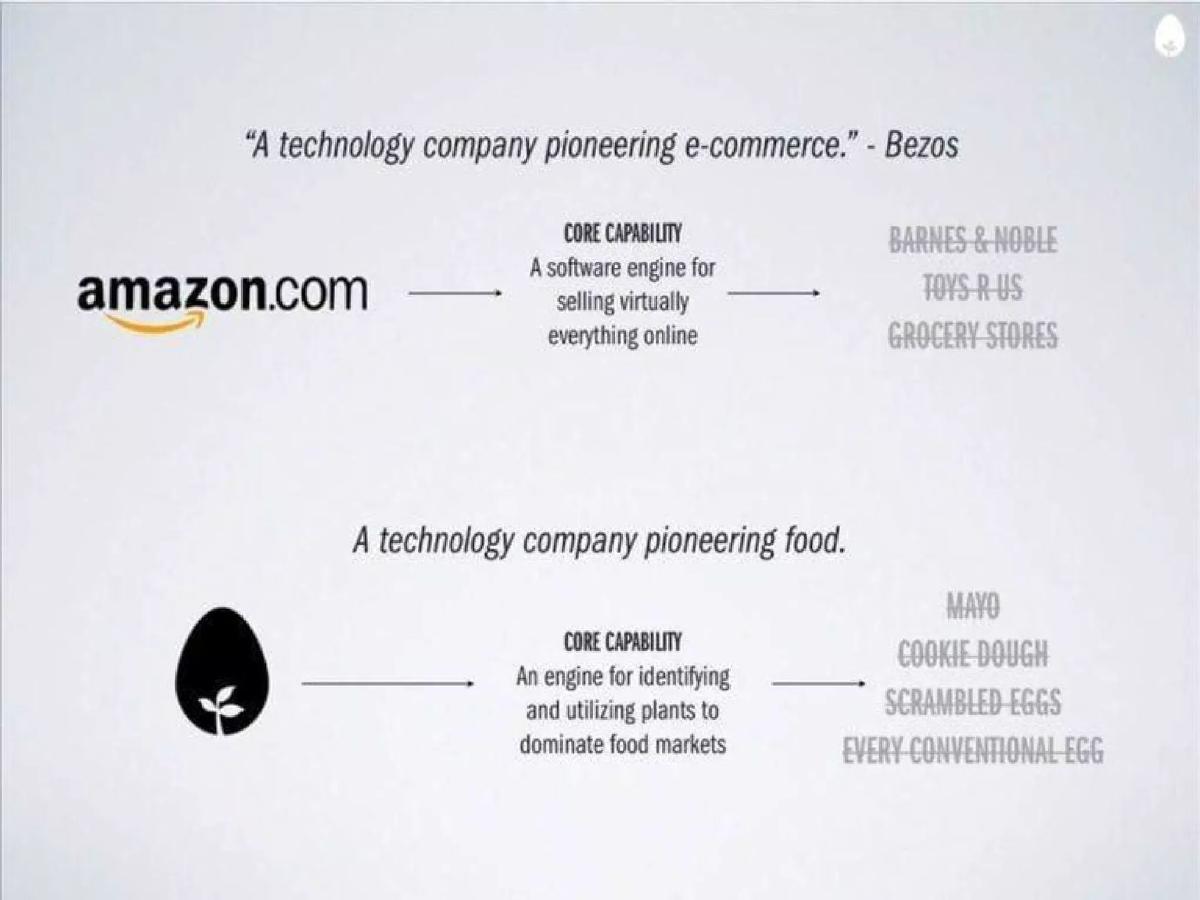
Eat Just, originally known as Hampton Creek, presents a masterclass in narrative reframing. The deck avoids the typical 'vegan food' tropes, instead positioning the company as a technology platform with a core engine for plant identification. By slide 2, they establish a direct analogy to Amazon, suggesting that just as Amazon used a software engine to disrupt retail, Eat Just uses a biological engine to disrupt the $55.5B egg market. The deck is heavy on social proof, featuring 20+ major media logos and video testimonials from culinary influencers. While it lacks a specific financial 'Ask' o…
Key takeaways
- The deck uses a high-status analogy on slide 2, comparing their 'engine for identifying plants' to Amazon's software engine.
- Market size is segmented into core products totaling $55.5B globally, including $11.3B for mayo and $42.5B for scrambled eggs (slide 10).
- The company claims a significant cost advantage, stating they are 48% more cost-effective than conventional chicken eggs at $0.39/lb vs $0.76/lb (slide 16).
- Sustainability is quantified as a 2:1 energy input-to-output ratio, compared to 39:1 for conventional eggs (slide 14).
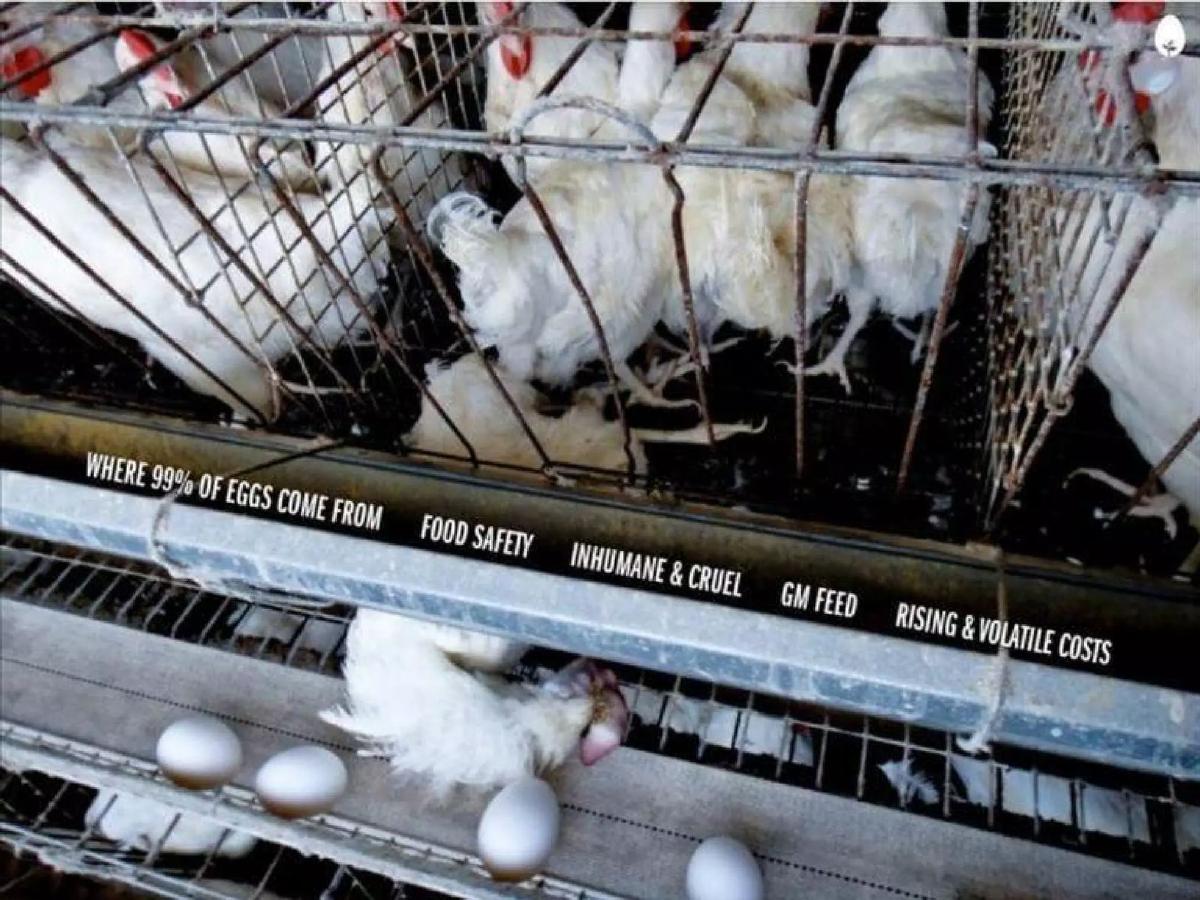
- The deck utilizes fear-based demand drivers, highlighting that 99% of eggs come from environments with food safety risks like Avian Flu (slides 3 and 15).
- Social proof is a primary pillar, with slide 9 showcasing 22 major media outlets including The New York Times and Bloomberg.
- The 'Tech Platform' section (slides 17-19) attempts to de-risk the R&D process by showing the screening of hundreds of plant species weekly.
- There is no 'Ask' slide or financial use-of-funds breakdown included in this version of the deck.
The Narrative of Disruption: Reframing Food as Tech
Eat Just, formerly Hampton Creek, provides a fascinating example of how to pitch a commodity product—eggs—as a high-growth technology platform. At the time of this deck, the company was positioning itself to disrupt a global industry plagued by sustainability issues and volatile pricing. The deck is light on text and heavy on high-impact imagery, designed to be presented rather than read in isolation. It relies on the 'Amazon Analogy' to bridge the gap between food science and venture-scale returns.
Slides 1-2: The Hook and the Analogy
Slide 1 is a minimalist title slide featuring a white egg silhouette with a plant sprout inside against a black background. It establishes the brand identity immediately: nature meets nutrition. However, it is Slide 2 that does the heavy lifting for the entire pitch. It presents a direct comparison to Amazon. The slide quotes Jeff Bezos: "A technology company pioneering e-commerce." It maps Amazon's core capability (a software engine) to its eventual dominance over Barnes & Noble and Toys R Us. Below this, Eat Just positions itself as "A technology company pioneering food," with a core capability described as "An engine for identifying and utilizing plants to dominate food markets." This slide is designed to tell investors that while they are starting with Mayo and Cookie Dough, the platform is built for total market replacement.
Slides 3-6: The Problem and the Vision
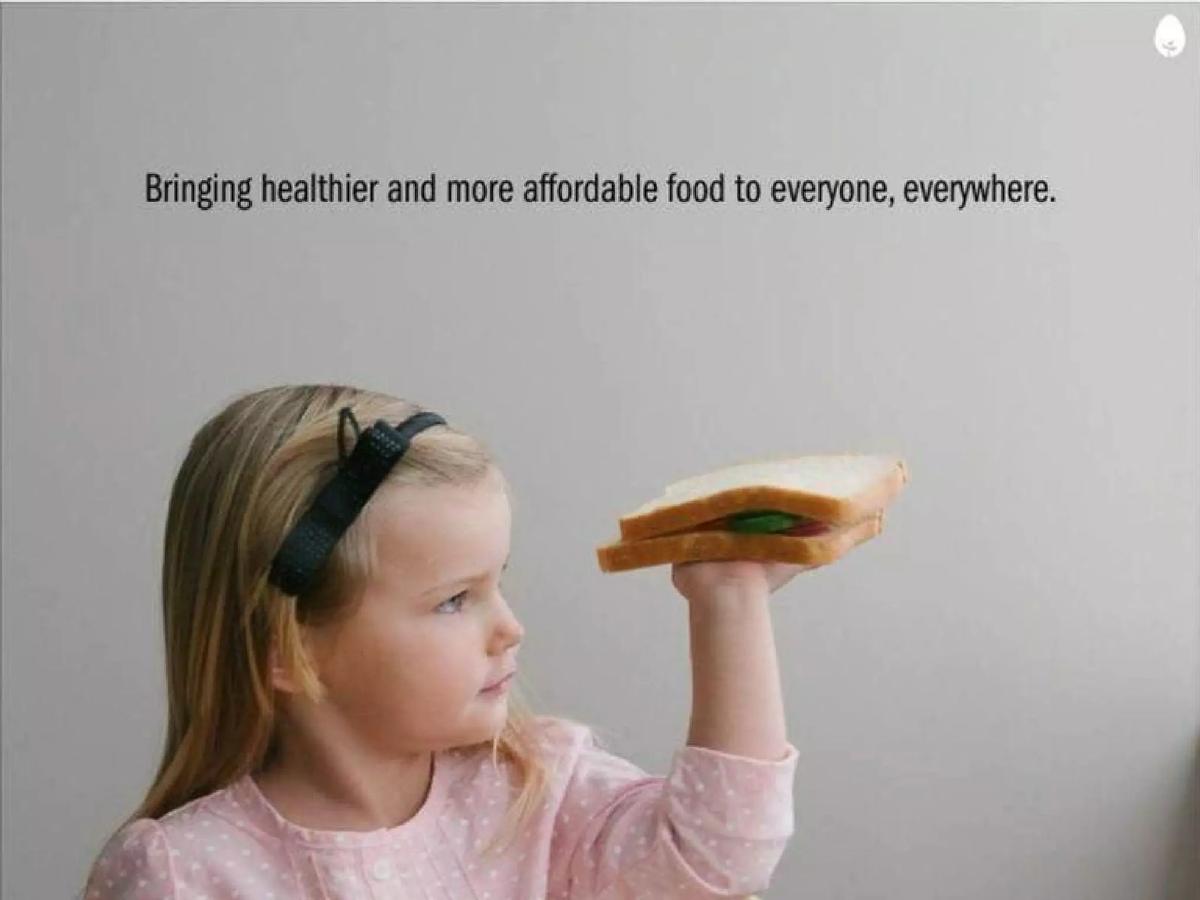
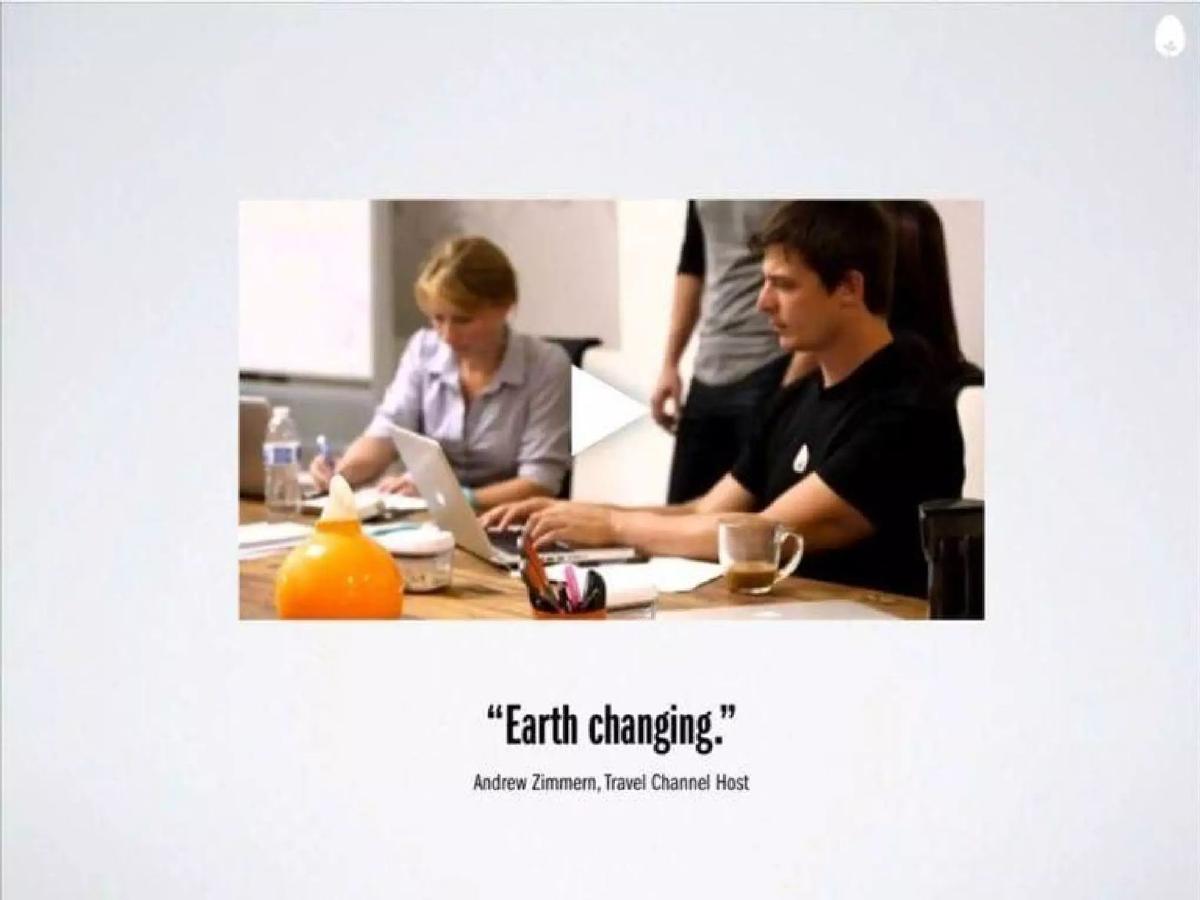
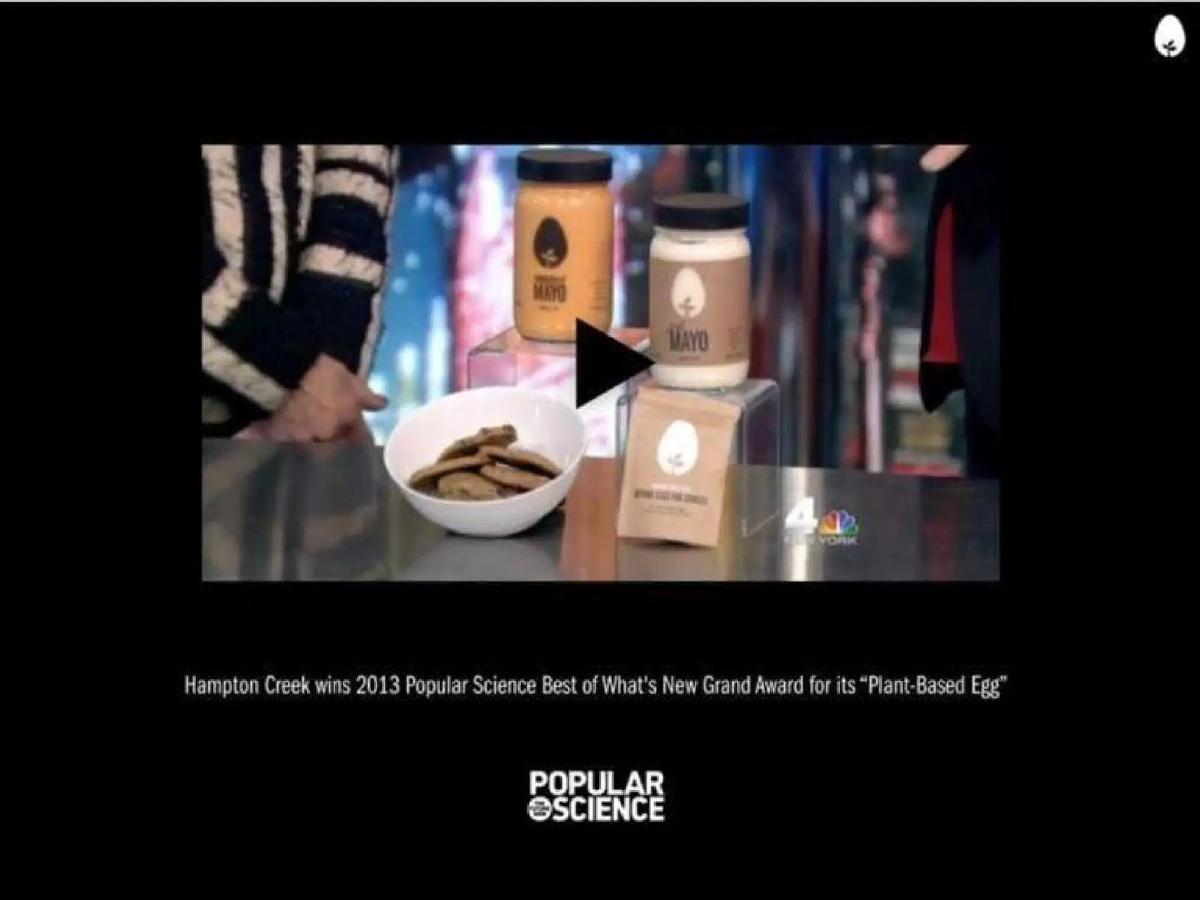
Slide 3 uses a high-contrast photo of chickens in battery cages. The text is blunt: "Where 99% of eggs come from." It lists the pain points for the industry: Food Safety, Inhumane & Cruel, GM Feed, and Rising & Volatile Costs. This sets up the 'Why Now?'—the current system is fragile. Slide 4 pivots to a softer image of a child with a sandwich, stating the mission: "Bringing healthier and more affordable food to everyone, everywhere." Slides 5 and 6 are social proof slides, featuring video stills. Slide 5 quotes Andrew Zimmern calling the product "Earth changing," and Slide 6 highlights the 2013 Popular Science 'Best of What's New' Grand Award for their plant-based egg.
Slides 7-9: The Team and Social Proof
Slide 7 is a dense list of the Hampton Creek team. It is unusual because it lists nearly 40 names, including Lab Technicians, Sensory Scientists, and a 'Director of Culinary Innovation.' This emphasizes the scale of their operations. Below the team, the Advisors section includes heavy hitters like Richard Wolford (Former CEO of Del Monte) and Josh Balk (Humane Society). Slide 8 is a 'Press' slide, but rather than just listing logos, it claims the company "has told its story to millions." It features 22 logos, including The New York Times, NPR, Forbes, and Bloomberg. This slide is intended to prove that the market is already paying attention and that the brand has 'arrived.'
Slides 10-12: Market Size and Opportunity
Slide 10 quantifies the "Massive Opportunity." It uses two graphics: a jar representing "Core Products" at $55.5B and an egg representing "Egg Ingredients" at $6B . The $55.5B figure is broken down into Mayo ($11.3B), Scrambled Eggs ($42.5B), and Cookie Dough ($1.7B in the US). Slide 11 provides a granular look at the Global Mayo Market, citing a $11.3B total with a table showing spend by country (e.g., US at $3.5B, Russia at $0.67B). Slide 12 focuses on the US Retail Cookie Dough Market at $1.7B , noting that General Mills accounts for $1.16B of those sales. These slides move the conversation from 'vegan alternative' to 'global commodity replacement.'
Slides 13-16: The Demand Drivers and Cost Advantage
Slide 13 lists "5 Factors Driving Demand," including rising costs, sustainable eating, cholesterol concerns, food safety (Avian Flu), and the fact that "34 Million have Egg Allergies or Egg Sensitivities in the US." Slide 14 dives into sustainability, showing a "Ratio of energy input to food-energy output." While Lamb is 57:1 and conventional Eggs are 39:1, Hampton Creek claims a 2:1 ratio. Slide 15 uses a world map to show major outbreaks of Listeria, Salmonella, and Avian Flu between 2009-2013, including a headline that "Yum 1Q profit drops 27% because of 2013 bird flu outbreak." This positions the product as a risk-mitigation tool for large food conglomerates. Slide 16 is perhaps the most important financial slide: "We are 48% more cost effective than conventional chicken eggs." It shows a bar chart comparing $0.39/lb for their product versus $0.76/lb for eggs. This is the 'killer app'—the product isn't just better for the planet; it's cheaper for the bottom line.
Slides 17-22: The Tech Platform and Product Showcase
Slide 17 introduces the "Tech Platform" section. Slide 18 shows a wall of test tubes, stating the company "screens through hundreds weekly." Slide 19 provides a scientific proof point, showing how two species of Canadian Yellow Pea give "radically different results" in mayo stability. This reinforces the 'Amazon engine' analogy from Slide 2. Slides 20-22 are lifestyle and product shots. Slide 20 shows 'Just Mayo' being used in a kitchen setting. Slide 21 is a video still from a 'Katie' show segment titled "Eat the Dough," and Slide 22 repeats the Popular Science award slide. The deck ends without a formal 'Ask' or 'Contact' slide, suggesting this version was used for high-level partnership or late-stage investor briefings where those details are handled in supplemental docs.
What Works in This Deck
The Amazon Analogy: By comparing a food company to a software engine, Eat Just successfully reframed the business. Investors value software companies at much higher multiples than food companies. This analogy justifies the 'Tech' in their name and their massive R&D spend.
Data-Driven Sustainability: Instead of using vague 'green' language, the deck uses specific ratios (2:1 vs 39:1) and cost-per-pound metrics ($0.39 vs $0.76). This appeals to the rational investor who cares about margins and efficiency as much as ethics.
Fear as a Motivator: The use of the Yum! Brands profit drop and the global map of disease outbreaks (Slide 15) turns a plant-based egg from a 'nice to have' into a 'must have' for supply chain security.
What Is Missing
The Financial Ask: There is no mention of how much capital is being raised or how it will be spent. While the catalogue facts state $465M was raised, the deck itself is silent on the terms of the round.
Unit Economics: While they show a cost advantage per pound, they do not show the path to profitability, current revenue, or customer acquisition costs (CAC). For a later-stage deck, this is a significant omission.
Competitive Landscape: The deck assumes they are the only ones in the space. There is no mention of other plant-based competitors or how they protect their IP (patents vs. trade secrets) beyond the 'screening engine' description.
What a Founder Should Copy
Visual Storytelling: The deck uses very little text. It relies on bold headlines and clear graphics to tell the story. This prevents the 'death by bullet point' that kills many pitches.
High-Status Social Proof: If you have press or awards, don't just list them—show them. The use of video stills and large logos makes the company feel inevitable.
Reframing the Category: If you are in a low-margin industry (like food), find the 'engine' or 'platform' within your business that behaves like a high-margin industry (like tech). Use an analogy to a well-known giant to help investors categorize your potential.
Frequently asked questions
- What is the core value proposition of Eat Just according to the deck?
- The core value proposition is two-fold: a massive cost advantage and a technology-driven approach to food. On slide 16, the company claims to be 48% more cost-effective than conventional eggs ($0.39 per pound versus $0.76). They frame this not as a simple recipe change, but as a 'tech platform' that screens hundreds of plants to find functional replacements for animal proteins.
- How does the deck handle the 'Problem' slide?
- Eat Just uses a visceral, image-heavy approach. Slide 3 shows chickens in cramped battery cages with text overlays highlighting 'Inhumane & Cruel,' 'Food Safety,' and 'Rising & Volatile Costs.' They later expand on this in slide 15 by mapping global outbreaks of Avian Flu and Salmonella, positioning their plant-based alternative as a solution to supply chain instability.
- What market segments are they targeting?
- Slide 10 identifies a $55.5B global opportunity. This is broken down into Mayo ($11.3B), Scrambled Eggs ($42.5B), and Cookie Dough ($1.7B in the US). They also identify a $6B global market for egg ingredients. By targeting these specific applications, they show a clear path from a single 'engine' to multiple high-revenue product lines.
- Why does the deck compare the company to Amazon?
- This is a strategic move to justify a 'tech' valuation for a food company. Slide 2 argues that Amazon's core capability wasn't just selling books, but a 'software engine for selling virtually everything.' Eat Just claims their core capability is an 'engine for identifying and utilizing plants,' implying they can eventually dominate all food markets, not just eggs.
- What is missing from this pitch deck?
- The deck is notably missing a 'The Ask' slide, a 'Milestones/Roadmap' slide, and any detailed financial projections. While it lists a large team on slide 7, it lacks the standard 'founder pedigree' information (where they worked or went to school). It relies heavily on vision and macro-market trends rather than specific business execution metrics.