The Eat Just (Hampton Creek) deck is a masterclass in narrative positioning, framing a food company as a 'technology company pioneering food.' The deck identifies a massive $55.5B global market for core products like mayo, scrambled eggs, and cookie dough, while highlighting the inefficiencies of the conventional egg industry, which has a 39:1 energy input-to-output ratio compared to Hampton Creek's 2:1. The presentation leans heavily on social proof, featuring logos from major media outlets like The New York Times and Forbes, alongside a 2013 Popular Science award. While it excels at definin…
Key takeaways
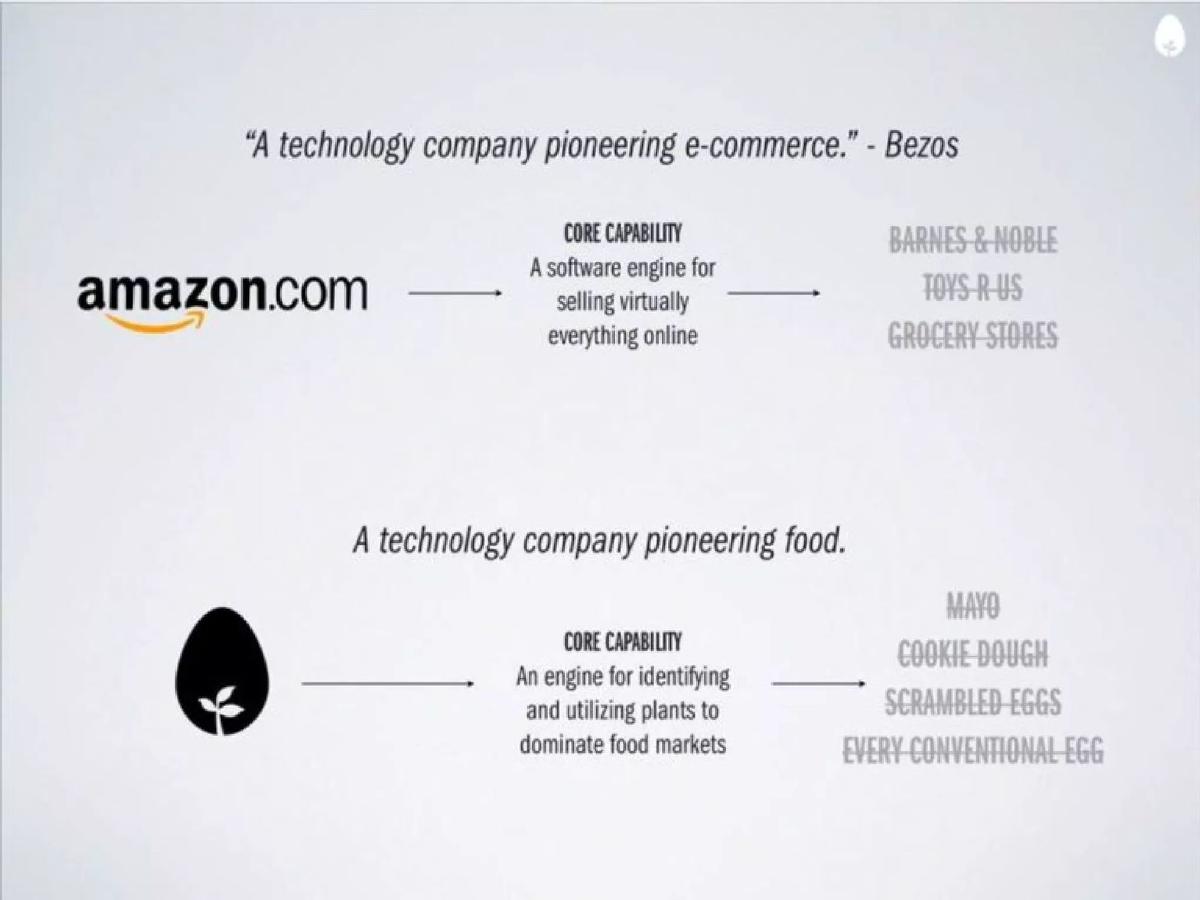
- The company positions itself as a technology platform, using an explicit analogy to Amazon's core capability on slide 2.
- Conventional egg production is framed as a liability due to a 39:1 energy input-to-output ratio, whereas the company claims a 2:1 ratio on slide 14.
- The deck identifies a $55.5B global market for core products, including $11.3B for mayo and $42.5B for scrambled eggs on slide 10.
- A significant cost advantage is claimed, stating the product is 48% more cost-effective than conventional chicken eggs ($0.39 vs $0.76 per lb) on slide 16.
- The 'Tech Platform' is defined by the ability to screen hundreds of plant species weekly to find specific functional replacements for animal proteins on slide 18.
- Food safety is a primary demand driver, citing major outbreaks of Avian Flu and Salmonella between 2009 and 2013 on slide 15.
- The team slide lists over 40 employees and 6 advisors, including the former CEO of Del Monte and a Director from the Humane Society on slide 7.
- The deck omits a formal 'Ask' slide, leaving out the amount of capital sought and the intended use of funds.
The Narrative Strategy: From Farm to Lab
The Eat Just (Hampton Creek) deck is a classic example of 'category reimagination.' Instead of presenting as a consumer packaged goods (CPG) company, they lead with a technology narrative. This is a deliberate move to secure venture capital multiples rather than the lower valuations typically associated with food companies. By slide 2, the comparison to Amazon is established, setting the stage for a platform-based business model rather than a single-product company.
Slides 1-2: The Hook and The Analogy
Slide 1 features a minimalist logo: an egg shape with a plant sprout inside. This immediately communicates the brand's mission without words. Slide 2 is the most critical slide in the deck for positioning. It uses a parallel structure to compare Amazon to Hampton Creek. Amazon's 'Core Capability' is a software engine for selling everything; Hampton Creek's 'Core Capability' is an 'engine for identifying and utilizing plants to dominate food markets.' This slide tells investors that the mayo and cookie dough are just the first 'books' in their version of the Amazon store.
Slides 3-6: The Problem and Social Proof
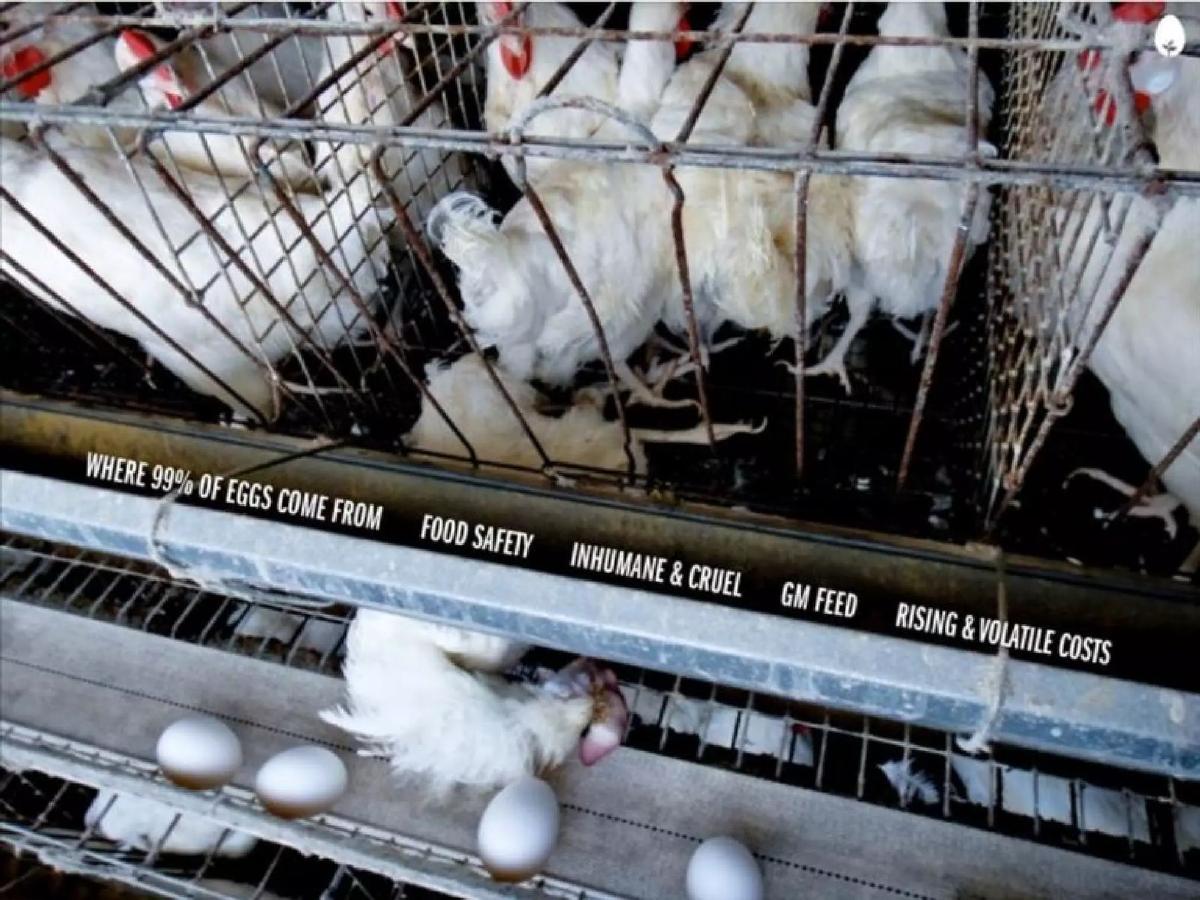
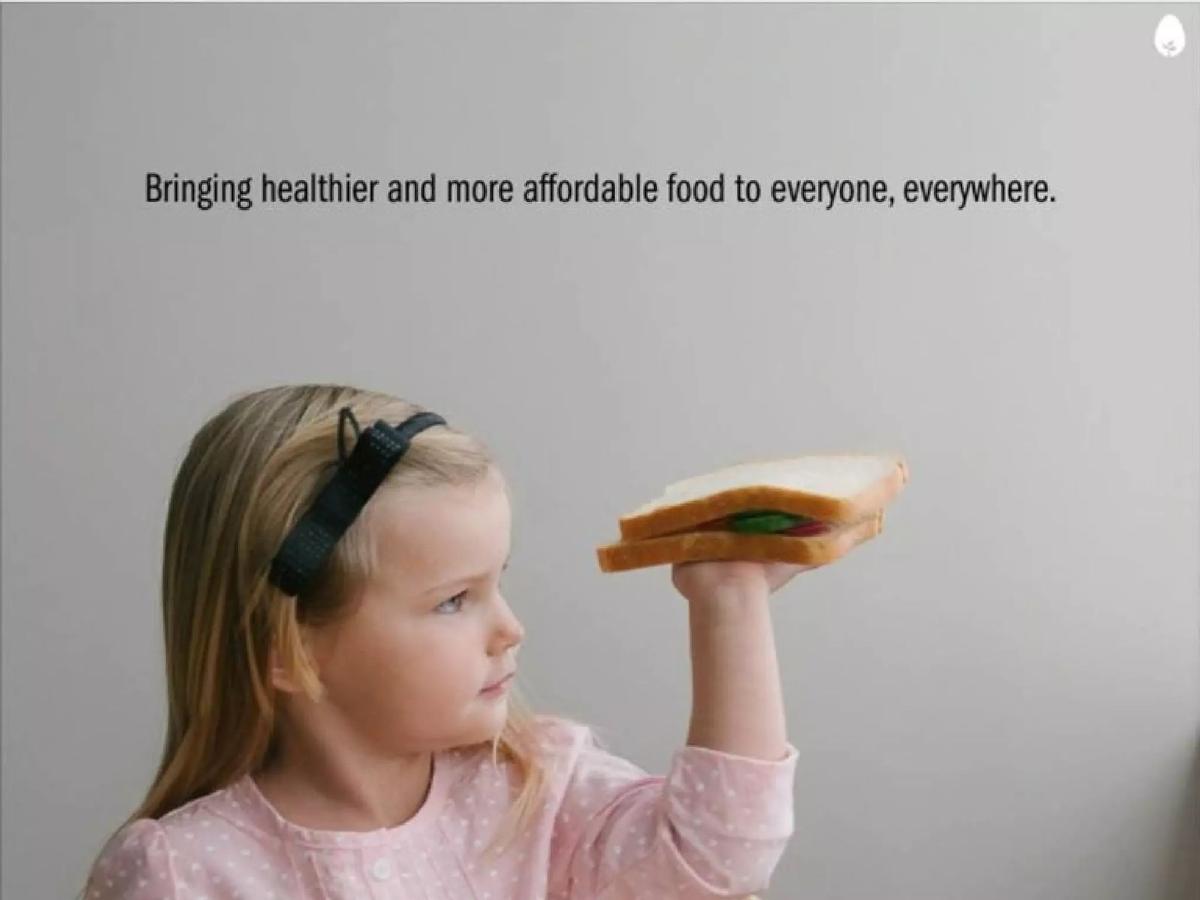
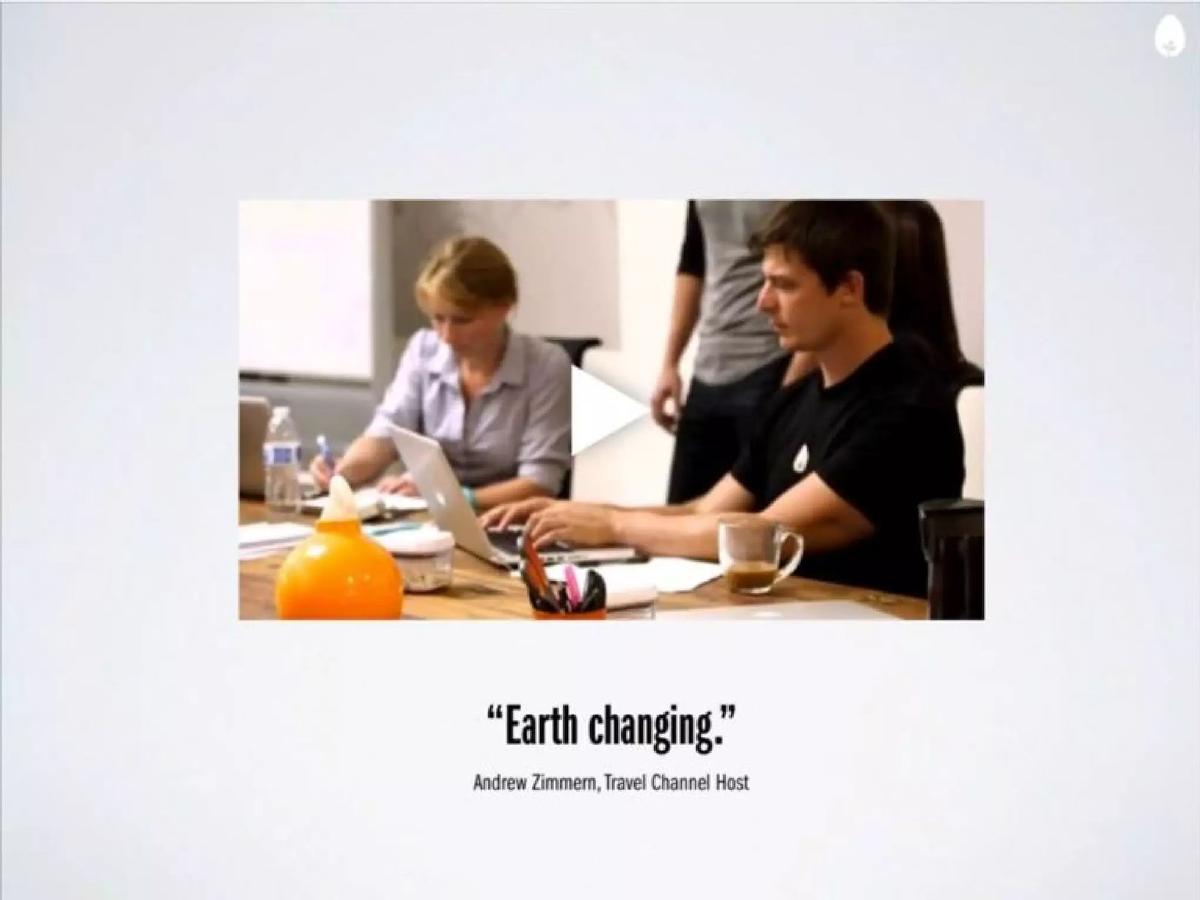
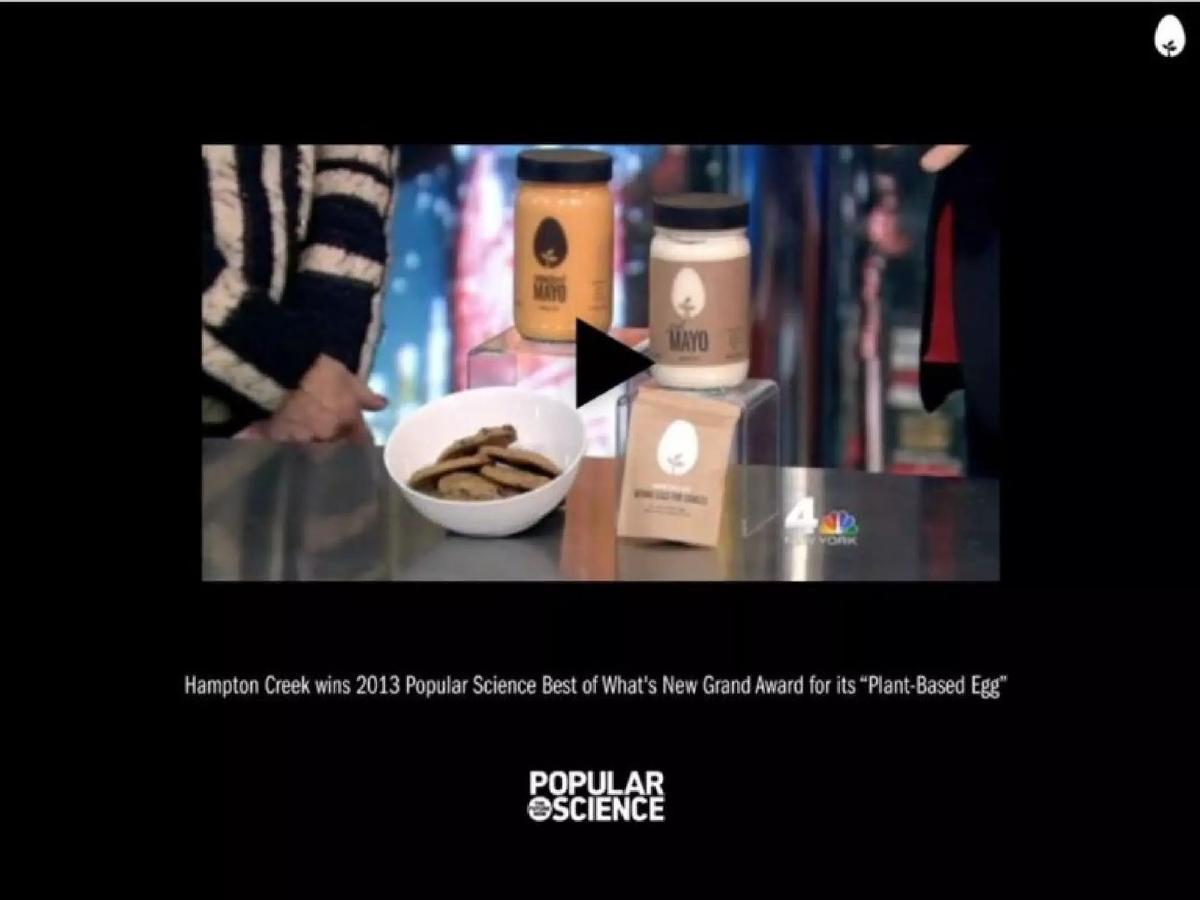
Slide 3 uses a visceral image of chickens in battery cages to highlight the 'Inhumane & Cruel' nature of 99% of egg production, while also noting 'Rising & Volatile Costs.' Slide 4 shifts to a positive vision: 'Bringing healthier and more affordable food to everyone, everywhere.' Slides 5 and 6 lean heavily on external validation. Slide 5 features a quote from Andrew Zimmern ('Earth changing'), and slide 6 highlights a 2013 Popular Science 'Best of What's New' Grand Award. This establishes that the technology is not just theoretical but has been recognized by industry experts.
Slides 7-8: The Team and Media Presence
Slide 7 provides a comprehensive list of the team and advisors. The team is large, featuring roles like 'Director of Culinary Innovation,' 'Senior Scientist, Biochemistry,' and 'Systems Engineer.' The advisors include heavy hitters like Richard Wolford (Former CEO of Del Monte) and Josh Balk (Humane Society). Slide 8 is a 'logo soup' of media coverage, including The New York Times, Forbes, and TEDx, proving that the company has already achieved significant mindshare.
Slides 9-12: Market Size and Opportunity
Slide 9 introduces the market section. Slide 10 quantifies the 'Massive Opportunity' at $55.5B globally for core products, with Scrambled Eggs being the largest segment at $42.5B. Slide 11 breaks down the $11.3B Global Mayo Market by region, showing the US at $3.5B and Other Asia at $1.73B. Slide 12 focuses on the $1.7B US Retail Cookie Dough Market, noting that General Mills accounts for $1.16B of those sales. These slides serve to show that even a small percentage of market capture would result in a massive business.
Slides 13-16: The 'Why Now' and Cost Advantage
Slide 13 lists the '5 Factors Driving Demand,' ranging from sustainability to egg allergies. Slide 14 is a powerful data visualization showing the energy input-to-output ratio. Conventional eggs are 39:1, while Hampton Creek claims 2:1. Slide 15 uses a world map to track major outbreaks of Listeria, Salmonella, and Avian Flu, framing the current food system as a safety risk. Slide 16 delivers the 'killer metric': the product is 48% more cost-effective than conventional eggs, priced at $0.39/lb versus $0.76/lb. This moves the product from a 'premium niche' to a 'mass-market replacement.'
Slides 17-19: The Tech Platform
Slide 17 transitions to the technical details. Slide 18 shows a wall of plant samples, stating the company 'screens through hundreds weekly.' Slide 19 provides a specific scientific example: two Canadian Yellow Pea species. Species #9 produces 'Stable Mayo,' while species #6 produces 'Unstable Mayo.' This slide is intended to prove that their 'engine' can identify functional differences that are invisible to the naked eye, creating a proprietary moat.
Slides 20-22: Product Showcase and Conclusion
Slide 20 is a lifestyle shot of 'Just Mayo' being used. Slide 21 is a video still (presumably from a TV appearance) showing 'Eat The Dough.' Slide 22 repeats the Popular Science award slide, ending the deck on a note of high-level validation. The repetition of the award slide suggests it was a primary piece of collateral in their early fundraising efforts.
What Works Well
Aggressive Positioning: The Amazon analogy is bold and effectively shifts the investor's mindset from 'food' to 'platform.' · Data-Driven Sustainability: Using energy ratios (39:1 vs 2:1) is more compelling to institutional investors than vague claims about 'being green.' · Cost as a Feature: Most plant-based companies struggle with being more expensive than the incumbent. Hampton Creek leads with a 48% cost advantage, which is a powerful lever for adoption. · Visual Evidence: The comparison of the two pea species (Slide 19) makes the 'tech platform' claim feel tangible and scientifically grounded.
What Is Missing
Financial Ask: There is no slide indicating how much money the company is raising or what the valuation expectations are. · Unit Economics: While they show a cost-per-pound comparison, they do not show the margins, customer acquisition costs (CAC), or lifetime value (LTV) for their retail products. · Distribution Strategy: The deck mentions market sizes but does not explain how they plan to get onto the shelves of the 'Grocery Stores' mentioned on slide 2. · Revenue Traction: There are no charts showing historical sales growth or current revenue run rates. · Roadmap: The deck identifies scrambled eggs as a $42.5B market but doesn't show a timeline for when that specific product will launch.
Founder Takeaways
Use Analogies Wisely: If you are in a low-margin industry (like food), find a high-margin industry (like tech) that shares a core functional trait and use it to reframe your business. · Quantify the Inefficiency: Don't just say the old way is bad; show the math. The 39:1 energy ratio is a metric that sticks in an investor's mind. · Social Proof Overload: If you have awards or major media mentions, don't hide them. Hampton Creek uses them to bookend the deck, creating a sense of inevitability. · Focus on Functional Moats: If your product is 'better,' explain the science of why it's better in a way a non-scientist can understand. The pea species comparison is a perfect example of 'show, don't just tell.'
Frequently asked questions
- What is the primary value proposition of Eat Just (Hampton Creek)?
- The primary value proposition is a technology-driven approach to food production that replaces conventional eggs with plant-based alternatives. According to slide 16, this results in a product that is 48% more cost-effective than chicken eggs. The company also emphasizes sustainability, claiming a 2:1 energy input-to-output ratio compared to the 39:1 ratio required for animal-derived eggs, as shown on slide 14.
- How does the company define its 'technology'?
- The deck defines its technology as an 'engine for identifying and utilizing plants to dominate food markets' (slide 2). This involves screening hundreds of plant samples weekly (slide 18) to find specific species, such as Canadian Yellow Peas, that provide the necessary functional properties for stable food emulsions like mayonnaise (slide 19).
- What market segments is the company targeting?
- The company targets three main 'Core Products' totaling a $55.5B global market: Mayo ($11.3B), Scrambled Eggs ($42.5B), and Cookie Dough ($1.7B in the US). They also identify a $6B global market for egg ingredients used in other food manufacturing processes, as detailed on slide 10.
- What external factors are driving demand for their product?
- Slide 13 lists five factors: rising and volatile egg costs, sustainable eating trends among millennials, cholesterol concerns, food safety (specifically antibiotic use and Avian Flu), and the 34 million people in the US with egg allergies or sensitivities.
- Is there a clear investment ask in this deck?
- No. The 22-slide deck provided does not include a slide detailing the amount of money being raised, the valuation, or the specific milestones the company intends to reach with new capital. It functions more as a high-level vision and capability deck than a final investment memorandum.