Giaibongda.com is a specialized platform designed to digitize the amateur soccer experience in Vietnam. The pitch deck, presented at the Echelon 2012 Vietnam Satellite event, focuses on solving the logistical challenges of amateur sports, such as tournament registration and referee dispatching. While the provided slides are light on financial metrics and market sizing, they showcase a live product with active league tables and localized content. The platform aims to bridge the gap between physical play and digital management, offering tools for organizers and a community hub for players. Howe…
Key takeaways
- The company slogan is 'Revolunionize the way amateurs play soccer' as seen on Slide 1.
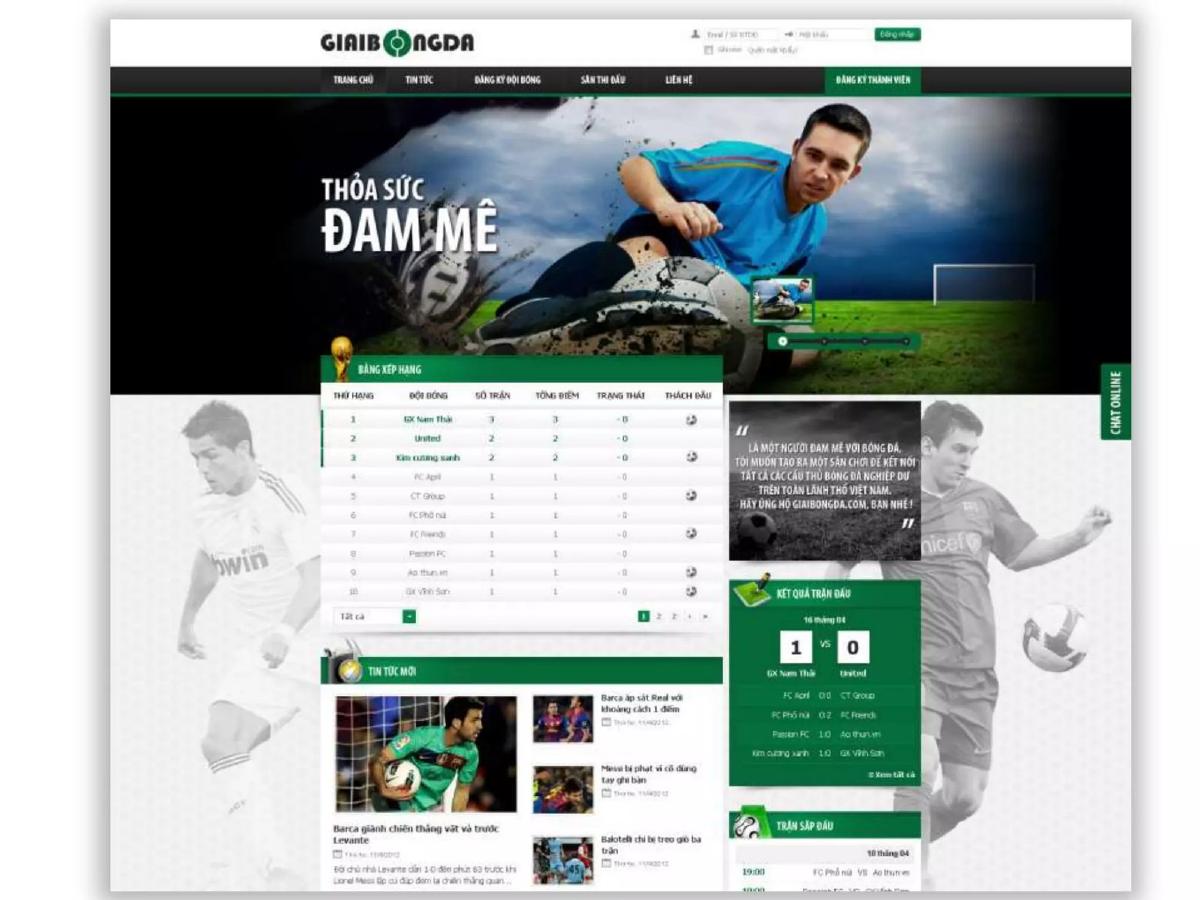
- The platform features a functional web interface with league standings, match results, and news updates (Slide 2).
- A specific league table on Slide 3 shows active teams such as 'GX Nam Thai', 'United', and 'Kim cuong xanh'.
- The service includes offline logistical support, specifically 'Tournament registration and referee dispatch' (Slide 4).
- The deck structure uses minimalist transition slides for 'Future Plans', 'User Acquisitions', 'Why us?', and 'Milestones' (Slides 5-8).
- The product includes a 'Chat Online' feature and a member registration portal ('Dang ky thanh vien') visible on Slide 2.
- Content is localized for the Vietnamese market, with news articles referencing global stars like Messi and Balotelli to drive engagement (Slide 2).
Giaibongda.com: Digitizing the Vietnamese Pitch
Giaibongda.com emerged during the early 2010s tech wave in Southeast Asia, specifically targeting the massive amateur soccer culture in Vietnam. The name itself, which translates to 'Football Tournament,' reflects a utilitarian approach to a specific market need: the organization of fragmented amateur leagues. This teardown examines a selection of slides from their 2012 Echelon Vietnam Satellite pitch, a period when localized 'O2O' (Online-to-Offline) services were beginning to gain traction in emerging markets.
Slide 1: Title and Vision
The cover slide introduces the brand Giaibongda with a logo that incorporates a stylized soccer ball/target icon. The subtitle, 'REVOLUNIONIZE THE WAY AMATEURS PLAY SOCCER,' contains a noticeable typo ('Revolunionize'), which is a common pitfall in decks prepared for international competitions by non-native speakers. Despite this, the intent is clear: the company is positioning itself as a disruptor in the amateur sports space. The imagery of a standard soccer pitch provides immediate context, ensuring the viewer knows exactly which vertical the company operates in within seconds.
Slide 2: Product Interface and Engagement
Slide 2 provides a comprehensive look at the Giaibongda.com web platform. The UI is dense, typical of early 2010s web design, featuring several key modules:
Bảng Xếp Hạng (League Table): A central widget showing team rankings, matches played, and total points. · Tin Tức Mới (Latest News): A news feed featuring global soccer icons like Lionel Messi and Mario Balotelli, likely used to drive daily active usage (DAU) beyond just match days. · Kết Quả Trận Đấu (Match Results): A scoreboard showing recent outcomes, such as a 1-0 victory for GX Nam Thai over United. · Trận Sắp Đấu (Upcoming Matches): A schedule to keep players informed of their next commitments.
The inclusion of a 'Chat Online' sidebar and a member registration button ('Đăng ký thành viên') suggests a focus on building a social community around the sport, rather than just providing a static utility tool.
Slide 3: Data Granularity
This slide is a zoomed-in view of the league management software. It demonstrates the platform's ability to handle multiple data points for amateur teams. We see ten teams listed, including GX Nam Thai, United, Kim cuong xanh, and FC April . The table tracks 'Số Trận' (Matches), 'Tổng Điểm' (Total Points), and 'Trạng Thái' (Status). By showing this level of detail, the founders are proving that the 'Online' portion of their O2O model is fully functional and capable of handling real-world league data.
Slide 4: The Offline Component
Slide 4 addresses the 'Offline' side of the business with the heading 'Tournament registration and referee dispatch.' This is a critical slide because it identifies the actual labor-saving value proposition. Organizing amateur sports is notoriously difficult due to the logistics of finding qualified referees and managing team registrations. The photos show a physical tournament setting and a referee's legs with a flag, signaling that Giaibongda.com is not just a software play, but a service provider that touches the physical game. This hybrid model is common in emerging markets where software alone often isn't enough to change entrenched behaviors.
Slides 5-8: The Narrative Framework
The final four slides provided are minimalist transition slides: 'Future Plans,' 'User Acquisitions,' 'Why us?' and 'Milestones.' In a professional pitch deck, these are usually placeholders for high-density data.
Future Plans: Likely covered geographic expansion or additional sports. · User Acquisitions: Should have detailed the cost per acquisition (CAC) and viral loops within soccer clubs. · Why us?: Usually highlights the team's unique background or a 'moat' such as exclusive partnerships with local pitches. · Milestones: Typically shows a timeline of growth from launch to the current date.
Without the content that followed these headers, the deck feels incomplete. However, as a structure, it follows a logical flow for a seed-stage pitch, moving from the 'what' (the product) to the 'how' (the logistics) and finally to the 'so what' (the business trajectory).
What Works in This Deck
The strongest element of this deck is the product transparency . By showing actual screenshots of the platform with real team names and scores, the founders eliminate any doubt about whether the product exists. In 2012, many startups pitched on 'vaporware' or mockups; Giaibongda.com showed a platform that was clearly being used by local teams. The focus on localized content is also a smart move. By mixing local league results with international soccer news, they created a reason for users to visit the site daily, increasing the surface area for monetization through advertising or sponsorships.
What Is Missing
The most glaring omission in the provided slides is the Business Model . While the logistical service of 'referee dispatch' is mentioned, there is no indication of how this is monetized. Is it a commission on the referee's fee? A subscription for the league organizer? Or a per-player registration fee? Furthermore, there is no Market Size analysis. To attract venture capital, the founders needed to demonstrate that the amateur soccer market in Vietnam (and potentially SE Asia) was large enough to support a scalable business. Finally, the Team Slide is missing from this selection. In early-stage investing, the 'who' is often more important than the 'what,' especially in a business that requires heavy operational lifting like referee coordination.
Founder's Guide: What to Copy
Founders building in the amateur sports or community management space should look at Slide 2 and 3 as a template for demonstrating utility . If your software manages data, show the data. Don't just say you have a 'dashboard'; show the dashboard populated with real-world information. Additionally, the clear separation of Online (Software) and Offline (Logistics) in Slide 4 is a good way to explain a complex service business. It tells the investor: 'We have the tech to manage the crowd, and the operations to manage the event.'
Final Analysis
Giaibongda.com represents a classic 'local hero' startup—taking a globally successful concept (sports management software) and tailoring it to the specific cultural and operational needs of a domestic market. While the deck suffers from some aesthetic issues and a lack of visible financial data, the core value proposition of simplifying the 'beautiful game' for the average person is timeless. For a 2012-era pitch, the focus on a working product and real-world logistics would have made them a credible contender in a regional startup competition like Echelon.
Frequently asked questions
- What is the primary service offered by Giaibongda.com?
- Based on Slide 4, the primary service involves managing the logistics of amateur soccer, specifically tournament registration and referee dispatching. The platform also provides a digital home for these leagues, featuring automated standings, match results, and localized sports news to keep players engaged between games.
- Does the deck provide information on the business model?
- No, the provided slides do not explicitly detail how the company makes money. While there are placeholders for 'Future Plans' and 'Why us?', the specific revenue streams—such as registration fees, advertising, or premium features—are not listed in the visual content of the deck.
- What is the current state of the product according to the slides?
- The product appears to be in a live or advanced beta state. Slides 2 and 3 show a high-fidelity web interface with real-time data, including a league table with 10 teams and specific match scores (e.g., GX Nam Thai vs United, 1-0). This indicates the core software for league management is functional.
- Who is the target audience for this platform?
- The target audience is amateur soccer players and tournament organizers in Vietnam. Slide 1 explicitly mentions 'amateurs,' and the use of Vietnamese language throughout the UI screenshots confirms a focus on the local domestic market rather than a global amateur sports play.
- What critical investor information is missing from the deck?
- The deck is missing several standard components, including a team slide, market size (TAM/SAM/SOM), detailed user growth metrics, unit economics, and a specific funding ask. The reliance on single-word transition slides (Slides 5-8) suggests these details were likely delivered verbally or exist in the missing 23 slides of the full 31-slide deck.