eBrevia presents a lean, 8-slide deck designed for a quick pitch environment, likely a demo day or startup alley event. The narrative is driven by the transition from manual 'entrepreneurial pain' to automated efficiency. Rather than getting bogged down in the mechanics of its NLP engine, the deck prioritizes social proof, citing a major partnership with Donnelley Financial Solutions and specific efficiency gains—such as saving two-thirds of review time. While it lacks traditional venture slides like a detailed team bio, financial projections, or a specific funding ask, it excels at establish…
Key takeaways
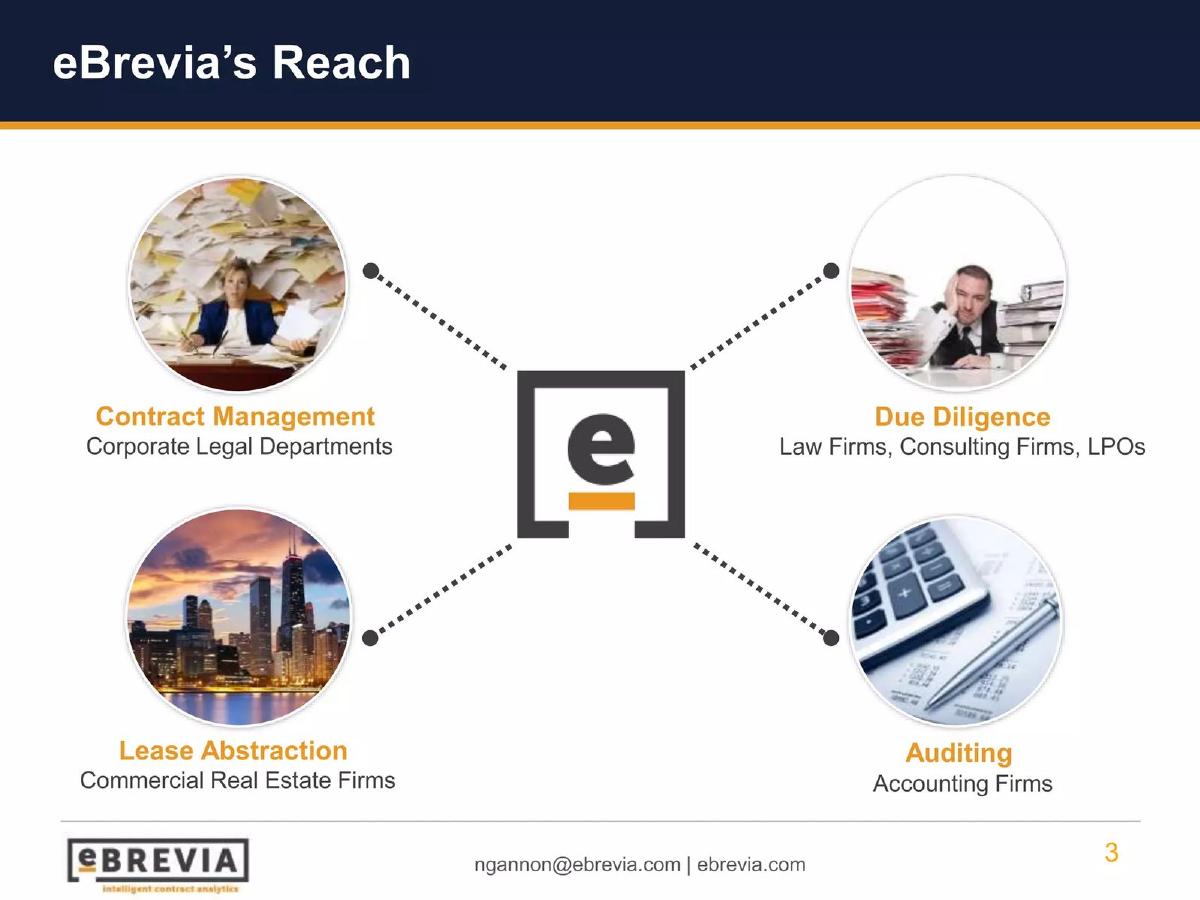
- The deck identifies four distinct market verticals: Contract Management, Due Diligence, Lease Abstraction, and Auditing (Slide 3).
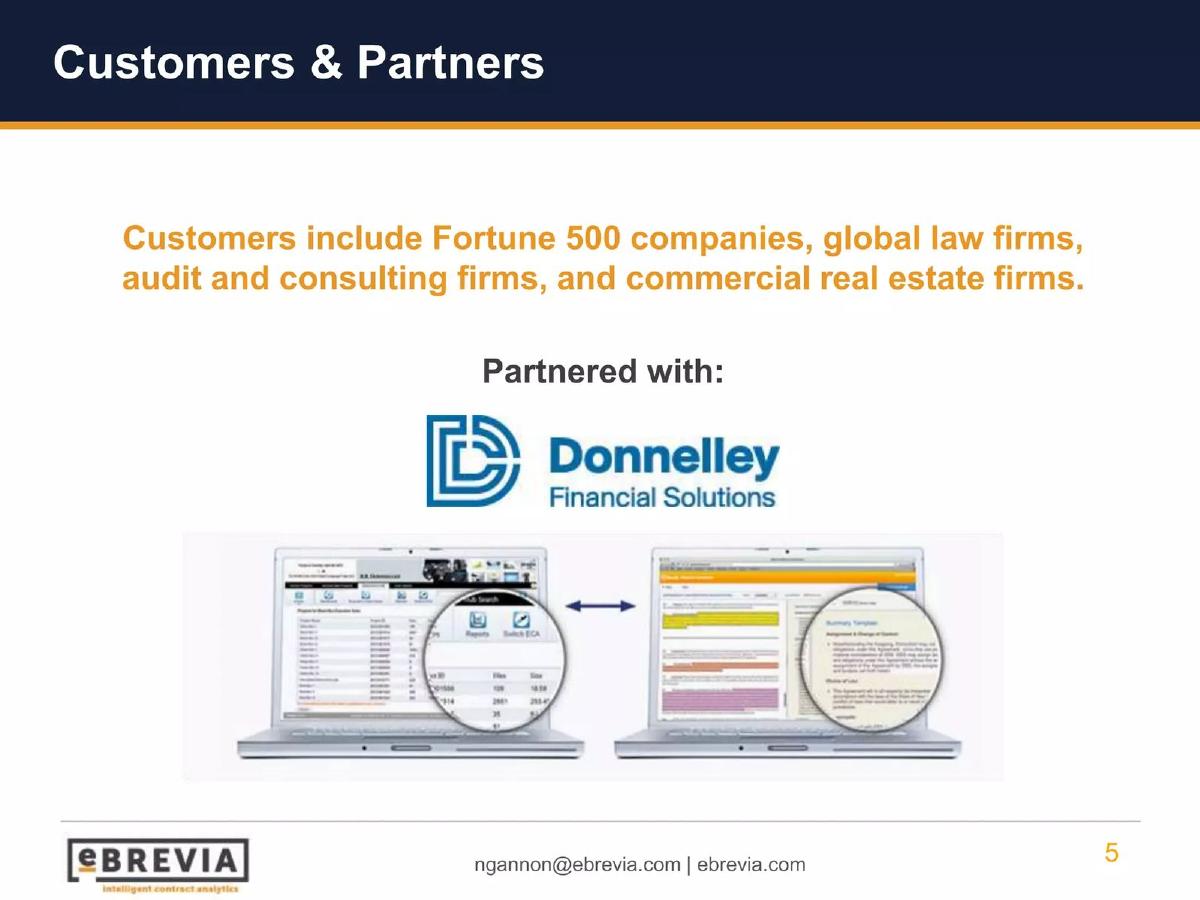
- A strategic partnership with Donnelley Financial Solutions is used as a primary credibility marker (Slide 5).
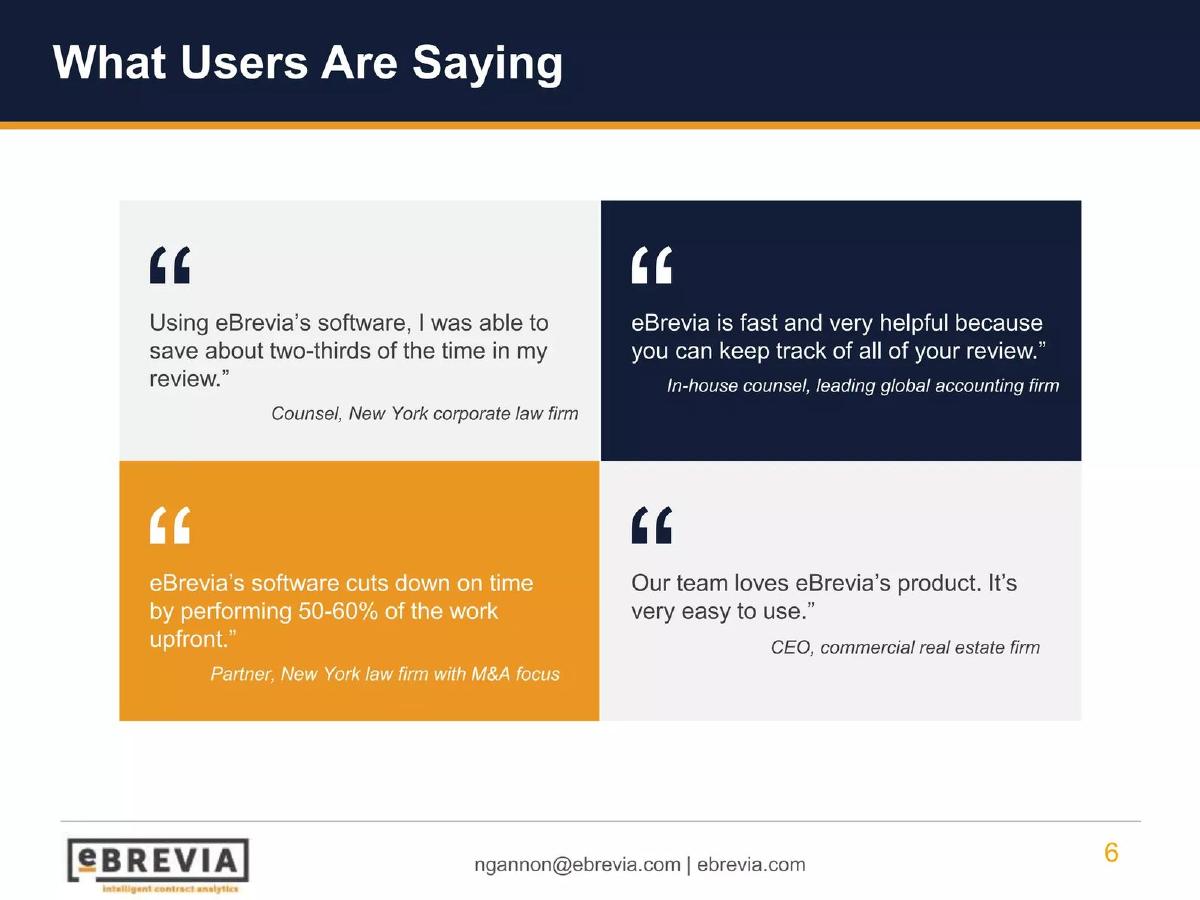
- Product efficiency is quantified through user testimonials, claiming a time savings of 'about two-thirds' in legal reviews (Slide 6).
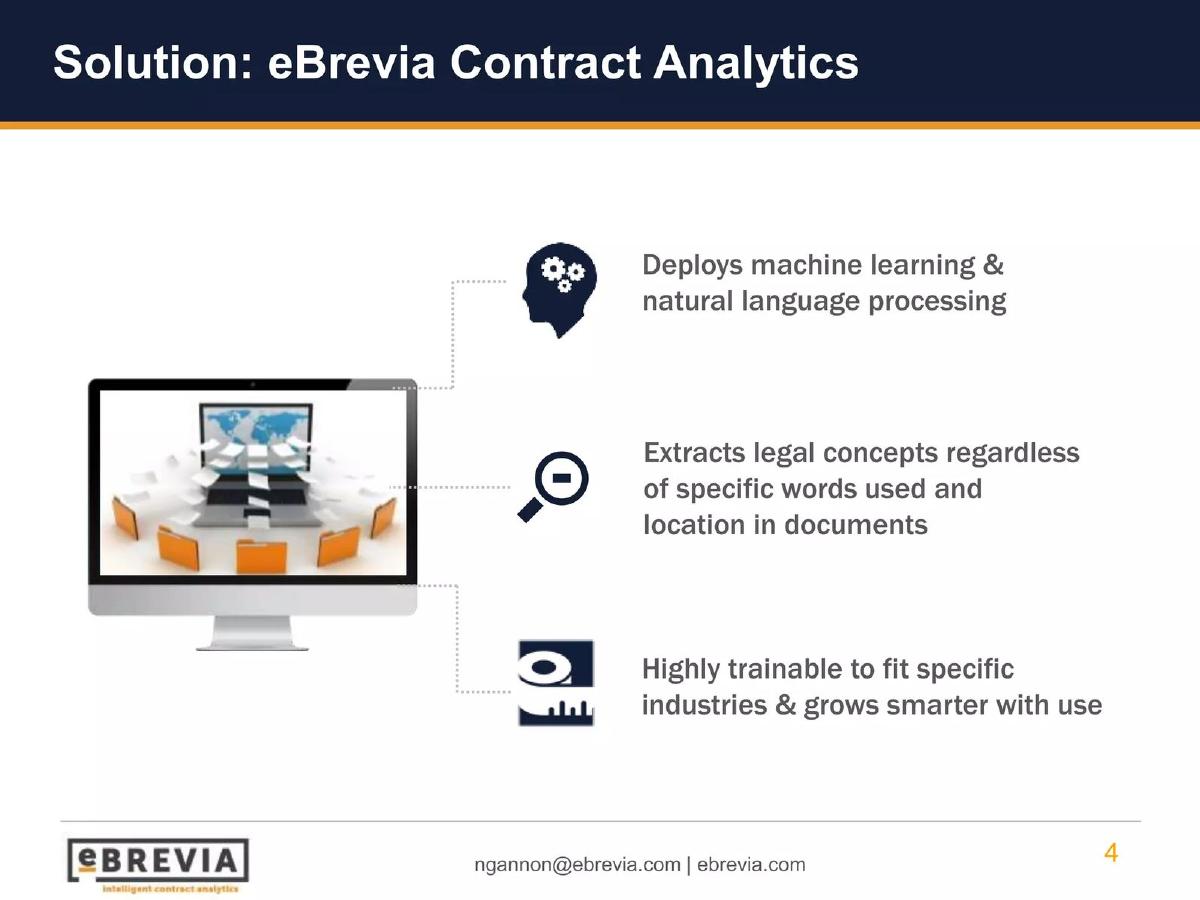
- The technology is described as 'highly trainable' and capable of extracting concepts regardless of specific wording (Slide 4).
- A partner at a New York law firm notes the software performs '50-60% of the work upfront' (Slide 6).
- The deck completely omits a team slide, providing only the CEO's contact information at the end (Slide 8).
- There are no financial projections, market size calculations (TAM/SAM/SOM), or competitive landscape analysis included in these 8 slides.
- The 'Origins' slide uses a visceral image of worker exhaustion to frame the problem of manual document review (Slide 2).
The eBrevia Pitch Deck: A Study in Brevity and Proof
The eBrevia deck is a specialized example of a 'short-form' pitch. At only 8 slides, it is designed to be consumed in under three minutes. It avoids the common pitfall of over-explaining the 'how' of artificial intelligence and instead focuses heavily on the 'who' and the 'what'—specifically, who is using it and what measurable results they are seeing. For a B2B SaaS company in a conservative industry like law, this focus on credibility is the correct strategic choice.
Slide 1: Title and Core Function
The cover slide is functional and direct. It features the eBrevia logo with the tagline 'intelligent contract analytics.' The bottom of the slide contains the clear value proposition: 'Automated Data Extraction From Contracts.' By using a photo of a massive stack of paper next to a laptop, the company immediately signals the transition from analog to digital efficiency.
Slide 2: The Problem (Origins)
Slide 2, titled 'Origins: Entrepreneurs’ Pain,' uses a stock image of an exhausted professional asleep at his desk. While simple, it effectively communicates the 'drudgery' aspect of manual contract review. It frames the startup not just as a tool, but as a solution to a human problem—burnout and inefficiency in professional services.
Slide 3: Market Reach and Verticals
This slide is crucial for showing the breadth of the application. eBrevia identifies four distinct pillars: Contract Management (Corporate Legal), Due Diligence (Law Firms/LPOs), Lease Abstraction (Real Estate), and Auditing (Accounting). By mapping the product to these four specific workflows, they demonstrate that their TAM (Total Addressable Market) is not just 'lawyers,' but any industry dealing with high-volume document obligations.
Slide 4: The Solution and Technology
Slide 4 explains the 'Solution: eBrevia Contract Analytics.' It lists three technical advantages: 1. Deployment of machine learning and NLP. 2. Extraction of concepts regardless of specific words used. 3. A 'highly trainable' system that grows smarter with use. This is the only slide that touches on the technology, and it does so by focusing on the benefits of the tech (flexibility and improvement over time) rather than the underlying architecture.
Slide 5: Customers and Strategic Partnerships
This is arguably the strongest slide in the deck. It claims a customer base of Fortune 500 companies and global law firms. Most importantly, it features a large logo for Donnelley Financial Solutions , stating a formal partnership. For a startup, showing that a multi-billion dollar incumbent is willing to put their brand next to yours is a massive de-risking signal for investors.
Slide 6: User Testimonials and Metrics
Slide 6 provides the 'proof in the pudding.' It features four quotes from different sectors. The most impactful figures are:
'save about two-thirds of the time' (Counsel, NY law firm) · 'cuts down on time by performing 50-60% of the work upfront' (Partner, M&A law firm)
These specific percentages transform the pitch from a vague 'we are faster' to a concrete 'we are a 2x-3x productivity multiplier.'
Slide 7: The 'Favorite' Customer Quote
Slide 7 is a bold choice, featuring a single large quote from a Senior Associate at a Large Law Firm: 'Being able to extract the Assignment and Change of Control provisions from all the documents was ing awesome!' While the use of censored profanity is unconventional, it serves to highlight the genuine relief and 'magic moment' the product provides to its actual users.
Slide 8: Contact and Locations
The final slide provides contact information for CEO Ned Gannon and lists office locations in Stamford, New York, and San Francisco . This indicates a multi-city presence, which suggests a level of scale and operational maturity, even though the deck does not explicitly state the headcount or company size.
What Works in the eBrevia Deck
Specific Use Cases: By breaking the market into four specific buckets (Slide 3), eBrevia avoids the 'boil the ocean' trap. They show they understand exactly where their software fits into existing professional workflows.
Quantifiable ROI: The inclusion of specific time-saving percentages (Slide 6) is the most important part of the deck. In B2B sales, you are selling a return on investment. If a partner at a law firm can bill more or work less because of your tool, the tool pays for itself.
Social Proof: The Donnelley Financial Solutions partnership (Slide 5) acts as a massive validator. It tells the investor that the product has already passed the 'enterprise-grade' test.
What is Missing from the eBrevia Deck
The Team Slide: This is a significant omission. In early-stage fundraising, the 'who' is often as important as the 'what.' There is no information about the founders' backgrounds, their technical expertise in NLP, or their experience in the legal industry.
Financials and Traction: The deck mentions 'Fortune 500' customers but does not provide a revenue run rate, growth percentages, or churn metrics. Investors would need to see the actual business performance behind the testimonials.
The Ask: There is no slide indicating how much money the company is raising, what the valuation expectations are, or how the funds will be allocated (e.g., hiring, sales expansion, R&D).
Competition: The legal tech space is crowded with players like Kira Systems and Luminance. The deck does not address how eBrevia differentiates itself from these competitors or what its 'moat' is.
Lessons for Founders
Focus on the 'Magic Moment': Slide 7 is a great example of capturing the emotional payoff of a product. If your software solves a truly painful task, find a way to express that relief in your deck.
Use Proxies for Trust: If you don't have millions in revenue yet, use partnerships and high-profile testimonials to build trust. One quote from a 'Partner at a Global Law Firm' is worth more than ten slides of technical diagrams.
Tailor the Length to the Venue: This deck was likely for a 'Startup Alley' or a quick-fire pitch competition. It is a reminder that you don't always need 20 slides. If you can prove the problem is real, the solution works, and people are paying for it, you have done 90% of the work.
Frequently asked questions
- What is eBrevia's core value proposition?
- eBrevia provides 'intelligent contract analytics' by using machine learning and natural language processing to automate data extraction. According to Slide 4, the software is designed to extract legal concepts based on meaning rather than just keywords, allowing it to function regardless of the specific language or document structure used. The primary value is time reduction in high-volume document review tasks.
- Which industries does eBrevia target?
- The deck specifies four key segments on Slide 3: Corporate Legal Departments (Contract Management), Law Firms and LPOs (Due Diligence), Commercial Real Estate Firms (Lease Abstraction), and Accounting Firms (Auditing). Slide 5 further notes that their customer base includes Fortune 500 companies and global law firms, indicating a focus on enterprise-level clients.
- How does eBrevia quantify its impact on productivity?
- The deck relies on qualitative testimonials backed by specific percentages on Slide 6. One New York law firm counsel claims a time savings of 'two-thirds,' while a partner at an M&A-focused firm states the software handles '50-60% of the work upfront.' These metrics provide a concrete ROI narrative for potential buyers and investors.
- What major partnerships are mentioned in the deck?
- Slide 5 highlights a significant partnership with Donnelley Financial Solutions (DFIN). This is a critical piece of evidence for a startup, as it suggests their technology has been vetted and integrated by a major incumbent in the financial and legal data space, serving as a proxy for technical due diligence.
- What essential pitch deck elements are missing from this presentation?
- This is a 'pitch alley' deck, meaning it is intentionally brief. However, for a full investment round, it lacks a Team slide (crucial for showing founder-market fit), a Market Size slide (to show the scale of the opportunity), a Business Model slide (explaining how they charge), and a specific 'The Ask' slide detailing how much capital they are raising.