AI Startup Solution Slide: Real Pitch Deck Examples
How AI startups present the solution in a pitch deck: say what the product does for a named user, show the output, and state a measured result.
AI Startup Solution Slide: Real Pitch Deck Examples
Eight solution slides from AI startups, shown in full, compare how each names the job the product does and for whom, shows what the model actually produces, and backs the promise with a measured result.
TL;DR
An AI startup's solution slide should say what the product does for a named user, show its output, and state a measured result. Nereus shows its model's output on real footage (a fish count of 264, fish sizes and hunger labels) and lists four results, such as "Reducing operation cost by 20%." Code Four names the user ("field officers") and the documents it writes for them. Teton says what changes for the user: nurses "work with patients instead of being custodians of the ward." The weaker Arcane slide offers "a new kind of platform for a new way of working" with six generic labels and no user, output or result.
AI solution slides from real pitch decks
Each example shows the exact stored slide above its analysis and links to the full teardown. Claims are as shown on the slides; we have not verified them.
Nereus solution slide — slide 3
Computer vision for fish farms. Two annotated video frames and four results.
Nereus deck, slide 3. Exact stored slide matched to this analysis.
Our analysis: The model's output is the slide: the investor sees a count, a size and a hunger label on real footage.
Evidence and limitation: Four percentage results; the slide does not say where, over what period or against what baseline they were measured.
What a founder can adapt: Put a real output from your model on the slide, labelled the way your user sees it.
Supporting analysis
What the deck claims: "Solution: Automated AI fish counting, sizing, hunger analysis to optimize the feeding." Left frame: "Estimated Total Fish 264" with bounding boxes. Right frame: fish labelled with sizes ("0.34m", "0.32m") and states ("hungry", "normal", "full"). Results: "Reducing operation cost by 20%"; "Increasing profit margin by 26%"; "Reducing pollution by 17%"; "Accelerating production speed by 33%."
Presentation choice: Seeing the output makes the feeding decision it drives easy to picture.
When it does not fit: Say which farm, how many pens and what period the 20% and 26% come from.
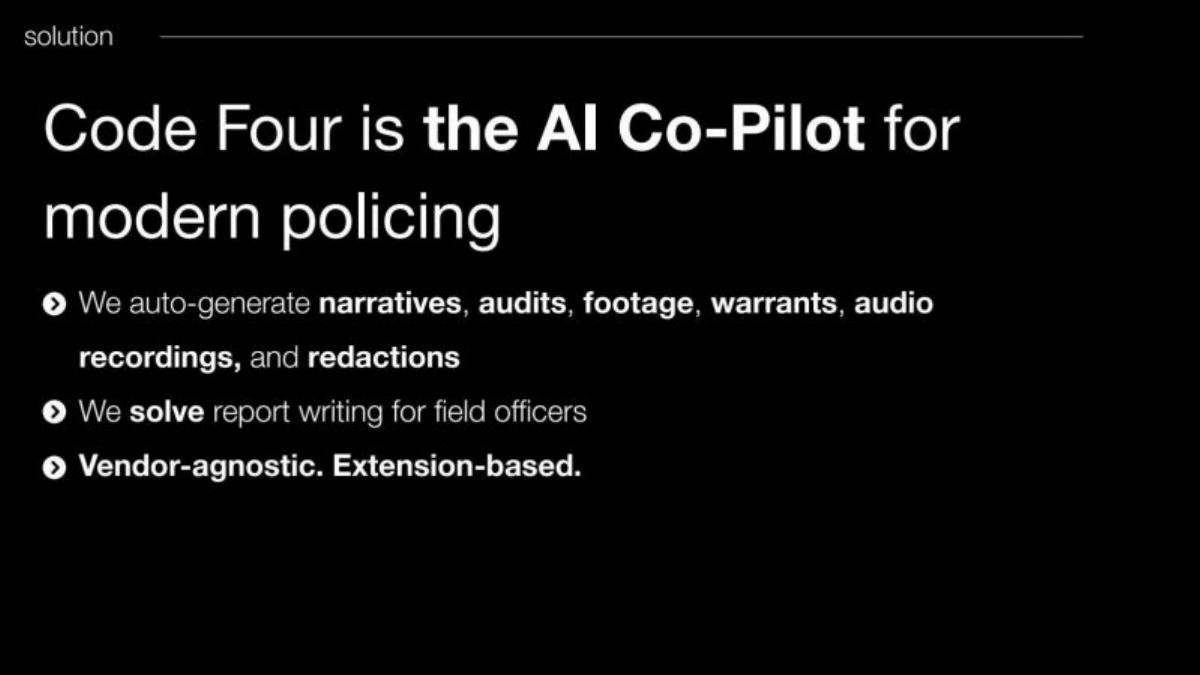
AI for police paperwork. A one-line positioning statement and three bullets.
Code Four deck, slide 4. Exact stored slide matched to this analysis.
Our analysis: It lists the exact documents produced, names the user and says how it installs.
Evidence and limitation: No figures on this slide.
What a founder can adapt: List the outputs by name and say how the product slots into what the buyer already runs.
Supporting analysis
What the deck claims: "Code Four is the AI Co-Pilot for modern policing." "We auto-generate narratives, audits, footage, warrants, audio recordings, and redactions." "We solve report writing for field officers." "Vendor-agnostic. Extension-based."
Presentation choice: "Extension-based" and "vendor-agnostic" answer the adoption question for a buyer tied to existing systems.
When it does not fit: Add time saved per report, or show one generated narrative next to the handwritten version.
AI observation for hospital wards. A product render and one paragraph.
Teton deck, slide 4. Exact stored slide matched to this analysis.
Our analysis: The last sentence names the user (nurses) and what they get back (time with patients).
Evidence and limitation: No figures; a render of the ceiling-mounted device.
What a founder can adapt: End with what your user does with the time or attention you free up.
Supporting analysis
What the deck claims: "Complete automation of observation and documentation." "A multimodal AI enabled system that fully automates observation and documentation related tasks in healthcare. Letting nurses work with patients instead of being custodians of the ward."
Presentation choice: It frames AI as returning time to a scarce professional rather than replacing them.
When it does not fit: Replace "complete" and "fully automates" with the tasks covered and hours saved per shift.
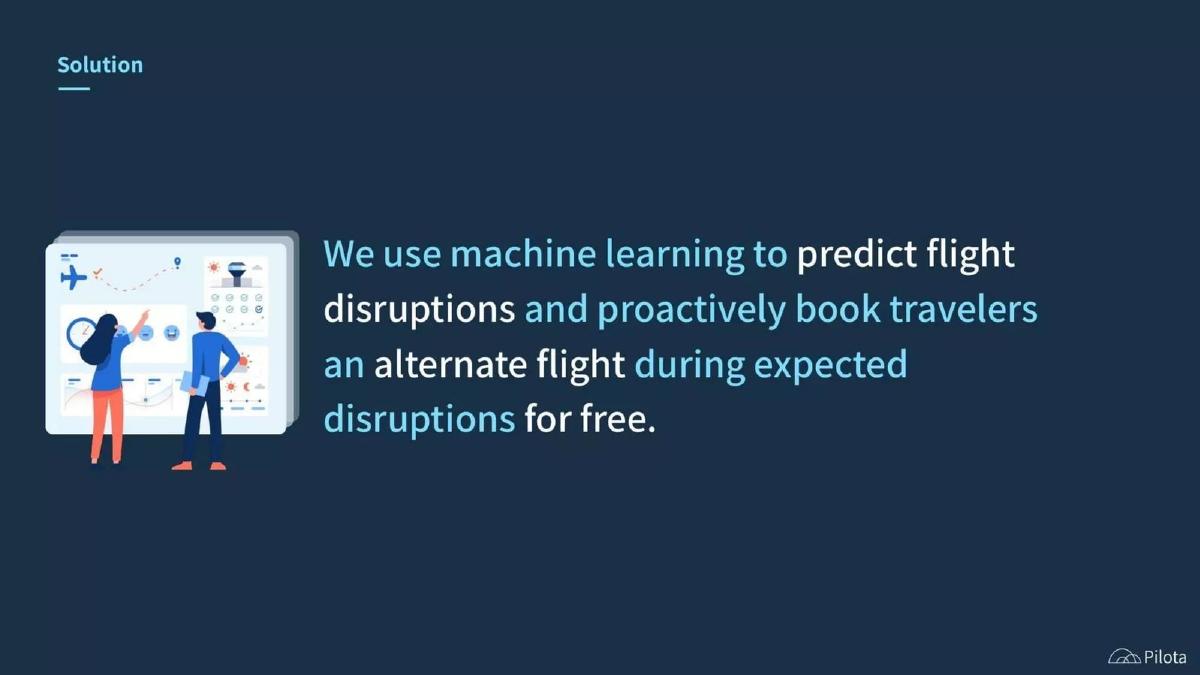
Flight disruption prediction for travellers. One sentence and an illustration.
Pilota deck, slide 5. Exact stored slide matched to this analysis.
Our analysis: One sentence carries the prediction, the action taken and the price to the traveller.
Evidence and limitation: No figures.
What a founder can adapt: Say what your product does after the model decides, not only what it predicts.
Supporting analysis
What the deck claims: "We use machine learning to predict flight disruptions and proactively book travelers an alternate flight during expected disruptions for free."
Presentation choice: The action (booking the alternative) is what the traveller values, not the prediction.
When it does not fit: Add prediction accuracy or how many hours earlier than the airline it warns; explain who pays if travellers don't.
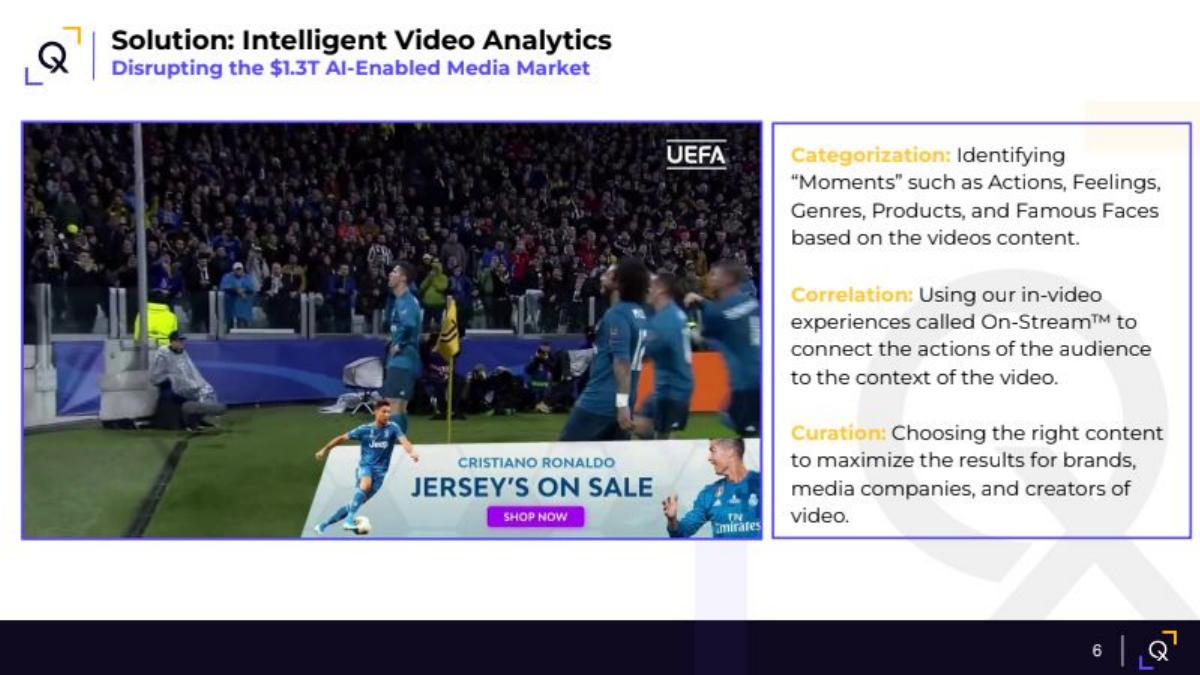
Video analytics for in-video ads. A football frame with an overlaid shopping ad and three steps.
Qortex deck, slide 5. Exact stored slide matched to this analysis.
Our analysis: The frame shows the output: the model spotted a moment and a relevant product.
Evidence and limitation: A market figure ("$1.3T") with no source; no performance figures.
What a founder can adapt: Show your output in the context where the buyer earns money from it.
Supporting analysis
What the deck claims: "Solution: Intelligent Video Analytics. Disrupting the $1.3T AI-Enabled Media Market." "Categorization: Identifying 'Moments' such as Actions, Feelings, Genres, Products, and Famous Faces based on the videos content." "Correlation: Using our in-video experiences called On-Stream™ to connect the actions of the audience to the context of the video." "Curation: Choosing the right content to maximize the results for brands, media companies, and creators of video." The frame shows a goal celebration with a "Cristiano Ronaldo jersey's on sale — Shop now" overlay.
Presentation choice: An investor sees the monetisation, not just the analysis.
When it does not fit: Drop the market figure from the solution headline and add a result such as click-through against a standard ad.
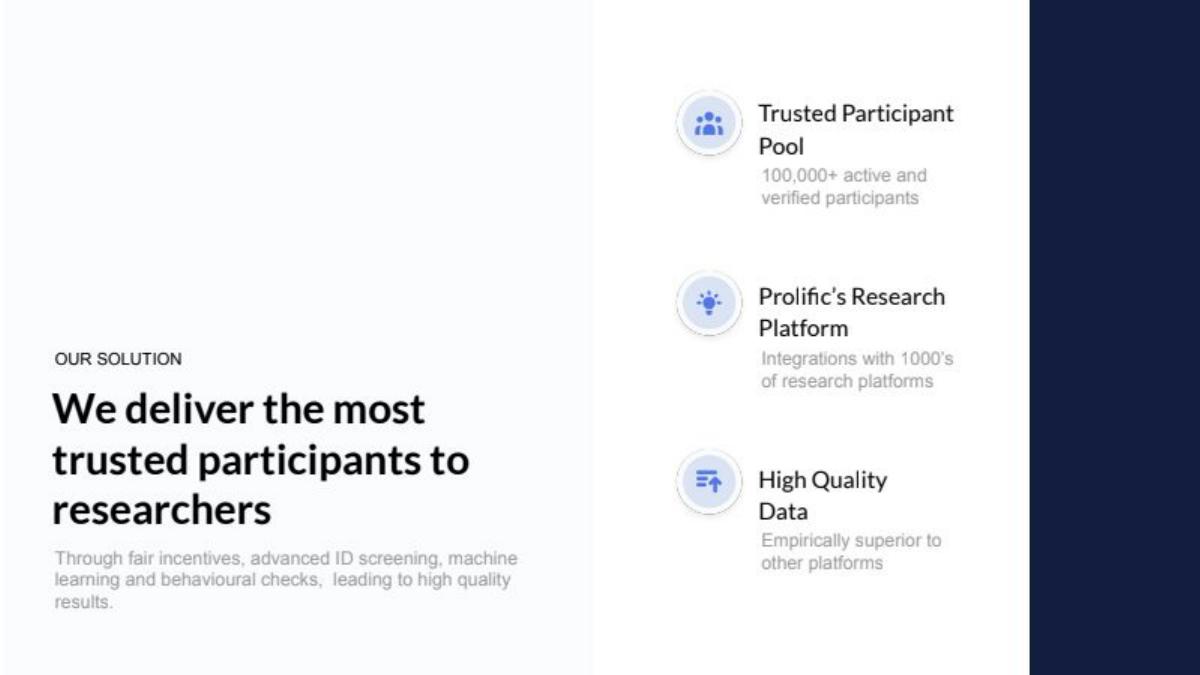
Research participants and data. A headline, one line on method and three supporting points.
Prolific deck, slide 3. Exact stored slide matched to this analysis.
Our analysis: Machine learning is one of four methods listed, placed where it belongs: as a means to trusted participants.
Evidence and limitation: Pool size and integration count; "empirically superior" without the study behind it.
What a founder can adapt: Mention AI as one step toward the result, not as the headline.
Supporting analysis
What the deck claims: "Our solution: We deliver the most trusted participants to researchers." "Through fair incentives, advanced ID screening, machine learning and behavioural checks, leading to high quality results." "Trusted Participant Pool: 100,000+ active and verified participants." "Prolific's Research Platform: Integrations with 1000's of research platforms." "High Quality Data: Empirically superior to other platforms."
Presentation choice: It sells the outcome researchers pay for (trustworthy data), not the model.
When it does not fit: Cite the comparison behind "empirically superior" and give its key number.
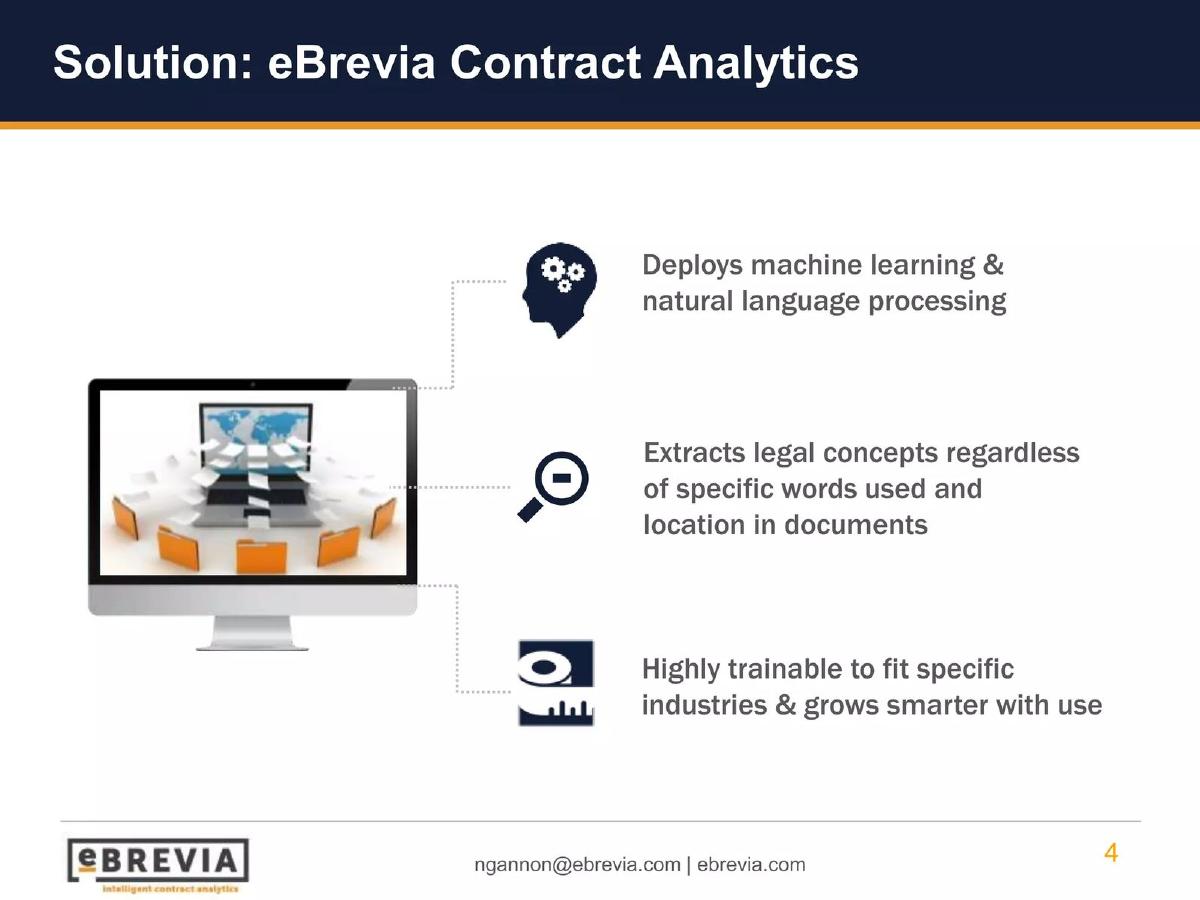
Contract analysis for lawyers. A stock computer image and three icon points.
eBrevia deck, slide 4. Exact stored slide matched to this analysis.
Our analysis: The middle point is the real solution (finding clauses however they are worded); the first point is technique.
Evidence and limitation: No figures, users or screens.
What a founder can adapt: Lead with what the product finds, and for which task (due diligence, lease review).
Supporting analysis
What the deck claims: "Solution: eBrevia Contract Analytics." "Deploys machine learning & natural language processing." "Extracts legal concepts regardless of specific words used and location in documents." "Highly trainable to fit specific industries & grows smarter with use."
Presentation choice: It shows how leading with technique buries the benefit.
When it does not fit: Replace the stock image with an extracted clause and state review time before and after.
An AI data copilot. A weaker example, included on purpose: three circles and six labels.
Arcane deck, slide 4. Exact stored slide matched to this analysis.
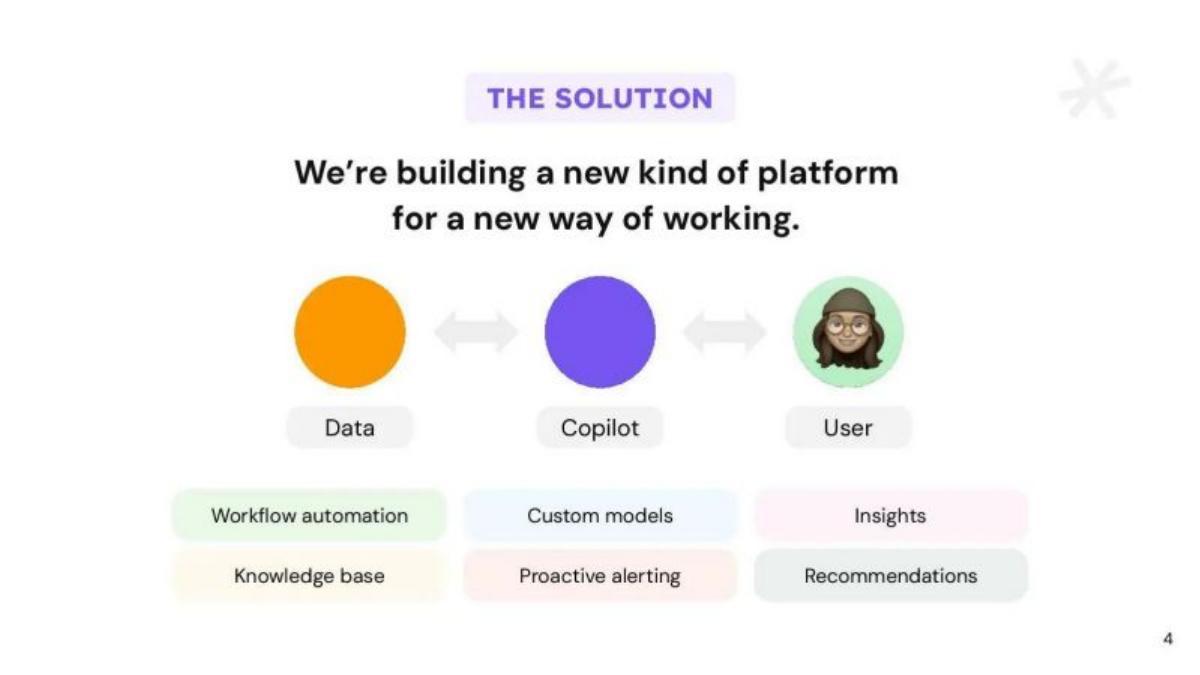
Our analysis: No user, task, output or result is named; the labels could describe most AI products.
Evidence and limitation: No figures, examples or screens.
What a founder can adapt: Pick the user and the one task they do first, and show the copilot doing it.
Supporting analysis
What the deck claims: "The solution: We're building a new kind of platform for a new way of working." Diagram: "Data" ⇄ "Copilot" ⇄ "User." Labels: "Workflow automation", "Custom models", "Insights", "Knowledge base", "Proactive alerting", "Recommendations."
Presentation choice: It shows how an AI solution slide becomes interchangeable when it stays at the category level.
When it does not fit: Replace "new kind of platform" with a sentence of the form: [user] gets [output] in [time] instead of [current way].
Whether each slide names the job and user, shows the model's output, and states a measured result.
Example
Job and user named
Output shown
Result measured
Nereus
Partly (feeding decisions)
Yes (count, size, hunger labels)
Yes (four %, baseline not stated)
Code Four
Yes (field officers, named documents)
No
No
Teton
Yes (nurses)
No (device render)
No
Pilota
Yes (travellers, rebooking)
No
No
Qortex
Partly (brands, media companies)
Yes (ad on live frame)
No
Prolific
Yes (researchers)
No
Partly (100,000+ pool)
eBrevia
Partly (legal concepts)
No (stock image)
No
Arcane
No
No
No
Key Takeaways
Name the job and the user: "auto-generates reports for field officers", not "AI co-pilot".
Show the output: a labelled frame, a generated document, a booked flight.
State one measured result and what it was measured against.
Say how the product fits in: extension, API, camera, outsourced service.
Leave model names and techniques to the technology slide unless they are the differentiator.
Build your AI solution slide
Show the task done, not the model.
User and job. Who uses it, and which task does it take over or speed up?
Output. What does the product produce? Can you show one real example?
Fit. How does it slot in: extension, API, device, service?
Result. What measured change has a customer seen, against what baseline?
Copyable framework: [User] gets [output] from [input] through [fit]. At [customer], [measure] went from [before] to [after] over [period].
Illustrative example 1 — written by us
Before: An AI-powered platform leveraging proprietary LLMs to transform document workflows.
After: Accounts-payable clerks forward supplier invoices to one inbox; we return coded, approved entries in their ERP within minutes. At a 40-person distributor, invoice processing time fell from 9 minutes to 2 over three months.
What improved: Our illustrative rewrite; figures are invented for the example. It names the user, the output, how it fits and a measured result with its baseline.
What this guide adds
The general solution slide guide covers any business. AI solution slides have their own failure mode: they describe the model ("machine learning & natural language processing", "multimodal AI") instead of the work it takes off someone's desk. This guide compares slides that show the work with slides that describe the technology.
It pairs with the AI problem slide guide. Read the two together: the problem slide names the task that fails; the solution slide should show that same task done.
Three parts of an AI solution slide
Job and user: what the product does and for whom (Code Four, Teton, Pilota).
Visible output: what the model produces, shown on the slide (Nereus, Qortex).
Measured result: a number with its basis (Nereus, partly Prolific).
Strong slides cover all three. Most real slides cover one or two.
Common mistakes
Technique as headline. "Machine learning & NLP" tells investors how, not what.
No output shown. Show one thing the model actually produced.
Category-level promises. "A new kind of platform" fits every AI deck.
Results without a baseline. A percentage needs the customer, period and comparison.
Prediction without action. Say what happens after the model decides.
Diagnostic checklist
The user and the task are named.
One real output is shown.
It says how the product fits into existing tools.
One result is measured, with its baseline.
It answers the task named on your problem slide.
Frequently asked questions
How we chose these examples
Corpus: published pitch deck teardowns on StartupFundraising.com. Founder-uploaded private decks are excluded.
Selection (2026-09-25): we searched extracted text of slides 2–6 for slides beginning with "solution" in decks whose recorded sector includes AI or artificial intelligence. About twenty candidates were read. Slides already used in other guides (Eikona, Studnt, Deepgram slide 6) were not reused; Vise AI's slide is marked "Confidential Investor Deck" and was set aside; defence and point-of-sale decks where AI is incidental were left out. Arcane is kept as a weaker contrast.
Overlap check: none of these eight slides appears in another guide. Code Four's problem slide (slide 3) is in the general problem slide guide; its slide 4 is used here. Prolific's slide comes from a different deck version than the one in the AI problem guide.
Review: all eight stored slide images were inspected on 2026-09-25 and matched to company, deck and slide number (editorial model review). No person has yet completed an editorial review of this page.
Claims are as shown on the slides; we have not verified them. We make no claim that any slide caused a fundraising outcome.