Arcane’s 2023 Seed deck is a masterclass in 'pedigree-led' fundraising. With only 9 slides, the company raised $5M from top-tier investors like Accel and Seedcamp. The deck avoids dense financial projections and market sizing entirely, choosing instead to focus on the 'who' and the 'what.' By positioning the product as a 'Copilot for Marketing teams,' Arcane taps into the 2023 AI zeitgeist. The presentation relies heavily on the founders' previous experience at high-growth companies like Deliveroo and Babylon to establish credibility. While it lacks traditional business model details or a spe…
Key takeaways
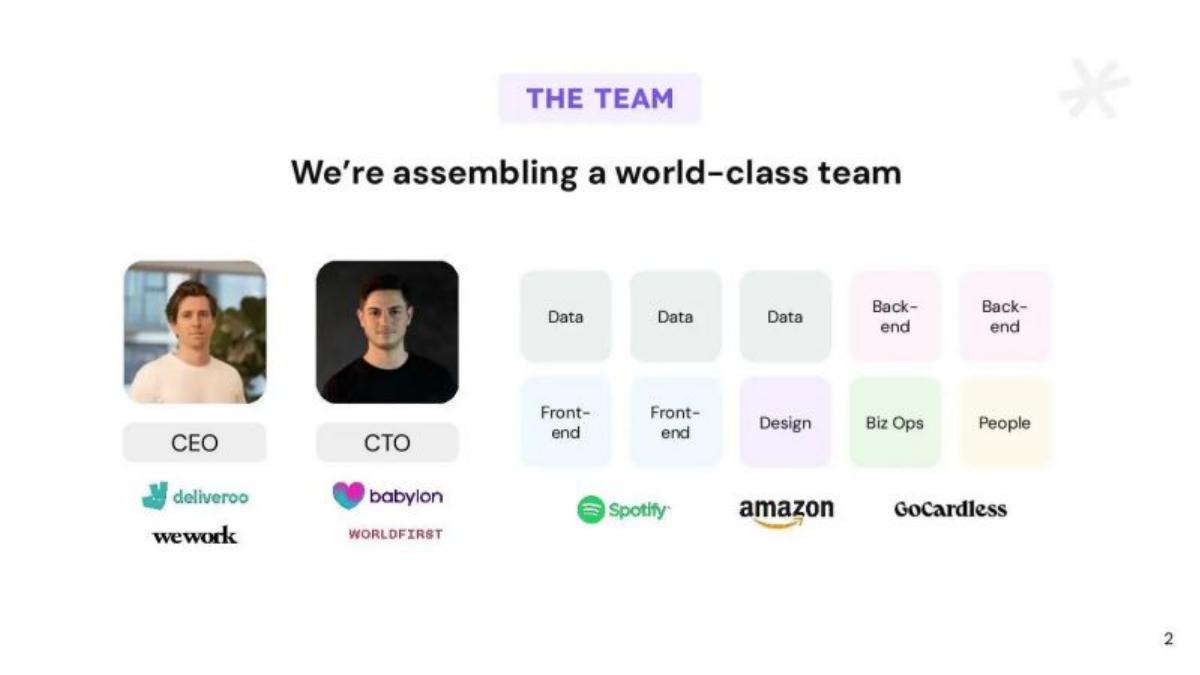
- The deck leads with the team on Slide 2, highlighting experience at Deliveroo, WeWork, Babylon, and Spotify to establish immediate authority.
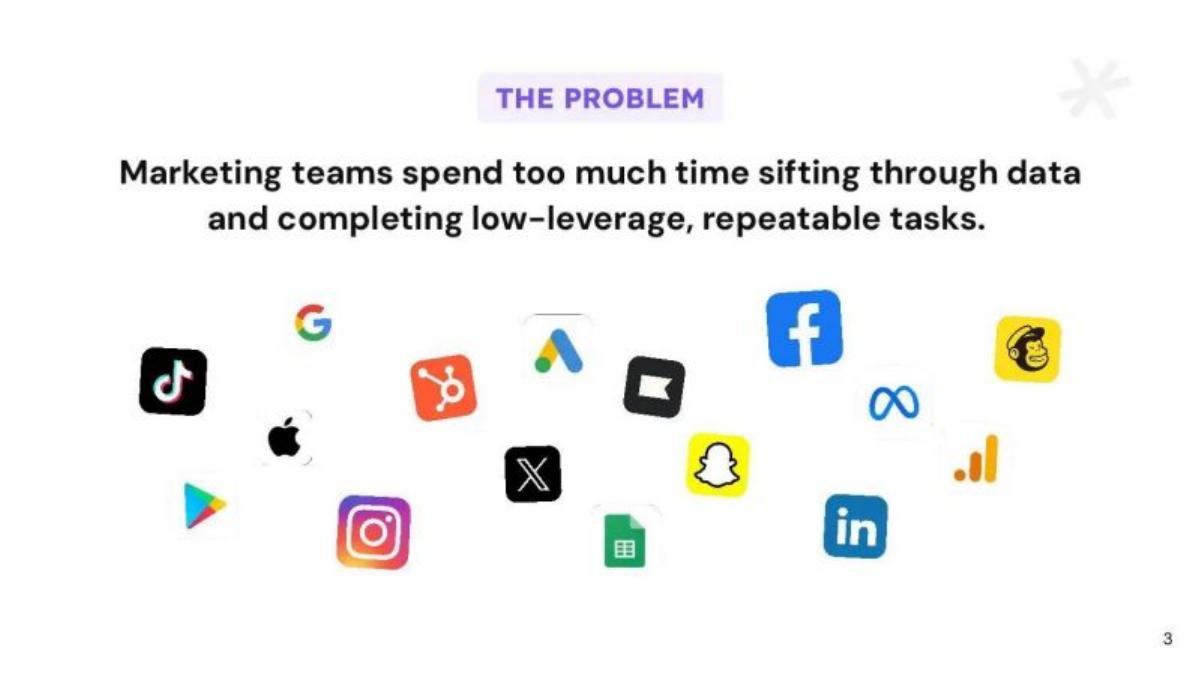
- The problem is defined on Slide 3 as marketing teams spending too much time on 'low-leverage, repeatable tasks' across a fragmented ecosystem of 15+ logos.
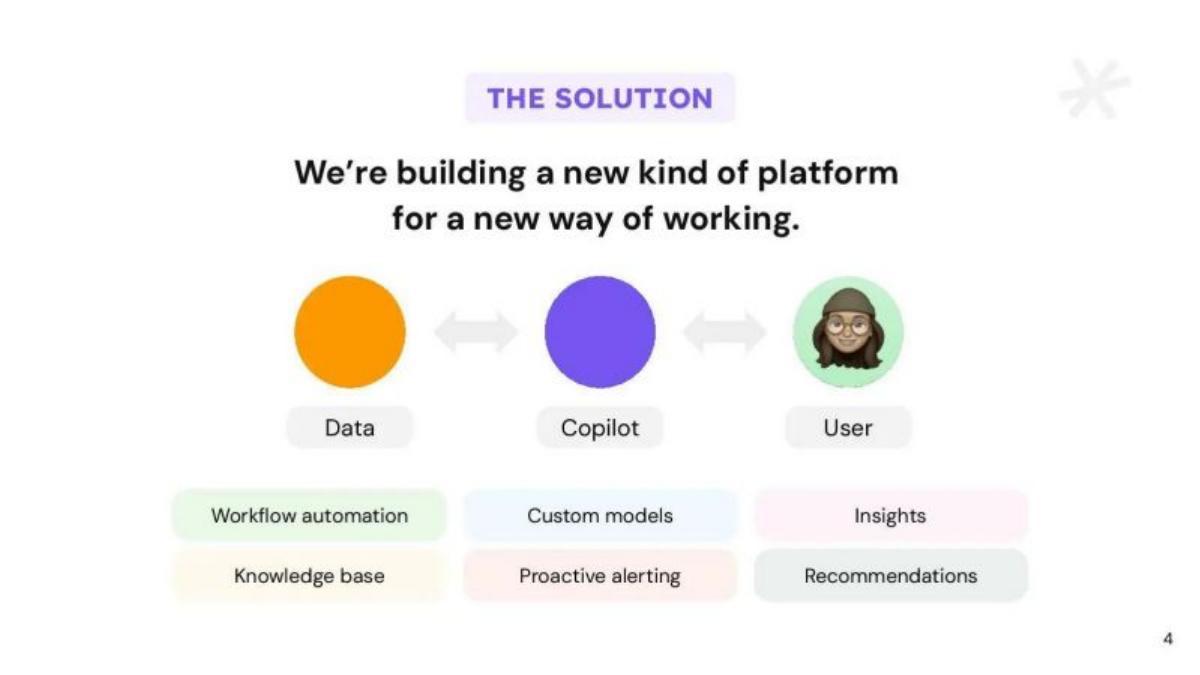
- Arcane positions itself as a 'new kind of platform' on Slide 4, sitting between data and the user to provide workflow automation and proactive alerting.
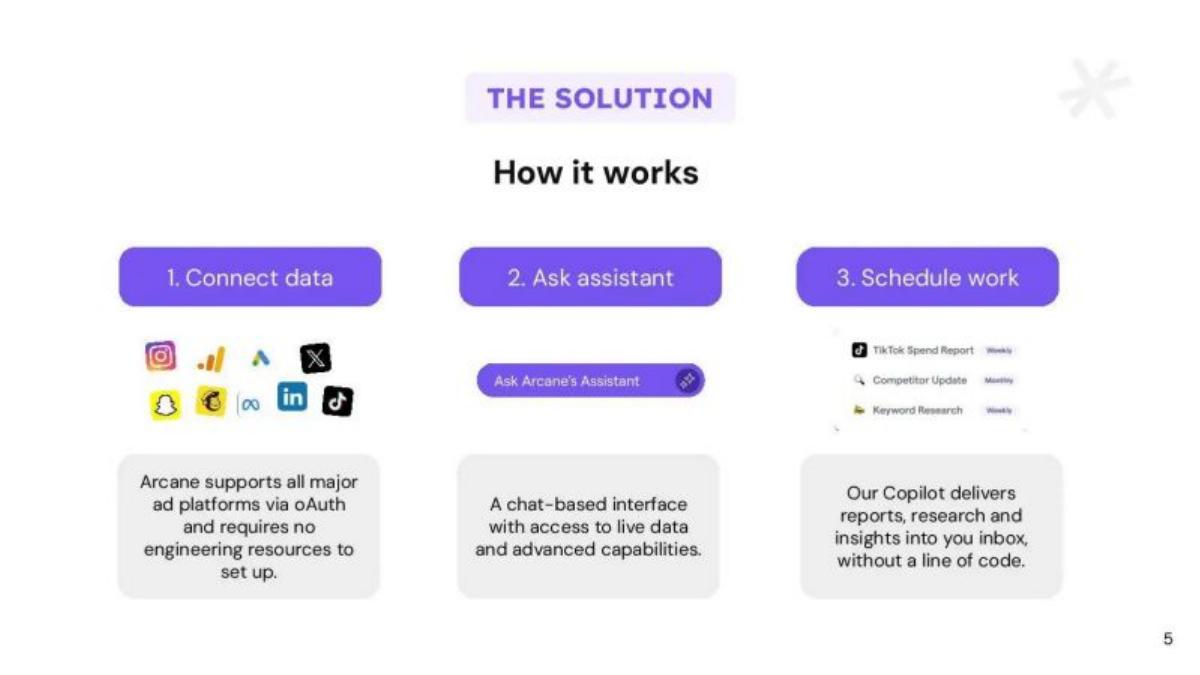
- The product functionality is distilled into a three-step process on Slide 5: Connect data, Ask assistant, and Schedule work.
- Slide 5 explicitly states that the platform requires 'no engineering resources to set up' and works 'without a line of code.'
- The mission on Slide 7 is to 'Give every Marketer the power of a team' through AI agents.
- The deck completely omits market size (TAM), competition, business model, and financial milestones.
- There is no 'Ask' slide in the 9-slide deck; the presentation concludes with a simple contact email on Slide 8.
The Anatomy of a Pedigree-Driven Seed Round
The Arcane pitch deck is a significant example of the 'less is more' philosophy in early-stage fundraising. In an era where AI startups are proliferating, Arcane managed to cut through the noise not with a 30-page data room, but with a 9-slide narrative that prioritizes team experience and a clear product loop. Raising $5M from Accel with such a brief document suggests that the founders' previous 'trench' experience at European unicorns was the primary driver of investor confidence.
Slide 1: The Hook
The cover slide is minimalist, featuring the Arcane logo and the tagline: "The Copilot for Marketing teams." By using the term 'Copilot,' Arcane immediately anchors its product in a category that investors already understand thanks to GitHub and Microsoft. It signals that the tool is assistive rather than a total replacement for human staff, which is a common narrative in successful 2023-era AI pitches.
Slide 2: The Team as the Primary Asset
Unusually, Arcane places the team slide second. This is a strategic move often used by 'second-time' founders or those with elite backgrounds. The slide features the CEO and CTO, but the real weight comes from the logos underneath: Deliveroo, WeWork, Babylon, WorldFirst, Spotify, Amazon, and GoCardless. The slide notes they are "assembling a world-class team" and shows placeholders for Data, Front-end, Back-end, Design, Biz Ops, and People roles. This slide tells the investor: 'We have seen scale, and we know who to hire to build for it.'
Slide 3: Defining the Fragmented Problem
Slide 3 identifies the pain point: "Marketing teams spend too much time sifting through data and completing low-leverage, repeatable tasks." To illustrate this, the slide displays a chaotic cloud of logos including Google, Facebook, TikTok, HubSpot, LinkedIn, and Mailchimp. This visualizes the 'tab fatigue' and data silo issues that modern marketers face, setting the stage for a centralized solution.
Slide 4: The Solution Architecture
The solution is presented as a three-node system: Data <-> Copilot <-> User. Arcane positions its 'Copilot' as the intelligent layer in the middle. The slide lists six core capabilities: Workflow automation, Custom models, Insights, Knowledge base, Proactive alerting, and Recommendations. This slide is crucial because it moves the conversation from 'what it is' (AI) to 'what it does' (automation and insights).
Slide 5: The Three-Step Workflow
This is the 'How it works' slide, and it is remarkably clear. It breaks the user journey into three steps:
1. Connect data: Supports all major ad platforms via OAuth with "no engineering resources to set up." · 2. Ask assistant: A chat-based interface with access to live data. · 3. Schedule work: Delivering reports and research (e.g., TikTok Spend Report, Competitor Update) to the inbox "without a line of code."
This slide addresses the two biggest barriers to SaaS adoption: integration difficulty and the learning curve.
Slide 6: The Demo Placeholder
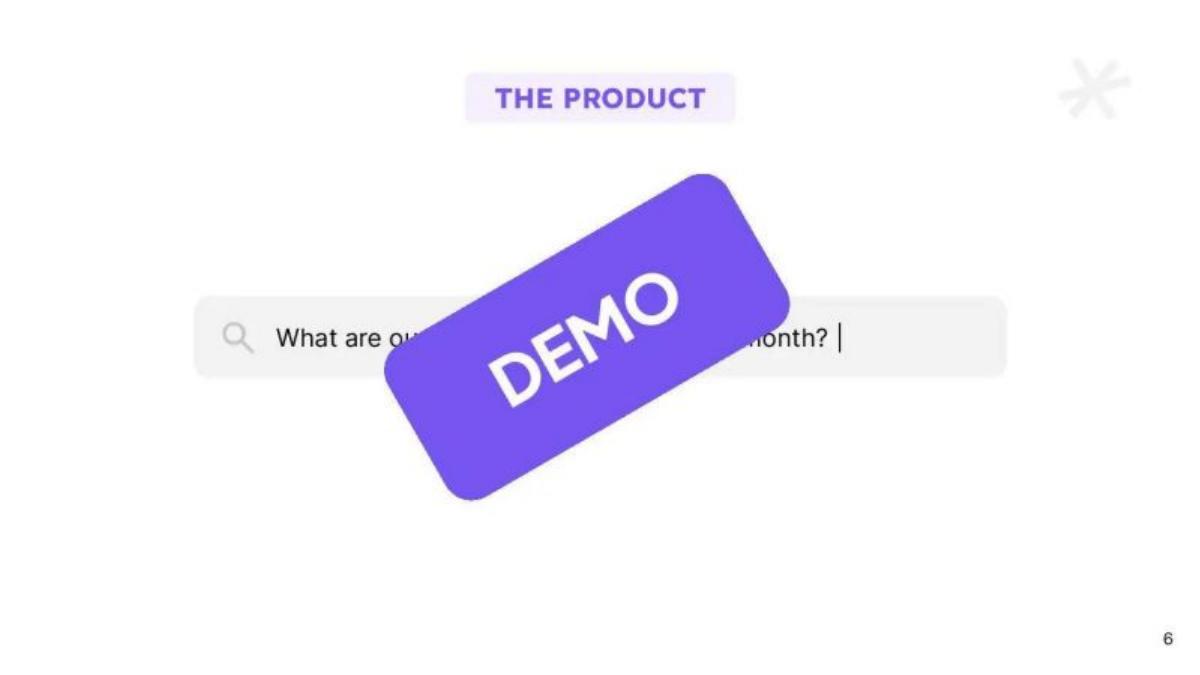
Slide 6 is simply a "DEMO" stamp over a search bar. In a live pitch, this is where the founders would switch to a browser to show the product in action. For a Seed round, a working prototype that can ingest live data and return a coherent answer is often the 'proof of work' that closes the deal.
Slide 7: The Vision and Mission
The mission is stated as: "Give every Marketer the power of a team." The visual shows one human user surrounded by five robot icons. This reinforces the 'Copilot' theme—Arcane isn't just a tool; it's a force multiplier that allows a single marketer to perform the output of an entire department.
Slide 8: The Simple Close
The deck ends with a contact email: founders@tryarcane.com. There is no 'Ask' slide detailing the $5M round or the specific use of proceeds. This suggests the deck was likely used as a visual aid for a conversation where those details were handled verbally or in a follow-up memo.
What Arcane Does Well
Pedigree Signaling: By putting the team slide first and using high-authority logos, Arcane bypasses the need to prove they can build a product. Investors assume technical competence based on the Spotify and Amazon backgrounds.
Clarity of Use Case: Many AI decks are vague about what the 'AI' actually does. Arcane is specific: it connects to your ad accounts and sends you reports. The 'Schedule work' feature on Slide 5 is a tangible benefit that any marketing manager can quantify in hours saved.
Zero-Friction Narrative: The repeated emphasis on "no engineering resources" and "without a line of code" (Slide 5) targets a specific pain point in marketing departments: the reliance on overstretched dev teams to get data out of silos.
What is Missing
Market Sizing (TAM): There is no mention of how large the marketing automation or AI copilot market is. While often considered 'filler' in Seed decks, its absence here shows the founders relied on the obviousness of the opportunity.
Business Model: The deck does not explain how Arcane makes money. Is it a per-seat SaaS model, a consumption-based model, or an agency-style retainer? This is a significant omission for a B2B play.
Competitive Landscape: The deck ignores the existence of other AI marketing tools or incumbents like HubSpot and Salesforce who are building their own 'Copilots.' Founders without this team's pedigree would likely need a slide explaining their 'moat.'
What Other Founders Should Copy
The 'Three-Step' Product Slide: Slide 5 is a perfect template for any technical product. If you can't explain your product in three steps (Connect, Ask, Schedule), it might be too complex for a Seed pitch.
Visualizing the Problem: Using a cloud of logos (Slide 3) to represent fragmentation is a highly effective way to make a conceptual problem feel 'heavy' and real to an investor.
The Mission Statement: "Give every [Persona] the power of a team" is a classic, effective framing for any automation startup. It focuses on empowerment rather than replacement, which is a much easier sell to both investors and future customers.
Frequently asked questions
- How much did Arcane raise with this deck?
- Arcane raised $5M in a Seed round in 2023. The round was led by Accel, with participation from Seedcamp, Firstminute Capital, Kima Ventures, and several high-profile angel investors including Tom Blomfield.
- Does the deck include a product demo?
- Slide 6 is a dedicated 'Demo' placeholder. While the static slide only shows a search bar asking 'What are our... month?', it indicates that a live demonstration or video was a core part of the pitch process.
- What is Arcane's core value proposition?
- Arcane's value proposition is centered on efficiency and accessibility. As stated on Slide 5, it allows marketers to connect major ad platforms via OAuth and generate reports or research via a chat-based interface without needing engineering support or writing code.
- Who are the founders of Arcane?
- The deck identifies the CEO and CTO on Slide 2. While names aren't printed on the slide, their professional backgrounds include leadership or engineering roles at Deliveroo, WeWork, Babylon, and WorldFirst.
- What is missing from the Arcane pitch deck?
- This is a very lean deck. It omits a Market Size (TAM) slide, a Competitor Matrix, a Business Model/Pricing slide, a Roadmap, and a formal 'The Ask' slide. It relies almost entirely on team credibility and product vision.